


 by Tom Gurney
Tom Gurney BSc (Hons) is an art history expert with over 20 years experience
Page created on / Page updated on
Email: tomgurney1@gmail.com / Phone: +44 7429 011000
René Magritte Prints
René Magritte’s images reached readers on book covers, in illustrated volumes and in portfolios of prints. A picture could move from canvas to a page with a title and an author’s name, or appear on a loose sheet meant to be seen with a sequence of other images. In each case the design has one history and the particular printed object has another. The date of a painting can be decades earlier than the date on the portfolio containing a lithograph after it.
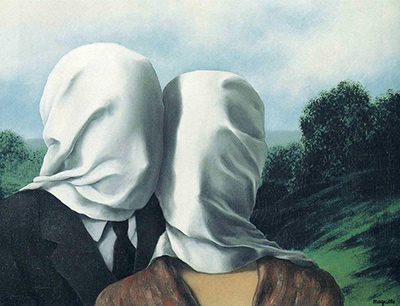
The image on this page shows the composition of the 1928 The Lovers held by the National Gallery of Australia. Two figures with cloth covering their heads stand side by side before a green landscape. Another painting from the same year shows a kiss indoors. The image here illustrates the landscape composition. Its visible design alone cannot establish the paper, publisher or edition of any print made after it. [1] [2]
At a Glance
- Book illustrationQu’est-ce que le surréalisme?, 1934
- Lithograph portfolioLes Enfants trouvés de Magritte, 1968
- Illustrated book with etchingsLe Lien de paille, 1969
Contents
A picture on a book cover
In 1934 André Breton’s Qu’est-ce que le surréalisme? appeared in Brussels with an illustration by Magritte. The cover uses a version of the image developed in The Rape, in which the contours of a head frame features taken from a torso. The Museum of Modern Art’s library documents the published book, and its exhibition account links the cover to Magritte’s painting of the same year. The book was the printed text of Breton’s Brussels lecture. A reader met Magritte’s image before opening it. [3] [4]
That setting changes what the image has to do. The outline must register alongside printed words and within the scale of a cover. The text supplies a subject and an author, while the image offers a figure whose features are hard to reconcile with what initially looks like a portrait. Those two elements are read together even though they make their points in different ways. An exhibition record for the oil tells us about the painting as an object. A library record tells us about the cover as part of a specific publication.
A portfolio after Magritte
The Kyoto City KYOCERA Museum of Art records Les Enfants trouvés de Magritte as a portfolio of twelve lithographs from 1968, the year after Magritte’s death. In the Hyogo Prefectural Museum of Art’s list, individual 1968 sheets appear under their respective subjects, including Ma mère l’oye and the sheet about the birds from Treasure Island. One institution’s entry describes the set, while the other entries let a reader identify individual sheets. [5] [6]
Christie’s describes one complete copy as twelve lithographs on Rives BFK paper, issued loose with a French text by Louis Scutenaire. It lists a title page, a table of contents and a justification page, which records edition details. That copy was numbered 55 of 350 and the sheets were initialled by the printer Fernand Mourlot. A.C. Mazo et Cie. published the set in Paris. The catalogue credits the images as after Magritte and distinguishes the printer’s initials from the artist’s authorship of the designs. [7]
Watch: Understanding Magritte
Three complementary films introduce the artist, explore words and images, and examine a painting’s materials. These are broader Magritte comparisons, alongside the work discussed here.
René Magritte: Great Art Explained
An introduction to Magritte’s life, characteristic images and visual puzzles.
Watch on YouTubeTitles in that portfolio include La Belle captive and La traversée difficile. Both recur elsewhere in Magritte’s work. Someone looking at an individual lithograph can use the portfolio’s table of contents and position of the sheet to locate it, while a painting catalogue groups objects by medium, date and dimensions. Even when the title is familiar, the record for a print has to explain the publication to which the sheet belongs. The name can lead a reader from one object to another without supplying those details on its own. [7]
Etchings for Louis Scutenaire
A different kind of collaboration produced Le Lien de paille, published by Georges Visat in Paris in 1969. Christie’s French catalogue documents the first edition of Scutenaire’s text with four colour etchings. Magritte executed the frontispiece. The three other plates were begun under his direction and Visat completed them after the artist’s death. A single volume thus brings together work made at different stages and gives the printer a distinct role in finishing it. [8]
The same copy illustrates how much information can be carried around the images. It is one of 25 copies described as outside the commercial run and initialled by Scutenaire, with an extra suite of the four etchings on pearlescent Japanese paper. The catalogue also records pencil numbering, a dry stamp on the suites and a reproduction of Magritte’s signature. The bound sheets and the additional suite belong to the same publication, but they can have different paper and marks. The description of the copy helps a reader tell which detail belongs to which part. [8]
Etching and lithography also leave different kinds of evidence on paper. An etching is printed from lines or areas bitten into a plate, and the pressure of the press can leave the outline of the plate impressed in the sheet. A lithograph is printed from a flat surface. Its image can reach the paper without that recessed plate edge. On a trimmed or mounted print, some of these clues can be hard to see. A technique named in a catalogue is best read together with the details of the particular impression, especially when another publisher has issued the same image by a different method.
Reading a credit line
A catalogue can give separate dates for the design and publication. It can name an artist, a printer and a publisher on the same line or explain their contributions in a longer note. In the 1968 portfolio Mourlot’s initials identify the printer on the documented sheets. In the 1969 Scutenaire book, Christie’s distinguishes a reproduced signature from pencil and embossed marks. The location and method of each mark matter as much as the name that appears there. [7] [8]
A painted image such as the landscape Lovers can be recognised from a small colour illustration. Looking at a physical sheet raises other questions. How far does the ink extend, where do the margins begin, and what has been recorded on the back or on a separate page? A book places an image in sequence with words. A portfolio can give each sheet margins of its own and leave the reader free to lay out several at once. The survival of a title page or justification can make the original relationship among those sheets visible again.
Magritte artworks directory
| Name | Date | Medium |
|---|---|---|
| Memory of a Voyage | 1963 | Oil on canvas |
| The Blood of the World | 1927; also catalogued as 1926–27 | Oil on canvas |
| The Hunters at the Edge of Night | Paris, 1928 | Oil on canvas |
| The Empty Picture Frame (La saignée) | 1938–39 | Gouache on paper |
| The Glass House | 1939 | Gouache on paper |
| Oasis | 1926 in the illustrated Christie’s catalogue | Oil on canvas |
| Natural Encounters | 1945 | Oil on canvas |
| Attempting the Impossible | 1928 | Oil on canvas |
| On the Threshold of Liberty | 1930 | Oil on canvas |
| The Titanic Days | 1928 | Oil on canvas |
| The Voice of Space | 1931 | Oil on canvas |
| Unexpected Answer | 1932 in the museum catalogue, 1933 on the reverse | Oil on canvas |
| Elective Affinities | 1932 in MoMA’s checklist, also published as 1933 | Oil on canvas |
| The Human Condition II | 1935 | Oil on canvas |
| The Six Elements | 1929 | Oil on canvas |
| The Happy Donor | 1966 | Oil on canvas |
| Clairvoyance (Self Portrait) | Brussels, 1936 | Oil on canvas |
| Philosopher’s Lamp | 1936 | Oil on canvas |
| The Annunciation | Paris, 1930 | Oil on canvas |
| The Lost Jockey | Circa 1942 in the illustrated lot catalogue | Gouache on paper laid down on canvas |
| Homage to Mack Sennett | 1936 in the Thyssen catalogue | Oil on canvas |
| Discovery | 1927 | Oil on canvas |
| Collective Invention | 1935 in the later catalogue index | Oil on canvas |
| The Wonders of Nature | 1953 | Oil on canvas |
| The Balcony | Circa 1950, with 1950 inscribed on the reverse | Oil on canvas |
| The Pilgrim | 1966 | Oil on canvas |
| The Invention of Life | 1928 | Oil on canvas |
| The Therapist | 1941 | Gouache on paper |
| The Gradation of Fire | 1938 or 1939 in the catalogue index | Gouache on paper |
| A Friend of Order | 1964 | Oil on canvas |
| The Poetic World | 1939 in Hammacher’s illustrated monograph | Gouache |
| The Muscles of the Sky | Paris, 1927 | Oil on canvas |
| The Battle of the Argonne | 1959 | Oil on canvas |
| Meditation | 1936 | Oil on canvas |
| The Domain of Arnheim | 1962 | Oil on canvas |
| This Is Not an Apple | 1964 | Oil on Unilite |
| The Meaning of Night | Brussels, 1927 | Oil on canvas |
| The Pleasure Principle (Portrait of Edward James) | 1937 | Oil on canvas |
| Ready Made Bouquet | 1957 | Oil on canvas |
| Popular Panorama | 1926 | Oil on canvas |
| Memory of a Journey | 1955 in the Thyssen catalogue. Tentatively 1958 in the catalogue index. | Gouache on paper, as exhibited at the Thyssen |
| Sheherazade | 1947 | Gouache on paper |
| The Difficult Crossing | 1926 | Oil on canvas |
| The Fair Captive | 1948 in the catalogue raisonné | Oil on canvas |
| The Birth of the Idol | 1926 | Oil on canvas |
| Hegel’s Holiday | 1958 | Oil on canvas |
| Homesickness | 1941 | Oil on canvas |
| The Rape (Le Viol) | 1934 | Oil on canvas |
| The Art of Living | 1967 | Oil on canvas |
| Secret Life IV | 1928 | Oil on canvas |
| The Tomb of the Wrestlers | 1960 | Oil on canvas |
| Young Girl Eating a Bird (The Pleasure) | 1927 | Oil on canvas |
| The Central Story | 1928 | Oil on canvas |
| The Seducer | 1953 | Oil on canvas |
| The Telescope | 1963 | Oil on canvas |
| The Banquet | 1958 | Oil on canvas |
| The Empty Mask | 1928 | Oil on canvas |
| The Cultivation of Ideas | 1927 | Oil on canvas |
| The Enchanted Pose | 1927 | Oil on canvas |
| The Future of Statues | 1937 | Oil on plaster |
| The Return of the Flame | 1943 | Oil on canvas |
| The White Page | 1967 | Oil on canvas |
| The Large Family | 1963 | Oil on canvas |
| Black Magic | 1945 | Oil on canvas |
| Les Amants I | 1928 | Oil on canvas |
| Man in a Bowler Hat | 1964 | Oil on canvas |
| The Portrait | 1935 | Oil on canvas |
| The Sixteenth of September | 1956 | Oil on canvas |
| Heartstrings | 1960 | Oil on canvas |
| The Present | 1939; also dated 1938 or 1939 | Gouache on paper |
| Act of Violence | 1932 | Oil on canvas |
| Fashionable People | 1950, in the 2016 thesis caption | Medium unconfirmed · Attribution follows the published caption |
| The Representation | 1962 | Oil on canvas |
| Memory | 1948 | Gouache on paper |
| The Mysteries of the Horizon | 1955 | Oil on canvas |
| Portrait of Stephy Langui | 1961 | Oil on canvas |
| The Double Secret | 1927 | Oil on canvas |
| Every Day | 1966 | Oil on canvas |
| The Invisible World | 1954 | Oil on canvas |
| Dawn of Cayenne | 1926 | Oil painting |
| Clear Ideas | 1955 (inscribed); possible 1958 execution | Oil on canvas |
| The Face of Genius | 1926 / 1927 | Oil on canvas |
| Good Faith | 1965; earlier record 1964–65 | Oil on canvas |
| The Flash | 1959 | Gouache and pencil on paper |
| Perpetual Motion | 1935; earlier catalogue 1934 | Oil on canvas |
| Personal Values | 1952 | Oil on canvas |
| Not to Be Reproduced | 1937 | Oil on canvas |
| The Red Model | 1935 | Oil on canvas |
| The Menaced Assassin | 1927 | Oil on canvas |
| The Castle of the Pyrenees | 1959 | Oil on canvas |
| The Blank Signature | 1965 | Oil on canvas |
| The Listening Room | 1952 | Oil on canvas |
| Golconde | 1953 | Oil on canvas |
| Time Transfixed | 1938 | Oil on canvas |
| The Treachery of Images | 1929 | Oil on canvas |
| The False Mirror | 1929 | Oil on canvas |
| The Empire of Light | 1953–54 | Oil on canvas |
| The Human Condition | 1933 | Oil on canvas |
| Les Amants | 1928 | Oil on canvas |
| The Son of Man | 1964 | Oil on canvas |
Frequently Asked Questions
Look for a publisher, printing method and date alongside any numbering or marks. For portfolios, the justification page can identify the edition.
Discussion
Look closely and compare your reading with others.
Reader Insights
What does the cover of Breton’s book ask an illustration to do?
Which records distinguish Mourlot’s role from Magritte’s?
What information might be lost when a sheet is separated from a portfolio?
Join the Conversation
Share a detail, comparison or question about René Magritte Prints below.
References
- National Gallery of Australia. International Art. Collection display, listing René Magritte’s Les Amants [The lovers], 1928. View source.
- National Gallery of Victoria. Magritte. Large-print exhibition labels, entry for the Canberra Les amants. View source.
- The Museum of Modern Art Library. How to Make a Modern Art Library. Entry for Breton’s Qu’est-ce que le surréalisme?, 1934. View source.
- The Museum of Modern Art. Magritte: The Mystery of the Ordinary, 1926–1938. Exhibition entry for Le Viol. View source.
- Kyoto City KYOCERA Museum of Art. Collection Room, Summer 2022. List of works, no. 51, H-759. View source.
- Hyogo Prefectural Museum of Art. 2010 Collection. List of works, nos. 25–26. View source.
- Christie’s. Les Enfants Trouvé de Magritte. Complete portfolio, 1968, lot 6502496. View source.
- Christie’s. Louis Scutenaire and René Magritte, Le Lien de paille. Illustrated edition, Paris, 1969, lot 4260183. View source.







