


 by Tom Gurney
Tom Gurney BSc (Hons) is an art history expert with over 20 years experience
Page created on / Page updated on
Email: tomgurney1@gmail.com / Phone: +44 7429 011000
The White Page
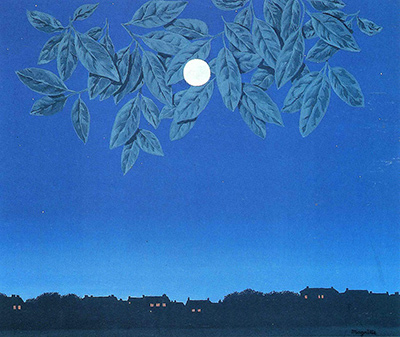
A white moon sits among overhanging leaves in René Magritte’s The White Page. Far below it, a thin line of houses and trees runs along the edge of a blue night sky. The houses have a few lit windows. The moon is much brighter and its edge is unbroken. As the eye follows the veins and outlines of the nearby leaves, it becomes apparent that the disc covers them. The picture gives the moon the brightness we might expect at night and the position we would expect a leaf to occupy.
Magritte painted La Page blanche in oil on canvas in 1967. It measures 54 by 65 centimetres and is number 1065 in volume III of the catalogue raisonné. The Royal Museums of Fine Arts of Belgium hold it under inventory number 10711, part of Georgette Magritte’s 1987 bequest. Their collection record notes the signature at the lower right and the title on the reverse. The museums describe it as the artist’s last painting to be completed, signed and titled. [1] [2] [3]
At a Glance
- Original titleLa Page blanche
- Date1967
- MediumOil on canvas
- Catalogue numberSylvester III 1065
- Size54 × 65 cm
- CollectionRoyal Museums of Fine Arts of Belgium, 10711
Selected works
Looking up from the houses
The band of land at the bottom is very narrow. Low roofs, chimneys and rounded trees give it an uneven silhouette. Small warm marks appear in pairs or groups where the windows would be, and there is little light on the walls around them. We can make out individual buildings along the ridge without seeing deeply into the land below. The roofs look distant because their outlines are simplified and because the dark shapes between them do much of the work of joining them into a single horizon.
The blue immediately above that line is brighter than it is near the top of the picture. The change happens gradually across a broad, open band. There is room for the eye to travel from the houses to the overhanging leaves without encountering another solid object. A few very small points of light are scattered in that open area. The strongest impression comes from the continuous colour, which allows a large interval of sky to sit between the houses and the foliage.
The leaves enter from the top and reach down in bunches. The smallest branches are thin enough to disappear among the leaf veins. Some leaves tilt towards us and show a broad surface. Others turn and narrow almost to an edge. The pointed ends sharpen where they meet the blue, and several fall well below the main group. Their size and the detail in their veins make them seem near enough that we might be standing just beneath the tree. The houses remain far away, seen through and below this partial canopy.
The moon before the leaves
The moon is set high in the picture, a little below the upper edge of the foliage. It is a small circle, yet the whiteness is intense against the many shades of blue around it. There is a dark leaf close to its upper edge and another below. Following their contours brings the eye to the disc, where the foliage is interrupted. The leaves often overlap one another elsewhere in the picture, so we can use the same ordinary cue here. The object with the continuous outline seems to be in front.
Watch: Understanding Magritte
Three complementary films introduce the artist, explore words and images, and examine a painting’s materials. These are broader Magritte comparisons, alongside the work discussed here.
René Magritte: Great Art Explained
An introduction to Magritte’s life, characteristic images and visual puzzles.
Watch on YouTubeThe rest of the scene supplies equally familiar cues for reading the moon as distant. Its roundness and brightness make it easy to name. The lit windows, dark roofs and blue sky all support that reading. A glance at the neighbourhood can therefore undo the impression the disc gives when we study its edge. At the scale of the whole painting, it belongs to the sky. In the small area where it touches the leaves, it occupies a position close to them.
The Royal Museums’ exhibition dossier explains that Magritte first painted a thin crescent. Visitors read it as a moon seen behind the leaves. To make the intended relationship clearer, he revised it into a full disc. The museums report that traces of the alteration can be seen when examining the canvas closely. A thin crescent can look as if something is covering part of a circle. The larger, closed shape leaves the eye a single edge to follow, and the leaves are interrupted wherever they meet it. The change affects how readily the intended overlap can be seen while keeping the rest of the night scene legible. [3]
What the white shape leaves open
In a remark reproduced in the exhibition dossier, Magritte described the extraordinary possibility of seeing leaves behind the moon. The comment helps explain why the relation mattered enough for him to revisit the shape of the disc. Both things are familiar and sit in a setting we can readily recognise. He altered the one piece of evidence that tells the eye how they are placed in relation to each other. The ordinary view up through a tree then requires a second look. [3]
The title can draw attention to the white surface where the dark veins and blue colour stop. The disc looks almost empty beside the leaf shapes, which are full of small differences in tone. At the scale of the houses, even a lighted window has an edge that suggests a wall and a room behind it. The moon’s edge gives us very little beyond the boundary itself. That sharp division makes the white area seem much larger in effect than its diameter would suggest.
The foliage also frames openings that contain only blue. Those gaps vary in width, and several have pointed outlines formed by the leaves on either side. The moon is close to one of those gaps, which gives the eye an immediate comparison. The blue follows each irregular leaf edge. The white circle keeps its curve even where a leaf crosses its path.
The painting can be read by starting at either end of the space it describes. Looking from the roofs upwards, the moon is part of the night above the houses. Looking from the ends of the branches inwards, the disc keeps the foliage from view. The open band of blue gives both readings room, while the tiny illuminated windows keep the picture anchored in the quiet of an ordinary evening.
Magritte artworks directory
| Name | Date | Medium |
|---|---|---|
| Memory of a Voyage | 1963 | Oil on canvas |
| The Blood of the World | 1927; also catalogued as 1926–27 | Oil on canvas |
| The Hunters at the Edge of Night | Paris, 1928 | Oil on canvas |
| The Empty Picture Frame (La saignée) | 1938–39 | Gouache on paper |
| The Glass House | 1939 | Gouache on paper |
| Oasis | 1926 in the illustrated Christie’s catalogue | Oil on canvas |
| Natural Encounters | 1945 | Oil on canvas |
| Attempting the Impossible | 1928 | Oil on canvas |
| On the Threshold of Liberty | 1930 | Oil on canvas |
| The Titanic Days | 1928 | Oil on canvas |
| The Voice of Space | 1931 | Oil on canvas |
| Unexpected Answer | 1932 in the museum catalogue, 1933 on the reverse | Oil on canvas |
| Elective Affinities | 1932 in MoMA’s checklist, also published as 1933 | Oil on canvas |
| The Human Condition II | 1935 | Oil on canvas |
| The Six Elements | 1929 | Oil on canvas |
| The Happy Donor | 1966 | Oil on canvas |
| Clairvoyance (Self Portrait) | Brussels, 1936 | Oil on canvas |
| Philosopher’s Lamp | 1936 | Oil on canvas |
| The Annunciation | Paris, 1930 | Oil on canvas |
| The Lost Jockey | Circa 1942 in the illustrated lot catalogue | Gouache on paper laid down on canvas |
| Homage to Mack Sennett | 1936 in the Thyssen catalogue | Oil on canvas |
| Discovery | 1927 | Oil on canvas |
| Collective Invention | 1935 in the later catalogue index | Oil on canvas |
| The Wonders of Nature | 1953 | Oil on canvas |
| The Balcony | Circa 1950, with 1950 inscribed on the reverse | Oil on canvas |
| The Pilgrim | 1966 | Oil on canvas |
| The Invention of Life | 1928 | Oil on canvas |
| The Therapist | 1941 | Gouache on paper |
| The Gradation of Fire | 1938 or 1939 in the catalogue index | Gouache on paper |
| A Friend of Order | 1964 | Oil on canvas |
| The Poetic World | 1939 in Hammacher’s illustrated monograph | Gouache |
| The Muscles of the Sky | Paris, 1927 | Oil on canvas |
| The Battle of the Argonne | 1959 | Oil on canvas |
| Meditation | 1936 | Oil on canvas |
| The Domain of Arnheim | 1962 | Oil on canvas |
| This Is Not an Apple | 1964 | Oil on Unilite |
| The Meaning of Night | Brussels, 1927 | Oil on canvas |
| The Pleasure Principle (Portrait of Edward James) | 1937 | Oil on canvas |
| Ready Made Bouquet | 1957 | Oil on canvas |
| Popular Panorama | 1926 | Oil on canvas |
| Memory of a Journey | 1955 in the Thyssen catalogue. Tentatively 1958 in the catalogue index. | Gouache on paper, as exhibited at the Thyssen |
| Sheherazade | 1947 | Gouache on paper |
| The Difficult Crossing | 1926 | Oil on canvas |
| The Fair Captive | 1948 in the catalogue raisonné | Oil on canvas |
| The Birth of the Idol | 1926 | Oil on canvas |
| Hegel’s Holiday | 1958 | Oil on canvas |
| Homesickness | 1941 | Oil on canvas |
| The Rape (Le Viol) | 1934 | Oil on canvas |
| The Art of Living | 1967 | Oil on canvas |
| Secret Life IV | 1928 | Oil on canvas |
| The Tomb of the Wrestlers | 1960 | Oil on canvas |
| Young Girl Eating a Bird (The Pleasure) | 1927 | Oil on canvas |
| The Central Story | 1928 | Oil on canvas |
| The Seducer | 1953 | Oil on canvas |
| The Telescope | 1963 | Oil on canvas |
| The Banquet | 1958 | Oil on canvas |
| The Empty Mask | 1928 | Oil on canvas |
| The Cultivation of Ideas | 1927 | Oil on canvas |
| The Enchanted Pose | 1927 | Oil on canvas |
| The Future of Statues | 1937 | Oil on plaster |
| The Return of the Flame | 1943 | Oil on canvas |
| The White Page | 1967 | Oil on canvas |
| The Large Family | 1963 | Oil on canvas |
| Black Magic | 1945 | Oil on canvas |
| Les Amants I | 1928 | Oil on canvas |
| Man in a Bowler Hat | 1964 | Oil on canvas |
| The Portrait | 1935 | Oil on canvas |
| The Sixteenth of September | 1956 | Oil on canvas |
| Heartstrings | 1960 | Oil on canvas |
| The Present | 1939; also dated 1938 or 1939 | Gouache on paper |
| Act of Violence | 1932 | Oil on canvas |
| Fashionable People | 1950, in the 2016 thesis caption | Medium unconfirmed · Attribution follows the published caption |
| The Representation | 1962 | Oil on canvas |
| Memory | 1948 | Gouache on paper |
| The Mysteries of the Horizon | 1955 | Oil on canvas |
| Portrait of Stephy Langui | 1961 | Oil on canvas |
| The Double Secret | 1927 | Oil on canvas |
| Every Day | 1966 | Oil on canvas |
| The Invisible World | 1954 | Oil on canvas |
| Dawn of Cayenne | 1926 | Oil painting |
| Clear Ideas | 1955 (inscribed); possible 1958 execution | Oil on canvas |
| The Face of Genius | 1926 / 1927 | Oil on canvas |
| Good Faith | 1965; earlier record 1964–65 | Oil on canvas |
| The Flash | 1959 | Gouache and pencil on paper |
| Perpetual Motion | 1935; earlier catalogue 1934 | Oil on canvas |
| Personal Values | 1952 | Oil on canvas |
| Not to Be Reproduced | 1937 | Oil on canvas |
| The Red Model | 1935 | Oil on canvas |
| The Menaced Assassin | 1927 | Oil on canvas |
| The Castle of the Pyrenees | 1959 | Oil on canvas |
| The Blank Signature | 1965 | Oil on canvas |
| The Listening Room | 1952 | Oil on canvas |
| Golconde | 1953 | Oil on canvas |
| Time Transfixed | 1938 | Oil on canvas |
| The Treachery of Images | 1929 | Oil on canvas |
| The False Mirror | 1929 | Oil on canvas |
| The Empire of Light | 1953–54 | Oil on canvas |
| The Human Condition | 1933 | Oil on canvas |
| Les Amants | 1928 | Oil on canvas |
| The Son of Man | 1964 | Oil on canvas |
Frequently Asked Questions
He revised the thin crescent into a full disc to clarify its position in front of the leaves.
Discussion
Look closely and compare your reading with others.
Reader Insights
Which details in the leaves make them look closer than the houses?
Where is the moon’s position in front of the foliage clearest?
How might a crescent change what you think is covering what?
Join the Conversation
Share a detail, comparison or question about The White Page below.
References
- Royal Museums of Fine Arts of Belgium. La page blanche, collection record, inv. 10711. View source.
- Magritte. Toutes les œuvres, tous les thèmes. French catalogue raisonné index, vol. III, p. 445, no. 1065. View source.
- Royal Museums of Fine Arts of Belgium. Magritte, Broodthaers & l’art contemporain, French exhibition dossier, pp. 12–13. View source.







