


 by Tom Gurney
Tom Gurney BSc (Hons) is an art history expert with over 20 years experience
Page created on / Page updated on
Email: tomgurney1@gmail.com / Phone: +44 7429 011000
The Poetic World
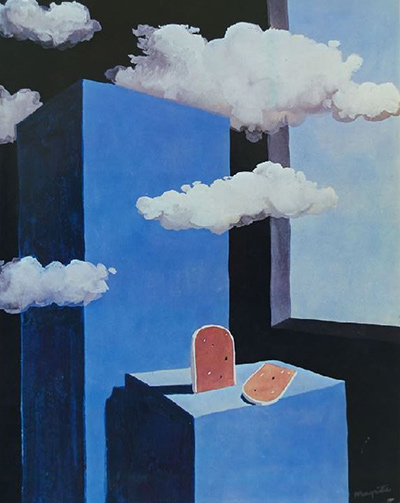
Clouds drift past blue blocks in René Magritte’s The Poetic World. On the top of the lower block sit two pink slices, one upright and the other resting at an angle. At the right, a broad pale rectangle looks like an opening onto the sky. The cloud crossing its edge also passes in front of the darker part of the scene. We can imagine a window that looks out onto clouds. The picture gives us a cloud that seems close enough to pass between the window and the objects in the room.
A. M. Hammacher’s illustrated monograph reproduces the pictured gouache as The Poetic World II and dates it to 1939. Its caption credits the Edward James Foundation at the time of publication. Hammacher reports a description in the foundation’s inventory that identifies the objects as clouds and pâté. This is a different composition from the 1937 oil catalogued by Christie’s as Le monde poétique II, which depicts curtains, pyramids and an eye. [1] [2]
At a Glance
- Published titleThe Poetic World II (Le Monde poétique II)
- Date1939 in Hammacher’s illustrated monograph
- MediumGouache
Selected works
Contents
Where the clouds pass
The large cloud near the top gives the clearest impression of moving across a boundary. Its lower edge is grey in places, and its upper edge breaks into rounded patches of white. Behind it, the darker area changes abruptly where it meets the pale rectangle on the right. The cloud continues across that change of colour. The rectangle’s vertical side can be found above and below it, making the cloud look as though it passes in front of an edge that belongs to the room.
A smaller cloud in the middle sits against the bright face of the taller blue block. Part of it continues to the right, where the background is much darker. The block’s vertical edge briefly disappears, then resumes as it descends. The cloud seems close enough to cover the edge in much the same way an object in the foreground might cover a piece of furniture. Its soft outline lets us recognise it as a cloud before we have decided where it can be in relation to the upright surface.
At the left, other fragments of cloud run out of the picture or meet the blue at different heights. Their positions make it difficult to gather them into a single sky. That is especially clear at the lower left, where a wide pale patch crosses the dark side of the tall block. The pale forms return often enough to give the eye a path across the whole work. Their overlaps make that path cross places that look inside and outside in turn.
The low block and the two slices
The nearer blue block gives the scene its most definite resting place. Its top is paler than the front, and the side at the left falls into shadow. The upper edges meet at points that let us picture the depth of the surface. One pink slice stands on end near the back. The other lies at a shallow angle further forward. Both have a narrow pale rim and small marks across the pink. We can tell they have a similar texture from how the edges and interiors are painted, even if we need the inventory description to put a familiar name to them. [1]
Watch: Understanding Magritte
Three complementary films introduce the artist, explore words and images, and examine a painting’s materials. These are broader Magritte comparisons, alongside the work discussed here.
René Magritte: Great Art Explained
An introduction to Magritte’s life, characteristic images and visual puzzles.
Watch on YouTubeThe position of the slices encourages a different kind of looking from the clouds. Each has a point where it touches the tabletop. Their relative sizes and the interval between them are easy to judge. A cloud nearly as wide as the top of the block could be very close or very far away, depending on what we take the surrounding rectangle to be. Putting the food near the bottom gives the eye a scale to return to. The longer we look upwards, the harder that scale is to sustain.
The two blocks themselves also give us different kinds of information. The lower one has a top on which objects can sit. The tall one rises behind it as a much larger blue plane. Its left side appears almost black. We can read it as a solid shape through the meeting of its faces, while its bright front carries nearly the same range of blue as the sky. The lower block makes the blue look substantial enough to bear weight. Higher up, that colour is available to read as space behind the clouds.
The upright slice also repeats the relation between the two blocks on a smaller scale. Its pink front turns up from the horizontal surface, with a rounded top where the tall block has a hard corner. The slice beside it is turned almost flat, so we see more of its upper surface. Looking between the two makes the angle of the table easier to gauge. That angle stays consistent when we return from the clouds to the still life.
The pink is concentrated in this small area at the bottom. Above it, the difference between blue, charcoal and white has to carry most of the picture. The shift in colour makes the lower block a place to pause before looking back up towards the pale forms that seem to have drifted into the room.
The title and the Edward James connection
The name The Poetic World II is useful only when it is accompanied by the picture or details of the object. Museum Boijmans Van Beuningen records that Edward James wanted a new version of Magritte’s 1926 Le monde poétique after seeing it in London. Christie’s documents the resulting oil as a separate 1937 commission with its own composition and catalogue number. The cloud-and-pâté gouache has a historical connection to the James collection through Hammacher’s published caption and inventory description. It has a distinct set of objects and a distinct organisation of space. [1] [2] [3]
The visible window-like edge and the pale surface immediately below it are good places to test what the picture offers. Follow the rectangle down to its lower border and it seems to separate a light view from a darker room. Follow the central cloud across its upright edge and that separation is much harder to keep. The two slices stay exactly where they were throughout both readings. Their presence gives the shifting space a small, fixed point from which we can begin to look again.
Magritte artworks directory
| Name | Date | Medium |
|---|---|---|
| Memory of a Voyage | 1963 | Oil on canvas |
| The Blood of the World | 1927; also catalogued as 1926–27 | Oil on canvas |
| The Hunters at the Edge of Night | Paris, 1928 | Oil on canvas |
| The Empty Picture Frame (La saignée) | 1938–39 | Gouache on paper |
| The Glass House | 1939 | Gouache on paper |
| Oasis | 1926 in the illustrated Christie’s catalogue | Oil on canvas |
| Natural Encounters | 1945 | Oil on canvas |
| Attempting the Impossible | 1928 | Oil on canvas |
| On the Threshold of Liberty | 1930 | Oil on canvas |
| The Titanic Days | 1928 | Oil on canvas |
| The Voice of Space | 1931 | Oil on canvas |
| Unexpected Answer | 1932 in the museum catalogue, 1933 on the reverse | Oil on canvas |
| Elective Affinities | 1932 in MoMA’s checklist, also published as 1933 | Oil on canvas |
| The Human Condition II | 1935 | Oil on canvas |
| The Six Elements | 1929 | Oil on canvas |
| The Happy Donor | 1966 | Oil on canvas |
| Clairvoyance (Self Portrait) | Brussels, 1936 | Oil on canvas |
| Philosopher’s Lamp | 1936 | Oil on canvas |
| The Annunciation | Paris, 1930 | Oil on canvas |
| The Lost Jockey | Circa 1942 in the illustrated lot catalogue | Gouache on paper laid down on canvas |
| Homage to Mack Sennett | 1936 in the Thyssen catalogue | Oil on canvas |
| Discovery | 1927 | Oil on canvas |
| Collective Invention | 1935 in the later catalogue index | Oil on canvas |
| The Wonders of Nature | 1953 | Oil on canvas |
| The Balcony | Circa 1950, with 1950 inscribed on the reverse | Oil on canvas |
| The Pilgrim | 1966 | Oil on canvas |
| The Invention of Life | 1928 | Oil on canvas |
| The Therapist | 1941 | Gouache on paper |
| The Gradation of Fire | 1938 or 1939 in the catalogue index | Gouache on paper |
| A Friend of Order | 1964 | Oil on canvas |
| The Poetic World | 1939 in Hammacher’s illustrated monograph | Gouache |
| The Muscles of the Sky | Paris, 1927 | Oil on canvas |
| The Battle of the Argonne | 1959 | Oil on canvas |
| Meditation | 1936 | Oil on canvas |
| The Domain of Arnheim | 1962 | Oil on canvas |
| This Is Not an Apple | 1964 | Oil on Unilite |
| The Meaning of Night | Brussels, 1927 | Oil on canvas |
| The Pleasure Principle (Portrait of Edward James) | 1937 | Oil on canvas |
| Ready Made Bouquet | 1957 | Oil on canvas |
| Popular Panorama | 1926 | Oil on canvas |
| Memory of a Journey | 1955 in the Thyssen catalogue. Tentatively 1958 in the catalogue index. | Gouache on paper, as exhibited at the Thyssen |
| Sheherazade | 1947 | Gouache on paper |
| The Difficult Crossing | 1926 | Oil on canvas |
| The Fair Captive | 1948 in the catalogue raisonné | Oil on canvas |
| The Birth of the Idol | 1926 | Oil on canvas |
| Hegel’s Holiday | 1958 | Oil on canvas |
| Homesickness | 1941 | Oil on canvas |
| The Rape (Le Viol) | 1934 | Oil on canvas |
| The Art of Living | 1967 | Oil on canvas |
| Secret Life IV | 1928 | Oil on canvas |
| The Tomb of the Wrestlers | 1960 | Oil on canvas |
| Young Girl Eating a Bird (The Pleasure) | 1927 | Oil on canvas |
| The Central Story | 1928 | Oil on canvas |
| The Seducer | 1953 | Oil on canvas |
| The Telescope | 1963 | Oil on canvas |
| The Banquet | 1958 | Oil on canvas |
| The Empty Mask | 1928 | Oil on canvas |
| The Cultivation of Ideas | 1927 | Oil on canvas |
| The Enchanted Pose | 1927 | Oil on canvas |
| The Future of Statues | 1937 | Oil on plaster |
| The Return of the Flame | 1943 | Oil on canvas |
| The White Page | 1967 | Oil on canvas |
| The Large Family | 1963 | Oil on canvas |
| Black Magic | 1945 | Oil on canvas |
| Les Amants I | 1928 | Oil on canvas |
| Man in a Bowler Hat | 1964 | Oil on canvas |
| The Portrait | 1935 | Oil on canvas |
| The Sixteenth of September | 1956 | Oil on canvas |
| Heartstrings | 1960 | Oil on canvas |
| The Present | 1939; also dated 1938 or 1939 | Gouache on paper |
| Act of Violence | 1932 | Oil on canvas |
| Fashionable People | 1950, in the 2016 thesis caption | Medium unconfirmed · Attribution follows the published caption |
| The Representation | 1962 | Oil on canvas |
| Memory | 1948 | Gouache on paper |
| The Mysteries of the Horizon | 1955 | Oil on canvas |
| Portrait of Stephy Langui | 1961 | Oil on canvas |
| The Double Secret | 1927 | Oil on canvas |
| Every Day | 1966 | Oil on canvas |
| The Invisible World | 1954 | Oil on canvas |
| Dawn of Cayenne | 1926 | Oil painting |
| Clear Ideas | 1955 (inscribed); possible 1958 execution | Oil on canvas |
| The Face of Genius | 1926 / 1927 | Oil on canvas |
| Good Faith | 1965; earlier record 1964–65 | Oil on canvas |
| The Flash | 1959 | Gouache and pencil on paper |
| Perpetual Motion | 1935; earlier catalogue 1934 | Oil on canvas |
| Personal Values | 1952 | Oil on canvas |
| Not to Be Reproduced | 1937 | Oil on canvas |
| The Red Model | 1935 | Oil on canvas |
| The Menaced Assassin | 1927 | Oil on canvas |
| The Castle of the Pyrenees | 1959 | Oil on canvas |
| The Blank Signature | 1965 | Oil on canvas |
| The Listening Room | 1952 | Oil on canvas |
| Golconde | 1953 | Oil on canvas |
| Time Transfixed | 1938 | Oil on canvas |
| The Treachery of Images | 1929 | Oil on canvas |
| The False Mirror | 1929 | Oil on canvas |
| The Empire of Light | 1953–54 | Oil on canvas |
| The Human Condition | 1933 | Oil on canvas |
| Les Amants | 1928 | Oil on canvas |
| The Son of Man | 1964 | Oil on canvas |
Frequently Asked Questions
This is the gouache with clouds, blue blocks and two pink slices reproduced by A. M. Hammacher.
Hammacher cites the Edward James Foundation inventory, which describes them as pieces of pâté.
Discussion
Look closely and compare your reading with others.
Reader Insights
Which cloud does the most to change your sense of what is inside the room?
What do the two slices tell you about the scale of the nearer block?
Where does the large pale rectangle first begin to look like a window?
Join the Conversation
Share a detail, comparison or question about The Poetic World below.
References
- A. M. Hammacher. Magritte. Colour plate 26, The Poetic World II, and accompanying text. View source.
- Christie’s. Le monde poétique II. Illustrated record for the 1937 oil, lot 6190943. View source.
- Museum Boijmans Van Beuningen. La reproduction interdite. Collection research on Edward James’s 1937 commissions. View source.







