


 by Tom Gurney
Tom Gurney BSc (Hons) is an art history expert with over 20 years experience
Page created on / Page updated on
Email: tomgurney1@gmail.com / Phone: +44 7429 011000
The Tomb of the Wrestlers
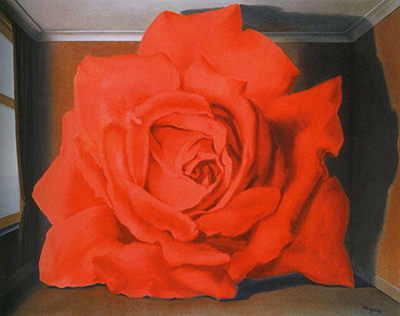
A red rose fills a room in René Magritte’s The Tomb of the Wrestlers. Its outer petals crowd the floor and almost reach the ceiling. A window at the left and a strip of wall at the right give us some idea of the space the flower has taken up. There is just enough room around it to see that it occupies an interior. The folds at the centre still have the shape we would expect of a rose small enough to hold in one hand.
Magritte painted Le tombeau des lutteurs in 1960 for Harry Torczyner. It is an oil on canvas measuring 89 by 116 centimetres and is listed as number 912 in volume III of the catalogue raisonné. Christie’s records that Torczyner acquired it directly from Magritte on 28 July 1960. Its inscription on the back gives 1944. Torczyner’s recollection and the correspondence cited by Christie’s place the commission and the making of the painting in 1960. The Museum of Modern Art retrospective and SFMOMA’s later exhibition also use that date. [1] [2] [3] [4]
At a Glance
- Original titleLe tombeau des lutteurs
- Date1960
- MediumOil on canvas
- Size89 × 116 cm
- Catalogue numberSylvester III 912
Selected works
Secret Life IV
1928A room measured by a rose
The window is seen from an angle at the left, close enough to the edge of the canvas for much of it to lie beyond the picture. The pale ceiling narrows towards the back wall. The upper joins at the sides and the short lines at floor level give the eye directions to follow into the room. These features are easiest to see around the corners of the canvas, where the rose leaves a little space. Following them helps establish how deep the room seems before we look into the folds of the flower.
The outer petals interrupt those directions. One broad petal rises high enough to cross the join between the wall and ceiling. At the bottom several petals make a ragged line close to the floor. The narrow strip of brown in front gives the eye somewhere to place their weight. The flower looks almost as if it has been lowered into the room whole. The window offers a familiar measure of height, even though it is partly out of sight. Against it, the rose seems much closer in scale to a person or a large piece of furniture than to a cut flower.
The petals at the centre turn in on themselves in tighter curves. Small shadows mark each overlap, especially where a thin edge bends towards the light. The wider outer petals have longer, more open surfaces. We can move from one edge to the next as if looking at an ordinary bloom held near the eye. The architecture continues to insist on another scale. Magritte makes the flower’s structure and the room’s proportions independently legible, so that the eye keeps testing each against the other.
Red in the room
The window gives the left edge a pale vertical band. The rose is brighter on that side and some petals on the right descend into deeper red. A dark shape follows the rose onto the right wall and up towards the ceiling. It gives the flower another way to occupy the room. Where the edge of the bloom falls against brown or grey, the red can be seen as a bounded surface. Where its shadow reaches further, the room itself seems to take on part of the flower’s outline.
Watch: Understanding Magritte
Three complementary films introduce the artist, explore words and images, and examine a painting’s materials. These are broader Magritte comparisons, alongside the work discussed here.
René Magritte: Great Art Explained
An introduction to Magritte’s life, characteristic images and visual puzzles.
Watch on YouTubeSeen from a little further away, the mass of red is more apparent than the individual petals. Seen close up, the surface breaks into turns and recesses. Torczyner associated the painting with a conversation about painters working with a restricted range of colour. His account says that he originally proposed a white rose in a white room with snow outside. Magritte delivered the red rose instead. In a later letter quoted by Christie’s, he joked that someone might appreciate the picture as an abstraction because of the sheer importance of the red. The outlines of the petals and room keep bringing us back to the objects that carry it. [1]
The title and the commission
In a letter reproduced in Torczyner’s recollection, Magritte associated the title with a book by Clavel that he had read in his youth and said he had forgotten. He nevertheless thought the remembered title suited the enormous red rose in a room. The painting supplies no wrestling scene. Its closest visual equivalent to a contest may be the pressure of the bloom against the space around it. The rose comes almost to the limits of the room, while the small stretches of wall and floor keep those limits visible. [1]
Christie’s connects the inscribed date of 1944 with Magritte’s earlier giant rose in L’Invitation au voyage, painted that year. Torczyner himself recalled the misleading date as a deliberate joke. His account of discussing the rose with Magritte, and the documented 1960 delivery, establish a chronology for the commission separately from the date the artist wrote on the canvas. That distinction matters when comparing the painting with works genuinely made during the 1940s. [1]
The exhibition history begins close to the date of the commission. Christie’s lists the painting in René Magritte in America, which opened in Dallas in December 1960 and travelled to Houston. It also appeared in the mid-1960s MoMA retrospective, whose catalogue reproduces the rose in colour. These records give the work a public chronology extending from the year of its making. The date on the inscription would put it much earlier. Seen through the timetable of the commission and exhibitions, the inscription is part of the unusual history of this particular canvas. [1] [3]
SFMOMA showed The Tomb of the Wrestlers in its 2018 exhibition The Fifth Season, alongside other paintings in which familiar objects occupy much more space than we expect. In The Listening Room, an apple similarly presses up against the limits of a room. The rose’s outline varies more abruptly, so different parts seem to take the measure of the room at different points. A high petal takes the eye to the ceiling and a low one nearly rests on the floor. Between them the folds still describe a flower, despite the scale on which Magritte has chosen to paint it. [4]
Magritte artworks directory
| Name | Date | Medium |
|---|---|---|
| Memory of a Voyage | 1963 | Oil on canvas |
| The Blood of the World | 1927; also catalogued as 1926–27 | Oil on canvas |
| The Hunters at the Edge of Night | Paris, 1928 | Oil on canvas |
| The Empty Picture Frame (La saignée) | 1938–39 | Gouache on paper |
| The Glass House | 1939 | Gouache on paper |
| Oasis | 1926 in the illustrated Christie’s catalogue | Oil on canvas |
| Natural Encounters | 1945 | Oil on canvas |
| Attempting the Impossible | 1928 | Oil on canvas |
| On the Threshold of Liberty | 1930 | Oil on canvas |
| The Titanic Days | 1928 | Oil on canvas |
| The Voice of Space | 1931 | Oil on canvas |
| Unexpected Answer | 1932 in the museum catalogue, 1933 on the reverse | Oil on canvas |
| Elective Affinities | 1932 in MoMA’s checklist, also published as 1933 | Oil on canvas |
| The Human Condition II | 1935 | Oil on canvas |
| The Six Elements | 1929 | Oil on canvas |
| The Happy Donor | 1966 | Oil on canvas |
| Clairvoyance (Self Portrait) | Brussels, 1936 | Oil on canvas |
| Philosopher’s Lamp | 1936 | Oil on canvas |
| The Annunciation | Paris, 1930 | Oil on canvas |
| The Lost Jockey | Circa 1942 in the illustrated lot catalogue | Gouache on paper laid down on canvas |
| Homage to Mack Sennett | 1936 in the Thyssen catalogue | Oil on canvas |
| Discovery | 1927 | Oil on canvas |
| Collective Invention | 1935 in the later catalogue index | Oil on canvas |
| The Wonders of Nature | 1953 | Oil on canvas |
| The Balcony | Circa 1950, with 1950 inscribed on the reverse | Oil on canvas |
| The Pilgrim | 1966 | Oil on canvas |
| The Invention of Life | 1928 | Oil on canvas |
| The Therapist | 1941 | Gouache on paper |
| The Gradation of Fire | 1938 or 1939 in the catalogue index | Gouache on paper |
| A Friend of Order | 1964 | Oil on canvas |
| The Poetic World | 1939 in Hammacher’s illustrated monograph | Gouache |
| The Muscles of the Sky | Paris, 1927 | Oil on canvas |
| The Battle of the Argonne | 1959 | Oil on canvas |
| Meditation | 1936 | Oil on canvas |
| The Domain of Arnheim | 1962 | Oil on canvas |
| This Is Not an Apple | 1964 | Oil on Unilite |
| The Meaning of Night | Brussels, 1927 | Oil on canvas |
| The Pleasure Principle (Portrait of Edward James) | 1937 | Oil on canvas |
| Ready Made Bouquet | 1957 | Oil on canvas |
| Popular Panorama | 1926 | Oil on canvas |
| Memory of a Journey | 1955 in the Thyssen catalogue. Tentatively 1958 in the catalogue index. | Gouache on paper, as exhibited at the Thyssen |
| Sheherazade | 1947 | Gouache on paper |
| The Difficult Crossing | 1926 | Oil on canvas |
| The Fair Captive | 1948 in the catalogue raisonné | Oil on canvas |
| The Birth of the Idol | 1926 | Oil on canvas |
| Hegel’s Holiday | 1958 | Oil on canvas |
| Homesickness | 1941 | Oil on canvas |
| The Rape (Le Viol) | 1934 | Oil on canvas |
| The Art of Living | 1967 | Oil on canvas |
| Secret Life IV | 1928 | Oil on canvas |
| The Tomb of the Wrestlers | 1960 | Oil on canvas |
| Young Girl Eating a Bird (The Pleasure) | 1927 | Oil on canvas |
| The Central Story | 1928 | Oil on canvas |
| The Seducer | 1953 | Oil on canvas |
| The Telescope | 1963 | Oil on canvas |
| The Banquet | 1958 | Oil on canvas |
| The Empty Mask | 1928 | Oil on canvas |
| The Cultivation of Ideas | 1927 | Oil on canvas |
| The Enchanted Pose | 1927 | Oil on canvas |
| The Future of Statues | 1937 | Oil on plaster |
| The Return of the Flame | 1943 | Oil on canvas |
| The White Page | 1967 | Oil on canvas |
| The Large Family | 1963 | Oil on canvas |
| Black Magic | 1945 | Oil on canvas |
| Les Amants I | 1928 | Oil on canvas |
| Man in a Bowler Hat | 1964 | Oil on canvas |
| The Portrait | 1935 | Oil on canvas |
| The Sixteenth of September | 1956 | Oil on canvas |
| Heartstrings | 1960 | Oil on canvas |
| The Present | 1939; also dated 1938 or 1939 | Gouache on paper |
| Act of Violence | 1932 | Oil on canvas |
| Fashionable People | 1950, in the 2016 thesis caption | Medium unconfirmed · Attribution follows the published caption |
| The Representation | 1962 | Oil on canvas |
| Memory | 1948 | Gouache on paper |
| The Mysteries of the Horizon | 1955 | Oil on canvas |
| Portrait of Stephy Langui | 1961 | Oil on canvas |
| The Double Secret | 1927 | Oil on canvas |
| Every Day | 1966 | Oil on canvas |
| The Invisible World | 1954 | Oil on canvas |
| Dawn of Cayenne | 1926 | Oil painting |
| Clear Ideas | 1955 (inscribed); possible 1958 execution | Oil on canvas |
| The Face of Genius | 1926 / 1927 | Oil on canvas |
| Good Faith | 1965; earlier record 1964–65 | Oil on canvas |
| The Flash | 1959 | Gouache and pencil on paper |
| Perpetual Motion | 1935; earlier catalogue 1934 | Oil on canvas |
| Personal Values | 1952 | Oil on canvas |
| Not to Be Reproduced | 1937 | Oil on canvas |
| The Red Model | 1935 | Oil on canvas |
| The Menaced Assassin | 1927 | Oil on canvas |
| The Castle of the Pyrenees | 1959 | Oil on canvas |
| The Blank Signature | 1965 | Oil on canvas |
| The Listening Room | 1952 | Oil on canvas |
| Golconde | 1953 | Oil on canvas |
| Time Transfixed | 1938 | Oil on canvas |
| The Treachery of Images | 1929 | Oil on canvas |
| The False Mirror | 1929 | Oil on canvas |
| The Empire of Light | 1953–54 | Oil on canvas |
| The Human Condition | 1933 | Oil on canvas |
| Les Amants | 1928 | Oil on canvas |
| The Son of Man | 1964 | Oil on canvas |
Frequently Asked Questions
Harry Torczyner recalled that Magritte deliberately gave the canvas a misleading date. The commission and delivery are documented in 1960.
Discussion
Look closely and compare your reading with others.
Reader Insights
Which part of the room gives you the clearest measure of the rose’s size?
How does the shadow affect the space the flower seems to occupy?
What can the title add to a reading based on the petals and the room?
Join the Conversation
Share a detail, comparison or question about The Tomb of the Wrestlers below.
References
- Christie’s. Le tombeau des lutteurs. Illustrated lot record, 1404197, with Harry Torczyner’s recollection and excerpts from Magritte’s letters. View source.
- Magritte. Toutes les œuvres, tous les thèmes. Catalogue raisonné index, vol. III, p. 326, no. 912. View source.
- James Thrall Soby. René Magritte. The Museum of Modern Art, 1965, illustration p. 40, checklist no. 76. View source.
- San Francisco Museum of Modern Art. René Magritte: The Fifth Season. Illustrated exhibition record, 2018. View source.







