


 by Tom Gurney
Tom Gurney BSc (Hons) is an art history expert with over 20 years experience
Page created on / Page updated on
Email: tomgurney1@gmail.com / Phone: +44 7429 011000
The Empty Picture Frame (La saignée)
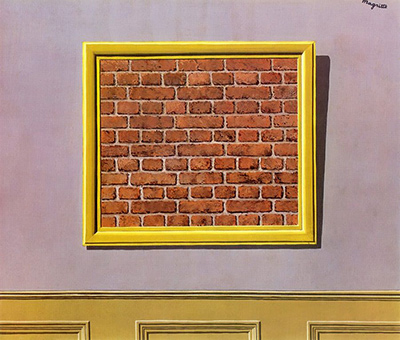
A narrow yellow frame hangs on a wall above the panelling. It has a shadow, so we can tell where its edge stands out from the wall. Look inside it and there is another wall, this time made of red brick. The frame gives the brickwork a clear beginning and end. It takes a little longer to decide whether we are looking at a picture of bricks, a patch of bare wall exposed through an opening or a device that makes those two possibilities equally hard to dismiss.
René Magritte’s La saignée is known in English as The Empty Picture Frame. Museum Boijmans Van Beuningen dates it to 1938–39. It is gouache on paper, measures 37 × 43 centimetres and is held under inventory number 2941 (MK). Those details identify the work with the yellow frame and wainscot shown here. [1]
At a Glance
- Catalogue titleLa saignée
- Date1938–39
- MediumGouache on paper
- Size37 × 43 cm
- CollectionMuseum Boijmans Van Beuningen, 2941 (MK)
Selected works
The Blood of the World
1927; also catalogued as 1926–27Contents
A closer look at the two walls
Magritte gives us enough of the room to place the object. The painted wall extends above and to either side of the frame. A horizontal line separates the wall from the lower panelling. We can follow it under the centre of the frame and out to both edges of the paper. That line has the steady direction of architecture we might recognise in an actual room. It also draws attention to how straight the yellow frame is.
Inside the frame, the irregular, reddish tones of the bricks make a contrast with the flatter area around them. Pale joints run across in courses, but the brick surfaces vary from one to the next. Those differences are part of the illusion of roughness. The yellow frame does something similar for a polished or painted surface. Its narrow bands catch light differently, and the dark strip down its right side suggests its thickness. Place those two observations side by side and an odd thing happens. The frame looks more firmly attached to the wall the longer we look at it, just as the stuff inside starts to look more like a different kind of wall.
That difference gives us two ways to read the rectangle. A painting hung there could depict a brick wall with just this degree of detail. A frame arranged round a portion of real brickwork might give that portion the character of a picture. Magritte has supplied enough visible evidence for either idea to occur to us. The shadow attests to the presence of a frame within the image. It tells us little about what lies in the space it bounds.
What a picture can show
A painting can act like a window. We see its edge, look past it into an imagined space and find a view that the actual room cannot supply. The material the painter worked on might be as near as an arm’s reach, while the view carries us miles away. A brick wall is an especially awkward subject for this convention. It is capable of stopping the very kind of view a painting is so good at opening up.
In a conversation reported in Les Beaux Arts in May 1939, Magritte discussed what could be shown behind a picture. Marijke Peyser’s Boijmans catalogue entry explains his sequence. There is canvas behind the painted surface, a wall behind the canvas and something else behind the wall. If we are speaking of physical things, that chain can continue. The image belongs to the painted surface. Trying to paint what comes after it in the chain produces another image for us to look at. The magazine reproduced La saignée alongside the discussion. [1]
Watch: Understanding Magritte
Three complementary films introduce the artist, explore words and images, and examine a painting’s materials. These are broader Magritte comparisons, alongside the work discussed here.
René Magritte: Great Art Explained
An introduction to Magritte’s life, characteristic images and visual puzzles.
Watch on YouTubeThe gouache makes the problem tangible. The mortar lines and colour changes are enough to bring brickwork to mind, yet no part of the picture allows us to reach behind it and test the material. We can inspect the represented wall as closely as we like. Every new detail gives us more of what the painter has made visible. Perhaps that is why the object in the picture is so persuasive. The very marks that make it appear possible for us to look through the frame alert us to what a picture can put there.
Gouache and the Brussels exhibition
Boijmans documents a solo exhibition of Magritte at the Centre for Fine Arts in Brussels, from 13 to 24 May 1939. He showed ten canvases and twenty-four gouaches. Some of their subjects had no earlier oil treatment. In a letter to the Belgian Surrealist Marcel Mariën, Magritte described a need to make fresh associations between ideas at a time when he was tired of painting. The museum cites that letter when it discusses his work in gouache and the range of combinations that appeared in the exhibition. [1]
Gouache uses opaque colour. In this work, the even area of the wall and the more closely divided colour of the brickwork give that opacity different jobs. One creates a surface whose visual quiet makes the frame easier to see. The other makes a shallow rectangle feel full of material. The picture is small enough for those decisions to be apprehended together. Its illusion does not require an expansive painted room. A strip of panelling and a patch of apparent brickwork furnish all the space Magritte needs.
Boijmans records the work in Edward James’s collection from 1939 to 1964 and with his foundation until the museum acquired it in 1977. Another Magritte associated with James, Not to Be Reproduced, also gives a familiar border an unfamiliar job. In that oil, the edge of the mirror encloses the back of the sitter’s head, repeated where we expect to see his face. The book sits beside him and behaves differently in the glass. Knowing what a mirror ordinarily does is part of the experience, just as knowing what a picture frame can do is part of looking at the gouache. [1] [2]
A frame, a title and a window
Magritte had treated the problem of the empty frame in another composition, Les Charmes du paysage. The Menil’s exhibition guide identifies the frame and rifle in that painting. A plate on the depicted frame that reads Paysage, makes the idea of a landscape present even where the expected view is missing. The rifle and the title plate distinguish that work from La saignée. In the later gouache, the bricks supply the obstruction and the shadow makes the frame feel as physical as the wall carrying it. [3] [4]
In the 1933 Human Condition, held by the National Gallery of Art in Washington, a canvas on an easel covers part of a window. The portion it covers can seem to continue the view outside. The painting asks us to look for the place where one view gives way to another. La saignée sets up a different experience. The yellow border is clear from the start. What takes longer to arrive at is a way of describing what it encloses. [5]
Stand mentally in the room again. Look at the shadow first, then at a single line of mortar. The shadow lets us imagine where the frame sits. The mortar makes the part inside it almost as physically convincing. The longer both impressions coexist, the less empty that frame begins to seem.
Magritte artworks directory
| Name | Date | Medium |
|---|---|---|
| Memory of a Voyage | 1963 | Oil on canvas |
| The Blood of the World | 1927; also catalogued as 1926–27 | Oil on canvas |
| The Hunters at the Edge of Night | Paris, 1928 | Oil on canvas |
| The Empty Picture Frame (La saignée) | 1938–39 | Gouache on paper |
| The Glass House | 1939 | Gouache on paper |
| Oasis | 1926 in the illustrated Christie’s catalogue | Oil on canvas |
| Natural Encounters | 1945 | Oil on canvas |
| Attempting the Impossible | 1928 | Oil on canvas |
| On the Threshold of Liberty | 1930 | Oil on canvas |
| The Titanic Days | 1928 | Oil on canvas |
| The Voice of Space | 1931 | Oil on canvas |
| Unexpected Answer | 1932 in the museum catalogue, 1933 on the reverse | Oil on canvas |
| Elective Affinities | 1932 in MoMA’s checklist, also published as 1933 | Oil on canvas |
| The Human Condition II | 1935 | Oil on canvas |
| The Six Elements | 1929 | Oil on canvas |
| The Happy Donor | 1966 | Oil on canvas |
| Clairvoyance (Self Portrait) | Brussels, 1936 | Oil on canvas |
| Philosopher’s Lamp | 1936 | Oil on canvas |
| The Annunciation | Paris, 1930 | Oil on canvas |
| The Lost Jockey | Circa 1942 in the illustrated lot catalogue | Gouache on paper laid down on canvas |
| Homage to Mack Sennett | 1936 in the Thyssen catalogue | Oil on canvas |
| Discovery | 1927 | Oil on canvas |
| Collective Invention | 1935 in the later catalogue index | Oil on canvas |
| The Wonders of Nature | 1953 | Oil on canvas |
| The Balcony | Circa 1950, with 1950 inscribed on the reverse | Oil on canvas |
| The Pilgrim | 1966 | Oil on canvas |
| The Invention of Life | 1928 | Oil on canvas |
| The Therapist | 1941 | Gouache on paper |
| The Gradation of Fire | 1938 or 1939 in the catalogue index | Gouache on paper |
| A Friend of Order | 1964 | Oil on canvas |
| The Poetic World | 1939 in Hammacher’s illustrated monograph | Gouache |
| The Muscles of the Sky | Paris, 1927 | Oil on canvas |
| The Battle of the Argonne | 1959 | Oil on canvas |
| Meditation | 1936 | Oil on canvas |
| The Domain of Arnheim | 1962 | Oil on canvas |
| This Is Not an Apple | 1964 | Oil on Unilite |
| The Meaning of Night | Brussels, 1927 | Oil on canvas |
| The Pleasure Principle (Portrait of Edward James) | 1937 | Oil on canvas |
| Ready Made Bouquet | 1957 | Oil on canvas |
| Popular Panorama | 1926 | Oil on canvas |
| Memory of a Journey | 1955 in the Thyssen catalogue. Tentatively 1958 in the catalogue index. | Gouache on paper, as exhibited at the Thyssen |
| Sheherazade | 1947 | Gouache on paper |
| The Difficult Crossing | 1926 | Oil on canvas |
| The Fair Captive | 1948 in the catalogue raisonné | Oil on canvas |
| The Birth of the Idol | 1926 | Oil on canvas |
| Hegel’s Holiday | 1958 | Oil on canvas |
| Homesickness | 1941 | Oil on canvas |
| The Rape (Le Viol) | 1934 | Oil on canvas |
| The Art of Living | 1967 | Oil on canvas |
| Secret Life IV | 1928 | Oil on canvas |
| The Tomb of the Wrestlers | 1960 | Oil on canvas |
| Young Girl Eating a Bird (The Pleasure) | 1927 | Oil on canvas |
| The Central Story | 1928 | Oil on canvas |
| The Seducer | 1953 | Oil on canvas |
| The Telescope | 1963 | Oil on canvas |
| The Banquet | 1958 | Oil on canvas |
| The Empty Mask | 1928 | Oil on canvas |
| The Cultivation of Ideas | 1927 | Oil on canvas |
| The Enchanted Pose | 1927 | Oil on canvas |
| The Future of Statues | 1937 | Oil on plaster |
| The Return of the Flame | 1943 | Oil on canvas |
| The White Page | 1967 | Oil on canvas |
| The Large Family | 1963 | Oil on canvas |
| Black Magic | 1945 | Oil on canvas |
| Les Amants I | 1928 | Oil on canvas |
| Man in a Bowler Hat | 1964 | Oil on canvas |
| The Portrait | 1935 | Oil on canvas |
| The Sixteenth of September | 1956 | Oil on canvas |
| Heartstrings | 1960 | Oil on canvas |
| The Present | 1939; also dated 1938 or 1939 | Gouache on paper |
| Act of Violence | 1932 | Oil on canvas |
| Fashionable People | 1950, in the 2016 thesis caption | Medium unconfirmed · Attribution follows the published caption |
| The Representation | 1962 | Oil on canvas |
| Memory | 1948 | Gouache on paper |
| The Mysteries of the Horizon | 1955 | Oil on canvas |
| Portrait of Stephy Langui | 1961 | Oil on canvas |
| The Double Secret | 1927 | Oil on canvas |
| Every Day | 1966 | Oil on canvas |
| The Invisible World | 1954 | Oil on canvas |
| Dawn of Cayenne | 1926 | Oil painting |
| Clear Ideas | 1955 (inscribed); possible 1958 execution | Oil on canvas |
| The Face of Genius | 1926 / 1927 | Oil on canvas |
| Good Faith | 1965; earlier record 1964–65 | Oil on canvas |
| The Flash | 1959 | Gouache and pencil on paper |
| Perpetual Motion | 1935; earlier catalogue 1934 | Oil on canvas |
| Personal Values | 1952 | Oil on canvas |
| Not to Be Reproduced | 1937 | Oil on canvas |
| The Red Model | 1935 | Oil on canvas |
| The Menaced Assassin | 1927 | Oil on canvas |
| The Castle of the Pyrenees | 1959 | Oil on canvas |
| The Blank Signature | 1965 | Oil on canvas |
| The Listening Room | 1952 | Oil on canvas |
| Golconde | 1953 | Oil on canvas |
| Time Transfixed | 1938 | Oil on canvas |
| The Treachery of Images | 1929 | Oil on canvas |
| The False Mirror | 1929 | Oil on canvas |
| The Empire of Light | 1953–54 | Oil on canvas |
| The Human Condition | 1933 | Oil on canvas |
| Les Amants | 1928 | Oil on canvas |
| The Son of Man | 1964 | Oil on canvas |
Frequently Asked Questions
It is La saignée, a 1938–39 gouache on paper in Museum Boijmans Van Beuningen, inventory 2941 (MK).
That is Les Charmes du paysage, a separate composition. The yellow frame and red bricks shown here belong to La saignée.
Discussion
Look closely and compare your reading with others.
Reader Insights
Where does the painted shadow tell you the frame is?
Which detail makes the brick rectangle look most like an actual wall?
How would the composition change if the frame surrounded a view of the sea?
Join the Conversation
Share a detail, comparison or question about The Empty Picture Frame (La saignée) below.
References
- Museum Boijmans Van Beuningen, La saignée, inventory 2941 (MK), collection record and catalogue essay by Marijke Peyser, with 1939 exhibition, magazine, correspondence and provenance evidence. View source.
- Museum Boijmans Van Beuningen, La reproduction interdite, collection record and catalogue essay on Edward James and the composition. View source.
- The Menil Collection, Magritte: The Mystery of the Ordinary, 1926–1938, gallery guide, discussion of Les Charmes du paysage. View source.
- The Museum of Modern Art, René Magritte, 1965 exhibition catalogue, reproduction of Les Charmes du paysage under the title The Spells of the Landscape. View source.
- National Gallery of Art, Washington, René Magritte, La condition humaine, 1933, collection and interpretation. View source.







