


 by Tom Gurney
Tom Gurney BSc (Hons) is an art history expert with over 20 years experience
Page created on / Page updated on
Email: tomgurney1@gmail.com / Phone: +44 7429 011000
The Six Elements
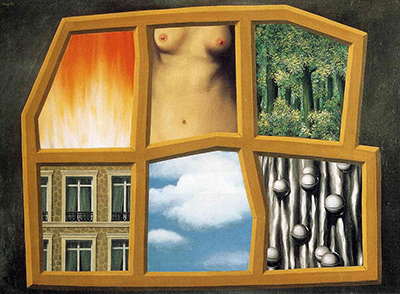
Six images sit inside a yellow frame against a dark ground in René Magritte’s The Six Elements. In the upper row, fire, a human torso and a forest stand side by side. Below them are the façade of a building, a blue sky with clouds and a cluster of gleaming shapes. The divisions make it easy to count the six. They also make it hard to decide how to read them together. A change of compartment can take the eye from a close view of skin to a stretch of woodland or a sky with no clear measure of distance.
The Philadelphia Museum of Art holds this 1929 painting under accession 1950-134-127. Museum Boijmans Van Beuningen reproduces it as Les six éléments, an oil on canvas measuring 73 by 99.9 centimetres, in its study of the related On the Threshold of Liberty. The two paintings use several of the same subjects while placing them in quite different structures. [1] [2]
At a Glance
- Original titleLes six éléments
- Date1929
- MediumOil on canvas
- Size73 × 99.9 cm
- CollectionPhiladelphia Museum of Art, 1950-134-127
Selected works
The frame sets the terms
The frame looks like something that might hold a set of small pictures, but its outer edge has a shape of its own. At the top left, a long diagonal closes off the corner above the flames. Above the forest, the top drops towards the right. The lower right compartment projects slightly beyond the one over it. The background makes these changes easy to see. It remains visible around the whole construction, giving the yellow outline the presence of a single object.
The inner divisions are just as important. The crosspiece rises slightly beneath the torso before dropping towards the edges. The divider between the sky and the gleaming objects bends before it reaches the bottom. Those shifts make some of the openings wider at one end than the other. Counting the compartments gives us a regular arrangement of three above and three below. Following the edges gives us a more variable arrangement, in which individual subjects have been made to fit shapes that are visibly unequal.
The warm colour also makes the divisions part of how we see each scene. Against the fire, the yellow seems to belong to the same range of colours as the flames. Against the blue sky, that same yellow reads as a much firmer boundary. Even the dark and light on either side of a narrow rail can change dramatically. The frame stays in front of what it encloses, yet which side of it seems brighter or closer depends on the panel next to it.
Moving between the six views
The torso is seen so close that the edges exclude the head and limbs. We can look across its side to the forest and see trunks receding among leaves. The shift is immediate because the two views are right next to each other. Skin occupies much of its panel as a single surface, while the forest contains many small openings into shade. There is no intermediate distance between them. A line of yellow is enough to put one view alongside the other.
Watch: Understanding Magritte
Three complementary films introduce the artist, explore words and images, and examine a painting’s materials. These are broader Magritte comparisons, alongside the work discussed here.
René Magritte: Great Art Explained
An introduction to Magritte’s life, characteristic images and visual puzzles.
Watch on YouTubeA different shift happens in the bottom row. The façade has windows and railings in orderly intervals. The panel cuts off the building at both sides, suggesting that the arrangement could carry on past the edges. Beside it, the clouds suggest an even larger view, with less to help us judge the position or size of any one form. At the right, the dark shapes and rounded highlights are packed closely enough to make us study their surfaces. The window grid gives a way to measure the first view. The second and third ask the eye to use other clues, such as the space between clouds or a bright mark across a curved surface.
The title offers a reason to look for a group of basic things. The Philadelphia Museum of Art notes that it calls to mind the classical elements of air, water, fire and earth. Fire and sky seem easy to place within that association. Trying to assign the rest makes the limitations of the scheme apparent. A façade can be made of things we take from the ground, but its windows also make it a recognisably human construction. The torso brings a different scale and subject altogether. The title makes those comparisons possible while leaving the grouping open. [1]
The forest is a useful place to test that grouping. Some trunks close to the front of the panel show only in fragments, while the leaf cover breaks into smaller spots of light towards the back. We can see wood there as part of a living landscape. In the adjacent yellow rails, a wood-like colour and construction have a different purpose. The painting leaves both appearances in view without requiring them to belong to the same kind of space.
When the views become walls
Boijmans describes The Six Elements as a precursor to the 1930 On the Threshold of Liberty. In that painting the forest, sky, façade and other motifs form the walls of an interior. Their borders turn at the corners and meet a floor, and a cannon sits in the open space before them. The view of the sky and the picture of the building are still close neighbours. How they relate to the viewer changes when they seem to be attached to the same room. [2]
In The Six Elements, the dark ground around the frame gives us no floor to stand on. Our eye can go straight from the flames to the windows below them, or from the skin to the sky. In the later picture, the wheel and barrel provide strong directions from which to approach the wall panels. The earlier picture leaves the order of looking more open. A path through it might follow colours, moving from the yellow-white fire to the pale clouds, or it might follow repeated vertical lines from the trees to the building. Those routes bring different views into contact without giving them a common place outside the frame.
There is also a difference in what the two pictures do with the corners. In the room, corners help explain why one panel slants away from another. In the earlier painting, the angles around the top left and top right belong to the assembled object itself, and the dark ground stays flat behind them. That is what makes the frame more than a way of sorting six images. Its outline gives the group a single shape, even while the spaces inside retain their own distances, surfaces and light.
Magritte artworks directory
| Name | Date | Medium |
|---|---|---|
| Memory of a Voyage | 1963 | Oil on canvas |
| The Blood of the World | 1927; also catalogued as 1926–27 | Oil on canvas |
| The Hunters at the Edge of Night | Paris, 1928 | Oil on canvas |
| The Empty Picture Frame (La saignée) | 1938–39 | Gouache on paper |
| The Glass House | 1939 | Gouache on paper |
| Oasis | 1926 in the illustrated Christie’s catalogue | Oil on canvas |
| Natural Encounters | 1945 | Oil on canvas |
| Attempting the Impossible | 1928 | Oil on canvas |
| On the Threshold of Liberty | 1930 | Oil on canvas |
| The Titanic Days | 1928 | Oil on canvas |
| The Voice of Space | 1931 | Oil on canvas |
| Unexpected Answer | 1932 in the museum catalogue, 1933 on the reverse | Oil on canvas |
| Elective Affinities | 1932 in MoMA’s checklist, also published as 1933 | Oil on canvas |
| The Human Condition II | 1935 | Oil on canvas |
| The Six Elements | 1929 | Oil on canvas |
| The Happy Donor | 1966 | Oil on canvas |
| Clairvoyance (Self Portrait) | Brussels, 1936 | Oil on canvas |
| Philosopher’s Lamp | 1936 | Oil on canvas |
| The Annunciation | Paris, 1930 | Oil on canvas |
| The Lost Jockey | Circa 1942 in the illustrated lot catalogue | Gouache on paper laid down on canvas |
| Homage to Mack Sennett | 1936 in the Thyssen catalogue | Oil on canvas |
| Discovery | 1927 | Oil on canvas |
| Collective Invention | 1935 in the later catalogue index | Oil on canvas |
| The Wonders of Nature | 1953 | Oil on canvas |
| The Balcony | Circa 1950, with 1950 inscribed on the reverse | Oil on canvas |
| The Pilgrim | 1966 | Oil on canvas |
| The Invention of Life | 1928 | Oil on canvas |
| The Therapist | 1941 | Gouache on paper |
| The Gradation of Fire | 1938 or 1939 in the catalogue index | Gouache on paper |
| A Friend of Order | 1964 | Oil on canvas |
| The Poetic World | 1939 in Hammacher’s illustrated monograph | Gouache |
| The Muscles of the Sky | Paris, 1927 | Oil on canvas |
| The Battle of the Argonne | 1959 | Oil on canvas |
| Meditation | 1936 | Oil on canvas |
| The Domain of Arnheim | 1962 | Oil on canvas |
| This Is Not an Apple | 1964 | Oil on Unilite |
| The Meaning of Night | Brussels, 1927 | Oil on canvas |
| The Pleasure Principle (Portrait of Edward James) | 1937 | Oil on canvas |
| Ready Made Bouquet | 1957 | Oil on canvas |
| Popular Panorama | 1926 | Oil on canvas |
| Memory of a Journey | 1955 in the Thyssen catalogue. Tentatively 1958 in the catalogue index. | Gouache on paper, as exhibited at the Thyssen |
| Sheherazade | 1947 | Gouache on paper |
| The Difficult Crossing | 1926 | Oil on canvas |
| The Fair Captive | 1948 in the catalogue raisonné | Oil on canvas |
| The Birth of the Idol | 1926 | Oil on canvas |
| Hegel’s Holiday | 1958 | Oil on canvas |
| Homesickness | 1941 | Oil on canvas |
| The Rape (Le Viol) | 1934 | Oil on canvas |
| The Art of Living | 1967 | Oil on canvas |
| Secret Life IV | 1928 | Oil on canvas |
| The Tomb of the Wrestlers | 1960 | Oil on canvas |
| Young Girl Eating a Bird (The Pleasure) | 1927 | Oil on canvas |
| The Central Story | 1928 | Oil on canvas |
| The Seducer | 1953 | Oil on canvas |
| The Telescope | 1963 | Oil on canvas |
| The Banquet | 1958 | Oil on canvas |
| The Empty Mask | 1928 | Oil on canvas |
| The Cultivation of Ideas | 1927 | Oil on canvas |
| The Enchanted Pose | 1927 | Oil on canvas |
| The Future of Statues | 1937 | Oil on plaster |
| The Return of the Flame | 1943 | Oil on canvas |
| The White Page | 1967 | Oil on canvas |
| The Large Family | 1963 | Oil on canvas |
| Black Magic | 1945 | Oil on canvas |
| Les Amants I | 1928 | Oil on canvas |
| Man in a Bowler Hat | 1964 | Oil on canvas |
| The Portrait | 1935 | Oil on canvas |
| The Sixteenth of September | 1956 | Oil on canvas |
| Heartstrings | 1960 | Oil on canvas |
| The Present | 1939; also dated 1938 or 1939 | Gouache on paper |
| Act of Violence | 1932 | Oil on canvas |
| Fashionable People | 1950, in the 2016 thesis caption | Medium unconfirmed · Attribution follows the published caption |
| The Representation | 1962 | Oil on canvas |
| Memory | 1948 | Gouache on paper |
| The Mysteries of the Horizon | 1955 | Oil on canvas |
| Portrait of Stephy Langui | 1961 | Oil on canvas |
| The Double Secret | 1927 | Oil on canvas |
| Every Day | 1966 | Oil on canvas |
| The Invisible World | 1954 | Oil on canvas |
| Dawn of Cayenne | 1926 | Oil painting |
| Clear Ideas | 1955 (inscribed); possible 1958 execution | Oil on canvas |
| The Face of Genius | 1926 / 1927 | Oil on canvas |
| Good Faith | 1965; earlier record 1964–65 | Oil on canvas |
| The Flash | 1959 | Gouache and pencil on paper |
| Perpetual Motion | 1935; earlier catalogue 1934 | Oil on canvas |
| Personal Values | 1952 | Oil on canvas |
| Not to Be Reproduced | 1937 | Oil on canvas |
| The Red Model | 1935 | Oil on canvas |
| The Menaced Assassin | 1927 | Oil on canvas |
| The Castle of the Pyrenees | 1959 | Oil on canvas |
| The Blank Signature | 1965 | Oil on canvas |
| The Listening Room | 1952 | Oil on canvas |
| Golconde | 1953 | Oil on canvas |
| Time Transfixed | 1938 | Oil on canvas |
| The Treachery of Images | 1929 | Oil on canvas |
| The False Mirror | 1929 | Oil on canvas |
| The Empire of Light | 1953–54 | Oil on canvas |
| The Human Condition | 1933 | Oil on canvas |
| Les Amants | 1928 | Oil on canvas |
| The Son of Man | 1964 | Oil on canvas |
Frequently Asked Questions
It belongs to the Philadelphia Museum of Art.
Several of the same motifs appear in the later painting, where their borders form the walls of a room.
Discussion
Look closely and compare your reading with others.
Reader Insights
Which two adjacent compartments make you change your sense of scale most abruptly?
How does the irregular outline affect the order in which you look at the six views?
What happens when you try to fit each compartment to the title?
Join the Conversation
Share a detail, comparison or question about The Six Elements below.
References
- Philadelphia Museum of Art. The Six Elements. Collection record, 1950-134-127. View source.
- Museum Boijmans Van Beuningen. Au seuil de la liberté. Collection research entry, with a reproduction of Les six éléments. View source.







