


 by Tom Gurney
Tom Gurney BSc (Hons) is an art history expert with over 20 years experience
Page created on / Page updated on
Email: tomgurney1@gmail.com / Phone: +44 7429 011000
The Titanic Days
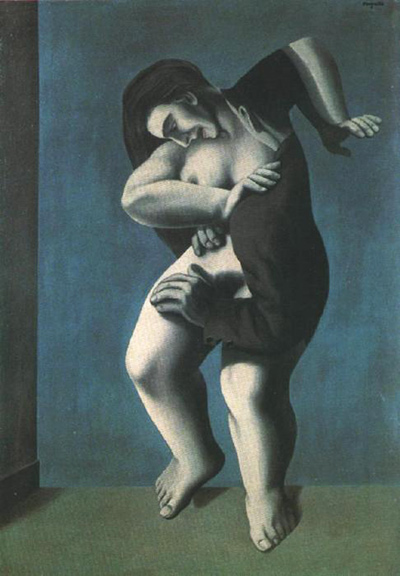
In René Magritte’s The Titanic Days, a clothed man attacks a nude woman. She turns her head down and braces a forearm across his shoulder. His hand grips her thigh. The pressure of one body against the other is clear, yet much of the man disappears where his shape would extend beyond hers. For a moment the dark clothing can look like shadow on the woman’s body. Then the hand on her leg makes the presence of a second person unmistakable.
Magritte painted this oil on canvas in Paris in 1928. The Kunstsammlung Nordrhein-Westfalen in Düsseldorf holds it as inventory 0275 and records the title on the reverse as Les jours gigantesques followed by “(II)”. The painted support measures 116 by 80.8 centimetres. The checklist for MoMA’s Magritte: The Mystery of the Ordinary, 1926–1938 identifies the canvas as catalogue raisonné number 247. [1] [2]
At a Glance
- Original titleLes jours gigantesques
- Date1928
- MediumOil on canvas
- Size116 × 80.8 cm
- CollectionKunstsammlung Nordrhein-Westfalen, 0275
- Catalogue numberSylvester I 247
Selected works
The Titanic Days
1928Unexpected Answer
1932 in the museum catalogue, 1933 on the reverseElective Affinities
1932 in MoMA’s checklist, also published as 1933Where the bodies meet
The woman’s head is one of the clearest forms in the upper part of the picture. Her hair forms a dark curve against the blue wall. The brow, nose and cheek are visible as she angles her face down towards her lifted arm. The line of the neck then disappears among the shoulder, the man’s jacket and the hand near her upper chest. Beginning at the head gives us a way to recognise a single person before tracing the places where another figure occupies the same outline.
The braced arm is seen close up. Its pale forearm crosses the front of the group and bends back towards the dark clothing. The highlights give it a rounded shape, and the fingers make contact at the shoulder. MoMA’s exhibition text draws attention to the forearm’s exaggerated musculature and to the way it creates an interval between two figures that otherwise seem pressed into a single plane. The arm does two things at once. The bend makes the woman’s resistance legible, and the projection of the forearm helps us imagine the space needed for that resistance. [3]
Farther down, the man’s hand curves across her thigh. It is possible to follow his fingers to the dark cuff. The rest of him is much more difficult to trace. The dark area seems to continue over her waist and along the outside of her hip. We recognise a hand and a sleeve because they have their own changes of light and direction. Beyond them, the outline we would use to separate his body from hers is also the outline that defines her body against the wall.
At the top right, another bent arm and hand stand out against the blue. That extension seems at first to offer a route away from the dense centre. Following it back leads to the same meeting of dark cloth and illuminated flesh. Each recognizable limb is a clue to an action. When we try to use all the clues together to reconstruct the figures’ positions, the picture becomes harder to resolve. The visible evidence of the assault remains clear through those changes of reading.
Light, weight and the blue room
A narrow dark strip marks the left edge. Near the floor, a short diagonal runs from that strip towards the place where the green ground meets the blue. These few lines give the setting a suggestion of a corner. They also supply a level against which we can see the tilt of the head and knees. The toes point down at different heights, and neither leg gives the body an obvious upright stance. Their positions contribute to the sense that the balance of the figure is changing.
Watch: Understanding Magritte
Three complementary films introduce the artist, explore words and images, and examine a painting’s materials. These are broader Magritte comparisons, alongside the work discussed here.
René Magritte: Great Art Explained
An introduction to Magritte’s life, characteristic images and visual puzzles.
Watch on YouTubeLight on the knees and shins gives them weight. Darkness deepens along the inner sides, and the fingers on the thigh are picked out against a lighter patch of skin. Those transitions make it possible to imagine the limbs as rounded volumes. The large dark shape in the middle then pulls us back to the flat surface of the canvas. Josef Helfenstein makes that tension central to his reading in the exhibition audio guide. The modelling allows us to recognise physical contact, while the compressed outlines make it difficult to assign the two people their own depth. [4]
The small amount of empty wall on either side matters to this effect. The group occupies less of the width near the legs, then broadens abruptly at the elbows. If we follow the patch of blue between the painted group and the right edge, its width tells us quite precisely where the body ends. Yet that same silhouette gives little guidance about which of the two people is nearest to the wall. The outer contour is very clear, while the depth within it remains unsettled. Magritte has made the surrounding room simple enough for that difference to hold throughout the picture.
Magritte uses a different distribution of space in The Hunters at the Edge of Night, also from Paris in 1928. There the bodies crowd behind an upright edge, with raised hands and open ground beyond. The space they look towards is visible, while what alarms them remains unclear. In The Titanic Days, the struggle is directly before us. The ambiguity concerns where one person’s shape ends and the other’s begins. Looking at the paintings together makes the position of an edge especially important. In one it belongs to a wall behind which the men stand. In the other it passes along the outline of the people themselves. [2]
The title and the painting’s history
MoMA’s guide connects the title to the Titans and to the struggle between the figures. That reading gives a sense of scale to a conflict painted within a narrow canvas. The colour of the wall and the plain area below it offer little to place the figures in a named setting. Our sense of the struggle comes from the woman’s stance, the pressure of the hands and the way the bodies fill the available space. The mythological reference draws attention to the force of those actions without assigning a named character to either figure. [4]
The Düsseldorf collection record traces the canvas through Brussels owners including Claude Spaak, Ruth Meredith Peters and Suzanne Bertouille. The museum acquired it from Galerie Beyeler in 1995. Its exhibition record includes the Surrealism survey that travelled between Paris and Düsseldorf in 2002 and the early-career Magritte show that opened at MoMA in 2013. In the latter exhibition, the canvas was presented alongside paintings that test how bodies, objects and rooms fit together. Here the test has a direct effect on what we can see of a woman resisting an attack. Her forearm makes that resistance visible even when it is difficult to see two complete bodies occupying the room. [1] [3]
Magritte artworks directory
| Name | Date | Medium |
|---|---|---|
| Memory of a Voyage | 1963 | Oil on canvas |
| The Blood of the World | 1927; also catalogued as 1926–27 | Oil on canvas |
| The Hunters at the Edge of Night | Paris, 1928 | Oil on canvas |
| The Empty Picture Frame (La saignée) | 1938–39 | Gouache on paper |
| The Glass House | 1939 | Gouache on paper |
| Oasis | 1926 in the illustrated Christie’s catalogue | Oil on canvas |
| Natural Encounters | 1945 | Oil on canvas |
| Attempting the Impossible | 1928 | Oil on canvas |
| On the Threshold of Liberty | 1930 | Oil on canvas |
| The Titanic Days | 1928 | Oil on canvas |
| The Voice of Space | 1931 | Oil on canvas |
| Unexpected Answer | 1932 in the museum catalogue, 1933 on the reverse | Oil on canvas |
| Elective Affinities | 1932 in MoMA’s checklist, also published as 1933 | Oil on canvas |
| The Human Condition II | 1935 | Oil on canvas |
| The Six Elements | 1929 | Oil on canvas |
| The Happy Donor | 1966 | Oil on canvas |
| Clairvoyance (Self Portrait) | Brussels, 1936 | Oil on canvas |
| Philosopher’s Lamp | 1936 | Oil on canvas |
| The Annunciation | Paris, 1930 | Oil on canvas |
| The Lost Jockey | Circa 1942 in the illustrated lot catalogue | Gouache on paper laid down on canvas |
| Homage to Mack Sennett | 1936 in the Thyssen catalogue | Oil on canvas |
| Discovery | 1927 | Oil on canvas |
| Collective Invention | 1935 in the later catalogue index | Oil on canvas |
| The Wonders of Nature | 1953 | Oil on canvas |
| The Balcony | Circa 1950, with 1950 inscribed on the reverse | Oil on canvas |
| The Pilgrim | 1966 | Oil on canvas |
| The Invention of Life | 1928 | Oil on canvas |
| The Therapist | 1941 | Gouache on paper |
| The Gradation of Fire | 1938 or 1939 in the catalogue index | Gouache on paper |
| A Friend of Order | 1964 | Oil on canvas |
| The Poetic World | 1939 in Hammacher’s illustrated monograph | Gouache |
| The Muscles of the Sky | Paris, 1927 | Oil on canvas |
| The Battle of the Argonne | 1959 | Oil on canvas |
| Meditation | 1936 | Oil on canvas |
| The Domain of Arnheim | 1962 | Oil on canvas |
| This Is Not an Apple | 1964 | Oil on Unilite |
| The Meaning of Night | Brussels, 1927 | Oil on canvas |
| The Pleasure Principle (Portrait of Edward James) | 1937 | Oil on canvas |
| Ready Made Bouquet | 1957 | Oil on canvas |
| Popular Panorama | 1926 | Oil on canvas |
| Memory of a Journey | 1955 in the Thyssen catalogue. Tentatively 1958 in the catalogue index. | Gouache on paper, as exhibited at the Thyssen |
| Sheherazade | 1947 | Gouache on paper |
| The Difficult Crossing | 1926 | Oil on canvas |
| The Fair Captive | 1948 in the catalogue raisonné | Oil on canvas |
| The Birth of the Idol | 1926 | Oil on canvas |
| Hegel’s Holiday | 1958 | Oil on canvas |
| Homesickness | 1941 | Oil on canvas |
| The Rape (Le Viol) | 1934 | Oil on canvas |
| The Art of Living | 1967 | Oil on canvas |
| Secret Life IV | 1928 | Oil on canvas |
| The Tomb of the Wrestlers | 1960 | Oil on canvas |
| Young Girl Eating a Bird (The Pleasure) | 1927 | Oil on canvas |
| The Central Story | 1928 | Oil on canvas |
| The Seducer | 1953 | Oil on canvas |
| The Telescope | 1963 | Oil on canvas |
| The Banquet | 1958 | Oil on canvas |
| The Empty Mask | 1928 | Oil on canvas |
| The Cultivation of Ideas | 1927 | Oil on canvas |
| The Enchanted Pose | 1927 | Oil on canvas |
| The Future of Statues | 1937 | Oil on plaster |
| The Return of the Flame | 1943 | Oil on canvas |
| The White Page | 1967 | Oil on canvas |
| The Large Family | 1963 | Oil on canvas |
| Black Magic | 1945 | Oil on canvas |
| Les Amants I | 1928 | Oil on canvas |
| Man in a Bowler Hat | 1964 | Oil on canvas |
| The Portrait | 1935 | Oil on canvas |
| The Sixteenth of September | 1956 | Oil on canvas |
| Heartstrings | 1960 | Oil on canvas |
| The Present | 1939; also dated 1938 or 1939 | Gouache on paper |
| Act of Violence | 1932 | Oil on canvas |
| Fashionable People | 1950, in the 2016 thesis caption | Medium unconfirmed · Attribution follows the published caption |
| The Representation | 1962 | Oil on canvas |
| Memory | 1948 | Gouache on paper |
| The Mysteries of the Horizon | 1955 | Oil on canvas |
| Portrait of Stephy Langui | 1961 | Oil on canvas |
| The Double Secret | 1927 | Oil on canvas |
| Every Day | 1966 | Oil on canvas |
| The Invisible World | 1954 | Oil on canvas |
| Dawn of Cayenne | 1926 | Oil painting |
| Clear Ideas | 1955 (inscribed); possible 1958 execution | Oil on canvas |
| The Face of Genius | 1926 / 1927 | Oil on canvas |
| Good Faith | 1965; earlier record 1964–65 | Oil on canvas |
| The Flash | 1959 | Gouache and pencil on paper |
| Perpetual Motion | 1935; earlier catalogue 1934 | Oil on canvas |
| Personal Values | 1952 | Oil on canvas |
| Not to Be Reproduced | 1937 | Oil on canvas |
| The Red Model | 1935 | Oil on canvas |
| The Menaced Assassin | 1927 | Oil on canvas |
| The Castle of the Pyrenees | 1959 | Oil on canvas |
| The Blank Signature | 1965 | Oil on canvas |
| The Listening Room | 1952 | Oil on canvas |
| Golconde | 1953 | Oil on canvas |
| Time Transfixed | 1938 | Oil on canvas |
| The Treachery of Images | 1929 | Oil on canvas |
| The False Mirror | 1929 | Oil on canvas |
| The Empire of Light | 1953–54 | Oil on canvas |
| The Human Condition | 1933 | Oil on canvas |
| Les Amants | 1928 | Oil on canvas |
| The Son of Man | 1964 | Oil on canvas |
Frequently Asked Questions
A clothed man attacks a nude woman. The overlapping contours make the two bodies difficult to separate.
The Kunstsammlung Nordrhein-Westfalen in Düsseldorf holds the canvas as inventory 0275.
Discussion
Look closely and compare your reading with others.
Reader Insights
Which edge first makes it difficult to tell the two bodies apart?
How do the angle of the floor and the position of the feet affect your sense of balance?
What changes when you follow the line of the woman’s braced arm from elbow to hand?
Join the Conversation
Share a detail, comparison or question about The Titanic Days below.
References
- Kunstsammlung Nordrhein-Westfalen. Les jours gigantesques. German collection record, 0275. View source.
- Museum of Modern Art. Magritte: The Mystery of the Ordinary, 1926–1938. Exhibition checklist, catalogue raisonné entries 228 and 247. View source.
- Museum of Modern Art. Magritte: The Mystery of the Ordinary, 1926–1938. Online exhibition and work commentary. View source.
- Museum of Modern Art. Les Jours gigantesques (The Titanic Days). Exhibition audio guide, with Josef Helfenstein of the Menil Collection. View source.







