


 by Tom Gurney
Tom Gurney BSc (Hons) is an art history expert with over 20 years experience
Page created on / Page updated on
Email: tomgurney1@gmail.com / Phone: +44 7429 011000
The Glass House
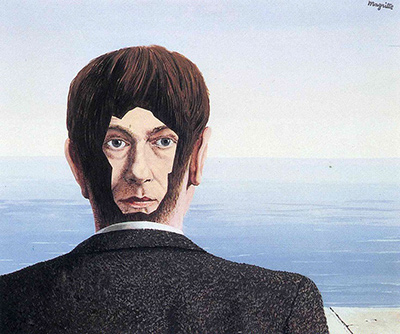
In René Magritte’s The Glass House, a man in a dark suit stands with his back to us. His shoulders suggest that he is facing the pale expanse beyond him. Yet a face looks out from the place where the back of his head should be. It takes a moment to see the face clearly, and another to realise how little Magritte has changed around it. The collar, ears and sweep of the hair still give us a view from behind. The face has to share that view with them.
Museum Boijmans Van Beuningen in Rotterdam records the work under its French title, La maison de verre. Magritte made it in 1939 in gouache on paper. It measures 33.6 by 40.2 centimetres, and the small signature in the upper right is part of the same composition. The museum lists Edward James as its first owner. [1]
At a Glance
- Original titleLa maison de verre
- Date1939
- MediumGouache on paper
- Size33.6 × 40.2 cm
- CollectionMuseum Boijmans Van Beuningen, 2942 (MK)
Selected works
Contents
From the shoulders to the eyes
Begin with the lower edge. The jacket takes up much of the foreground, and its dark shape rises towards the neck. The shoulders give the body its breadth. The collar fits against the neck in a way that helps establish which side of the body we are looking at. Beyond the figure, a thin horizontal division carries across the pale background. Those few cues give the picture a clear arrangement of foreground and distance before we have worked out what is happening at the centre.
The head interrupts that broad horizontal view. Its outline rises above the waterline so that we can follow the rounded contour of the hair against the paler sky. The ears are visible at either side and mark the limits of the form. Inside those limits, the eyes, nose and mouth come into view. Dark hair remains visible around and across the features, especially towards the top. At a distance the head can first register as a single dark mass. Looking closer changes what the marks within it appear to describe.
It would take a different set of clues to read the man as someone who has turned to look over his shoulder. We would expect one side of the face to come forward and the other to recede, with the neck registering the turn. Here the features have a roughly frontal arrangement within a head that still sits squarely above the back of the jacket. The image makes two readings possible at the same time, and the careful placement of the features keeps either reading from taking over.
The small pale shape at the lower right gives the eye a place to go after the face. From there it is easy to pick up the horizon again and follow it towards the man’s outline. The picture becomes stranger on this second pass. The head had seemed, for an instant, to look naturally out at us. The return to the shoulders restores the figure’s original direction. Each time we change where we look, a different part of the figure tells us how he is standing.
What the title does to the scene
A glass house is an enclosure that allows someone outside to see into it. That idea can change the way we look at the hair. In places it seems to cover or darken the features, yet it also lets enough of them show for us to recognise a face. The title gives us a familiar example of seeing through a surface, then leaves us with the much stranger experience of applying that idea to a human head. The suggestion comes from the relation between the words and the visible marks.
Watch: Understanding Magritte
Three complementary films introduce the artist, explore words and images, and examine a painting’s materials. These are broader Magritte comparisons, alongside the work discussed here.
René Magritte: Great Art Explained
An introduction to Magritte’s life, characteristic images and visual puzzles.
Watch on YouTubeIt is also possible to take the title as a question about who can see whom. From the way the body stands, the man seems to look over the water. From the way the features face, he seems to meet our eyes. The pale background gives him somewhere to look while the face gives us the feeling of being seen. Magritte gets that effect with one figure and a remarkably quiet setting. The horizon remains level and the jacket hangs heavily as the direction of the gaze becomes uncertain.
The title also directs attention to the expanse behind the figure. A sheet of clear glass is often visible only because something catches at its edge, or because it reflects part of the scene. The waterline here is a strong horizontal, but it gives us no obvious boundary for a pane. The faint separation of sea and sky makes space seem open just as the title invites us to look for an enclosure. The one area where a surface seems to be both present and penetrable is the hair. Looking for the glass sends our attention back to the head.
The handling of gouache helps set up that experience. The broad pale areas and dark jacket are easy to distinguish across the sheet. Within the head, smaller shifts in tone ask for a more gradual look. The edges of the silhouette are firm enough for the back of the head to register quickly. Inside that outline, recognition takes longer. The face and the turned back arrive at different speeds, even though both are there from the start. [1]
Edward James and another view from behind
Two years before The Glass House, Magritte placed a similarly turned figure at the centre of Not to Be Reproduced, an oil painting also held by Boijmans. That work portrays Edward James standing before a mirror. The book on the mantel has the reflection we would expect, while the mirror gives us a second view of the back of James’s head. The setting makes it possible to identify exactly where the change takes place. In the gouache, the features appear within the outline of the single head, bringing the puzzle into the figure itself. [2]
James’s connection with both works gives that comparison a historical footing. Boijmans traces ownership of the gouache from James in 1939 to the Edward James Foundation in 1964 and records its own purchase in 1977. The museum’s exhibition history also places the sheet in Magritte’s 1939 solo show at the Palais des Beaux-Arts in Brussels. Decades later it appeared in the 2016 Surreal Encounters exhibition in Edinburgh, where James was one of the collectors whose holdings shaped the exhibition. The two occasions placed the same small work within the artist’s own career and within the later history of collecting Surrealism. [1] [3]
The National Galleries of Scotland used a detail of the earlier Edward James portrait to introduce that exhibition. The choice brings out an aspect of the gouache that is easy to overlook when it is reproduced on its own. Like the earlier painting, it joins a man’s dark suit and carefully dressed hair to a broken expectation about how we see other people. The roughly forty-centimetre sheet brings that question down to the scale of something we can look at closely. The features are small enough to be lost in the first glance, yet clear enough to affect how we read the whole figure once we find them. [3]
The difference between the two pictures is easiest to see by following the figure’s line of sight. In Not to Be Reproduced, we can imagine James looking at an image whose face the viewer keeps expecting to see. In The Glass House, there is already a face in view. Its position makes it hard to say whose direction it follows. The man still seems to face towards the horizon, even as we find ourselves looking back at him.
Magritte artworks directory
| Name | Date | Medium |
|---|---|---|
| Memory of a Voyage | 1963 | Oil on canvas |
| The Blood of the World | 1927; also catalogued as 1926–27 | Oil on canvas |
| The Hunters at the Edge of Night | Paris, 1928 | Oil on canvas |
| The Empty Picture Frame (La saignée) | 1938–39 | Gouache on paper |
| The Glass House | 1939 | Gouache on paper |
| Oasis | 1926 in the illustrated Christie’s catalogue | Oil on canvas |
| Natural Encounters | 1945 | Oil on canvas |
| Attempting the Impossible | 1928 | Oil on canvas |
| On the Threshold of Liberty | 1930 | Oil on canvas |
| The Titanic Days | 1928 | Oil on canvas |
| The Voice of Space | 1931 | Oil on canvas |
| Unexpected Answer | 1932 in the museum catalogue, 1933 on the reverse | Oil on canvas |
| Elective Affinities | 1932 in MoMA’s checklist, also published as 1933 | Oil on canvas |
| The Human Condition II | 1935 | Oil on canvas |
| The Six Elements | 1929 | Oil on canvas |
| The Happy Donor | 1966 | Oil on canvas |
| Clairvoyance (Self Portrait) | Brussels, 1936 | Oil on canvas |
| Philosopher’s Lamp | 1936 | Oil on canvas |
| The Annunciation | Paris, 1930 | Oil on canvas |
| The Lost Jockey | Circa 1942 in the illustrated lot catalogue | Gouache on paper laid down on canvas |
| Homage to Mack Sennett | 1936 in the Thyssen catalogue | Oil on canvas |
| Discovery | 1927 | Oil on canvas |
| Collective Invention | 1935 in the later catalogue index | Oil on canvas |
| The Wonders of Nature | 1953 | Oil on canvas |
| The Balcony | Circa 1950, with 1950 inscribed on the reverse | Oil on canvas |
| The Pilgrim | 1966 | Oil on canvas |
| The Invention of Life | 1928 | Oil on canvas |
| The Therapist | 1941 | Gouache on paper |
| The Gradation of Fire | 1938 or 1939 in the catalogue index | Gouache on paper |
| A Friend of Order | 1964 | Oil on canvas |
| The Poetic World | 1939 in Hammacher’s illustrated monograph | Gouache |
| The Muscles of the Sky | Paris, 1927 | Oil on canvas |
| The Battle of the Argonne | 1959 | Oil on canvas |
| Meditation | 1936 | Oil on canvas |
| The Domain of Arnheim | 1962 | Oil on canvas |
| This Is Not an Apple | 1964 | Oil on Unilite |
| The Meaning of Night | Brussels, 1927 | Oil on canvas |
| The Pleasure Principle (Portrait of Edward James) | 1937 | Oil on canvas |
| Ready Made Bouquet | 1957 | Oil on canvas |
| Popular Panorama | 1926 | Oil on canvas |
| Memory of a Journey | 1955 in the Thyssen catalogue. Tentatively 1958 in the catalogue index. | Gouache on paper, as exhibited at the Thyssen |
| Sheherazade | 1947 | Gouache on paper |
| The Difficult Crossing | 1926 | Oil on canvas |
| The Fair Captive | 1948 in the catalogue raisonné | Oil on canvas |
| The Birth of the Idol | 1926 | Oil on canvas |
| Hegel’s Holiday | 1958 | Oil on canvas |
| Homesickness | 1941 | Oil on canvas |
| The Rape (Le Viol) | 1934 | Oil on canvas |
| The Art of Living | 1967 | Oil on canvas |
| Secret Life IV | 1928 | Oil on canvas |
| The Tomb of the Wrestlers | 1960 | Oil on canvas |
| Young Girl Eating a Bird (The Pleasure) | 1927 | Oil on canvas |
| The Central Story | 1928 | Oil on canvas |
| The Seducer | 1953 | Oil on canvas |
| The Telescope | 1963 | Oil on canvas |
| The Banquet | 1958 | Oil on canvas |
| The Empty Mask | 1928 | Oil on canvas |
| The Cultivation of Ideas | 1927 | Oil on canvas |
| The Enchanted Pose | 1927 | Oil on canvas |
| The Future of Statues | 1937 | Oil on plaster |
| The Return of the Flame | 1943 | Oil on canvas |
| The White Page | 1967 | Oil on canvas |
| The Large Family | 1963 | Oil on canvas |
| Black Magic | 1945 | Oil on canvas |
| Les Amants I | 1928 | Oil on canvas |
| Man in a Bowler Hat | 1964 | Oil on canvas |
| The Portrait | 1935 | Oil on canvas |
| The Sixteenth of September | 1956 | Oil on canvas |
| Heartstrings | 1960 | Oil on canvas |
| The Present | 1939; also dated 1938 or 1939 | Gouache on paper |
| Act of Violence | 1932 | Oil on canvas |
| Fashionable People | 1950, in the 2016 thesis caption | Medium unconfirmed · Attribution follows the published caption |
| The Representation | 1962 | Oil on canvas |
| Memory | 1948 | Gouache on paper |
| The Mysteries of the Horizon | 1955 | Oil on canvas |
| Portrait of Stephy Langui | 1961 | Oil on canvas |
| The Double Secret | 1927 | Oil on canvas |
| Every Day | 1966 | Oil on canvas |
| The Invisible World | 1954 | Oil on canvas |
| Dawn of Cayenne | 1926 | Oil painting |
| Clear Ideas | 1955 (inscribed); possible 1958 execution | Oil on canvas |
| The Face of Genius | 1926 / 1927 | Oil on canvas |
| Good Faith | 1965; earlier record 1964–65 | Oil on canvas |
| The Flash | 1959 | Gouache and pencil on paper |
| Perpetual Motion | 1935; earlier catalogue 1934 | Oil on canvas |
| Personal Values | 1952 | Oil on canvas |
| Not to Be Reproduced | 1937 | Oil on canvas |
| The Red Model | 1935 | Oil on canvas |
| The Menaced Assassin | 1927 | Oil on canvas |
| The Castle of the Pyrenees | 1959 | Oil on canvas |
| The Blank Signature | 1965 | Oil on canvas |
| The Listening Room | 1952 | Oil on canvas |
| Golconde | 1953 | Oil on canvas |
| Time Transfixed | 1938 | Oil on canvas |
| The Treachery of Images | 1929 | Oil on canvas |
| The False Mirror | 1929 | Oil on canvas |
| The Empire of Light | 1953–54 | Oil on canvas |
| The Human Condition | 1933 | Oil on canvas |
| Les Amants | 1928 | Oil on canvas |
| The Son of Man | 1964 | Oil on canvas |
Frequently Asked Questions
Magritte made the gouache on paper in 1939. Museum Boijmans Van Beuningen acquired it in 1977.
The suit and head suggest a man facing away, while a face appears within the outline of the back of his head.
Discussion
Look closely and compare your reading with others.
Reader Insights
Which detail first persuades you that the figure is facing away?
How does the face change when you look at the whole sheet and then return to the head?
What does the title suggest about who can see through the surface and who can be seen?
Join the Conversation
Share a detail, comparison or question about The Glass House below.
References
- Museum Boijmans Van Beuningen. La maison de verre (Het glazen huis). Collection record, 2942 (MK). View source.
- Museum Boijmans Van Beuningen. La reproduction interdite. Collection record. View source.
- National Galleries of Scotland. Surreal Encounters: Collecting the Marvellous. Exhibition record, 2016. View source.







