


 by Tom Gurney
Tom Gurney BSc (Hons) is an art history expert with over 20 years experience
Page created on / Page updated on
Email: tomgurney1@gmail.com / Phone: +44 7429 011000
The Voice of Space
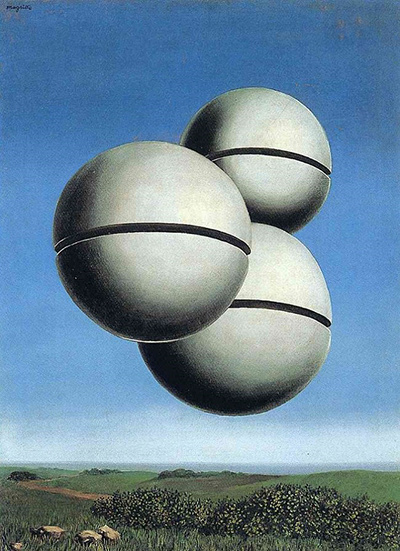
Three round bells hang above fields and bushes in René Magritte’s The Voice of Space. They almost fill the blue sky. Each has a dark slit that curves across its surface, and the light catches all three as though they were solid objects within reach. The land beneath them looks much farther away. There is a band of clear air between the lowest bell and the horizon, a gap that makes their suspension in the sky easy to see and difficult to explain.
This is the 1931 version of La Voix des airs, an oil on canvas in the Peggy Guggenheim Collection in Venice. It measures 72.7 by 54.2 centimetres, and the collection records it under accession 76.2553 PG 101. The illustrated catalogue for the Thyssen-Bornemisza exhibition The Magritte Machine identifies the same composition as catalogue raisonné number 339. The Buffalo AKG Art Museum holds a separate painting with the same title, dated 1928. [1] [2] [3]
At a Glance
- Original titleLa Voix des airs
- Date1931
- MediumOil on canvas
- Size72.7 × 54.2 cm
- CollectionPeggy Guggenheim Collection, 76.2553 PG 101
- Catalogue numberSylvester II 339
Selected works
The Titanic Days
1928Unexpected Answer
1932 in the museum catalogue, 1933 on the reverseElective Affinities
1932 in MoMA’s checklist, also published as 1933Three bells in the blue
The nearest-looking bell is to the left. It overlaps the other two, which are stacked more loosely at the right. You can follow the upper bell’s outline around its lit side until it disappears behind the front bell. The lower one comes out from the same overlap and curves back in towards the centre. Those partial contours give a good sense of which object sits in front of which, even though they give very little indication of how far apart the objects are.
The way the light falls gives each bell a rounded surface. The palest areas are broad, with darker edges towards the left and underneath. In the front bell, the shadow spreads across much of the lower half. The slit interrupts that shading with a sharper line, and its arc makes it seem to continue around a curved form. It also cuts the pale shape into two regions that the eye can compare. The width of the opening changes as it rounds the body, helping the sphere read as a hollow object with an inside.
At the point where the bells overlap, the three slits travel at slightly different angles. Each belongs to its own slope and height. Their resemblance makes us look across them as a group, but there is enough variation for the individual bells to stay distinct. Try following the dark line on the nearest bell and then picking up the line on the lower bell. The small jump between them makes the sense of layering clearer. It also directs the eye towards the outer curve that sweeps down over the open sky.
The space below them
The lowest area of the picture contains a few nearer forms that give us an idea of how the land recedes. Rocks and grasses are visible along the bottom edge. The line of bushes behind them comes forward in small clusters, while far fields and low rises lose their detail. This sequence of smaller and less distinct forms gives the land a readable distance. Space works differently above it. The bells are shaded and overlap in a way that feels equally convincing, but no familiar object at their height lets us judge their size.
That difference keeps the distance open to more than one reading. If the bells are close, they could look large because they occupy so much of our view. If they are farther away, their width becomes monumental compared with the narrow landscape. The clean strip of sky beneath the group matters in both cases. It makes the objects look as though they are clear of the ground and gives the eye somewhere to travel between the bells and the fields. The landscape looks calm enough to make that gap especially conspicuous.
Watch: Understanding Magritte
Three complementary films introduce the artist, explore words and images, and examine a painting’s materials. These are broader Magritte comparisons, alongside the work discussed here.
René Magritte: Great Art Explained
An introduction to Magritte’s life, characteristic images and visual puzzles.
Watch on YouTubeThe Peggy Guggenheim Collection draws attention to the precise painting of both the objects and their setting. The care given to the ground helps explain why the sky feels so exposed. The terrain provides a horizon and a succession of surfaces, while the upper part of the picture lets us follow the outline of each bell against a nearly continuous blue. The same precision works across both areas. It makes the field look like a place we could enter and the bells like things that have somehow arrived there. [1]
The change in blue from the upper edge to the horizon is gradual. Below the bells, the pale band keeps the shapes of the most distant hills legible. Near the top, the stronger blue gives the lit side of the upper bell a crisp outline. There is no equivalent transition in scale between the bushes and the floating objects. The eye can move across an unbroken field of colour even though it has to make a much larger jump in deciding how close the bells are.
Two versions and the sound of a bell
Buffalo’s 1928 The Voice of Space uses a subdued, nearly monochrome landscape and a different arrangement of the round forms. The museum relates the sombre setting to the industrial terrain of the Belgian region where Magritte grew up. It also associates the forms with bells on horses’ collars and the way their sound carried through the air. That account offers a way to think about the title of the later painting. Distance can change how loud a bell sounds while leaving the listener unsure where it hangs. In the Venice version, we can see the bells very clearly and still have difficulty placing them at a particular distance. [3]
The strip of sky under the cluster can also be read as space for a sound to travel through. The objects themselves appear still. No horse, collar or hand is visible to put them in motion, and the slits reveal darkness rather than movement within the bells. The title brings a possible sound into a scene that supplies so few visual signs of its cause. One can imagine the bells ringing across the fields, then return to the picture and notice how completely each object holds its place.
The Venice collection’s Italian accessibility guide calls the picture La voce dell’aria and describes air imagined as passing through the slits and making the bells sound. That reading starts with a feature we can locate. Each slit has a distinct angle, so the three openings lead the eye through the group rather than along a single horizontal line. The guide’s emphasis on air makes the unoccupied space an active part of the experience. It is where the viewer has room to imagine what the objects might do. [5]
Magritte also used floating bells in Pink Bells, Tattered Skies, a 1930 oil at the Museo Reina Sofía. There the bells occupy one side of the composition, with clouds in the other half. The colour changes sharply between the two fields. In the Venice painting, the bells and the countryside share one stretch of blue, so the land can serve as a measure of the space beneath them. The comparison shows how much the position of the horizon contributes to The Voice of Space. A small amount of ground gives us a familiar distance from which to imagine the reach of an unseen sound. [4]
Magritte artworks directory
| Name | Date | Medium |
|---|---|---|
| Memory of a Voyage | 1963 | Oil on canvas |
| The Blood of the World | 1927; also catalogued as 1926–27 | Oil on canvas |
| The Hunters at the Edge of Night | Paris, 1928 | Oil on canvas |
| The Empty Picture Frame (La saignée) | 1938–39 | Gouache on paper |
| The Glass House | 1939 | Gouache on paper |
| Oasis | 1926 in the illustrated Christie’s catalogue | Oil on canvas |
| Natural Encounters | 1945 | Oil on canvas |
| Attempting the Impossible | 1928 | Oil on canvas |
| On the Threshold of Liberty | 1930 | Oil on canvas |
| The Titanic Days | 1928 | Oil on canvas |
| The Voice of Space | 1931 | Oil on canvas |
| Unexpected Answer | 1932 in the museum catalogue, 1933 on the reverse | Oil on canvas |
| Elective Affinities | 1932 in MoMA’s checklist, also published as 1933 | Oil on canvas |
| The Human Condition II | 1935 | Oil on canvas |
| The Six Elements | 1929 | Oil on canvas |
| The Happy Donor | 1966 | Oil on canvas |
| Clairvoyance (Self Portrait) | Brussels, 1936 | Oil on canvas |
| Philosopher’s Lamp | 1936 | Oil on canvas |
| The Annunciation | Paris, 1930 | Oil on canvas |
| The Lost Jockey | Circa 1942 in the illustrated lot catalogue | Gouache on paper laid down on canvas |
| Homage to Mack Sennett | 1936 in the Thyssen catalogue | Oil on canvas |
| Discovery | 1927 | Oil on canvas |
| Collective Invention | 1935 in the later catalogue index | Oil on canvas |
| The Wonders of Nature | 1953 | Oil on canvas |
| The Balcony | Circa 1950, with 1950 inscribed on the reverse | Oil on canvas |
| The Pilgrim | 1966 | Oil on canvas |
| The Invention of Life | 1928 | Oil on canvas |
| The Therapist | 1941 | Gouache on paper |
| The Gradation of Fire | 1938 or 1939 in the catalogue index | Gouache on paper |
| A Friend of Order | 1964 | Oil on canvas |
| The Poetic World | 1939 in Hammacher’s illustrated monograph | Gouache |
| The Muscles of the Sky | Paris, 1927 | Oil on canvas |
| The Battle of the Argonne | 1959 | Oil on canvas |
| Meditation | 1936 | Oil on canvas |
| The Domain of Arnheim | 1962 | Oil on canvas |
| This Is Not an Apple | 1964 | Oil on Unilite |
| The Meaning of Night | Brussels, 1927 | Oil on canvas |
| The Pleasure Principle (Portrait of Edward James) | 1937 | Oil on canvas |
| Ready Made Bouquet | 1957 | Oil on canvas |
| Popular Panorama | 1926 | Oil on canvas |
| Memory of a Journey | 1955 in the Thyssen catalogue. Tentatively 1958 in the catalogue index. | Gouache on paper, as exhibited at the Thyssen |
| Sheherazade | 1947 | Gouache on paper |
| The Difficult Crossing | 1926 | Oil on canvas |
| The Fair Captive | 1948 in the catalogue raisonné | Oil on canvas |
| The Birth of the Idol | 1926 | Oil on canvas |
| Hegel’s Holiday | 1958 | Oil on canvas |
| Homesickness | 1941 | Oil on canvas |
| The Rape (Le Viol) | 1934 | Oil on canvas |
| The Art of Living | 1967 | Oil on canvas |
| Secret Life IV | 1928 | Oil on canvas |
| The Tomb of the Wrestlers | 1960 | Oil on canvas |
| Young Girl Eating a Bird (The Pleasure) | 1927 | Oil on canvas |
| The Central Story | 1928 | Oil on canvas |
| The Seducer | 1953 | Oil on canvas |
| The Telescope | 1963 | Oil on canvas |
| The Banquet | 1958 | Oil on canvas |
| The Empty Mask | 1928 | Oil on canvas |
| The Cultivation of Ideas | 1927 | Oil on canvas |
| The Enchanted Pose | 1927 | Oil on canvas |
| The Future of Statues | 1937 | Oil on plaster |
| The Return of the Flame | 1943 | Oil on canvas |
| The White Page | 1967 | Oil on canvas |
| The Large Family | 1963 | Oil on canvas |
| Black Magic | 1945 | Oil on canvas |
| Les Amants I | 1928 | Oil on canvas |
| Man in a Bowler Hat | 1964 | Oil on canvas |
| The Portrait | 1935 | Oil on canvas |
| The Sixteenth of September | 1956 | Oil on canvas |
| Heartstrings | 1960 | Oil on canvas |
| The Present | 1939; also dated 1938 or 1939 | Gouache on paper |
| Act of Violence | 1932 | Oil on canvas |
| Fashionable People | 1950, in the 2016 thesis caption | Medium unconfirmed · Attribution follows the published caption |
| The Representation | 1962 | Oil on canvas |
| Memory | 1948 | Gouache on paper |
| The Mysteries of the Horizon | 1955 | Oil on canvas |
| Portrait of Stephy Langui | 1961 | Oil on canvas |
| The Double Secret | 1927 | Oil on canvas |
| Every Day | 1966 | Oil on canvas |
| The Invisible World | 1954 | Oil on canvas |
| Dawn of Cayenne | 1926 | Oil painting |
| Clear Ideas | 1955 (inscribed); possible 1958 execution | Oil on canvas |
| The Face of Genius | 1926 / 1927 | Oil on canvas |
| Good Faith | 1965; earlier record 1964–65 | Oil on canvas |
| The Flash | 1959 | Gouache and pencil on paper |
| Perpetual Motion | 1935; earlier catalogue 1934 | Oil on canvas |
| Personal Values | 1952 | Oil on canvas |
| Not to Be Reproduced | 1937 | Oil on canvas |
| The Red Model | 1935 | Oil on canvas |
| The Menaced Assassin | 1927 | Oil on canvas |
| The Castle of the Pyrenees | 1959 | Oil on canvas |
| The Blank Signature | 1965 | Oil on canvas |
| The Listening Room | 1952 | Oil on canvas |
| Golconde | 1953 | Oil on canvas |
| Time Transfixed | 1938 | Oil on canvas |
| The Treachery of Images | 1929 | Oil on canvas |
| The False Mirror | 1929 | Oil on canvas |
| The Empire of Light | 1953–54 | Oil on canvas |
| The Human Condition | 1933 | Oil on canvas |
| Les Amants | 1928 | Oil on canvas |
| The Son of Man | 1964 | Oil on canvas |
Frequently Asked Questions
This is the 1931 Venice oil with three overlapping bells above a green landscape. Buffalo AKG Art Museum holds a separate 1928 painting.
They are rounded bells with dark slits. The Buffalo museum relates the motif to bells on horses’ collars.
Discussion
Look closely and compare your reading with others.
Reader Insights
Which overlap tells you the most about the bells’ positions?
How would the bells seem to change in size if the landscape were hidden?
What sort of sound does the title lead you to imagine, and where would you hear it from?
Join the Conversation
Share a detail, comparison or question about The Voice of Space below.
References
- Peggy Guggenheim Collection. Voice of Space. Venice collection record, accession 76.2553 PG 101. View source.
- Museo Nacional Thyssen-Bornemisza. La máquina Magritte. Exhibition catalogue, p. 165, catalogue raisonné entry 339. View source.
- Buffalo AKG Art Museum. La voix des airs (The Voice of Space). Collection record, 1976:13. View source.
- Paloma Esteban Leal. Grelots roses, ciels en lambeaux (Pink Bells, Tattered Skies). Museo Reina Sofía collection record, AD04763. View source.
- Peggy Guggenheim Collection. La voce dell’aria, Italian descriptive card for the museum’s accessibility programme. View source.







