



Memory
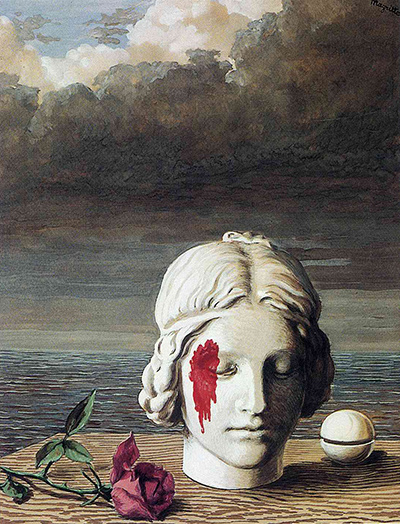
A pale sculpted head rests on a wood-grained ledge before the sea. A rose lies to the left, and a small round bell stands at the right. Above them, dark clouds gather around an opening of lighter sky. The head's downcast features seem quiet, yet a conspicuous red mark runs from the temple across one side of its face.
This version of René Magritte's Memory, or La mémoire, is a 1948 gouache on paper measuring 46 × 37 centimetres, catalogued as Sylvester IV 1254. It was offered at Christie's in 2022. Magritte returned to the title and bleeding-head motif in several different works; this particular image should be understood through its own setting and medium. [1]
At a Glance
Two distinct works on paper
Contents
A cast with an impossible wound
The head is recognisable as a sculpted object. Its pale surface, truncated neck and carefully arranged hair distinguish it from an ordinary person standing before the water. The face remains still, with closed or lowered eyes and a comparatively neutral mouth.
The red stain changes that recognition. It looks like blood on a surface that ought not to bleed. Its irregular outline and downward trails disturb the smooth modelling around it. The painting brings an association with bodily injury into an image whose objecthood remains otherwise clear.
That coexistence is more unsettling than a complete transformation would be. The head does not simply become a living woman. It retains the stillness and form of a cast while acquiring one dramatic sign of vulnerability. We continue to read both possibilities because neither fully replaces the other.
Rose, bell and head
The rose supplies another kind of colour near the lower left. Its darker red petals lie close to the ledge, accompanied by a long stem and leaves. The flower's horizontal extension contrasts with the head's upright position, helping to establish a small group of differently shaped objects.
At the right, the pale bell forms a rounded counterweight. Its dark division makes it legible as something more specific than a smooth ball. The little object's compact shape and lighter upper surface also echo aspects of the head without turning the two into matching forms.
Together, the three objects make a still-life arrangement that can be read quickly. Looking longer makes their relationship less secure. Flower, cast and bell are familiar things, but the red stain gives one of them a condition the others cannot explain. Their proximity invites connections without proving a single story.
The ledge and its grain
The ledge establishes a firm foreground. Its wood-like lines run across the surface beneath the objects, giving them a shared place to stand or lie. The grain creates a pattern that differs from the small horizontal marks of the sea behind it.
This distinction separates near and far. The head occupies an immediate space with the flower and bell, while the water recedes towards the horizon. Magritte gives us a readable setting even as the bleeding cast challenges what can happen within it.
The pattern beneath the head also emphasises its base. We see where the neck ends and meets the ledge. That contact makes the head seem physically present as an object, strengthening the contradiction introduced by the wound. Its apparently solid situation gives the impossible detail something convincing to disturb.
Watch: Understanding Magritte
Three complementary films introduce the artist, explore words and images, and examine a painting’s materials. These are broader Magritte comparisons, alongside the work discussed here.
René Magritte: Great Art Explained
An introduction to Magritte’s life, characteristic images and visual puzzles.
Watch on YouTubeA sky larger than the still life
The clouds occupy much of the upper composition. Dark passages spread across the sky, while lighter shapes gather above them. The small group on the ledge therefore sits beneath a much broader atmospheric presence.
The sea provides a quieter interval between sky and objects. Its fine marks create distance without introducing a boat or a figure that would begin another narrative. The head remains the principal human likeness, but its surroundings give that likeness an unusually exposed setting.
Notice the difference between the cloud edges and the outlines of the foreground things. The head, bell and flower can be separated with relative clarity. The sky offers more gradual transitions. Their coexistence makes the scene both sharply constructed and difficult to settle into a single mood.
This 1948 paper version
The catalogue identifies the work as gouache, a water-based opaque paint, on paper. That medium belongs to this object even though Magritte also made oil paintings of Memory. Repeated titles and related compositions do not make the physical works identical. [1]
Christie's records this gouache in the Hugo Gallery's New York exhibition of 1948 and later on long-term loan to the Musée Magritte from 2012 to 2021. These are episodes in its recorded history, not evidence that it is permanently owned by that museum. [1]
The distinction matters when viewing reproductions. A familiar head and stain can make several works seem interchangeable at first glance. The sky, accompanying objects, dimensions and support help bring us back to the particular image under consideration. Here the rose, bell and open seascape are especially useful points of recognition.
Other works called Memory
A later version at the Fondazione Cerruti is catalogued around 1957, in tempera on paper, 34.8 × 26 centimetres. Its setting includes curtains and a different arrangement around the head. It belongs to the same recurring subject but is a separate object with its own catalogue history. [2]
The comparison shows how much can change while the central motif remains recognisable. An added curtain alters the relation between foreground and distance; a different sky changes the atmosphere; moving the accompanying objects changes their visual balance. The wound alone cannot describe every version's effect.
In this 1948 gouache, the great expanse of cloud makes the comparatively small foreground group feel particularly exposed. The rose extends towards the left edge while the bell closes the arrangement at the right. These relationships belong to the image as decisively as the title does.
Title and interpretation
Christie's essay discusses Magritte's 1962 interview with Jan Walravens, in which he considered the relationship between this subject and the word “memory”. In that account, the title was brought into a relationship with the image; the picture had not been made as an illustration of an already formulated explanation. [1]
That distinction leaves room for thought without requiring an invented personal drama. The image can evoke injury, stillness, persistence or something remembered, but it does not identify a lost lover, a diagnosis or one specific event from Magritte's life. A possible association should remain distinguishable from a documented fact.
The strongest point of return is the red against the pale cast. We recognise the mark immediately, yet its presence remains incompatible with the object carrying it. Around that small contradiction, the sea, sky, flower and bell continue to appear ordinary. Memory makes an image difficult to forget by allowing what we recognise to remain inseparable from what we cannot fully account for.
Magritte artworks directory
| Name | Date | Medium |
|---|---|---|
| Memory of a Voyage | 1963 | Oil on canvas |
| The Blood of the World | 1927; also catalogued as 1926–27 | Oil on canvas |
| The Hunters at the Edge of Night | Paris, 1928 | Oil on canvas |
| The Empty Picture Frame (La saignée) | 1938–39 | Gouache on paper |
| The Glass House | 1939 | Gouache on paper |
| Oasis | 1926 in the illustrated Christie’s catalogue | Oil on canvas |
| Natural Encounters | 1945 | Oil on canvas |
| Attempting the Impossible | 1928 | Oil on canvas |
| On the Threshold of Liberty | 1930 | Oil on canvas |
| The Titanic Days | 1928 | Oil on canvas |
| The Voice of Space | 1931 | Oil on canvas |
| Unexpected Answer | 1932 in the museum catalogue, 1933 on the reverse | Oil on canvas |
| Elective Affinities | 1932 in MoMA’s checklist, also published as 1933 | Oil on canvas |
| The Human Condition II | 1935 | Oil on canvas |
| The Six Elements | 1929 | Oil on canvas |
| The Happy Donor | 1966 | Oil on canvas |
| Clairvoyance (Self Portrait) | Brussels, 1936 | Oil on canvas |
| Philosopher’s Lamp | 1936 | Oil on canvas |
| The Annunciation | Paris, 1930 | Oil on canvas |
| The Lost Jockey | Circa 1942 in the illustrated lot catalogue | Gouache on paper laid down on canvas |
| Homage to Mack Sennett | 1936 in the Thyssen catalogue | Oil on canvas |
| Discovery | 1927 | Oil on canvas |
| Collective Invention | 1935 in the later catalogue index | Oil on canvas |
| The Wonders of Nature | 1953 | Oil on canvas |
| The Balcony | Circa 1950, with 1950 inscribed on the reverse | Oil on canvas |
| The Pilgrim | 1966 | Oil on canvas |
| The Invention of Life | 1928 | Oil on canvas |
| The Therapist | 1941 | Gouache on paper |
| The Gradation of Fire | 1938 or 1939 in the catalogue index | Gouache on paper |
| A Friend of Order | 1964 | Oil on canvas |
| The Poetic World | 1939 in Hammacher’s illustrated monograph | Gouache |
| The Muscles of the Sky | Paris, 1927 | Oil on canvas |
| The Battle of the Argonne | 1959 | Oil on canvas |
| Meditation | 1936 | Oil on canvas |
| The Domain of Arnheim | 1962 | Oil on canvas |
| This Is Not an Apple | 1964 | Oil on Unilite |
| The Meaning of Night | Brussels, 1927 | Oil on canvas |
| The Pleasure Principle (Portrait of Edward James) | 1937 | Oil on canvas |
| Ready Made Bouquet | 1957 | Oil on canvas |
| Popular Panorama | 1926 | Oil on canvas |
| Memory of a Journey | 1955 in the Thyssen catalogue. Tentatively 1958 in the catalogue index. | Gouache on paper, as exhibited at the Thyssen |
| Sheherazade | 1947 | Gouache on paper |
| The Difficult Crossing | 1926 | Oil on canvas |
| The Fair Captive | 1948 in the catalogue raisonné | Oil on canvas |
| The Birth of the Idol | 1926 | Oil on canvas |
| Hegel’s Holiday | 1958 | Oil on canvas |
| Homesickness | 1941 | Oil on canvas |
| The Rape (Le Viol) | 1934 | Oil on canvas |
| The Art of Living | 1967 | Oil on canvas |
| Secret Life IV | 1928 | Oil on canvas |
| The Tomb of the Wrestlers | 1960 | Oil on canvas |
| Young Girl Eating a Bird (The Pleasure) | 1927 | Oil on canvas |
| The Central Story | 1928 | Oil on canvas |
| The Seducer | 1953 | Oil on canvas |
| The Telescope | 1963 | Oil on canvas |
| The Banquet | 1958 | Oil on canvas |
| The Empty Mask | 1928 | Oil on canvas |
| The Cultivation of Ideas | 1927 | Oil on canvas |
| The Enchanted Pose | 1927 | Oil on canvas |
| The Future of Statues | 1937 | Oil on plaster |
| The Return of the Flame | 1943 | Oil on canvas |
| The White Page | 1967 | Oil on canvas |
| The Large Family | 1963 | Oil on canvas |
| Black Magic | 1945 | Oil on canvas |
| Les Amants I | 1928 | Oil on canvas |
| Man in a Bowler Hat | 1964 | Oil on canvas |
| The Portrait | 1935 | Oil on canvas |
| The Sixteenth of September | 1956 | Oil on canvas |
| Heartstrings | 1960 | Oil on canvas |
| The Present | 1939; also dated 1938 or 1939 | Gouache on paper |
| Act of Violence | 1932 | Oil on canvas |
| Fashionable People | 1950, in the 2016 thesis caption | Medium unconfirmed · Attribution follows the published caption |
| The Representation | 1962 | Oil on canvas |
| Memory | 1948 | Gouache on paper |
| The Mysteries of the Horizon | 1955 | Oil on canvas |
| Portrait of Stephy Langui | 1961 | Oil on canvas |
| The Double Secret | 1927 | Oil on canvas |
| Every Day | 1966 | Oil on canvas |
| The Invisible World | 1954 | Oil on canvas |
| Dawn of Cayenne | 1926 | Oil painting |
| Clear Ideas | 1955 (inscribed); possible 1958 execution | Oil on canvas |
| The Face of Genius | 1926 / 1927 | Oil on canvas |
| Good Faith | 1965; earlier record 1964–65 | Oil on canvas |
| The Flash | 1959 | Gouache and pencil on paper |
| Perpetual Motion | 1935; earlier catalogue 1934 | Oil on canvas |
| Personal Values | 1952 | Oil on canvas |
| Not to Be Reproduced | 1937 | Oil on canvas |
| The Red Model | 1935 | Oil on canvas |
| The Menaced Assassin | 1927 | Oil on canvas |
| The Castle of the Pyrenees | 1959 | Oil on canvas |
| The Blank Signature | 1965 | Oil on canvas |
| The Listening Room | 1952 | Oil on canvas |
| Golconde | 1953 | Oil on canvas |
| Time Transfixed | 1938 | Oil on canvas |
| The Treachery of Images | 1929 | Oil on canvas |
| The False Mirror | 1929 | Oil on canvas |
| The Empire of Light | 1953–54 | Oil on canvas |
| The Human Condition | 1933 | Oil on canvas |
| Les Amants | 1928 | Oil on canvas |
| The Son of Man | 1964 | Oil on canvas |
Frequently Asked Questions
No. This matched 1948 version is gouache on paper. [1]
No. The Cerruti work is a different, smaller tempera on paper dated around 1957. [2]
Discussion
Compare the cast, red mark and surrounding still-life objects.
Reader Insights
Which detail makes the head look most convincingly like a cast?
How does the large sky affect the small foreground arrangement?
What changes when you compare the rose, bell and red stain?
Join the Conversation
Share a detail, comparison or question about Memory below.
References
- Christie's, René Magritte, La mémoire, 2022, lot 109. The 1948 gouache, Sylvester IV 1254; object and exhibition records, with discussion of the 1962 Walravens interview in the catalogue essay. View source.Splash image: Memory, 1948. Gouache on paper, 46 × 37 cm. Private collection, as catalogued in 2022; Sylvester IV 1254.
- Fondazione Cerruti, La Mémoire / Memory, c. 1957, tempera on paper, inventory 0136. Separate later version and Fabio Cafagna's collection essay. View source.







