


 by Tom Gurney
Tom Gurney BSc (Hons) is an art history expert with over 20 years experience
Page created on / Page updated on
Email: tomgurney1@gmail.com / Phone: +44 7429 011000
The Meaning of Night
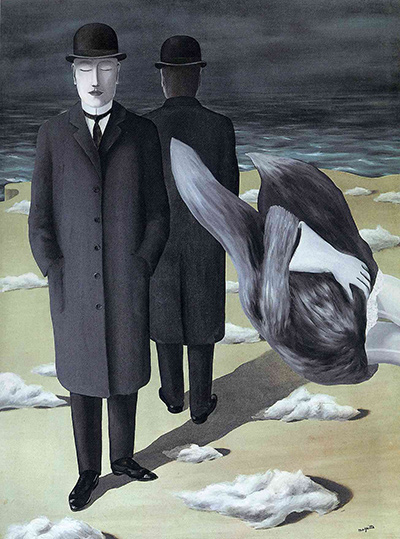
Two men in bowler hats stand close together on a beach in René Magritte’s The Meaning of Night. One faces us with his hands in his coat pockets. The other presents his back and appears to look towards the sea. Pale clumps are scattered at their feet, and a large, dark, hairy-looking form occupies the sand beside them. An illuminated hand rests against that form. The men’s clothes would be easy to place on a city street. Here the beach is nearly empty, and their proximity tells us very little about what has brought either of them there.
The Menil Collection in Houston records Le Sens de la nuit as a 1927 oil on canvas measuring 138.4 by 105.4 centimetres. The exhibition checklist for Magritte: The Mystery of the Ordinary, 1926–1938 places its making in Brussels and lists it as number 136 in the catalogue raisonné. The Menil included the painting in its presentation of the exhibition in 2014. [1] [2]
At a Glance
- Original titleLe Sens de la nuit
- Date and placeBrussels, 1927
- MediumOil on canvas
- Size138.4 × 105.4 cm
- CollectionThe Menil Collection, Houston, 1979-34 DJ
- Catalogue numberSylvester I 136
Selected works
Two men in the same clothes
The nearer man’s hat breaks the line of the horizon. Its rim gives his face a distinct upper border, and the light below it picks out his nose and cheeks. His eyes appear lowered or closed. His elbows are slightly out from his sides where his hands go into his pockets, giving his figure a breadth that carries down almost to the ground. A line of buttons gives us a way to follow the coat from his chest towards its hem. His stance looks settled enough for him to have been there for some time.
The second man is visible just to the right. His matching hat and dark coat initially make him seem like another view of the same figure. Magritte exposes enough of the back of the coat to make the turn convincing, while the front figure conceals part of his outline. The distance between them is difficult to measure. We can tell which one overlaps the other and which way each is facing. There is much less to help us decide whether their backs are almost touching or whether there is a step of sand between them.
Their positions make it possible to look from one to the other as if turning a figure around. The man who shows his face offers very little expression, and the man who turns away takes his expression entirely out of sight. Each has a recognisable posture and almost the same uniform of street clothes. That resemblance makes the small differences in silhouette, the direction of the hat brims and the fall of the cloth matter all the more. The repetition is easy to grasp. The relation between the men stays open.
The beach and the hand
The shallows and horizon lead the eye laterally across a painting dominated by upright figures. Close to the shore, dark and light bands in the water pull away from that steady line, introducing a variation that continues in the pale objects on the sand. Those clumps resemble foam or irregular stones. Their soft margins are especially noticeable near the men’s coats, where the paint describes seams, buttons and folds with a different kind of precision.
Watch: Understanding Magritte
Three complementary films introduce the artist, explore words and images, and examine a painting’s materials. These are broader Magritte comparisons, alongside the work discussed here.
René Magritte: Great Art Explained
An introduction to Magritte’s life, characteristic images and visual puzzles.
Watch on YouTubeThe dark form at the right has a curved outline and a surface that looks furry or fibrous in places. A pale hand stretches across it. The fingers are small enough to miss on a first look, and their position gives the curve beneath them something like the shape of a body. Following the hand back towards the dark coat gives us a plausible connection with one of the men, while the overlap of dark surfaces makes it hard to follow that connection all the way. The hand can look like the simplest gesture in the scene and the hardest to account for.
An angular shadow reaches across the sand in the foreground. Its edge is relatively firm against the light ground. Between that edge and the shadowed coats there are enough consistent cues to imagine a place with depth, even as local details make the space harder to read. The lit face, the pale clumps and the hand occupy different parts of the picture. Looking at them in turn carries the eye from the men down to the beach and back towards the middle. None of those points of light discloses a clear source for the scene’s illumination.
Night in the title
The title makes it tempting to take the dark water and the sombre clothes as evidence that we are seeing the beach after sunset. The pinkish sand and the brightness of the face and hand give the foreground a more exposed quality. Magritte has left enough visibility for us to study the scene closely, including details we might expect darkness to conceal. The painting gives us very little information about the time of night, and there is no clock, lamp or visible moon to settle the question. The phrase The Meaning of Night sends us back to the picture looking for connections that a description of the setting alone would leave untouched.
The exhibition catalogue sets the work beside Max Ernst’s Pietà or Revolution by Night of 1923. Its authors draw attention to Magritte’s muted colour and apparently straightforward space, and to the way the doubling turns the bowler-hatted figure into something strange. Their comparison also helps explain why this early pairing is worth looking at on its own terms. The two hats and coats make the men seem thoroughly at home in the ordinary world. When the eye tries to account for why the same figure seems to be facing in two directions, the ordinary details give the question its force. [3]
In the same catalogue, the picture faces Magritte’s 1927 The Menaced Assassin. That painting gives its figures a room, doors and objects to gather around. The Meaning of Night has an open shore and two men close enough to obscure parts of each other. The horizon suggests that one can see a long way, though the most puzzling thing is within reach of the men. Coming back to the painting after looking at the other canvas, the small gesture of the hand stands out against all the surrounding space. [3]
Magritte artworks directory
| Name | Date | Medium |
|---|---|---|
| Memory of a Voyage | 1963 | Oil on canvas |
| The Blood of the World | 1927; also catalogued as 1926–27 | Oil on canvas |
| The Hunters at the Edge of Night | Paris, 1928 | Oil on canvas |
| The Empty Picture Frame (La saignée) | 1938–39 | Gouache on paper |
| The Glass House | 1939 | Gouache on paper |
| Oasis | 1926 in the illustrated Christie’s catalogue | Oil on canvas |
| Natural Encounters | 1945 | Oil on canvas |
| Attempting the Impossible | 1928 | Oil on canvas |
| On the Threshold of Liberty | 1930 | Oil on canvas |
| The Titanic Days | 1928 | Oil on canvas |
| The Voice of Space | 1931 | Oil on canvas |
| Unexpected Answer | 1932 in the museum catalogue, 1933 on the reverse | Oil on canvas |
| Elective Affinities | 1932 in MoMA’s checklist, also published as 1933 | Oil on canvas |
| The Human Condition II | 1935 | Oil on canvas |
| The Six Elements | 1929 | Oil on canvas |
| The Happy Donor | 1966 | Oil on canvas |
| Clairvoyance (Self Portrait) | Brussels, 1936 | Oil on canvas |
| Philosopher’s Lamp | 1936 | Oil on canvas |
| The Annunciation | Paris, 1930 | Oil on canvas |
| The Lost Jockey | Circa 1942 in the illustrated lot catalogue | Gouache on paper laid down on canvas |
| Homage to Mack Sennett | 1936 in the Thyssen catalogue | Oil on canvas |
| Discovery | 1927 | Oil on canvas |
| Collective Invention | 1935 in the later catalogue index | Oil on canvas |
| The Wonders of Nature | 1953 | Oil on canvas |
| The Balcony | Circa 1950, with 1950 inscribed on the reverse | Oil on canvas |
| The Pilgrim | 1966 | Oil on canvas |
| The Invention of Life | 1928 | Oil on canvas |
| The Therapist | 1941 | Gouache on paper |
| The Gradation of Fire | 1938 or 1939 in the catalogue index | Gouache on paper |
| A Friend of Order | 1964 | Oil on canvas |
| The Poetic World | 1939 in Hammacher’s illustrated monograph | Gouache |
| The Muscles of the Sky | Paris, 1927 | Oil on canvas |
| The Battle of the Argonne | 1959 | Oil on canvas |
| Meditation | 1936 | Oil on canvas |
| The Domain of Arnheim | 1962 | Oil on canvas |
| This Is Not an Apple | 1964 | Oil on Unilite |
| The Meaning of Night | Brussels, 1927 | Oil on canvas |
| The Pleasure Principle (Portrait of Edward James) | 1937 | Oil on canvas |
| Ready Made Bouquet | 1957 | Oil on canvas |
| Popular Panorama | 1926 | Oil on canvas |
| Memory of a Journey | 1955 in the Thyssen catalogue. Tentatively 1958 in the catalogue index. | Gouache on paper, as exhibited at the Thyssen |
| Sheherazade | 1947 | Gouache on paper |
| The Difficult Crossing | 1926 | Oil on canvas |
| The Fair Captive | 1948 in the catalogue raisonné | Oil on canvas |
| The Birth of the Idol | 1926 | Oil on canvas |
| Hegel’s Holiday | 1958 | Oil on canvas |
| Homesickness | 1941 | Oil on canvas |
| The Rape (Le Viol) | 1934 | Oil on canvas |
| The Art of Living | 1967 | Oil on canvas |
| Secret Life IV | 1928 | Oil on canvas |
| The Tomb of the Wrestlers | 1960 | Oil on canvas |
| Young Girl Eating a Bird (The Pleasure) | 1927 | Oil on canvas |
| The Central Story | 1928 | Oil on canvas |
| The Seducer | 1953 | Oil on canvas |
| The Telescope | 1963 | Oil on canvas |
| The Banquet | 1958 | Oil on canvas |
| The Empty Mask | 1928 | Oil on canvas |
| The Cultivation of Ideas | 1927 | Oil on canvas |
| The Enchanted Pose | 1927 | Oil on canvas |
| The Future of Statues | 1937 | Oil on plaster |
| The Return of the Flame | 1943 | Oil on canvas |
| The White Page | 1967 | Oil on canvas |
| The Large Family | 1963 | Oil on canvas |
| Black Magic | 1945 | Oil on canvas |
| Les Amants I | 1928 | Oil on canvas |
| Man in a Bowler Hat | 1964 | Oil on canvas |
| The Portrait | 1935 | Oil on canvas |
| The Sixteenth of September | 1956 | Oil on canvas |
| Heartstrings | 1960 | Oil on canvas |
| The Present | 1939; also dated 1938 or 1939 | Gouache on paper |
| Act of Violence | 1932 | Oil on canvas |
| Fashionable People | 1950, in the 2016 thesis caption | Medium unconfirmed · Attribution follows the published caption |
| The Representation | 1962 | Oil on canvas |
| Memory | 1948 | Gouache on paper |
| The Mysteries of the Horizon | 1955 | Oil on canvas |
| Portrait of Stephy Langui | 1961 | Oil on canvas |
| The Double Secret | 1927 | Oil on canvas |
| Every Day | 1966 | Oil on canvas |
| The Invisible World | 1954 | Oil on canvas |
| Dawn of Cayenne | 1926 | Oil painting |
| Clear Ideas | 1955 (inscribed); possible 1958 execution | Oil on canvas |
| The Face of Genius | 1926 / 1927 | Oil on canvas |
| Good Faith | 1965; earlier record 1964–65 | Oil on canvas |
| The Flash | 1959 | Gouache and pencil on paper |
| Perpetual Motion | 1935; earlier catalogue 1934 | Oil on canvas |
| Personal Values | 1952 | Oil on canvas |
| Not to Be Reproduced | 1937 | Oil on canvas |
| The Red Model | 1935 | Oil on canvas |
| The Menaced Assassin | 1927 | Oil on canvas |
| The Castle of the Pyrenees | 1959 | Oil on canvas |
| The Blank Signature | 1965 | Oil on canvas |
| The Listening Room | 1952 | Oil on canvas |
| Golconde | 1953 | Oil on canvas |
| Time Transfixed | 1938 | Oil on canvas |
| The Treachery of Images | 1929 | Oil on canvas |
| The False Mirror | 1929 | Oil on canvas |
| The Empire of Light | 1953–54 | Oil on canvas |
| The Human Condition | 1933 | Oil on canvas |
| Les Amants | 1928 | Oil on canvas |
| The Son of Man | 1964 | Oil on canvas |
Frequently Asked Questions
The painting belongs to the Menil Collection in Houston.
One man faces us and the other turns towards the sea.
Discussion
Look closely and compare your reading with others.
Reader Insights
Where do the men’s coats make it easiest to distinguish one figure from the other?
What do the pale clumps on the ground suggest about the edge of the water?
How does the hand affect your reading of the dark form?
Join the Conversation
Share a detail, comparison or question about The Meaning of Night below.
References
- The Menil Collection. The Meaning of Night (Le sens de la nuit). Collection record, 1979-34 DJ. View source.
- The Museum of Modern Art. Magritte: The Mystery of the Ordinary, 1926–1938. Exhibition checklist, p. 2. View source.
- Anne Umland, Stephanie D’Alessandro and Josef Helfenstein. Magritte: The Mystery of the Ordinary, 1926–1938. The Museum of Modern Art, 2013, pp. 18–19, 48–49. View source.







