


 by Tom Gurney
Tom Gurney BSc (Hons) is an art history expert with over 20 years experience
Page created on / Page updated on
Email: tomgurney1@gmail.com / Phone: +44 7429 011000
Unexpected Answer
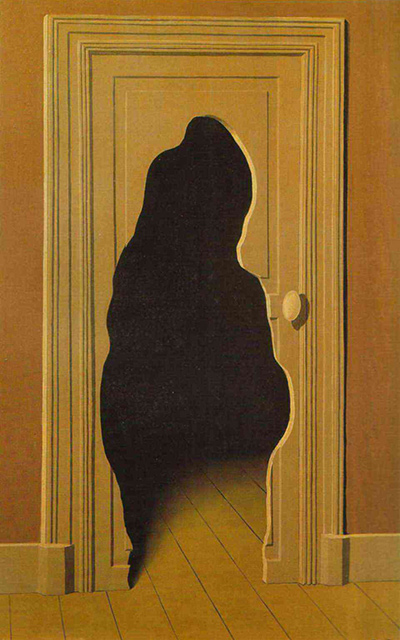
A closed door stands straight ahead in René Magritte’s Unexpected Answer. Its round knob is still in place and the moulding fits against the wall. A large, irregular opening runs from well above the knob to the floor. Through it we can see the floorboards continue into darkness. The door has stayed in the position that normally blocks the way, yet most of the space we need to pass through it is already open.
The Royal Museums of Fine Arts of Belgium hold this oil on canvas under the title La réponse imprévue, inventory 7241. The canvas measures 82 by 54.4 centimetres. The museum’s online record dates it to 1932 and transcribes the title with the year 1933 on the reverse. Its 1968 bulletin also reproduced the work with the date 1933. These dates refer to the same pictured canvas. The museum records its acquisition in Brussels in 1966. [1] [2]
At a Glance
- Original titleLa réponse imprévue
- Date1932 in the museum catalogue, 1933 on the reverse
- MediumOil on canvas
- Size82 × 54.4 cm
- CollectionRoyal Museums of Fine Arts of Belgium, 7241
Selected works
The Titanic Days
1928Unexpected Answer
1932 in the museum catalogue, 1933 on the reverseElective Affinities
1932 in MoMA’s checklist, also published as 1933Contents
A door that stays closed
The upright frame nearly fills the canvas. Several narrow lines run around it, catching the light along one side and leaving a dark edge along another. The repetition gives the doorway a clear depth. It also makes the borders of the door easy to follow. We can see where its flat face meets the frame and where an inset panel sits within the broader rectangle. Those details make the door seem familiar before the opening changes what we expect it to do.
The knob is especially important. Set to the right of the dark shape, it projects enough to catch light and cast a small shadow. The surviving material around it makes clear that we are looking at the door itself. We can imagine reaching for the knob and swinging the door on its hinges. The much larger passage just beside it makes that ordinary action redundant. Magritte leaves both possibilities in view, with the usual means of opening a door still attached to a door that can already be crossed.
At the top, some of the rectangular panel survives around the rounded tip of the opening. Farther down, the hole widens to one side and then to the other. In places a thin light edge separates the door’s face from the darkness beyond. It suggests the thickness of the material at the cut. That small change of tone matters because the dark shape could otherwise look like something flat painted onto the panel. The illuminated edge begins to turn it into an opening, and the floorboards below carry that reading farther.
The door’s rectangular structure survives mainly at the edges. The upper panel retains much of its top line, and the vertical strip beside the knob continues almost the whole height of the opening. On the left, the dark shape comes much closer to the frame. This uneven distribution keeps the object recognisable while making the passage look large enough to use. It also matters that the painted wall remains intact beyond the moulding. We can see where a conventional doorway ends and where this particular breach has been made.
Watch: Understanding Magritte
Three complementary films introduce the artist, explore words and images, and examine a painting’s materials. These are broader Magritte comparisons, alongside the work discussed here.
René Magritte: Great Art Explained
An introduction to Magritte’s life, characteristic images and visual puzzles.
Watch on YouTubeFollowing the floor through the opening
At the bottom of the picture, the boards give us a set of lines that run away from where we stand. Some reach across the place where the door would normally close. They remain visible for a short distance beyond its face, then fade into the dark. There is no step up or down and no obvious break in the direction of the boards. The change is in how much light reaches the surface.
That continuity gives the opening a convincing depth without showing us the space beyond it. Above floor level, darkness hides almost everything that might tell us where we would arrive. There is enough visible ground to imagine taking a step through. Beyond that first step we have very little to go on. Magritte lets one familiar part of the room continue into an area that otherwise offers few clues about its size or shape.
The outline can recall a person standing in the doorway. It narrows at the top and broadens below, with an uneven profile that the eye can read as a head and body. The boards remain visible through the lower part of the shape. Looking down at them makes it easier to read the dark area as open space. Looking back up towards the rounded tip makes the suggestion of a figure return. The opening can carry both impressions because the same edge describes the missing wood and sketches a possible silhouette.
What problem does a door pose?
The museum’s 1968 bulletin cites Magritte’s account in La ligne de vie, published in Combat in December 1938. He recalled treating the door as a problem that called for a hole one could pass through. He described a closed door in a room with an irregular opening that reveals the night. In that account, the shape has a practical consequence. The door’s normal purpose can be fulfilled without moving the door itself. The detail about night also helps explain why the floor can continue while whatever lies beyond it stays out of sight. [2]
The title leaves room for the experience of first encountering the picture. The fitted frame and visible knob invite us to decide whether the door is open or closed. The gap gives a different answer from the wood and the hardware. Because the painting is nearly frontal, the conflict stays visible from one position. The door can be read as a fitted object with a distinct face, and the floor through it can be read as a route. The plain wall at either side gives us little reason to look away from that particular meeting.
The Royal Museums later included the painting in their Dalí & Magritte visitor guide in a section on the relation between the interior and what lies beyond it. That pairing of ideas is visible in the floor alone. The boards put us inside a room and establish a direction past its boundary. The darkness stops us from seeing where that direction ends. Standing before the painting, we can see both the obstruction and the start of a way through it. The answer makes the doorway possible while leaving the destination open. [3]
Magritte artworks directory
| Name | Date | Medium |
|---|---|---|
| Memory of a Voyage | 1963 | Oil on canvas |
| The Blood of the World | 1927; also catalogued as 1926–27 | Oil on canvas |
| The Hunters at the Edge of Night | Paris, 1928 | Oil on canvas |
| The Empty Picture Frame (La saignée) | 1938–39 | Gouache on paper |
| The Glass House | 1939 | Gouache on paper |
| Oasis | 1926 in the illustrated Christie’s catalogue | Oil on canvas |
| Natural Encounters | 1945 | Oil on canvas |
| Attempting the Impossible | 1928 | Oil on canvas |
| On the Threshold of Liberty | 1930 | Oil on canvas |
| The Titanic Days | 1928 | Oil on canvas |
| The Voice of Space | 1931 | Oil on canvas |
| Unexpected Answer | 1932 in the museum catalogue, 1933 on the reverse | Oil on canvas |
| Elective Affinities | 1932 in MoMA’s checklist, also published as 1933 | Oil on canvas |
| The Human Condition II | 1935 | Oil on canvas |
| The Six Elements | 1929 | Oil on canvas |
| The Happy Donor | 1966 | Oil on canvas |
| Clairvoyance (Self Portrait) | Brussels, 1936 | Oil on canvas |
| Philosopher’s Lamp | 1936 | Oil on canvas |
| The Annunciation | Paris, 1930 | Oil on canvas |
| The Lost Jockey | Circa 1942 in the illustrated lot catalogue | Gouache on paper laid down on canvas |
| Homage to Mack Sennett | 1936 in the Thyssen catalogue | Oil on canvas |
| Discovery | 1927 | Oil on canvas |
| Collective Invention | 1935 in the later catalogue index | Oil on canvas |
| The Wonders of Nature | 1953 | Oil on canvas |
| The Balcony | Circa 1950, with 1950 inscribed on the reverse | Oil on canvas |
| The Pilgrim | 1966 | Oil on canvas |
| The Invention of Life | 1928 | Oil on canvas |
| The Therapist | 1941 | Gouache on paper |
| The Gradation of Fire | 1938 or 1939 in the catalogue index | Gouache on paper |
| A Friend of Order | 1964 | Oil on canvas |
| The Poetic World | 1939 in Hammacher’s illustrated monograph | Gouache |
| The Muscles of the Sky | Paris, 1927 | Oil on canvas |
| The Battle of the Argonne | 1959 | Oil on canvas |
| Meditation | 1936 | Oil on canvas |
| The Domain of Arnheim | 1962 | Oil on canvas |
| This Is Not an Apple | 1964 | Oil on Unilite |
| The Meaning of Night | Brussels, 1927 | Oil on canvas |
| The Pleasure Principle (Portrait of Edward James) | 1937 | Oil on canvas |
| Ready Made Bouquet | 1957 | Oil on canvas |
| Popular Panorama | 1926 | Oil on canvas |
| Memory of a Journey | 1955 in the Thyssen catalogue. Tentatively 1958 in the catalogue index. | Gouache on paper, as exhibited at the Thyssen |
| Sheherazade | 1947 | Gouache on paper |
| The Difficult Crossing | 1926 | Oil on canvas |
| The Fair Captive | 1948 in the catalogue raisonné | Oil on canvas |
| The Birth of the Idol | 1926 | Oil on canvas |
| Hegel’s Holiday | 1958 | Oil on canvas |
| Homesickness | 1941 | Oil on canvas |
| The Rape (Le Viol) | 1934 | Oil on canvas |
| The Art of Living | 1967 | Oil on canvas |
| Secret Life IV | 1928 | Oil on canvas |
| The Tomb of the Wrestlers | 1960 | Oil on canvas |
| Young Girl Eating a Bird (The Pleasure) | 1927 | Oil on canvas |
| The Central Story | 1928 | Oil on canvas |
| The Seducer | 1953 | Oil on canvas |
| The Telescope | 1963 | Oil on canvas |
| The Banquet | 1958 | Oil on canvas |
| The Empty Mask | 1928 | Oil on canvas |
| The Cultivation of Ideas | 1927 | Oil on canvas |
| The Enchanted Pose | 1927 | Oil on canvas |
| The Future of Statues | 1937 | Oil on plaster |
| The Return of the Flame | 1943 | Oil on canvas |
| The White Page | 1967 | Oil on canvas |
| The Large Family | 1963 | Oil on canvas |
| Black Magic | 1945 | Oil on canvas |
| Les Amants I | 1928 | Oil on canvas |
| Man in a Bowler Hat | 1964 | Oil on canvas |
| The Portrait | 1935 | Oil on canvas |
| The Sixteenth of September | 1956 | Oil on canvas |
| Heartstrings | 1960 | Oil on canvas |
| The Present | 1939; also dated 1938 or 1939 | Gouache on paper |
| Act of Violence | 1932 | Oil on canvas |
| Fashionable People | 1950, in the 2016 thesis caption | Medium unconfirmed · Attribution follows the published caption |
| The Representation | 1962 | Oil on canvas |
| Memory | 1948 | Gouache on paper |
| The Mysteries of the Horizon | 1955 | Oil on canvas |
| Portrait of Stephy Langui | 1961 | Oil on canvas |
| The Double Secret | 1927 | Oil on canvas |
| Every Day | 1966 | Oil on canvas |
| The Invisible World | 1954 | Oil on canvas |
| Dawn of Cayenne | 1926 | Oil painting |
| Clear Ideas | 1955 (inscribed); possible 1958 execution | Oil on canvas |
| The Face of Genius | 1926 / 1927 | Oil on canvas |
| Good Faith | 1965; earlier record 1964–65 | Oil on canvas |
| The Flash | 1959 | Gouache and pencil on paper |
| Perpetual Motion | 1935; earlier catalogue 1934 | Oil on canvas |
| Personal Values | 1952 | Oil on canvas |
| Not to Be Reproduced | 1937 | Oil on canvas |
| The Red Model | 1935 | Oil on canvas |
| The Menaced Assassin | 1927 | Oil on canvas |
| The Castle of the Pyrenees | 1959 | Oil on canvas |
| The Blank Signature | 1965 | Oil on canvas |
| The Listening Room | 1952 | Oil on canvas |
| Golconde | 1953 | Oil on canvas |
| Time Transfixed | 1938 | Oil on canvas |
| The Treachery of Images | 1929 | Oil on canvas |
| The False Mirror | 1929 | Oil on canvas |
| The Empire of Light | 1953–54 | Oil on canvas |
| The Human Condition | 1933 | Oil on canvas |
| Les Amants | 1928 | Oil on canvas |
| The Son of Man | 1964 | Oil on canvas |
Frequently Asked Questions
The Royal Museums’ French collection record dates it to 1932 and transcribes a 1933 inscription on the reverse.
It remains shut, but an irregular opening allows the floorboards to continue into the darkness beyond.
Discussion
Look closely and compare your reading with others.
Reader Insights
Which part of the door first makes the dark shape look like an opening?
What do the floorboards tell you about the space on the other side?
Where does your reading change if you follow the shape from top to bottom?
Join the Conversation
Share a detail, comparison or question about Unexpected Answer below.
References
- Royal Museums of Fine Arts of Belgium. La réponse imprévue. French collection record, inventory 7241. View source.
- Royal Museums of Fine Arts of Belgium. Bulletin, 1968, nos. 1–2, p. 72 and note 33. View source.
- Royal Museums of Fine Arts of Belgium. Dalí & Magritte. French visitor guide, “Dedans × au-delà”. View source.







