



Portrait of Stephy Langui
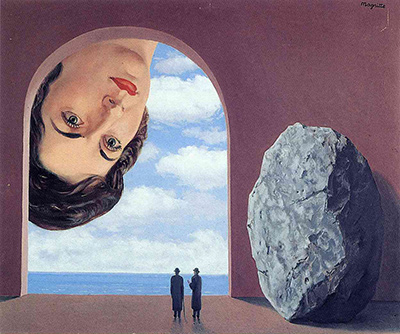
An immense woman's face hangs upside down within an arched opening. Beneath it, two small figures stand upright before a strip of sea. A large grey rock occupies the space at the right, while the reddish wall defines an interior that seems to contain several incompatible scales. The image gives us a portrait and a view, but no single position from which both become ordinary.
René Magritte painted this work in 1961. The catalogue record, transcribed by MagritteDB as Sylvester III 939, describes an oil on canvas measuring 50 × 60 centimetres. Its title is supplied in the catalogue as Portrait of Stéphy Langui. L'aparté's educational dossier reproduces the same composition under the French title Portrait de Stephy Langui. [1] [2]
At a Glance
Contents
A portrait turned upside down
The woman's features are carefully described: dark hair, eyes, nose and red lips remain clear despite their inversion. Recognition comes quickly, but the orientation prevents us from treating the face as a conventional head-and-shoulders portrait. It enters from above and to the left rather than rising from an upright body.
The arch cuts across the likeness. Part of the head seems to lie beyond the opening's edge, so the wall also acts as a device for cropping the face. We are given enough of the sitter's appearance to recognise a portrait, without the surrounding bodily information that would make her placement straightforward.
It is tempting to rotate the image mentally until the face becomes upright. Doing so would overturn the two small figures, the horizon and the rock. The painting makes that attempted correction local rather than universal: one part can be normalised only by making other parts less familiar.
Two figures keeping the ground
Near the lower centre, the small people establish an upright orientation. They stand close together and face the opening, with their backs towards us. Their dark clothing makes them legible against the lighter sea and sky.
Their size is crucial. In a conventional landscape, tiny figures often help us measure a broad space. Here, they also reveal how enormous the inverted head would be if all the visible forms occupied one continuous world. A portrait-sized likeness becomes overwhelming when compared with these miniature bodies.
The figures offer no dramatic gesture that explains the apparition. Their quiet stance allows them to function as observers within the painting. We look towards the face while also looking at people who occupy the scene below it, producing more than one position from which the strange arrangement can be considered.
The arch as an opening and a border
The reddish wall occupies much of the composition and defines the curve of the opening. Its broad colour contrasts with the blue beyond. This makes the arch easy to read before we have decided what relation the face bears to it.
An architectural opening ordinarily promises access to another space. Here, the distant sea and sky fulfil that promise, but the huge face interrupts it. The arch becomes both a route towards a view and a border around a likeness that does not fit the scale of that view.
Follow the curve from the left side towards the top. It encloses part of the woman's head without completing a conventional oval portrait frame. The cropped likeness and the open landscape share the same boundary. The wall seems physically substantial, yet its most important role is to control which parts of the other forms can be seen.
Watch: Understanding Magritte
Three complementary films introduce the artist, explore words and images, and examine a painting’s materials. These are broader Magritte comparisons, alongside the work discussed here.
René Magritte: Great Art Explained
An introduction to Magritte’s life, characteristic images and visual puzzles.
Watch on YouTubeSea, horizon and a measure of distance
The horizon provides a calm horizontal line near the bottom of the opening. Above it, blue sky and white clouds offer a familiar sense of outdoor space. These features help the setting remain readable even while the portrait refuses an ordinary orientation.
The small figures appear to stand before this distance. Their upright bodies and the level horizon cooperate in establishing a ground plane. That cooperation makes the inverted face feel more exceptional: the whole world has not simply been turned over.
The sky also creates a colour contrast with the woman's skin and dark hair. The portrait is sharply present against an expansive blue setting, while the water remains comparatively restrained. Depth does not disappear; it persists alongside a scale relationship that prevents us from settling comfortably into the scene.
The rock at the right
The grey rock is large enough to rival the face as a principal form. Its irregular outline and rough surface contrast with the smooth wall and carefully modelled features. Pale ridges and darker areas give it weight and a sense of uneven volume.
Unlike the head, it appears grounded. Its lower edge meets the floor, and its height can be compared directly with the tiny people nearby. This gives the composition another way of suggesting size, even though those comparisons do not resolve the enormous portrait.
The rock also blocks part of the reddish surface rather than opening onto space. On the left, the arch reveals distance and a face; on the right, the stone asserts an opaque mass. One side encourages looking through, while the other asks us to confront a surface we cannot see beyond.
Three kinds of surface
The painting brings together flesh, architecture and stone. Their textures remain distinct enough to sustain recognition: the face is smooth and detailed, the wall broad and comparatively plain, the boulder uneven and faceted. The composition's strangeness depends partly on that clarity.
If every surface dissolved into an undifferentiated dream, the differences of scale would be harder to grasp. Instead, the likeness looks like a likeness and the rock looks like a rock. Their relation creates the disturbance.
Compare the shadows and changes of tone across these surfaces. They give each object local credibility without producing a complete explanation of the scene. The viewer can accept the modelling of a cheek or the weight of the stone while remaining uncertain about how the different forms could coexist.
How this changes the portrait encounter
An ordinary portrait often invites us to meet a sitter at approximately human scale. This image distributes that encounter across incompatible positions. The face is close and inverted, the standing figures distant and upright, and the viewer remains outside the whole arrangement.
The supplied catalogue title identifies the work's portrait subject; it does not establish a story about why the face was inverted. The painting can be examined closely without inventing a personal anecdote or treating each object as a fixed biographical symbol.
A useful final comparison is between the woman's eyes and the small figures below. The eyes belong to a detailed individual likeness, while the figures give little personal information. Yet the latter provide the steadier orientation within the space. The portrait offers identity where the setting offers uncertainty, and the miniature observers offer stability where scale makes their position difficult to comprehend.
Magritte artworks directory
| Name | Date | Medium |
|---|---|---|
| Memory of a Voyage | 1963 | Oil on canvas |
| The Blood of the World | 1927; also catalogued as 1926–27 | Oil on canvas |
| The Hunters at the Edge of Night | Paris, 1928 | Oil on canvas |
| The Empty Picture Frame (La saignée) | 1938–39 | Gouache on paper |
| The Glass House | 1939 | Gouache on paper |
| Oasis | 1926 in the illustrated Christie’s catalogue | Oil on canvas |
| Natural Encounters | 1945 | Oil on canvas |
| Attempting the Impossible | 1928 | Oil on canvas |
| On the Threshold of Liberty | 1930 | Oil on canvas |
| The Titanic Days | 1928 | Oil on canvas |
| The Voice of Space | 1931 | Oil on canvas |
| Unexpected Answer | 1932 in the museum catalogue, 1933 on the reverse | Oil on canvas |
| Elective Affinities | 1932 in MoMA’s checklist, also published as 1933 | Oil on canvas |
| The Human Condition II | 1935 | Oil on canvas |
| The Six Elements | 1929 | Oil on canvas |
| The Happy Donor | 1966 | Oil on canvas |
| Clairvoyance (Self Portrait) | Brussels, 1936 | Oil on canvas |
| Philosopher’s Lamp | 1936 | Oil on canvas |
| The Annunciation | Paris, 1930 | Oil on canvas |
| The Lost Jockey | Circa 1942 in the illustrated lot catalogue | Gouache on paper laid down on canvas |
| Homage to Mack Sennett | 1936 in the Thyssen catalogue | Oil on canvas |
| Discovery | 1927 | Oil on canvas |
| Collective Invention | 1935 in the later catalogue index | Oil on canvas |
| The Wonders of Nature | 1953 | Oil on canvas |
| The Balcony | Circa 1950, with 1950 inscribed on the reverse | Oil on canvas |
| The Pilgrim | 1966 | Oil on canvas |
| The Invention of Life | 1928 | Oil on canvas |
| The Therapist | 1941 | Gouache on paper |
| The Gradation of Fire | 1938 or 1939 in the catalogue index | Gouache on paper |
| A Friend of Order | 1964 | Oil on canvas |
| The Poetic World | 1939 in Hammacher’s illustrated monograph | Gouache |
| The Muscles of the Sky | Paris, 1927 | Oil on canvas |
| The Battle of the Argonne | 1959 | Oil on canvas |
| Meditation | 1936 | Oil on canvas |
| The Domain of Arnheim | 1962 | Oil on canvas |
| This Is Not an Apple | 1964 | Oil on Unilite |
| The Meaning of Night | Brussels, 1927 | Oil on canvas |
| The Pleasure Principle (Portrait of Edward James) | 1937 | Oil on canvas |
| Ready Made Bouquet | 1957 | Oil on canvas |
| Popular Panorama | 1926 | Oil on canvas |
| Memory of a Journey | 1955 in the Thyssen catalogue. Tentatively 1958 in the catalogue index. | Gouache on paper, as exhibited at the Thyssen |
| Sheherazade | 1947 | Gouache on paper |
| The Difficult Crossing | 1926 | Oil on canvas |
| The Fair Captive | 1948 in the catalogue raisonné | Oil on canvas |
| The Birth of the Idol | 1926 | Oil on canvas |
| Hegel’s Holiday | 1958 | Oil on canvas |
| Homesickness | 1941 | Oil on canvas |
| The Rape (Le Viol) | 1934 | Oil on canvas |
| The Art of Living | 1967 | Oil on canvas |
| Secret Life IV | 1928 | Oil on canvas |
| The Tomb of the Wrestlers | 1960 | Oil on canvas |
| Young Girl Eating a Bird (The Pleasure) | 1927 | Oil on canvas |
| The Central Story | 1928 | Oil on canvas |
| The Seducer | 1953 | Oil on canvas |
| The Telescope | 1963 | Oil on canvas |
| The Banquet | 1958 | Oil on canvas |
| The Empty Mask | 1928 | Oil on canvas |
| The Cultivation of Ideas | 1927 | Oil on canvas |
| The Enchanted Pose | 1927 | Oil on canvas |
| The Future of Statues | 1937 | Oil on plaster |
| The Return of the Flame | 1943 | Oil on canvas |
| The White Page | 1967 | Oil on canvas |
| The Large Family | 1963 | Oil on canvas |
| Black Magic | 1945 | Oil on canvas |
| Les Amants I | 1928 | Oil on canvas |
| Man in a Bowler Hat | 1964 | Oil on canvas |
| The Portrait | 1935 | Oil on canvas |
| The Sixteenth of September | 1956 | Oil on canvas |
| Heartstrings | 1960 | Oil on canvas |
| The Present | 1939; also dated 1938 or 1939 | Gouache on paper |
| Act of Violence | 1932 | Oil on canvas |
| Fashionable People | 1950, in the 2016 thesis caption | Medium unconfirmed · Attribution follows the published caption |
| The Representation | 1962 | Oil on canvas |
| Memory | 1948 | Gouache on paper |
| The Mysteries of the Horizon | 1955 | Oil on canvas |
| Portrait of Stephy Langui | 1961 | Oil on canvas |
| The Double Secret | 1927 | Oil on canvas |
| Every Day | 1966 | Oil on canvas |
| The Invisible World | 1954 | Oil on canvas |
| Dawn of Cayenne | 1926 | Oil painting |
| Clear Ideas | 1955 (inscribed); possible 1958 execution | Oil on canvas |
| The Face of Genius | 1926 / 1927 | Oil on canvas |
| Good Faith | 1965; earlier record 1964–65 | Oil on canvas |
| The Flash | 1959 | Gouache and pencil on paper |
| Perpetual Motion | 1935; earlier catalogue 1934 | Oil on canvas |
| Personal Values | 1952 | Oil on canvas |
| Not to Be Reproduced | 1937 | Oil on canvas |
| The Red Model | 1935 | Oil on canvas |
| The Menaced Assassin | 1927 | Oil on canvas |
| The Castle of the Pyrenees | 1959 | Oil on canvas |
| The Blank Signature | 1965 | Oil on canvas |
| The Listening Room | 1952 | Oil on canvas |
| Golconde | 1953 | Oil on canvas |
| Time Transfixed | 1938 | Oil on canvas |
| The Treachery of Images | 1929 | Oil on canvas |
| The False Mirror | 1929 | Oil on canvas |
| The Empire of Light | 1953–54 | Oil on canvas |
| The Human Condition | 1933 | Oil on canvas |
| Les Amants | 1928 | Oil on canvas |
| The Son of Man | 1964 | Oil on canvas |
Frequently Asked Questions
Discussion
Compare the familiar objects with the spaces they appear to occupy.
Reader Insights
Which part of the picture first establishes an upright orientation for you?
How does the rock change your estimate of the tiny figures' scale?
Does the arch feel more like architecture or a border around a portrait?
Join the Conversation
Share a detail, comparison or question about Portrait of Stephy Langui below.
References
- Magritte. Toutes les œuvres, tous les thèmes, catalogue transcription, analyses of titles, page 22: entry 1055, Sylvester III 939, p. 354; supplied title, date, medium and dimensions. View source.Splash image: Portrait of Stephy Langui, 1961. Oil on canvas, 50 × 60 cm. Sylvester III 939; title supplied in the catalogue.
- L'aparté, Montfort Communauté, Sophie Marrey, Ihcar: Voyage aux centres du multivers, educational dossier (2018), p. 6: reproduction and caption. View source.







