


 by Tom Gurney
Tom Gurney BSc (Hons) is an art history expert with over 20 years experience
Page created on / Page updated on
Email: tomgurney1@gmail.com / Phone: +44 7429 011000
The Cultivation of Ideas
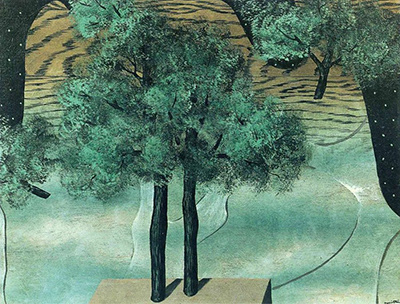
Two dark trunks rise from a rectangular block in René Magritte’s The Cultivation of Ideas. Their branches meet in a broad mass of green foliage. Behind them is a pale surface marked by sweeping lines, and above that is a band of brown with a grain like wood. Black areas at either side contain small, bright points. The trees are easy to recognise, and the space they occupy is surprisingly hard to assemble. Every time a part of the picture suggests a familiar landscape, another part gives us a different sense of its scale or substance.
The pictured La Culture des idées is the 1927 oil on canvas recorded as 50 by 65 centimetres and number 186 in volume I of the catalogue raisonné. The French motif index identifies the trees, foliage and block-like support in this composition. The title also belongs to a smaller, upright oil tentatively dated 1956 in the French index and to a gouache catalogued by Christie’s as number 1494 in volume IV. [1] [2] [3]
At a Glance
- Original titleLa Culture des idées
- Date1927
- MediumOil on canvas
- Size50 × 65 cm
- Catalogue numberSylvester I 186
Selected works
The trees and their support
The trunks begin close to each other near the lower edge of the canvas. Both are slender and dark, with small changes in direction as they rise. The left trunk has a slight bend near its base. The right one stays straighter for much of its length. The narrow interval between them is filled with the pale colour of the background. It helps keep the two trees distinct for as long as we can follow the trunks. Once the trunks reach the dense foliage, it becomes much harder to assign the branches or leaves to one tree or the other.
Small dark marks on the block extend to the right of the trunks. They suggest shadows and give a sense of contact where each trunk meets the flat top. The top is a muted brown, with very little texture compared with the crowded foliage above it. At the right a narrow side face darkens abruptly. This gives the support thickness, though the bottom of the canvas cuts it off. We see enough to understand it as a solid object with straight edges. The painting leaves open how much of it continues below the part we can see.
The trees look rooted in that flat plane, and the consistency of the shadows makes their position convincing. The block has little of the broken colour or soft outline of the ground behind it. Its edges bring to mind something cut to shape. The canopy extends well beyond it on either side. In the lower part of the picture there is just enough room for the two trunks. At the top the branches spread until they are difficult to distinguish from the foliage behind them.
A landscape of adjoining surfaces
The foliage is built up from crowded marks in many shades of green. Darker passages gather near the middle of the crown, while lighter patches help bring some of the leaves forward. A few dark branches remain visible through the smaller strokes. Other groups of leaves enter at the margins and seem to have trunks of their own. On the upper right, one such trunk slants through a warmer area. At the left, a short diagonal interrupts a cluster of foliage. These pieces encourage us to read the picture as a group of trees extending beyond the central pair.
Watch: Understanding Magritte
Three complementary films introduce the artist, explore words and images, and examine a painting’s materials. These are broader Magritte comparisons, alongside the work discussed here.
René Magritte: Great Art Explained
An introduction to Magritte’s life, characteristic images and visual puzzles.
Watch on YouTubeThe pale field behind the two trunks occupies much of the lower canvas. Green and blue vary in soft patches, and several thin lines travel across them. A large curve at the right sweeps towards the block. Narrower lines pass near the trunks, and part of one curve is lost behind them. The curves could suggest a path or the boundary of an area of ground. Their arcs are so long that they also remind us of lines drawn over a broad, flat surface. That surface has room to recede, yet its soft colouring and continuous marks make its relation to the trees hard to measure.
Towards the top, the texture changes. Dark bands spread across an ochre area in uneven lengths, giving it the appearance of a wood grain seen close up. Some lines are fine and others widen into more irregular streaks. Foliage interrupts that pattern as though the trees were standing in front of it. The grain makes the area feel tangible in a way that would be unexpected of a distant sky. The picture joins the different textures along a fairly broad passage, where the open blue-green below gives way to warm parallel marks above.
The edges and the title
Dark, curved shapes at the margins provide a second interruption. Their little pale dots recall stars even though the middle of the painting has the light and colour of a landscape we can see clearly. The brightest points are close to the outer edges and easy to overlook on a first pass. The curve on the right descends well into the pale field, where it meets a light edge. Following it down, the eye can read the darkness as something beyond the green surface or as an area that intrudes into it. Much of the ambiguity lies in that precise meeting of the two shapes.
The French motif index uses question marks for some of the forms it identifies, including the support and a possible path. Those distinctions are worth preserving when looking at the original arrangement. Trunks and leaves give us a starting point. The curves, star-like points and wood grain can each be seen clearly without settling what kind of setting contains them. The word cultivation makes the trees seem especially significant, because they appear to grow from the smallest and most regular plane in the picture. Their foliage then spreads across the boundaries we might use to put the scene in order. [1]
One can follow the painting upward from the block and find a pair of trees, or start from the upper foliage and work back down until the two trunks emerge. The view changes with that direction of attention. At their bases the trees are as distinct as the two marks they cast on the support. Seen from above those bases, they share so much of the same crown that the point where one ends and the other begins is left for the eye to decide.
Magritte artworks directory
| Name | Date | Medium |
|---|---|---|
| Memory of a Voyage | 1963 | Oil on canvas |
| The Blood of the World | 1927; also catalogued as 1926–27 | Oil on canvas |
| The Hunters at the Edge of Night | Paris, 1928 | Oil on canvas |
| The Empty Picture Frame (La saignée) | 1938–39 | Gouache on paper |
| The Glass House | 1939 | Gouache on paper |
| Oasis | 1926 in the illustrated Christie’s catalogue | Oil on canvas |
| Natural Encounters | 1945 | Oil on canvas |
| Attempting the Impossible | 1928 | Oil on canvas |
| On the Threshold of Liberty | 1930 | Oil on canvas |
| The Titanic Days | 1928 | Oil on canvas |
| The Voice of Space | 1931 | Oil on canvas |
| Unexpected Answer | 1932 in the museum catalogue, 1933 on the reverse | Oil on canvas |
| Elective Affinities | 1932 in MoMA’s checklist, also published as 1933 | Oil on canvas |
| The Human Condition II | 1935 | Oil on canvas |
| The Six Elements | 1929 | Oil on canvas |
| The Happy Donor | 1966 | Oil on canvas |
| Clairvoyance (Self Portrait) | Brussels, 1936 | Oil on canvas |
| Philosopher’s Lamp | 1936 | Oil on canvas |
| The Annunciation | Paris, 1930 | Oil on canvas |
| The Lost Jockey | Circa 1942 in the illustrated lot catalogue | Gouache on paper laid down on canvas |
| Homage to Mack Sennett | 1936 in the Thyssen catalogue | Oil on canvas |
| Discovery | 1927 | Oil on canvas |
| Collective Invention | 1935 in the later catalogue index | Oil on canvas |
| The Wonders of Nature | 1953 | Oil on canvas |
| The Balcony | Circa 1950, with 1950 inscribed on the reverse | Oil on canvas |
| The Pilgrim | 1966 | Oil on canvas |
| The Invention of Life | 1928 | Oil on canvas |
| The Therapist | 1941 | Gouache on paper |
| The Gradation of Fire | 1938 or 1939 in the catalogue index | Gouache on paper |
| A Friend of Order | 1964 | Oil on canvas |
| The Poetic World | 1939 in Hammacher’s illustrated monograph | Gouache |
| The Muscles of the Sky | Paris, 1927 | Oil on canvas |
| The Battle of the Argonne | 1959 | Oil on canvas |
| Meditation | 1936 | Oil on canvas |
| The Domain of Arnheim | 1962 | Oil on canvas |
| This Is Not an Apple | 1964 | Oil on Unilite |
| The Meaning of Night | Brussels, 1927 | Oil on canvas |
| The Pleasure Principle (Portrait of Edward James) | 1937 | Oil on canvas |
| Ready Made Bouquet | 1957 | Oil on canvas |
| Popular Panorama | 1926 | Oil on canvas |
| Memory of a Journey | 1955 in the Thyssen catalogue. Tentatively 1958 in the catalogue index. | Gouache on paper, as exhibited at the Thyssen |
| Sheherazade | 1947 | Gouache on paper |
| The Difficult Crossing | 1926 | Oil on canvas |
| The Fair Captive | 1948 in the catalogue raisonné | Oil on canvas |
| The Birth of the Idol | 1926 | Oil on canvas |
| Hegel’s Holiday | 1958 | Oil on canvas |
| Homesickness | 1941 | Oil on canvas |
| The Rape (Le Viol) | 1934 | Oil on canvas |
| The Art of Living | 1967 | Oil on canvas |
| Secret Life IV | 1928 | Oil on canvas |
| The Tomb of the Wrestlers | 1960 | Oil on canvas |
| Young Girl Eating a Bird (The Pleasure) | 1927 | Oil on canvas |
| The Central Story | 1928 | Oil on canvas |
| The Seducer | 1953 | Oil on canvas |
| The Telescope | 1963 | Oil on canvas |
| The Banquet | 1958 | Oil on canvas |
| The Empty Mask | 1928 | Oil on canvas |
| The Cultivation of Ideas | 1927 | Oil on canvas |
| The Enchanted Pose | 1927 | Oil on canvas |
| The Future of Statues | 1937 | Oil on plaster |
| The Return of the Flame | 1943 | Oil on canvas |
| The White Page | 1967 | Oil on canvas |
| The Large Family | 1963 | Oil on canvas |
| Black Magic | 1945 | Oil on canvas |
| Les Amants I | 1928 | Oil on canvas |
| Man in a Bowler Hat | 1964 | Oil on canvas |
| The Portrait | 1935 | Oil on canvas |
| The Sixteenth of September | 1956 | Oil on canvas |
| Heartstrings | 1960 | Oil on canvas |
| The Present | 1939; also dated 1938 or 1939 | Gouache on paper |
| Act of Violence | 1932 | Oil on canvas |
| Fashionable People | 1950, in the 2016 thesis caption | Medium unconfirmed · Attribution follows the published caption |
| The Representation | 1962 | Oil on canvas |
| Memory | 1948 | Gouache on paper |
| The Mysteries of the Horizon | 1955 | Oil on canvas |
| Portrait of Stephy Langui | 1961 | Oil on canvas |
| The Double Secret | 1927 | Oil on canvas |
| Every Day | 1966 | Oil on canvas |
| The Invisible World | 1954 | Oil on canvas |
| Dawn of Cayenne | 1926 | Oil painting |
| Clear Ideas | 1955 (inscribed); possible 1958 execution | Oil on canvas |
| The Face of Genius | 1926 / 1927 | Oil on canvas |
| Good Faith | 1965; earlier record 1964–65 | Oil on canvas |
| The Flash | 1959 | Gouache and pencil on paper |
| Perpetual Motion | 1935; earlier catalogue 1934 | Oil on canvas |
| Personal Values | 1952 | Oil on canvas |
| Not to Be Reproduced | 1937 | Oil on canvas |
| The Red Model | 1935 | Oil on canvas |
| The Menaced Assassin | 1927 | Oil on canvas |
| The Castle of the Pyrenees | 1959 | Oil on canvas |
| The Blank Signature | 1965 | Oil on canvas |
| The Listening Room | 1952 | Oil on canvas |
| Golconde | 1953 | Oil on canvas |
| Time Transfixed | 1938 | Oil on canvas |
| The Treachery of Images | 1929 | Oil on canvas |
| The False Mirror | 1929 | Oil on canvas |
| The Empire of Light | 1953–54 | Oil on canvas |
| The Human Condition | 1933 | Oil on canvas |
| Les Amants | 1928 | Oil on canvas |
| The Son of Man | 1964 | Oil on canvas |
Frequently Asked Questions
The horizontal 1927 oil with two dark trunks rising from a geometric support.
Discussion
Look closely and compare your reading with others.
Reader Insights
Where do the two trees start to look like one crown?
Which marks make the pale surface seem to continue behind the block?
How do the bright points at the edges change your reading of the scene?
Join the Conversation
Share a detail, comparison or question about The Cultivation of Ideas below.
References
- Magritte. Toutes les œuvres, tous les thèmes. French catalogue raisonné and motif index, vol. I, p. 248, no. 186. View source.
- Magritte. Toutes les œuvres, tous les thèmes. French catalogue raisonné title index, vol. III, p. 259, no. 839. View source.
- Christie’s. La culture des idées, gouache on paper, catalogue raisonné vol. IV, no. 1494. View source.







