


 by Tom Gurney
Tom Gurney BSc (Hons) is an art history expert with over 20 years experience
Page created on / Page updated on
Email: tomgurney1@gmail.com / Phone: +44 7429 011000
Elective Affinities
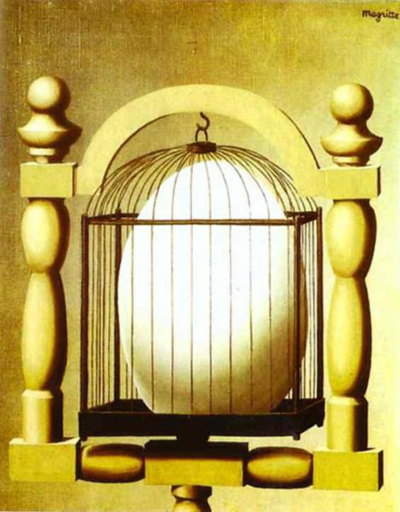
An egg nearly fills a birdcage in René Magritte’s Elective Affinities. The cage has thin bars, a curved roof and a small hook. Around it stands a heavier frame with turned posts and an arch. These familiar forms give us a way to judge the egg’s size. Its pale shell rises so close to the bars that there seems to be scarcely enough room for it inside. A bird might have room to turn or move about in such a cage. The egg occupies most of the space available to it.
The Museum of Modern Art’s exhibition checklist records the pictured oil as Les Affinités électives, Brussels, 1932, catalogue raisonné number 349. The canvas measures 41 by 33 centimetres and was listed as privately held in that exhibition. Some published accounts date the oil to 1933, including a Christie’s catalogue entry for a separate, signed 1932 work on paper with the same subject. The oil shown here carries its signature at the upper right. Christie’s records the signature and date on the paper version at the lower left. [1] [2] [3]
At a Glance
- Original titleLes Affinités électives
- Date1932 in MoMA’s checklist, also published as 1933
- MediumOil on canvas
- Size41 × 33 cm
- Catalogue numberSylvester II 349
Selected works
The Titanic Days
1928Unexpected Answer
1932 in the museum catalogue, 1933 on the reverseElective Affinities
1932 in MoMA’s checklist, also published as 1933Contents
An egg large enough to fill a cage
The pale egg catches the eye before we have made sense of its container. Its brighter side spreads across a number of bars, so the shell reads as a continuous surface despite the lines in front of it. The lower part darkens as it approaches the base. Up above, the smaller end follows the curve of the wire roof. Those two shapes fit closely enough that we can imagine the central object taking up almost all the height of the cage.
The bars are useful for seeing that scale. Each line gives us a different position at which to compare the edge of the shell with the open spaces around it. Along the sides, several thin intervals stay dark. Towards the middle the shell is visible through a much broader run of wires. The contrast makes the surface look smoother and gives the wires a sharpness of their own. Together they allow us to see how much space the egg takes up without measuring it against anything outside the frame of the picture.
The egg also changes the apparent purpose of the container. Bars keep a moving creature within sight. Here they pass in front of a form that seems entirely still. The birdcage and egg have a familiar relation through the absent bird, and that relation makes the scene intelligible as soon as we recognise the objects. The proportions change how we feel about their combination. The cage is recognisable as a place that could house a bird, while its contents seem to have been made for its full dimensions.
How the frame holds the cage
The pair of turned posts makes a broad enclosure around the narrow wires. Each post has a round finial and a set of swelling and narrowing shapes. The arch across them repeats the curve of the cage roof at a greater distance from the egg. We are looking at one curved form inside another and both inside a heavier structure. The weight suggested by the posts helps give the thin bars an appearance of delicacy, even though they hold a form that seems very large.
Watch: Understanding Magritte
Three complementary films introduce the artist, explore words and images, and examine a painting’s materials. These are broader Magritte comparisons, alongside the work discussed here.
René Magritte: Great Art Explained
An introduction to Magritte’s life, characteristic images and visual puzzles.
Watch on YouTubeWhat holds the cage itself in place is harder to determine. MoMA curator Anne Umland points out that its upper left corner comes forward of the outer structure, while the lower left appears tucked behind it. A hook hangs above the cage and a support is visible beneath it. Each feature makes sense when we look at it on its own. Following the frame around the whole cage brings together several clues to support and position that are difficult to reconcile. [2]
Those small inconsistencies affect the way we see the central egg. The carefully drawn wires encourage us to believe that the shell is inside them. The relationship between the wires and the larger frame is less stable. We can be fairly sure which object the bars enclose without being equally sure how the enclosure occupies the space around it. Much of the picture’s effect comes from that uneven distribution of certainty. The shell is easy to follow across the lit centre, while the darker assemblies at the top and bottom require more attention.
Look at the intervals between the outer posts and the two sides of the cage. These strips of background allow us to distinguish the wood from the metal without deciding exactly how they join. At the base, those intervals close again into a single band of closely packed shapes. The light falls on the rounded wooden parts much as it does on the shell, while the wires stay dark and thin across both. That difference helps us keep track of which line belongs to each object when their borders come close together.
Magritte’s account of the image
Magritte later recalled waking in a room where a bird was asleep in its cage. In the moment of waking, he had the impression that the bird had been replaced by an egg. The published account treats the surprise as a discovery about related objects. A bird and an egg have an evident connection, yet finding the egg in the place of the bird could still produce a shock. MoMA retells the episode in its exhibition guide, and the Royal Museums of Fine Arts of Belgium discuss it in a 1968 bulletin citing Magritte’s La ligne de vie. The account gives a way into the combination. The dating of the pictured oil rests on the separate exhibition and catalogue records. [1] [2] [4]
Another example of Magritte describing a familiar object as a problem is Unexpected Answer. In the same bulletin, the account of a closed door with an opening through it sits near the story of the birdcage. In the door painting, the floor continues through a surface that should stop us. In Elective Affinities, the bars surround a thing we can connect to a bird before we consider how it could fit inside. The two paintings allow the mind to make an ordinary association and then leave the eye to work through its physical consequences. Here the dark wires on the shell keep bringing us back to the precise size of the object Magritte asks us to imagine in the cage. [4]
Magritte artworks directory
| Name | Date | Medium |
|---|---|---|
| Memory of a Voyage | 1963 | Oil on canvas |
| The Blood of the World | 1927; also catalogued as 1926–27 | Oil on canvas |
| The Hunters at the Edge of Night | Paris, 1928 | Oil on canvas |
| The Empty Picture Frame (La saignée) | 1938–39 | Gouache on paper |
| The Glass House | 1939 | Gouache on paper |
| Oasis | 1926 in the illustrated Christie’s catalogue | Oil on canvas |
| Natural Encounters | 1945 | Oil on canvas |
| Attempting the Impossible | 1928 | Oil on canvas |
| On the Threshold of Liberty | 1930 | Oil on canvas |
| The Titanic Days | 1928 | Oil on canvas |
| The Voice of Space | 1931 | Oil on canvas |
| Unexpected Answer | 1932 in the museum catalogue, 1933 on the reverse | Oil on canvas |
| Elective Affinities | 1932 in MoMA’s checklist, also published as 1933 | Oil on canvas |
| The Human Condition II | 1935 | Oil on canvas |
| The Six Elements | 1929 | Oil on canvas |
| The Happy Donor | 1966 | Oil on canvas |
| Clairvoyance (Self Portrait) | Brussels, 1936 | Oil on canvas |
| Philosopher’s Lamp | 1936 | Oil on canvas |
| The Annunciation | Paris, 1930 | Oil on canvas |
| The Lost Jockey | Circa 1942 in the illustrated lot catalogue | Gouache on paper laid down on canvas |
| Homage to Mack Sennett | 1936 in the Thyssen catalogue | Oil on canvas |
| Discovery | 1927 | Oil on canvas |
| Collective Invention | 1935 in the later catalogue index | Oil on canvas |
| The Wonders of Nature | 1953 | Oil on canvas |
| The Balcony | Circa 1950, with 1950 inscribed on the reverse | Oil on canvas |
| The Pilgrim | 1966 | Oil on canvas |
| The Invention of Life | 1928 | Oil on canvas |
| The Therapist | 1941 | Gouache on paper |
| The Gradation of Fire | 1938 or 1939 in the catalogue index | Gouache on paper |
| A Friend of Order | 1964 | Oil on canvas |
| The Poetic World | 1939 in Hammacher’s illustrated monograph | Gouache |
| The Muscles of the Sky | Paris, 1927 | Oil on canvas |
| The Battle of the Argonne | 1959 | Oil on canvas |
| Meditation | 1936 | Oil on canvas |
| The Domain of Arnheim | 1962 | Oil on canvas |
| This Is Not an Apple | 1964 | Oil on Unilite |
| The Meaning of Night | Brussels, 1927 | Oil on canvas |
| The Pleasure Principle (Portrait of Edward James) | 1937 | Oil on canvas |
| Ready Made Bouquet | 1957 | Oil on canvas |
| Popular Panorama | 1926 | Oil on canvas |
| Memory of a Journey | 1955 in the Thyssen catalogue. Tentatively 1958 in the catalogue index. | Gouache on paper, as exhibited at the Thyssen |
| Sheherazade | 1947 | Gouache on paper |
| The Difficult Crossing | 1926 | Oil on canvas |
| The Fair Captive | 1948 in the catalogue raisonné | Oil on canvas |
| The Birth of the Idol | 1926 | Oil on canvas |
| Hegel’s Holiday | 1958 | Oil on canvas |
| Homesickness | 1941 | Oil on canvas |
| The Rape (Le Viol) | 1934 | Oil on canvas |
| The Art of Living | 1967 | Oil on canvas |
| Secret Life IV | 1928 | Oil on canvas |
| The Tomb of the Wrestlers | 1960 | Oil on canvas |
| Young Girl Eating a Bird (The Pleasure) | 1927 | Oil on canvas |
| The Central Story | 1928 | Oil on canvas |
| The Seducer | 1953 | Oil on canvas |
| The Telescope | 1963 | Oil on canvas |
| The Banquet | 1958 | Oil on canvas |
| The Empty Mask | 1928 | Oil on canvas |
| The Cultivation of Ideas | 1927 | Oil on canvas |
| The Enchanted Pose | 1927 | Oil on canvas |
| The Future of Statues | 1937 | Oil on plaster |
| The Return of the Flame | 1943 | Oil on canvas |
| The White Page | 1967 | Oil on canvas |
| The Large Family | 1963 | Oil on canvas |
| Black Magic | 1945 | Oil on canvas |
| Les Amants I | 1928 | Oil on canvas |
| Man in a Bowler Hat | 1964 | Oil on canvas |
| The Portrait | 1935 | Oil on canvas |
| The Sixteenth of September | 1956 | Oil on canvas |
| Heartstrings | 1960 | Oil on canvas |
| The Present | 1939; also dated 1938 or 1939 | Gouache on paper |
| Act of Violence | 1932 | Oil on canvas |
| Fashionable People | 1950, in the 2016 thesis caption | Medium unconfirmed · Attribution follows the published caption |
| The Representation | 1962 | Oil on canvas |
| Memory | 1948 | Gouache on paper |
| The Mysteries of the Horizon | 1955 | Oil on canvas |
| Portrait of Stephy Langui | 1961 | Oil on canvas |
| The Double Secret | 1927 | Oil on canvas |
| Every Day | 1966 | Oil on canvas |
| The Invisible World | 1954 | Oil on canvas |
| Dawn of Cayenne | 1926 | Oil painting |
| Clear Ideas | 1955 (inscribed); possible 1958 execution | Oil on canvas |
| The Face of Genius | 1926 / 1927 | Oil on canvas |
| Good Faith | 1965; earlier record 1964–65 | Oil on canvas |
| The Flash | 1959 | Gouache and pencil on paper |
| Perpetual Motion | 1935; earlier catalogue 1934 | Oil on canvas |
| Personal Values | 1952 | Oil on canvas |
| Not to Be Reproduced | 1937 | Oil on canvas |
| The Red Model | 1935 | Oil on canvas |
| The Menaced Assassin | 1927 | Oil on canvas |
| The Castle of the Pyrenees | 1959 | Oil on canvas |
| The Blank Signature | 1965 | Oil on canvas |
| The Listening Room | 1952 | Oil on canvas |
| Golconde | 1953 | Oil on canvas |
| Time Transfixed | 1938 | Oil on canvas |
| The Treachery of Images | 1929 | Oil on canvas |
| The False Mirror | 1929 | Oil on canvas |
| The Empire of Light | 1953–54 | Oil on canvas |
| The Human Condition | 1933 | Oil on canvas |
| Les Amants | 1928 | Oil on canvas |
| The Son of Man | 1964 | Oil on canvas |
Frequently Asked Questions
A pale egg nearly fills the cage. Magritte later recalled waking and having the impression that an egg had replaced the sleeping bird.
It shows the oil listed as catalogue raisonné number 349, with the signature at upper right. A separate work on paper is signed and dated 1932 at lower left.
Discussion
Look closely and compare your reading with others.
Reader Insights
Which part of the cage gives you the clearest sense of the egg’s size?
How does the cage seem to be supported if you start at the hook? How does that reading change at the bottom?
What do you notice about the painting before you learn how Magritte described the image?
Join the Conversation
Share a detail, comparison or question about Elective Affinities below.
References
- Museum of Modern Art. Magritte: The Mystery of the Ordinary, 1926–1938. Exhibition checklist, p. 13, catalogue raisonné entry 349. View source.
- Museum of Modern Art. Les Affinités électives (Elective Affinities). Exhibition audio guide, with curator Anne Umland. View source.
- Christie’s. Les affinités électives. Illustrated catalogue entry for the work on paper, lot 4856987. View source.
- Royal Museums of Fine Arts of Belgium. Bulletin, 1968, nos. 1–2, p. 72, notes 33 and 35. View source.







