


 by Tom Gurney
Tom Gurney BSc (Hons) is an art history expert with over 20 years experience
Page created on / Page updated on
Email: tomgurney1@gmail.com / Phone: +44 7429 011000
Black Magic
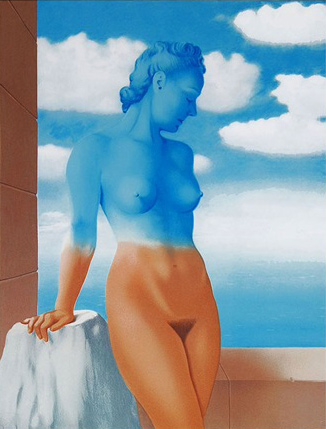
A woman rests her hand on a stone beside the sea in René Magritte’s Black Magic. Her fingers curve over the rough surface, and her head turns towards the right. The colour of her body changes from warm ochre to blue at about the height of her waist. Her shoulders and head take on the colour of the sky, with their outlines still visible against the clouds. The pose gives the figure a steady place in the foreground even as the colour makes part of her seem to belong to the distance.
The painting shown here is the 1945 La Magie noire in the Royal Museums of Fine Arts of Belgium, inventory 10706. The museums record it as an oil on canvas measuring 79 by 59 centimetres, signed at the lower right and titled and dated on the reverse. It entered their collection through Georgette Magritte’s bequest in 1987. The French catalogue index lists this version as number 587 in volume II and gives the dimensions as 80 by 60 centimetres. [1] [2]
At a Glance
- Original titleLa Magie noire
- Date1945
- MediumOil on canvas
- Catalogue numberSylvester II 587
- Size79 × 59 cm (museum record)
- CollectionRoyal Museums of Fine Arts of Belgium, 10706
Selected works
A hand on the stone
At the lower left, a single hand holds our attention where the figure touches the stone. The fingers spread in an uneven row, and the ends curve down over the outer face. The change of angle makes the contact legible. A small area of shadow gathers between the fingers, where flesh overlaps stone. Above it, the forearm narrows towards the wrist. Its outline descends past the vertical edge of the wall, making the arm easy to pick out even where its colour begins to cool farther up.
The stone has an uneven top and broad folds of light and shadow that run downwards. Its outline varies from a rounded edge beneath the hand to a sharper turn beside the figure’s leg. The flat wall at the far left has the smoother look of laid masonry. Its joints break the surface into large blocks. Both materials occupy the front of the picture, and the difference in their surfaces helps us see how near the hand is to us. The fingers are small against the mass of the stone, while the wall makes the overall scale of the figure easier to judge.
A low parapet at the right continues the warm colour of the wall. Its upper edge crosses the view below the lowest clouds, and its straight line makes a distinct boundary between the space occupied by the woman and the sea beyond. The figure overlaps that edge. The position of her hips and legs therefore remains readable even though much of the sea shares a blue with her upper body. The three foreground elements give the viewer something to return to when the colour begins to unsettle the figure’s position.
Where the blue begins
The change is particularly apparent along the waist and the relaxed arm. At the waist it forms a pale interval where the warm lower half meets the cooler upper half. On the arm the colour shifts a little farther down, so the transformation is easy to see on either side of the gap between arm and torso. The shadows across the body continue through the change. Those shadows give the eye a way to follow a curve even when the colour on either side of it suggests a different material.
Watch: Understanding Magritte
Three complementary films introduce the artist, explore words and images, and examine a painting’s materials. These are broader Magritte comparisons, alongside the work discussed here.
René Magritte: Great Art Explained
An introduction to Magritte’s life, characteristic images and visual puzzles.
Watch on YouTubeThe lowered head is seen in profile. The nose, chin and forehead form a short, clear outline against the cloud behind them. At the back of the neck, the hair gathers into a distinct shape, with blue shadows between the waves of hair. The clouds are much softer at their edges. In places their white makes the face’s outline particularly easy to read. Elsewhere the surrounding blue is close enough to the figure’s colour that the separation depends more on the shading along the body.
A broad cloud bank lies almost at the height of the change across the waist. Its lighter colour echoes the pale passage on the figure, and the arrangement makes it easy to glance from one to the other. The cloud has enough space to spread behind her and towards the right edge. The change on the body is confined to the surface of the figure. The closeness of the two effects makes the transition seem plausible for a moment, before the outline encourages us to look at the body and the air separately again.
Returning to the same transformation
Magritte had used the title La Magie noire for an oil in 1934, more than a decade before this canvas. The Thyssen exhibition catalogue reproduces that first version, where a white bird appears on the woman’s shoulder. A letter to André Breton from June 1934, cited in Christie’s account of the related painting Le Miroir universel, describes the idea as turning flesh into sky. In the Brussels oil, the transformation happens across the figure, while the hand on the stone gives that same body an explicit point of contact with the earth. [3] [4]
The visual differences are worth attending to because the title recurs in several records, including another oil from 1945. The Brussels picture has a stone at the lower left, an open view at the right and a figure who looks down. With the main forms kept distinct, the key change takes place in the colour itself. The blue follows the shape of the shoulder and head, and the warmer paint follows the hand and hips. We can trace the figure continuously across both. [1] [2]
There is a small opening between the lowered arm and the torso. The sea or sky seen there keeps its colour almost from one side of the gap to the other. The arm and the torso change colour at different heights, which makes the boundary look specific to each part of the body.
The title makes the change sound like an event. There is no particular instant that the pose requires us to imagine, and the hand seems to have been resting on the stone for some time. Attention can therefore move upwards from the weight of the hand to the colour of the face, then back down again. Each direction changes which parts of the painting feel firmly placed and which appear to open into the sky.
Magritte artworks directory
| Name | Date | Medium |
|---|---|---|
| Memory of a Voyage | 1963 | Oil on canvas |
| The Blood of the World | 1927; also catalogued as 1926–27 | Oil on canvas |
| The Hunters at the Edge of Night | Paris, 1928 | Oil on canvas |
| The Empty Picture Frame (La saignée) | 1938–39 | Gouache on paper |
| The Glass House | 1939 | Gouache on paper |
| Oasis | 1926 in the illustrated Christie’s catalogue | Oil on canvas |
| Natural Encounters | 1945 | Oil on canvas |
| Attempting the Impossible | 1928 | Oil on canvas |
| On the Threshold of Liberty | 1930 | Oil on canvas |
| The Titanic Days | 1928 | Oil on canvas |
| The Voice of Space | 1931 | Oil on canvas |
| Unexpected Answer | 1932 in the museum catalogue, 1933 on the reverse | Oil on canvas |
| Elective Affinities | 1932 in MoMA’s checklist, also published as 1933 | Oil on canvas |
| The Human Condition II | 1935 | Oil on canvas |
| The Six Elements | 1929 | Oil on canvas |
| The Happy Donor | 1966 | Oil on canvas |
| Clairvoyance (Self Portrait) | Brussels, 1936 | Oil on canvas |
| Philosopher’s Lamp | 1936 | Oil on canvas |
| The Annunciation | Paris, 1930 | Oil on canvas |
| The Lost Jockey | Circa 1942 in the illustrated lot catalogue | Gouache on paper laid down on canvas |
| Homage to Mack Sennett | 1936 in the Thyssen catalogue | Oil on canvas |
| Discovery | 1927 | Oil on canvas |
| Collective Invention | 1935 in the later catalogue index | Oil on canvas |
| The Wonders of Nature | 1953 | Oil on canvas |
| The Balcony | Circa 1950, with 1950 inscribed on the reverse | Oil on canvas |
| The Pilgrim | 1966 | Oil on canvas |
| The Invention of Life | 1928 | Oil on canvas |
| The Therapist | 1941 | Gouache on paper |
| The Gradation of Fire | 1938 or 1939 in the catalogue index | Gouache on paper |
| A Friend of Order | 1964 | Oil on canvas |
| The Poetic World | 1939 in Hammacher’s illustrated monograph | Gouache |
| The Muscles of the Sky | Paris, 1927 | Oil on canvas |
| The Battle of the Argonne | 1959 | Oil on canvas |
| Meditation | 1936 | Oil on canvas |
| The Domain of Arnheim | 1962 | Oil on canvas |
| This Is Not an Apple | 1964 | Oil on Unilite |
| The Meaning of Night | Brussels, 1927 | Oil on canvas |
| The Pleasure Principle (Portrait of Edward James) | 1937 | Oil on canvas |
| Ready Made Bouquet | 1957 | Oil on canvas |
| Popular Panorama | 1926 | Oil on canvas |
| Memory of a Journey | 1955 in the Thyssen catalogue. Tentatively 1958 in the catalogue index. | Gouache on paper, as exhibited at the Thyssen |
| Sheherazade | 1947 | Gouache on paper |
| The Difficult Crossing | 1926 | Oil on canvas |
| The Fair Captive | 1948 in the catalogue raisonné | Oil on canvas |
| The Birth of the Idol | 1926 | Oil on canvas |
| Hegel’s Holiday | 1958 | Oil on canvas |
| Homesickness | 1941 | Oil on canvas |
| The Rape (Le Viol) | 1934 | Oil on canvas |
| The Art of Living | 1967 | Oil on canvas |
| Secret Life IV | 1928 | Oil on canvas |
| The Tomb of the Wrestlers | 1960 | Oil on canvas |
| Young Girl Eating a Bird (The Pleasure) | 1927 | Oil on canvas |
| The Central Story | 1928 | Oil on canvas |
| The Seducer | 1953 | Oil on canvas |
| The Telescope | 1963 | Oil on canvas |
| The Banquet | 1958 | Oil on canvas |
| The Empty Mask | 1928 | Oil on canvas |
| The Cultivation of Ideas | 1927 | Oil on canvas |
| The Enchanted Pose | 1927 | Oil on canvas |
| The Future of Statues | 1937 | Oil on plaster |
| The Return of the Flame | 1943 | Oil on canvas |
| The White Page | 1967 | Oil on canvas |
| The Large Family | 1963 | Oil on canvas |
| Black Magic | 1945 | Oil on canvas |
| Les Amants I | 1928 | Oil on canvas |
| Man in a Bowler Hat | 1964 | Oil on canvas |
| The Portrait | 1935 | Oil on canvas |
| The Sixteenth of September | 1956 | Oil on canvas |
| Heartstrings | 1960 | Oil on canvas |
| The Present | 1939; also dated 1938 or 1939 | Gouache on paper |
| Act of Violence | 1932 | Oil on canvas |
| Fashionable People | 1950, in the 2016 thesis caption | Medium unconfirmed · Attribution follows the published caption |
| The Representation | 1962 | Oil on canvas |
| Memory | 1948 | Gouache on paper |
| The Mysteries of the Horizon | 1955 | Oil on canvas |
| Portrait of Stephy Langui | 1961 | Oil on canvas |
| The Double Secret | 1927 | Oil on canvas |
| Every Day | 1966 | Oil on canvas |
| The Invisible World | 1954 | Oil on canvas |
| Dawn of Cayenne | 1926 | Oil painting |
| Clear Ideas | 1955 (inscribed); possible 1958 execution | Oil on canvas |
| The Face of Genius | 1926 / 1927 | Oil on canvas |
| Good Faith | 1965; earlier record 1964–65 | Oil on canvas |
| The Flash | 1959 | Gouache and pencil on paper |
| Perpetual Motion | 1935; earlier catalogue 1934 | Oil on canvas |
| Personal Values | 1952 | Oil on canvas |
| Not to Be Reproduced | 1937 | Oil on canvas |
| The Red Model | 1935 | Oil on canvas |
| The Menaced Assassin | 1927 | Oil on canvas |
| The Castle of the Pyrenees | 1959 | Oil on canvas |
| The Blank Signature | 1965 | Oil on canvas |
| The Listening Room | 1952 | Oil on canvas |
| Golconde | 1953 | Oil on canvas |
| Time Transfixed | 1938 | Oil on canvas |
| The Treachery of Images | 1929 | Oil on canvas |
| The False Mirror | 1929 | Oil on canvas |
| The Empire of Light | 1953–54 | Oil on canvas |
| The Human Condition | 1933 | Oil on canvas |
| Les Amants | 1928 | Oil on canvas |
| The Son of Man | 1964 | Oil on canvas |
Frequently Asked Questions
The 1945 oil in Brussels, catalogue raisonné no. 587.
Discussion
Look closely and compare your reading with others.
Reader Insights
Which details make the hand seem to carry weight on the stone?
Where is the boundary between the blue figure and the sky most visible?
How do the wall and parapet affect the way you see the figure’s position?
Join the Conversation
Share a detail, comparison or question about Black Magic below.
References
- Royal Museums of Fine Arts of Belgium. La magie noire, collection record, inv. 10706. View source.
- Magritte. Toutes les œuvres, tous les thèmes. French catalogue raisonné index, vol. II, pp. 357 and 359, nos. 587 and 591. View source.
- Museo Nacional Thyssen-Bornemisza. La máquina Magritte, catalogue entry for the first version of La Magie noire. View source.
- Christie’s. Le miroir universel, catalogue notes on the first La Magie noire and Magritte’s letter to Breton. View source.







