


 by Tom Gurney
Tom Gurney BSc (Hons) is an art history expert with over 20 years experience
Page created on / Page updated on
Email: tomgurney1@gmail.com / Phone: +44 7429 011000
The Wonders of Nature
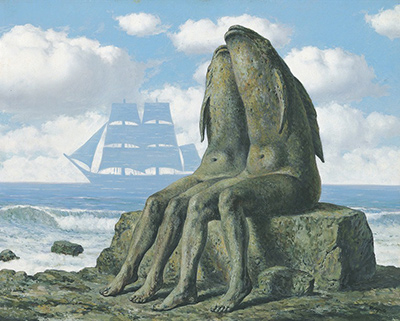
Two figures sit close together on a rock beside the sea in René Magritte’s The Wonders of Nature. Their feet rest among the stones, and their bodies rise into fish heads. Both have the mottled colour of the rock they sit on. Behind them, a sailing ship appears in pale blue against the clouds. The shore gives the figures a convincing place to sit. The shared colour of bodies and rock makes it harder to tell how separate they are from their seat.
The Museum of Contemporary Art Chicago holds this 1953 oil on canvas as Les merveilles de la nature, accession 1982.48, a gift of Joseph and Jory Shapiro. Its exhibition record gives the canvas measurements as 77.5 by 98.1 centimetres. The illustrated Thyssen-Bornemisza catalogue for The Magritte Machine reproduces the same paired figures, shore and ship. [1] [2] [3]
At a Glance
- Original titleLes merveilles de la nature
- Date1953
- MediumOil on canvas
- Size77.5 × 98.1 cm
- CollectionMuseum of Contemporary Art Chicago, 1982.48
Selected works
Discovery
1927Collective Invention
1935 in the later catalogue indexHomage to Mack Sennett
1936 in the Thyssen catalogueThe Lost Jockey
Circa 1942 in the illustrated lot catalogueFeet on the shore, heads in the sky
The feet offer the easiest place to begin. They are small but distinct against the low rocks. Each belongs to a leg that rises into a bent knee, with the knees set at slightly different heights. A shadow runs through the narrow gap between the nearer legs. From that angle it is possible to imagine two people sitting on a ledge, each with both feet on the ground. The pose makes sense before we have traced it as far as the shoulders.
Higher up, the bodies narrow and turn into forms with gills and fins. Their heads lift and appear to touch. A long dark edge runs down the nearer figure, where the fish form curves away from the light. The other figure is partly hidden, yet its outline can be followed into the gap between the two bodies. They remain legible as a pair. Their proximity suggests intimacy even though the heads give us very little of the facial expression we might look for in two people seated so close together.
The figures also sit at a slight diagonal to the viewer. Their feet descend towards the lower left, while the great mass of their upper bodies rises further right. This leaves a broad opening to the left of their heads where the ship can be seen. It also allows the pair to occupy very different amounts of the picture at different heights. At the shore their feet stand among many small forms. Against the sky their heads make a comparatively uninterrupted shape.
How the bodies resemble stone
The Chicago museum describes the figures as a pair of reversed mermaids made of stone. That reading is especially persuasive where the nearer body meets the ledge. The stone has uneven faces and small pale spots. Close to the seat, the figures’ surfaces pick up similar marks, with touches of green and ochre through the grey. Both the rough block and the curved body carry shadows within much the same range of dark colour. The texture makes the seated pair look as if they share the material from which the ledge is made. [4]
Watch: Understanding Magritte
Three complementary films introduce the artist, explore words and images, and examine a painting’s materials. These are broader Magritte comparisons, alongside the work discussed here.
René Magritte: Great Art Explained
An introduction to Magritte’s life, characteristic images and visual puzzles.
Watch on YouTubeTheir outlines keep that material from looking uniform. The toes have a clear direction, the knees turn forwards, and the longer parts of the legs catch light along a curve. On the nearest side of the block, the lines break at angles and give the impression of rough stone. We can follow the difference between body and rock through the shape even as the surface colour keeps bringing them together. That makes the ledge more than a support. It is the nearest example of what the figures themselves appear to have become.
In the earlier Collective Invention, a creature with a fish’s head and human legs lies on the sand. The visible differences begin with the pose. There the body is horizontal and seems to bear its weight along the beach. In The Wonders of Nature, the ledge lifts the pair into a sitting position so we can see more clearly how their forms lean towards one another. The single creature in the earlier picture looks exposed at the waterline. The pair has a place to sit above it. [5]
The ship and the water
Behind the figures the sea is partly hidden by the rock. At the left a wave rises, with a band of white marking where it breaks. Beyond it, the water becomes flatter in colour as it approaches the horizon. The sea suggests continuous motion even where its surface is painted in short marks. Those marks are different from the specks and irregular patches that give the bodies and rocks their texture. The contrast keeps the seated pair looking still without taking any of the motion away from the shore.
The ship appears to the left of the figures. Its sails and rigging have enough definition to be recognised, but the colour is much closer to the blue of the sky than to the dark colour of the bodies. The lighter areas between parts of the ship bring the clouds into its structure. Its lower edge sits near the far line of the sea, while most of its shape lies against the sky. In a picture where the foreground bodies are given the weight of rock, that pale arrangement of sails makes the familiar shape of a ship seem unusually light.
The clouds pass behind the two heads as well as behind the sails. At the upper edge of the nearer head, a small light rim makes the fish’s contour particularly clear. At the ship, the clouds and light blue shapes are harder to distinguish. The same sky gives us two different degrees of separation. We can locate the stone figures quite precisely within the foreground, while the ship’s distance remains more difficult to judge.
It is possible to take the title as an invitation to begin with the visible features of a coastal scene. Clouds collect over water. White waves move around rocks. A vessel can be seen in the distance. Each of those details gives the figures a world to inhabit. The forms that are hardest to explain are also the closest and most substantial things we see. The ground, the light and the seated pose keep making them believable as we look back from the ship.
Magritte artworks directory
| Name | Date | Medium |
|---|---|---|
| Memory of a Voyage | 1963 | Oil on canvas |
| The Blood of the World | 1927; also catalogued as 1926–27 | Oil on canvas |
| The Hunters at the Edge of Night | Paris, 1928 | Oil on canvas |
| The Empty Picture Frame (La saignée) | 1938–39 | Gouache on paper |
| The Glass House | 1939 | Gouache on paper |
| Oasis | 1926 in the illustrated Christie’s catalogue | Oil on canvas |
| Natural Encounters | 1945 | Oil on canvas |
| Attempting the Impossible | 1928 | Oil on canvas |
| On the Threshold of Liberty | 1930 | Oil on canvas |
| The Titanic Days | 1928 | Oil on canvas |
| The Voice of Space | 1931 | Oil on canvas |
| Unexpected Answer | 1932 in the museum catalogue, 1933 on the reverse | Oil on canvas |
| Elective Affinities | 1932 in MoMA’s checklist, also published as 1933 | Oil on canvas |
| The Human Condition II | 1935 | Oil on canvas |
| The Six Elements | 1929 | Oil on canvas |
| The Happy Donor | 1966 | Oil on canvas |
| Clairvoyance (Self Portrait) | Brussels, 1936 | Oil on canvas |
| Philosopher’s Lamp | 1936 | Oil on canvas |
| The Annunciation | Paris, 1930 | Oil on canvas |
| The Lost Jockey | Circa 1942 in the illustrated lot catalogue | Gouache on paper laid down on canvas |
| Homage to Mack Sennett | 1936 in the Thyssen catalogue | Oil on canvas |
| Discovery | 1927 | Oil on canvas |
| Collective Invention | 1935 in the later catalogue index | Oil on canvas |
| The Wonders of Nature | 1953 | Oil on canvas |
| The Balcony | Circa 1950, with 1950 inscribed on the reverse | Oil on canvas |
| The Pilgrim | 1966 | Oil on canvas |
| The Invention of Life | 1928 | Oil on canvas |
| The Therapist | 1941 | Gouache on paper |
| The Gradation of Fire | 1938 or 1939 in the catalogue index | Gouache on paper |
| A Friend of Order | 1964 | Oil on canvas |
| The Poetic World | 1939 in Hammacher’s illustrated monograph | Gouache |
| The Muscles of the Sky | Paris, 1927 | Oil on canvas |
| The Battle of the Argonne | 1959 | Oil on canvas |
| Meditation | 1936 | Oil on canvas |
| The Domain of Arnheim | 1962 | Oil on canvas |
| This Is Not an Apple | 1964 | Oil on Unilite |
| The Meaning of Night | Brussels, 1927 | Oil on canvas |
| The Pleasure Principle (Portrait of Edward James) | 1937 | Oil on canvas |
| Ready Made Bouquet | 1957 | Oil on canvas |
| Popular Panorama | 1926 | Oil on canvas |
| Memory of a Journey | 1955 in the Thyssen catalogue. Tentatively 1958 in the catalogue index. | Gouache on paper, as exhibited at the Thyssen |
| Sheherazade | 1947 | Gouache on paper |
| The Difficult Crossing | 1926 | Oil on canvas |
| The Fair Captive | 1948 in the catalogue raisonné | Oil on canvas |
| The Birth of the Idol | 1926 | Oil on canvas |
| Hegel’s Holiday | 1958 | Oil on canvas |
| Homesickness | 1941 | Oil on canvas |
| The Rape (Le Viol) | 1934 | Oil on canvas |
| The Art of Living | 1967 | Oil on canvas |
| Secret Life IV | 1928 | Oil on canvas |
| The Tomb of the Wrestlers | 1960 | Oil on canvas |
| Young Girl Eating a Bird (The Pleasure) | 1927 | Oil on canvas |
| The Central Story | 1928 | Oil on canvas |
| The Seducer | 1953 | Oil on canvas |
| The Telescope | 1963 | Oil on canvas |
| The Banquet | 1958 | Oil on canvas |
| The Empty Mask | 1928 | Oil on canvas |
| The Cultivation of Ideas | 1927 | Oil on canvas |
| The Enchanted Pose | 1927 | Oil on canvas |
| The Future of Statues | 1937 | Oil on plaster |
| The Return of the Flame | 1943 | Oil on canvas |
| The White Page | 1967 | Oil on canvas |
| The Large Family | 1963 | Oil on canvas |
| Black Magic | 1945 | Oil on canvas |
| Les Amants I | 1928 | Oil on canvas |
| Man in a Bowler Hat | 1964 | Oil on canvas |
| The Portrait | 1935 | Oil on canvas |
| The Sixteenth of September | 1956 | Oil on canvas |
| Heartstrings | 1960 | Oil on canvas |
| The Present | 1939; also dated 1938 or 1939 | Gouache on paper |
| Act of Violence | 1932 | Oil on canvas |
| Fashionable People | 1950, in the 2016 thesis caption | Medium unconfirmed · Attribution follows the published caption |
| The Representation | 1962 | Oil on canvas |
| Memory | 1948 | Gouache on paper |
| The Mysteries of the Horizon | 1955 | Oil on canvas |
| Portrait of Stephy Langui | 1961 | Oil on canvas |
| The Double Secret | 1927 | Oil on canvas |
| Every Day | 1966 | Oil on canvas |
| The Invisible World | 1954 | Oil on canvas |
| Dawn of Cayenne | 1926 | Oil painting |
| Clear Ideas | 1955 (inscribed); possible 1958 execution | Oil on canvas |
| The Face of Genius | 1926 / 1927 | Oil on canvas |
| Good Faith | 1965; earlier record 1964–65 | Oil on canvas |
| The Flash | 1959 | Gouache and pencil on paper |
| Perpetual Motion | 1935; earlier catalogue 1934 | Oil on canvas |
| Personal Values | 1952 | Oil on canvas |
| Not to Be Reproduced | 1937 | Oil on canvas |
| The Red Model | 1935 | Oil on canvas |
| The Menaced Assassin | 1927 | Oil on canvas |
| The Castle of the Pyrenees | 1959 | Oil on canvas |
| The Blank Signature | 1965 | Oil on canvas |
| The Listening Room | 1952 | Oil on canvas |
| Golconde | 1953 | Oil on canvas |
| Time Transfixed | 1938 | Oil on canvas |
| The Treachery of Images | 1929 | Oil on canvas |
| The False Mirror | 1929 | Oil on canvas |
| The Empire of Light | 1953–54 | Oil on canvas |
| The Human Condition | 1933 | Oil on canvas |
| Les Amants | 1928 | Oil on canvas |
| The Son of Man | 1964 | Oil on canvas |
Frequently Asked Questions
The Museum of Contemporary Art Chicago holds the canvas, a gift of Joseph and Jory Shapiro.
The museum describes them as stone. Their painted texture and colour are similar to the rock on which they sit.
Discussion
Look closely and compare your reading with others.
Reader Insights
Where is the resemblance between the figures and their stone seat strongest?
How does the position of the heads affect the way you read the pair?
Which features make the ship appear distant, and which make it seem unusually light?
Join the Conversation
Share a detail, comparison or question about The Wonders of Nature below.
References
- Museum of Contemporary Art Chicago. Les merveilles de la nature (The Wonders of Nature). Collection record. View source.
- Museum of Contemporary Art Chicago. Constellations: Paintings from the MCA Collection. Exhibition record, including canvas dimensions and accession. View source.
- Museo Nacional Thyssen-Bornemisza. La máquina Magritte. Illustrated exhibition catalogue, section on mimicry. View source.
- Museum of Contemporary Art Chicago. “René Magritte Has Changed.” Museum editorial accompanying the collection work. View source.
- Romantik, vol. 3. Illustrated study, figure 6, L’invention collective. Aarhus University Press. View source.







