




Every Day
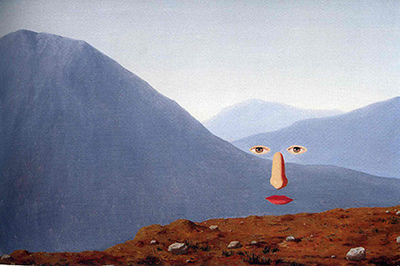
Two eyes, a nose and red lips hover before a range of blue mountains. They occupy the positions we expect within a face, but no head encloses them. The landscape continues through the spaces where cheeks, forehead and chin would ordinarily appear. A recognisable human presence emerges from an arrangement that leaves much of the person absent.
René Magritte painted Every Day, or Tous les jours, in 1966. This oil on canvas measures 50.2 × 73.3 centimetres and is catalogued as Sylvester III 1052. Christie's offered it from a private collection in 2013. [1]
At a Glance
Date of this work
Every Day
1966 [1]Contents
Recognising a face from fragments
The features are separated, yet their relationship is familiar. The eyes establish an approximate horizontal axis, the nose extends below and between them, and the mouth sits lower down. We can read a face almost immediately because their positions supply a structure that survives the missing outline.
This recognition is different from seeing a complete portrait partly covered by another object. There is no visible surface around the features to hide the rest of the head. Mountain slopes occupy the intervening areas. The absent flesh remains imaginable, but the painting does not describe a continuous body behind those interruptions.
Look first at the eyes and then at the gaps beside the nose. The change in attention makes the arrangement alternate between a human likeness and several distinct painted forms. Neither experience fully replaces the other. The features retain enough coordination to keep suggesting a face, even when the landscape's continuity becomes impossible to overlook.
The eyes and the direction of attention
The eyes confront the viewer from within a broad setting. Their relatively small size does not make them incidental: the familiar force of a gaze gives them an importance beyond their share of the painted surface. They establish a point of encounter amid slopes that otherwise seem uninhabited.
Their surrounding flesh-coloured edges distinguish them from the blue behind. These narrow borders provide just enough bodily information for each eye to remain legible. The image does not need fully described brows and cheeks to create the impression of someone looking out.
That impression makes the landscape feel less passive. We might ordinarily inspect a mountain view without expecting it to return our attention. Here, the isolated eyes complicate that relation. The setting remains expansive, but the gaze gives it a strangely immediate point of contact with the person standing before the painting.
Nose, mouth and contrasting colour
The nose is elongated and strongly modelled beside the more compact eyes. Its warm colour sets it apart from the cool mountains. Light and shade give it a sense of volume, even though the surface from which it would normally project is missing.
The lips make another concentrated accent. Their red colour interrupts the comparatively muted landscape, while their horizontal shape answers the line established by the eyes above. The mouth remains closed, offering no explanation through speech or expression that could settle the apparition's identity.
Follow the features downwards in sequence. The eye can connect them into an imagined head, then notice that the spaces between them belong visibly to the mountains. The painting makes that connection easy and difficult at the same time. Its strongest uncertainty lies in the relationship between recognisable parts and a whole that is never fully supplied.
Watch: Understanding Magritte
Three complementary films introduce the artist, explore words and images, and examine a painting’s materials. These are broader Magritte comparisons, alongside the work discussed here.
René Magritte: Great Art Explained
An introduction to Magritte’s life, characteristic images and visual puzzles.
Watch on YouTubeMountains continuing through the head
The largest slope rises at the left and falls towards the centre. Further ridges recede in lighter blues, creating a readable sequence of distances. The facial features appear against these different planes rather than occupying a separate portrait panel within the landscape.
This continuity gives the gaps their significance. A missing cheek does not become a neutral blank. It reveals more of a mountain whose contour can be followed towards other parts of the picture. The setting actively completes its own forms where the face remains incomplete.
Try concentrating on a ridge as it passes near the eyes. Its direction belongs to the landscape, while their horizontal alignment belongs to the imagined face. Those two systems coexist without becoming one coherent anatomy. The painting lets the eye move between them, continually changing which arrangement seems to organise the scene.
The stony foreground
The lower band offers a different kind of detail. Brown ground, scattered pale stones and small patches of vegetation establish a rough surface close to the viewer. Their irregular distribution contrasts with the more carefully aligned facial features above.
The foreground also gives the scene a place from which to be imagined. We can read a near edge and then look beyond it towards successive mountain slopes. This relatively convincing spatial progression makes the unsupported features more conspicuous. Their strangeness takes place within a setting that otherwise supplies familiar cues of distance.
The warm ground and red lips create a loose colour relationship across that distance. It does not turn the mouth into part of the terrain, but it helps connect the painting visually. The features remain distinct while participating in the larger distribution of warm and cool passages.
A title corrected for exhibition
The catalogue reports that Magritte briefly used Every Morning before instructing Iolas to print Every Day for the early 1967 Paris exhibition. The final title also appears on the canvas's reverse. That documented correction is more secure than assigning a particular daily hardship to the scene. [1]
The ordinary phrase introduces an interesting tension. Mountains and isolated features present an exceptional encounter, while the title refers to repetition and familiarity. The image does not identify a particular routine, occupation or event that would explain the phrase for us.
This leaves the title available as a provocation to attention. An apparently familiar face has been reduced to a few recognisable elements; an apparently familiar landscape has acquired a gaze. The words can encourage us to reconsider the everyday act of recognising things without resolving the painting into a single illustrated lesson.
A likeness without a settled person
Christie's records the painting through the Alexandre Iolas Gallery and a New York private collection acquired in 1967. The catalogue does not identify a sitter. Its collection history and date should remain separate from speculation about whose face the features might represent. [1]
The absence of a named person does not prevent a strong encounter. Indeed, it helps keep attention on how little information can produce the sense of a face. Eyes, nose and lips are sufficiently particular to suggest presence, while the missing head makes that presence hard to locate physically.
Return finally to the spaces beside the nose. They are among the least elaborately painted parts of an imagined face, because no flesh appears there at all. Yet they are essential to the effect. Every Day makes the viewer hold together a human likeness and a landscape that continues exactly where that likeness ought to be.
Magritte artworks directory
| Name | Date | Medium |
|---|---|---|
| Memory of a Voyage | 1963 | Oil on canvas |
| The Blood of the World | 1927; also catalogued as 1926–27 | Oil on canvas |
| The Hunters at the Edge of Night | Paris, 1928 | Oil on canvas |
| The Empty Picture Frame (La saignée) | 1938–39 | Gouache on paper |
| The Glass House | 1939 | Gouache on paper |
| Oasis | 1926 in the illustrated Christie’s catalogue | Oil on canvas |
| Natural Encounters | 1945 | Oil on canvas |
| Attempting the Impossible | 1928 | Oil on canvas |
| On the Threshold of Liberty | 1930 | Oil on canvas |
| The Titanic Days | 1928 | Oil on canvas |
| The Voice of Space | 1931 | Oil on canvas |
| Unexpected Answer | 1932 in the museum catalogue, 1933 on the reverse | Oil on canvas |
| Elective Affinities | 1932 in MoMA’s checklist, also published as 1933 | Oil on canvas |
| The Human Condition II | 1935 | Oil on canvas |
| The Six Elements | 1929 | Oil on canvas |
| The Happy Donor | 1966 | Oil on canvas |
| Clairvoyance (Self Portrait) | Brussels, 1936 | Oil on canvas |
| Philosopher’s Lamp | 1936 | Oil on canvas |
| The Annunciation | Paris, 1930 | Oil on canvas |
| The Lost Jockey | Circa 1942 in the illustrated lot catalogue | Gouache on paper laid down on canvas |
| Homage to Mack Sennett | 1936 in the Thyssen catalogue | Oil on canvas |
| Discovery | 1927 | Oil on canvas |
| Collective Invention | 1935 in the later catalogue index | Oil on canvas |
| The Wonders of Nature | 1953 | Oil on canvas |
| The Balcony | Circa 1950, with 1950 inscribed on the reverse | Oil on canvas |
| The Pilgrim | 1966 | Oil on canvas |
| The Invention of Life | 1928 | Oil on canvas |
| The Therapist | 1941 | Gouache on paper |
| The Gradation of Fire | 1938 or 1939 in the catalogue index | Gouache on paper |
| A Friend of Order | 1964 | Oil on canvas |
| The Poetic World | 1939 in Hammacher’s illustrated monograph | Gouache |
| The Muscles of the Sky | Paris, 1927 | Oil on canvas |
| The Battle of the Argonne | 1959 | Oil on canvas |
| Meditation | 1936 | Oil on canvas |
| The Domain of Arnheim | 1962 | Oil on canvas |
| This Is Not an Apple | 1964 | Oil on Unilite |
| The Meaning of Night | Brussels, 1927 | Oil on canvas |
| The Pleasure Principle (Portrait of Edward James) | 1937 | Oil on canvas |
| Ready Made Bouquet | 1957 | Oil on canvas |
| Popular Panorama | 1926 | Oil on canvas |
| Memory of a Journey | 1955 in the Thyssen catalogue. Tentatively 1958 in the catalogue index. | Gouache on paper, as exhibited at the Thyssen |
| Sheherazade | 1947 | Gouache on paper |
| The Difficult Crossing | 1926 | Oil on canvas |
| The Fair Captive | 1948 in the catalogue raisonné | Oil on canvas |
| The Birth of the Idol | 1926 | Oil on canvas |
| Hegel’s Holiday | 1958 | Oil on canvas |
| Homesickness | 1941 | Oil on canvas |
| The Rape (Le Viol) | 1934 | Oil on canvas |
| The Art of Living | 1967 | Oil on canvas |
| Secret Life IV | 1928 | Oil on canvas |
| The Tomb of the Wrestlers | 1960 | Oil on canvas |
| Young Girl Eating a Bird (The Pleasure) | 1927 | Oil on canvas |
| The Central Story | 1928 | Oil on canvas |
| The Seducer | 1953 | Oil on canvas |
| The Telescope | 1963 | Oil on canvas |
| The Banquet | 1958 | Oil on canvas |
| The Empty Mask | 1928 | Oil on canvas |
| The Cultivation of Ideas | 1927 | Oil on canvas |
| The Enchanted Pose | 1927 | Oil on canvas |
| The Future of Statues | 1937 | Oil on plaster |
| The Return of the Flame | 1943 | Oil on canvas |
| The White Page | 1967 | Oil on canvas |
| The Large Family | 1963 | Oil on canvas |
| Black Magic | 1945 | Oil on canvas |
| Les Amants I | 1928 | Oil on canvas |
| Man in a Bowler Hat | 1964 | Oil on canvas |
| The Portrait | 1935 | Oil on canvas |
| The Sixteenth of September | 1956 | Oil on canvas |
| Heartstrings | 1960 | Oil on canvas |
| The Present | 1939; also dated 1938 or 1939 | Gouache on paper |
| Act of Violence | 1932 | Oil on canvas |
| Fashionable People | 1950, in the 2016 thesis caption | Medium unconfirmed · Attribution follows the published caption |
| The Representation | 1962 | Oil on canvas |
| Memory | 1948 | Gouache on paper |
| The Mysteries of the Horizon | 1955 | Oil on canvas |
| Portrait of Stephy Langui | 1961 | Oil on canvas |
| The Double Secret | 1927 | Oil on canvas |
| Every Day | 1966 | Oil on canvas |
| The Invisible World | 1954 | Oil on canvas |
| Dawn of Cayenne | 1926 | Oil painting |
| Clear Ideas | 1955 (inscribed); possible 1958 execution | Oil on canvas |
| The Face of Genius | 1926 / 1927 | Oil on canvas |
| Good Faith | 1965; earlier record 1964–65 | Oil on canvas |
| The Flash | 1959 | Gouache and pencil on paper |
| Perpetual Motion | 1935; earlier catalogue 1934 | Oil on canvas |
| Personal Values | 1952 | Oil on canvas |
| Not to Be Reproduced | 1937 | Oil on canvas |
| The Red Model | 1935 | Oil on canvas |
| The Menaced Assassin | 1927 | Oil on canvas |
| The Castle of the Pyrenees | 1959 | Oil on canvas |
| The Blank Signature | 1965 | Oil on canvas |
| The Listening Room | 1952 | Oil on canvas |
| Golconde | 1953 | Oil on canvas |
| Time Transfixed | 1938 | Oil on canvas |
| The Treachery of Images | 1929 | Oil on canvas |
| The False Mirror | 1929 | Oil on canvas |
| The Empire of Light | 1953–54 | Oil on canvas |
| The Human Condition | 1933 | Oil on canvas |
| Les Amants | 1928 | Oil on canvas |
| The Son of Man | 1964 | Oil on canvas |
Frequently Asked Questions
No outline of a complete head is shown. The mountains continue through the gaps between the separately depicted features.
The eyes, nose and lips retain their familiar positions relative to one another, allowing recognition to persist despite the missing surrounding flesh.
Discussion
Compare the familiar objects with the spaces they appear to occupy.
Reader Insights
Which gap most strongly disrupts your recognition of a face?
How does the gaze change your experience of the mountain landscape?
What do the warm foreground colours contribute to the isolated features?
Join the Conversation
Share a detail, comparison or question about Every Day below.
References
- Christie's, René Magritte, Tous les jours, 2013, lot 116: object record, provenance, exhibition history and title correspondence. View source.Splash image: Every Day, 1966. Oil on canvas, 50.2 × 73.3 cm. Sylvester III 1052; private collection as recorded in the 2013 catalogue.







