




The Representation
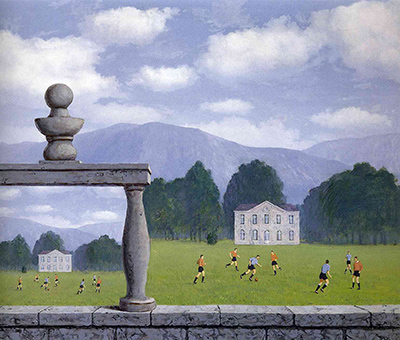
Footballers move across a green lawn in front of a pale house, trees and blue mountains. At the left, a stone balustrade encloses another version of the same scene. The players and house appear again at a smaller scale, while the sky and mountains seem to continue across the interruption. An ordinary game becomes a problem about where a picture begins and ends.
René Magritte painted The Representation, or La Représentation, in 1962. The oil on canvas measures 81 × 100 centimetres and is catalogued as Sylvester III 940. It is signed on the front and signed, titled and dated on the reverse. [1]
Date of this work
The Representation
1962 [1]Contents
Finding the repeated game
Start with the footballers in the open area at the right. Their coloured shirts and dark shorts distinguish the separate figures against the grass. A player in blue moves near the ball, while others approach or wait at different points around him. Their gestures give the scene a recognisable activity without requiring us to identify a particular match.
Now look through the opening in the stonework at the left. The arrangement returns in miniature: the players occupy corresponding positions and the pale building stands behind them. This is more specific than finding another group playing the same sport. The small scene repeats the organisation of the larger one.
The repetition changes how distance works. Smaller figures normally tell us that people are further away, but these figures also resemble a reduced image of their neighbours. We can read the opening as a view into space, then notice that its contents act like a picture within the picture. Both readings remain available.
A railing that behaves like a frame
The stonework has enough physical detail to seem substantial. Its lower course runs across the foreground, a turned upright rises near the centre, and an upper rail extends towards the left edge. Chipped surfaces and irregular colour suggest a material object rather than an abstract outline drawn around the smaller scene.
Yet the opening also supplies three sides of a frame. It gives the miniature game a distinct area, separated from the larger players by the central support. The border's weight makes that separation especially noticeable: the footballers beyond appear light and small beside it.
The upper rail stops rather than continuing across the whole composition. Above it stands a rounded finial, whose stacked curves echo the turned support below. This incomplete structure refuses to settle into a continuous barrier between us and the lawn. It is both a plausible piece of architecture and an oddly selective device for dividing what we see.
Two houses and uncertain distance
The pale house provides a useful way to compare the two scenes. Its triangular central feature, rows of windows and darker roof remain legible in the larger version. At the left, its reduced counterpart repeats the same general facade behind the smaller footballers.
A distant building could naturally look smaller than a nearby one. Here, however, the correspondence extends to the surrounding activity and greenery. The house belongs to a whole repeated arrangement. What initially looks like ordinary perspective starts to look like reproduction.
Try following the grass from the larger game towards the left opening. There is no separately labelled screen to announce a change of scale. Stone interrupts the view, but the countryside retains its continuity of colour. Magritte lets the conventions of landscape painting carry us towards an arrangement those conventions cannot fully explain.
Watch: Understanding Magritte
Three complementary films introduce the artist, explore words and images, and examine a painting’s materials. These are broader Magritte comparisons, alongside the work discussed here.
René Magritte: Great Art Explained
An introduction to Magritte’s life, characteristic images and visual puzzles.
Watch on YouTubeTrees, mountains and a shared sky
The larger trees form a dense green backdrop behind the central house. Their rounded masses contrast with the small, angular movements of the players. Beyond them, a mountain ridge spreads across the painting in soft blues. The sky occupies much of the upper area, opening the composition beyond the foreground's close stonework.
Within the smaller scene, trees and mountains return at another scale. Their familiar relationships help us recognise the repeat even before we count the figures. The landscape therefore participates in the puzzle rather than serving as a neutral background for it.
The sky makes the interruption harder to isolate. Its blue and white passages extend above both versions of the game, without a complete enclosing border around the smaller one. A conventional framed painting would clearly separate its own sky from the wall around it. Here, the distinction has to be worked out from overlapping clues.
Movement held in a repeated instant
The footballers' bent knees and angled arms imply changing positions. Their attention appears directed towards the ball and one another. The game suggests a next moment: a pass, a challenge or a shift in the group.
Repetition arrests that expectation. The miniature players seem caught in the same configuration as the larger group. Instead of showing successive stages of a match, the painting presents comparable actions simultaneously at different scales. The scene's energy becomes inseparable from its stillness as an image.
This is why the sporting subject matters to the composition. Movement gives us recognisable relationships to compare. We do not need a narrative about the players' identities or the result of the game; the positions of their bodies already provide a pattern that can be repeated and noticed.
The title and the act of looking
The Representation directs attention towards the status of the image. Everything on the canvas is represented, including the stonework that appears to stand in front of the landscape. The smaller game makes that fact more conspicuous by repeating a scene we have already accepted as a coherent view.
One useful interpretation is that the painting asks how much a border contributes to our recognition of a picture. The left opening looks framed, yet the frame belongs to the same painted world as its surroundings. Looking through it never takes us outside representation.
That reading does not require the image to become an illustrated philosophical formula. The visible arrangement remains precise and peculiar: football, architecture and landscape hold together while their scales disagree. The title gives us a way to attend to that disagreement without resolving it into a single hidden message.
A documented canvas from 1962
Sotheby's historical record states that Alexander Iolas acquired the painting directly from Magritte in February 1962. It also lists exhibitions at Iolas Gallery in New York and the Walker Art Center that year. These entries document this particular canvas, rather than every work sharing its French title. [1]
The distinction matters when looking up La Représentation: the football scene is the 1962 landscape composition described here. Its most revealing details remain available in the image itself. Compare the two houses, follow the interrupted railing, then return to the ballplayers. The picture's uncertainty grows from relationships that can be seen and tested, even though they never become an ordinary continuous space.
Magritte artworks directory
| Name | Date | Medium |
|---|---|---|
| Memory of a Voyage | 1963 | Oil on canvas |
| The Blood of the World | 1927; also catalogued as 1926–27 | Oil on canvas |
| The Hunters at the Edge of Night | Paris, 1928 | Oil on canvas |
| The Empty Picture Frame (La saignée) | 1938–39 | Gouache on paper |
| The Glass House | 1939 | Gouache on paper |
| Oasis | 1926 in the illustrated Christie’s catalogue | Oil on canvas |
| Natural Encounters | 1945 | Oil on canvas |
| Attempting the Impossible | 1928 | Oil on canvas |
| On the Threshold of Liberty | 1930 | Oil on canvas |
| The Titanic Days | 1928 | Oil on canvas |
| The Voice of Space | 1931 | Oil on canvas |
| Unexpected Answer | 1932 in the museum catalogue, 1933 on the reverse | Oil on canvas |
| Elective Affinities | 1932 in MoMA’s checklist, also published as 1933 | Oil on canvas |
| The Human Condition II | 1935 | Oil on canvas |
| The Six Elements | 1929 | Oil on canvas |
| The Happy Donor | 1966 | Oil on canvas |
| Clairvoyance (Self Portrait) | Brussels, 1936 | Oil on canvas |
| Philosopher’s Lamp | 1936 | Oil on canvas |
| The Annunciation | Paris, 1930 | Oil on canvas |
| The Lost Jockey | Circa 1942 in the illustrated lot catalogue | Gouache on paper laid down on canvas |
| Homage to Mack Sennett | 1936 in the Thyssen catalogue | Oil on canvas |
| Discovery | 1927 | Oil on canvas |
| Collective Invention | 1935 in the later catalogue index | Oil on canvas |
| The Wonders of Nature | 1953 | Oil on canvas |
| The Balcony | Circa 1950, with 1950 inscribed on the reverse | Oil on canvas |
| The Pilgrim | 1966 | Oil on canvas |
| The Invention of Life | 1928 | Oil on canvas |
| The Therapist | 1941 | Gouache on paper |
| The Gradation of Fire | 1938 or 1939 in the catalogue index | Gouache on paper |
| A Friend of Order | 1964 | Oil on canvas |
| The Poetic World | 1939 in Hammacher’s illustrated monograph | Gouache |
| The Muscles of the Sky | Paris, 1927 | Oil on canvas |
| The Battle of the Argonne | 1959 | Oil on canvas |
| Meditation | 1936 | Oil on canvas |
| The Domain of Arnheim | 1962 | Oil on canvas |
| This Is Not an Apple | 1964 | Oil on Unilite |
| The Meaning of Night | Brussels, 1927 | Oil on canvas |
| The Pleasure Principle (Portrait of Edward James) | 1937 | Oil on canvas |
| Ready Made Bouquet | 1957 | Oil on canvas |
| Popular Panorama | 1926 | Oil on canvas |
| Memory of a Journey | 1955 in the Thyssen catalogue. Tentatively 1958 in the catalogue index. | Gouache on paper, as exhibited at the Thyssen |
| Sheherazade | 1947 | Gouache on paper |
| The Difficult Crossing | 1926 | Oil on canvas |
| The Fair Captive | 1948 in the catalogue raisonné | Oil on canvas |
| The Birth of the Idol | 1926 | Oil on canvas |
| Hegel’s Holiday | 1958 | Oil on canvas |
| Homesickness | 1941 | Oil on canvas |
| The Rape (Le Viol) | 1934 | Oil on canvas |
| The Art of Living | 1967 | Oil on canvas |
| Secret Life IV | 1928 | Oil on canvas |
| The Tomb of the Wrestlers | 1960 | Oil on canvas |
| Young Girl Eating a Bird (The Pleasure) | 1927 | Oil on canvas |
| The Central Story | 1928 | Oil on canvas |
| The Seducer | 1953 | Oil on canvas |
| The Telescope | 1963 | Oil on canvas |
| The Banquet | 1958 | Oil on canvas |
| The Empty Mask | 1928 | Oil on canvas |
| The Cultivation of Ideas | 1927 | Oil on canvas |
| The Enchanted Pose | 1927 | Oil on canvas |
| The Future of Statues | 1937 | Oil on plaster |
| The Return of the Flame | 1943 | Oil on canvas |
| The White Page | 1967 | Oil on canvas |
| The Large Family | 1963 | Oil on canvas |
| Black Magic | 1945 | Oil on canvas |
| Les Amants I | 1928 | Oil on canvas |
| Man in a Bowler Hat | 1964 | Oil on canvas |
| The Portrait | 1935 | Oil on canvas |
| The Sixteenth of September | 1956 | Oil on canvas |
| Heartstrings | 1960 | Oil on canvas |
| The Present | 1939; also dated 1938 or 1939 | Gouache on paper |
| Act of Violence | 1932 | Oil on canvas |
| Fashionable People | 1950, in the 2016 thesis caption | Medium unconfirmed · Attribution follows the published caption |
| The Representation | 1962 | Oil on canvas |
| Memory | 1948 | Gouache on paper |
| The Mysteries of the Horizon | 1955 | Oil on canvas |
| Portrait of Stephy Langui | 1961 | Oil on canvas |
| The Double Secret | 1927 | Oil on canvas |
| Every Day | 1966 | Oil on canvas |
| The Invisible World | 1954 | Oil on canvas |
| Dawn of Cayenne | 1926 | Oil painting |
| Clear Ideas | 1955 (inscribed); possible 1958 execution | Oil on canvas |
| The Face of Genius | 1926 / 1927 | Oil on canvas |
| Good Faith | 1965; earlier record 1964–65 | Oil on canvas |
| The Flash | 1959 | Gouache and pencil on paper |
| Perpetual Motion | 1935; earlier catalogue 1934 | Oil on canvas |
| Personal Values | 1952 | Oil on canvas |
| Not to Be Reproduced | 1937 | Oil on canvas |
| The Red Model | 1935 | Oil on canvas |
| The Menaced Assassin | 1927 | Oil on canvas |
| The Castle of the Pyrenees | 1959 | Oil on canvas |
| The Blank Signature | 1965 | Oil on canvas |
| The Listening Room | 1952 | Oil on canvas |
| Golconde | 1953 | Oil on canvas |
| Time Transfixed | 1938 | Oil on canvas |
| The Treachery of Images | 1929 | Oil on canvas |
| The False Mirror | 1929 | Oil on canvas |
| The Empire of Light | 1953–54 | Oil on canvas |
| The Human Condition | 1933 | Oil on canvas |
| Les Amants | 1928 | Oil on canvas |
| The Son of Man | 1964 | Oil on canvas |
Frequently Asked Questions
1962 [1]
Oil on canvas [1]
81 × 100 cm [1]
Discussion
Compare the familiar objects with the spaces they appear to occupy.
Reader Insights
Which repeated gesture first makes you notice that the smaller game corresponds to the larger one?
Where does the stonework act as architecture, and where does it begin to function like a picture frame?
How do the shared colours of the grass and sky complicate the changes in scale?
Join the Conversation
Share a detail, comparison or question about The Representation below.
References
- Sotheby's, René Magritte, La Représentation, Exquisite Corpus Evening Auction, lot 20 (2025). Object description, dimensions, reverse inscriptions, catalogue reference, historical provenance and exhibitions. View source.Splash image: The Representation, 1962. Oil on canvas, 81 × 100 cm. Sylvester III 940; historical provenance and exhibitions recorded by Sotheby’s in 2025.







