


 by Tom Gurney
Tom Gurney BSc (Hons) is an art history expert with over 20 years experience
Page created on / Page updated on
Email: tomgurney1@gmail.com / Phone: +44 7429 011000
Hegel’s Holiday
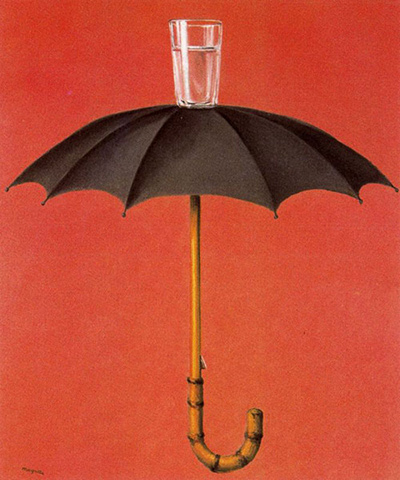
A glass of water balances on the crown of an open black umbrella in René Magritte’s Hegel’s Holiday. The umbrella spreads almost from side to side and its curved handle hangs just above the bottom of the picture. Red fills the space around both objects. With no table under the glass, the dark canopy takes its place as a support. A fold in the fabric or a change in the angle of the shaft would seem enough to upset it. Magritte paints the objects at the instant when the water in the glass is level and everything holds.
The pictured Les Vacances de Hegel is the 1958 oil on canvas, 60 by 50 centimetres, catalogued as number 874 in volume III of the catalogue raisonné. Christie’s illustrates the canvas and records a signature at the lower left and the title and date on the back. The red ground, open umbrella and glass match the illustration. The artist returned to the subject in a smaller oil in 1959, listed as number 895. Christie’s records the larger canvas at the Alexandre Iolas Gallery in New York in 1959 and in the Magritte retrospective that travelled to Tokyo and Kyoto in 1971. [1] [2] [3]
At a Glance
- Original titleLes Vacances de Hegel
- Date1958
- MediumOil on canvas
- Size60 × 50 cm
- Catalogue numberSylvester III 874
Selected works
Where the glass sits
The glass is narrower at its base than at its rim. Thin white strokes along its sides give it a thickness, and at the top a bright curve describes the lip. A horizontal line marks the water a little below that rim. The colour behind the glass is still visible through it, especially in the upper part. The brightest lines at the base are crowded into the small area that meets the umbrella. They make the bottom edge quite clear, although most of the glass itself appears transparent.
Below it, the canopy is almost a single dark shape at first glance. Look at the seams and it divides into panels, with differently lit surfaces between them. Each seam runs out from the crown towards a small point where the fabric is drawn tight. The fabric sags slightly between the points, making a line of shallow scallops across the lower edge. Its surface is curved in a way that makes it a particularly unlikely place to set a glass. The glass has been put at the one point where that curvature looks roughly even on either side.
The shaft descends almost vertically from under the canopy. A narrow lit edge lets us follow it against the red. Its line is broadly in register with the middle of the glass, and the small shift between them becomes easier to see when we compare their positions with the edges of the canvas. Near the bottom the shaft thickens into the curved handle. There are dark divisions across the handle and changes of colour around each bend. These details bring the eye down to the very end of the arrangement, where the turn of the hook leads it back upwards.
Watch: Understanding Magritte
Three complementary films introduce the artist, explore words and images, and examine a painting’s materials. These are broader Magritte comparisons, alongside the work discussed here.
René Magritte: Great Art Explained
An introduction to Magritte’s life, characteristic images and visual puzzles.
Watch on YouTubeTwo ways of dealing with water
The umbrella gives the image its widest span. The glass gives it a narrow upright accent. The red behind them leaves each outer edge distinct and supplies no obvious indication of where either object is held up. An open umbrella might normally bring a person into a picture, perhaps by showing a wrist at the handle or a face beneath the fabric. Here the space under the canopy is open all the way to the hook. That makes the top contact especially noticeable, since it is the only place where the two objects meet.
Each object has an ordinary use. The umbrella directs rain away from whatever is under it. The glass holds the water it receives. Magritte explained to Suzi Gablik that he began with the problem of how to make a picture of a glass of water worth looking at. His illustrated letter of 19 May 1958 describes repeated drawings in which a stroke gradually grew into an umbrella. The umbrella went into the glass in one stage and came to rest below it in the final arrangement. The sketches document how the objects found their positions through a series of changes. [4]
The open umbrella puts the two functions in particularly clear relation. Its canopy broadens from the point where the glass is narrowest. It would carry water away from that point, while the glass above gives the water a bounded surface and level. The painting shows the contained water through its bright upper line. The other behaviour has to be supplied from what we know about an umbrella. There is enough information in the cloth and the glass for the eye to make that connection.
Why Hegel is in the title
In the letter to Gablik, Magritte imagined that the philosopher Georg Wilhelm Friedrich Hegel would have enjoyed the idea of one arrangement bringing two contrary functions together. He compared that enjoyment to the amusement of being on holiday. Christie’s also cites a November 1958 letter to the dealer Alexandre Iolas in which Magritte discusses his return to the title Hegel’s Holiday after considering The Philosopher’s Holiday. The title connects the picture to a particular reader the artist had imagined while thinking about the relation between the objects. [1] [4]
The Centre Pompidou used the 1958 image in its material for The Treachery of Images, an exhibition that examined Magritte’s engagement with philosophy. The painting offers its own route into that subject. Starting at the waterline, we can see how a bright horizontal mark makes the contents of the glass recognisable. Following the dark seams out from the crown takes us along paths that rain might follow. The picture brings those directions together where the narrow bottom of the glass meets the wide cover of the umbrella. [5]
At the very top the glass is small enough to be overlooked if one takes in the silhouette of the umbrella first. Once it has been seen, the umbrella’s position begins to look surprisingly exact. The hook, the shaft, the crown and the line of the water seem to depend on one another. The name of a philosopher suggests a way of thinking about the pairing. Looking at the painted contact point shows how little space Magritte needed to make that pairing visible.
Magritte artworks directory
| Name | Date | Medium |
|---|---|---|
| Memory of a Voyage | 1963 | Oil on canvas |
| The Blood of the World | 1927; also catalogued as 1926–27 | Oil on canvas |
| The Hunters at the Edge of Night | Paris, 1928 | Oil on canvas |
| The Empty Picture Frame (La saignée) | 1938–39 | Gouache on paper |
| The Glass House | 1939 | Gouache on paper |
| Oasis | 1926 in the illustrated Christie’s catalogue | Oil on canvas |
| Natural Encounters | 1945 | Oil on canvas |
| Attempting the Impossible | 1928 | Oil on canvas |
| On the Threshold of Liberty | 1930 | Oil on canvas |
| The Titanic Days | 1928 | Oil on canvas |
| The Voice of Space | 1931 | Oil on canvas |
| Unexpected Answer | 1932 in the museum catalogue, 1933 on the reverse | Oil on canvas |
| Elective Affinities | 1932 in MoMA’s checklist, also published as 1933 | Oil on canvas |
| The Human Condition II | 1935 | Oil on canvas |
| The Six Elements | 1929 | Oil on canvas |
| The Happy Donor | 1966 | Oil on canvas |
| Clairvoyance (Self Portrait) | Brussels, 1936 | Oil on canvas |
| Philosopher’s Lamp | 1936 | Oil on canvas |
| The Annunciation | Paris, 1930 | Oil on canvas |
| The Lost Jockey | Circa 1942 in the illustrated lot catalogue | Gouache on paper laid down on canvas |
| Homage to Mack Sennett | 1936 in the Thyssen catalogue | Oil on canvas |
| Discovery | 1927 | Oil on canvas |
| Collective Invention | 1935 in the later catalogue index | Oil on canvas |
| The Wonders of Nature | 1953 | Oil on canvas |
| The Balcony | Circa 1950, with 1950 inscribed on the reverse | Oil on canvas |
| The Pilgrim | 1966 | Oil on canvas |
| The Invention of Life | 1928 | Oil on canvas |
| The Therapist | 1941 | Gouache on paper |
| The Gradation of Fire | 1938 or 1939 in the catalogue index | Gouache on paper |
| A Friend of Order | 1964 | Oil on canvas |
| The Poetic World | 1939 in Hammacher’s illustrated monograph | Gouache |
| The Muscles of the Sky | Paris, 1927 | Oil on canvas |
| The Battle of the Argonne | 1959 | Oil on canvas |
| Meditation | 1936 | Oil on canvas |
| The Domain of Arnheim | 1962 | Oil on canvas |
| This Is Not an Apple | 1964 | Oil on Unilite |
| The Meaning of Night | Brussels, 1927 | Oil on canvas |
| The Pleasure Principle (Portrait of Edward James) | 1937 | Oil on canvas |
| Ready Made Bouquet | 1957 | Oil on canvas |
| Popular Panorama | 1926 | Oil on canvas |
| Memory of a Journey | 1955 in the Thyssen catalogue. Tentatively 1958 in the catalogue index. | Gouache on paper, as exhibited at the Thyssen |
| Sheherazade | 1947 | Gouache on paper |
| The Difficult Crossing | 1926 | Oil on canvas |
| The Fair Captive | 1948 in the catalogue raisonné | Oil on canvas |
| The Birth of the Idol | 1926 | Oil on canvas |
| Hegel’s Holiday | 1958 | Oil on canvas |
| Homesickness | 1941 | Oil on canvas |
| The Rape (Le Viol) | 1934 | Oil on canvas |
| The Art of Living | 1967 | Oil on canvas |
| Secret Life IV | 1928 | Oil on canvas |
| The Tomb of the Wrestlers | 1960 | Oil on canvas |
| Young Girl Eating a Bird (The Pleasure) | 1927 | Oil on canvas |
| The Central Story | 1928 | Oil on canvas |
| The Seducer | 1953 | Oil on canvas |
| The Telescope | 1963 | Oil on canvas |
| The Banquet | 1958 | Oil on canvas |
| The Empty Mask | 1928 | Oil on canvas |
| The Cultivation of Ideas | 1927 | Oil on canvas |
| The Enchanted Pose | 1927 | Oil on canvas |
| The Future of Statues | 1937 | Oil on plaster |
| The Return of the Flame | 1943 | Oil on canvas |
| The White Page | 1967 | Oil on canvas |
| The Large Family | 1963 | Oil on canvas |
| Black Magic | 1945 | Oil on canvas |
| Les Amants I | 1928 | Oil on canvas |
| Man in a Bowler Hat | 1964 | Oil on canvas |
| The Portrait | 1935 | Oil on canvas |
| The Sixteenth of September | 1956 | Oil on canvas |
| Heartstrings | 1960 | Oil on canvas |
| The Present | 1939; also dated 1938 or 1939 | Gouache on paper |
| Act of Violence | 1932 | Oil on canvas |
| Fashionable People | 1950, in the 2016 thesis caption | Medium unconfirmed · Attribution follows the published caption |
| The Representation | 1962 | Oil on canvas |
| Memory | 1948 | Gouache on paper |
| The Mysteries of the Horizon | 1955 | Oil on canvas |
| Portrait of Stephy Langui | 1961 | Oil on canvas |
| The Double Secret | 1927 | Oil on canvas |
| Every Day | 1966 | Oil on canvas |
| The Invisible World | 1954 | Oil on canvas |
| Dawn of Cayenne | 1926 | Oil painting |
| Clear Ideas | 1955 (inscribed); possible 1958 execution | Oil on canvas |
| The Face of Genius | 1926 / 1927 | Oil on canvas |
| Good Faith | 1965; earlier record 1964–65 | Oil on canvas |
| The Flash | 1959 | Gouache and pencil on paper |
| Perpetual Motion | 1935; earlier catalogue 1934 | Oil on canvas |
| Personal Values | 1952 | Oil on canvas |
| Not to Be Reproduced | 1937 | Oil on canvas |
| The Red Model | 1935 | Oil on canvas |
| The Menaced Assassin | 1927 | Oil on canvas |
| The Castle of the Pyrenees | 1959 | Oil on canvas |
| The Blank Signature | 1965 | Oil on canvas |
| The Listening Room | 1952 | Oil on canvas |
| Golconde | 1953 | Oil on canvas |
| Time Transfixed | 1938 | Oil on canvas |
| The Treachery of Images | 1929 | Oil on canvas |
| The False Mirror | 1929 | Oil on canvas |
| The Empire of Light | 1953–54 | Oil on canvas |
| The Human Condition | 1933 | Oil on canvas |
| Les Amants | 1928 | Oil on canvas |
| The Son of Man | 1964 | Oil on canvas |
Frequently Asked Questions
Magritte imagined that Hegel would enjoy the pairing of two opposite functions, holding and shedding water.
Discussion
Look closely and compare your reading with others.
Reader Insights
Which detail makes the glass seem most securely balanced?
How do the umbrella’s seams affect the way you imagine water moving across it?
What changes when you read the title after looking at the two objects?
Join the Conversation
Share a detail, comparison or question about Hegel’s Holiday below.
References
- Christie’s. Les vacances de Hegel. Illustrated lot record, no. 5493649, with Magritte’s correspondence and a reproduction of the later oil. View source.
- Magritte. Toutes les œuvres, tous les thèmes. Catalogue raisonné index, vol. III, p. 288, no. 874. View source.
- Magritte. Toutes les œuvres, tous les thèmes. Catalogue raisonné index, vol. III, p. 304, no. 895. View source.
- René Magritte. Illustrated letter to Suzi Gablik, 19 May 1958. Sotheby’s, Books and Manuscripts, lot 150. View source.
- Centre Pompidou. René Magritte. The Treachery of Images. Exhibition record, 2016–17, illustrating the 1958 canvas. View source.







