


 by Tom Gurney
Tom Gurney BSc (Hons) is an art history expert with over 20 years experience
Page created on / Page updated on
Email: tomgurney1@gmail.com / Phone: +44 7429 011000
The Art of Living
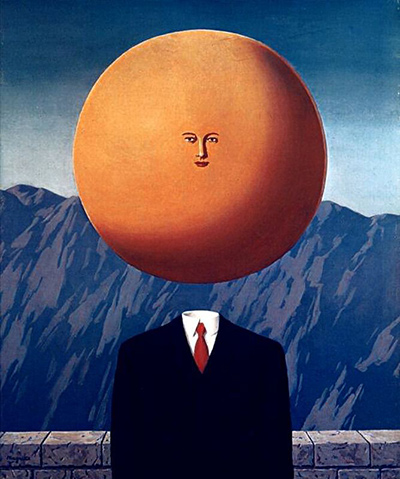
An orange sphere hangs above a dark suit in René Magritte’s The Art of Living. The suit has a white collar and a red tie, with a narrow opening above them where a neck might begin. A small face looks out from the much larger sphere. Beyond the suit and the low stone wall behind it, blue mountains rise into a darkening sky. The tie and face are close to the same vertical line. Between them there is a band of open landscape, enough to make the upper and lower parts look separate even as we read them as a figure.
This is the 1967 oil on canvas L’Art de vivre, number 1061 in volume III of the catalogue raisonné. The index lists approximately 65 by 54 centimetres and marks the measurements as uncertain. Christie’s illustrates the painting alongside a related pencil drawing from the same year. The illustration identifies the composition with the single suited figure and mountains and lists the painting in a private collection at the time of publication. [1] [2]
At a Glance
- Original titleL’Art de vivre
- Date1967
- MediumOil on canvas
- SizeApproximately 65 × 54 cm in the catalogue index
- Catalogue numberSylvester III 1061
Selected works
Secret Life IV
1928The sphere and the collar
Bright colour spreads across the upper left of the sphere. It darkens along the right side and towards the bottom, where the rounded edge runs clearly across the blue mountains. Magritte gives the sphere an almost unbroken surface. The face at its centre is very small, with two eyes, a nose and a mouth drawn near one another. The eyes and mouth are dark enough to be legible within a large field of colour. They occupy so little of it that we can see the sphere as a whole before we notice that it has features.
The face is set a little above the widest part of the form. It looks out towards us, and the suit below is presented quite squarely. We can put the two in relation from the direction in which they face. Their proportions make that relation harder to accept. The sphere extends beyond the shoulders on both sides, yet the eyes are only a little distance apart. The proportions resemble those of a face seen from further away than the object that carries it.
The opening of the white collar brings the eye to the place where the body ends. The two sides of the collar angle towards the red knot, which sits above a narrow length of tie. Against the broad dark colour of the suit this makes a sharp patch of light. The circle above has no notch or small flat place to fit that opening. The edge of the sphere and the curved gap in the shirt can each be traced from end to end. The space between them allows the mountains to show through.
The mountains beyond the wall
At the bottom, rows of blocks run behind the cut-off figure. A pale border separates their upper surfaces from the dark mountain below the horizon. The blocks are large enough for their seams and irregular marks to be visible. They establish a near edge for the landscape. Beyond the wall, much larger ridges are described by long slanting bands of blue. Some of those bands suggest faces of rock catching light, while others fall into darker crevices. Their scale has to be inferred from the extent of the range across the picture.
Watch: Understanding Magritte
Three complementary films introduce the artist, explore words and images, and examine a painting’s materials. These are broader Magritte comparisons, alongside the work discussed here.
René Magritte: Great Art Explained
An introduction to Magritte’s life, characteristic images and visual puzzles.
Watch on YouTubeThe mountains also give the sphere a setting against which its edge can be read. Its upper part meets sky, while the lower part cuts across the diagonal marks of the peaks. We can follow the same curve through both backgrounds. It gives the head its solidity, though nothing between the mountains and the wall shows how the sphere came to be there. The most reliable evidence for its position is the way it interrupts the ridge. Its actual distance from the figure is difficult to judge.
The colours connect different parts of the scene. The orange is brightest around the small face and deepens into a darker red near the lower curve. The tie picks up a related colour lower down. Between them, the blue behind the collar remains visible. The red accents make the figure easy to assemble visually across that interval. The white of the shirt and the light edge of the wall help keep the scale of the body distinct from the much broader landscape.
The strip of sky above the sphere is narrower than the open sky at either side. It keeps the circle clear of the top edge while leaving very little space above it. The suit, by comparison, runs straight into the bottom edge. This difference helps the head appear suspended and the torso appear to continue below the frame.
A drawing with two figures
Christie’s relates the oil to a pencil drawing Magritte made in 1967. The drawing shows two figures, and the auction catalogue identifies the male figure as the counterpart to the one Magritte placed alone among mountains in The Art of Living. That comparison gives the suit and round head a life outside this particular setting. In the oil, the space a companion could occupy is taken up by ridges and sky. The face consequently has little to compete with once we find it. [2]
Magritte also used the French title for a 1948 gouache held by the Royal Museums of Fine Arts of Belgium. The museum records that earlier work on paper with its own dated signature. The title therefore leads to objects made nearly twenty years apart. An illustration of the floating sphere, suit and Alpine setting is the way to recognise the late painting discussed here. [2] [3]
A related problem of scale appears in The Pleasure Principle. In that 1937 portrait, a bright glow fills the area above Edward James’s collar and prevents us from seeing the sitter’s features. In the 1967 oil, Magritte has given the head a firm edge and made the facial features unusually small. The effects are easiest to compare if we look first at the collars. Each gives the eye a point from which to locate a head. In The Art of Living the small face draws us into the orange surface, then the circle around it makes us see how far that surface has extended beyond the scale of the suit. [4]
Magritte artworks directory
| Name | Date | Medium |
|---|---|---|
| Memory of a Voyage | 1963 | Oil on canvas |
| The Blood of the World | 1927; also catalogued as 1926–27 | Oil on canvas |
| The Hunters at the Edge of Night | Paris, 1928 | Oil on canvas |
| The Empty Picture Frame (La saignée) | 1938–39 | Gouache on paper |
| The Glass House | 1939 | Gouache on paper |
| Oasis | 1926 in the illustrated Christie’s catalogue | Oil on canvas |
| Natural Encounters | 1945 | Oil on canvas |
| Attempting the Impossible | 1928 | Oil on canvas |
| On the Threshold of Liberty | 1930 | Oil on canvas |
| The Titanic Days | 1928 | Oil on canvas |
| The Voice of Space | 1931 | Oil on canvas |
| Unexpected Answer | 1932 in the museum catalogue, 1933 on the reverse | Oil on canvas |
| Elective Affinities | 1932 in MoMA’s checklist, also published as 1933 | Oil on canvas |
| The Human Condition II | 1935 | Oil on canvas |
| The Six Elements | 1929 | Oil on canvas |
| The Happy Donor | 1966 | Oil on canvas |
| Clairvoyance (Self Portrait) | Brussels, 1936 | Oil on canvas |
| Philosopher’s Lamp | 1936 | Oil on canvas |
| The Annunciation | Paris, 1930 | Oil on canvas |
| The Lost Jockey | Circa 1942 in the illustrated lot catalogue | Gouache on paper laid down on canvas |
| Homage to Mack Sennett | 1936 in the Thyssen catalogue | Oil on canvas |
| Discovery | 1927 | Oil on canvas |
| Collective Invention | 1935 in the later catalogue index | Oil on canvas |
| The Wonders of Nature | 1953 | Oil on canvas |
| The Balcony | Circa 1950, with 1950 inscribed on the reverse | Oil on canvas |
| The Pilgrim | 1966 | Oil on canvas |
| The Invention of Life | 1928 | Oil on canvas |
| The Therapist | 1941 | Gouache on paper |
| The Gradation of Fire | 1938 or 1939 in the catalogue index | Gouache on paper |
| A Friend of Order | 1964 | Oil on canvas |
| The Poetic World | 1939 in Hammacher’s illustrated monograph | Gouache |
| The Muscles of the Sky | Paris, 1927 | Oil on canvas |
| The Battle of the Argonne | 1959 | Oil on canvas |
| Meditation | 1936 | Oil on canvas |
| The Domain of Arnheim | 1962 | Oil on canvas |
| This Is Not an Apple | 1964 | Oil on Unilite |
| The Meaning of Night | Brussels, 1927 | Oil on canvas |
| The Pleasure Principle (Portrait of Edward James) | 1937 | Oil on canvas |
| Ready Made Bouquet | 1957 | Oil on canvas |
| Popular Panorama | 1926 | Oil on canvas |
| Memory of a Journey | 1955 in the Thyssen catalogue. Tentatively 1958 in the catalogue index. | Gouache on paper, as exhibited at the Thyssen |
| Sheherazade | 1947 | Gouache on paper |
| The Difficult Crossing | 1926 | Oil on canvas |
| The Fair Captive | 1948 in the catalogue raisonné | Oil on canvas |
| The Birth of the Idol | 1926 | Oil on canvas |
| Hegel’s Holiday | 1958 | Oil on canvas |
| Homesickness | 1941 | Oil on canvas |
| The Rape (Le Viol) | 1934 | Oil on canvas |
| The Art of Living | 1967 | Oil on canvas |
| Secret Life IV | 1928 | Oil on canvas |
| The Tomb of the Wrestlers | 1960 | Oil on canvas |
| Young Girl Eating a Bird (The Pleasure) | 1927 | Oil on canvas |
| The Central Story | 1928 | Oil on canvas |
| The Seducer | 1953 | Oil on canvas |
| The Telescope | 1963 | Oil on canvas |
| The Banquet | 1958 | Oil on canvas |
| The Empty Mask | 1928 | Oil on canvas |
| The Cultivation of Ideas | 1927 | Oil on canvas |
| The Enchanted Pose | 1927 | Oil on canvas |
| The Future of Statues | 1937 | Oil on plaster |
| The Return of the Flame | 1943 | Oil on canvas |
| The White Page | 1967 | Oil on canvas |
| The Large Family | 1963 | Oil on canvas |
| Black Magic | 1945 | Oil on canvas |
| Les Amants I | 1928 | Oil on canvas |
| Man in a Bowler Hat | 1964 | Oil on canvas |
| The Portrait | 1935 | Oil on canvas |
| The Sixteenth of September | 1956 | Oil on canvas |
| Heartstrings | 1960 | Oil on canvas |
| The Present | 1939; also dated 1938 or 1939 | Gouache on paper |
| Act of Violence | 1932 | Oil on canvas |
| Fashionable People | 1950, in the 2016 thesis caption | Medium unconfirmed · Attribution follows the published caption |
| The Representation | 1962 | Oil on canvas |
| Memory | 1948 | Gouache on paper |
| The Mysteries of the Horizon | 1955 | Oil on canvas |
| Portrait of Stephy Langui | 1961 | Oil on canvas |
| The Double Secret | 1927 | Oil on canvas |
| Every Day | 1966 | Oil on canvas |
| The Invisible World | 1954 | Oil on canvas |
| Dawn of Cayenne | 1926 | Oil painting |
| Clear Ideas | 1955 (inscribed); possible 1958 execution | Oil on canvas |
| The Face of Genius | 1926 / 1927 | Oil on canvas |
| Good Faith | 1965; earlier record 1964–65 | Oil on canvas |
| The Flash | 1959 | Gouache and pencil on paper |
| Perpetual Motion | 1935; earlier catalogue 1934 | Oil on canvas |
| Personal Values | 1952 | Oil on canvas |
| Not to Be Reproduced | 1937 | Oil on canvas |
| The Red Model | 1935 | Oil on canvas |
| The Menaced Assassin | 1927 | Oil on canvas |
| The Castle of the Pyrenees | 1959 | Oil on canvas |
| The Blank Signature | 1965 | Oil on canvas |
| The Listening Room | 1952 | Oil on canvas |
| Golconde | 1953 | Oil on canvas |
| Time Transfixed | 1938 | Oil on canvas |
| The Treachery of Images | 1929 | Oil on canvas |
| The False Mirror | 1929 | Oil on canvas |
| The Empire of Light | 1953–54 | Oil on canvas |
| The Human Condition | 1933 | Oil on canvas |
| Les Amants | 1928 | Oil on canvas |
| The Son of Man | 1964 | Oil on canvas |
Frequently Asked Questions
The 1967 oil with one suited figure, a round orange head and mountains.
Discussion
Look closely and compare your reading with others.
Reader Insights
Which detail first makes the sphere read as a head?
How does the wall affect your sense of the figure’s position?
What does the gap above the collar contribute to the composition?
Join the Conversation
Share a detail, comparison or question about The Art of Living below.
References
- Magritte. Toutes les œuvres, tous les thèmes. Catalogue raisonné index, vol. III, p. 443, no. 1061. View source.
- Christie’s. Illustrated lot record for a related 1967 pencil drawing, lot 4954779, fig. 1 illustrating L’Art de vivre. View source.
- Royal Museums of Fine Arts of Belgium. L’Art de Vivre. Collection record for the 1948 gouache. View source.
- Sotheby’s. Le Principe du plaisir. Illustrated lot record for the 1937 oil, lot 35. View source.







