


 by Tom Gurney
Tom Gurney BSc (Hons) is an art history expert with over 20 years experience
Page created on / Page updated on
Email: tomgurney1@gmail.com / Phone: +44 7429 011000
Memory of a Journey
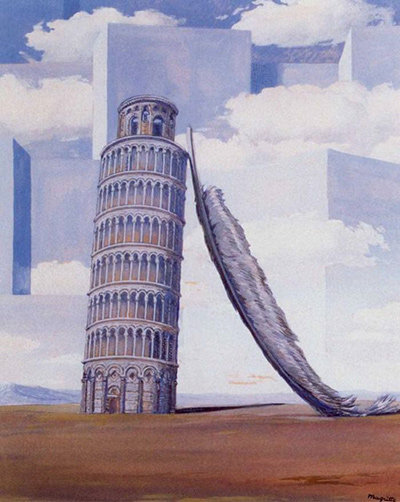
The Leaning Tower of Pisa tilts towards a feather in René Magritte’s Memory of a Journey. The feather stands diagonally, the bare tip of its shaft reaching up to the tower and its broad, ragged end curving down to the ground. Above them, white clouds pass among sharply bounded blocks of blue. The brown foreground is almost empty. With so little around the tower, it is easy to see how far it leans and how little appears to be holding it up.
The version reproduced here is the upright Souvenir de voyage catalogued as number 1454 in volume IV of the catalogue raisonné. The Museo Nacional Thyssen-Bornemisza reproduced it in La máquina Magritte as a gouache on paper from the Pérez Simón Collection, dated 1955 and measuring 37 by 30.5 centimetres. The online catalogue raisonné index gives a tentative date of 1958 and lists 55 by 31.4 centimetres as uncertain measurements. The repeated catalogue number and the illustrated composition identify the picture, while the two sets of object details remain in disagreement. [1] [2]
At a Glance
- Original titleSouvenir de voyage
- Date1955 in the Thyssen catalogue. Tentatively 1958 in the catalogue index.
- MediumGouache on paper, as exhibited at the Thyssen
- Size37 × 30.5 cm in the Thyssen catalogue. The index gives 55 × 31.4 cm as uncertain.
- Catalogue numberSylvester IV 1454
What the feather seems to hold
The tower rises in a series of rings. On each level the narrow columns and arches follow the curve of the building, giving us a sense of how it would look from the side. The rings are tilted too, so the effect of the lean continues from the base to the smaller chamber at the top. The plain surroundings make this especially clear. There are no adjoining buildings for comparison, and the low horizon gives us a nearly horizontal line against which to judge the angle.
The feather meets the tower high on its right side, near the point where the building has moved furthest from the vertical. From there the dark line of the shaft curves down and away. The feather’s fine strands follow the bend, with broken edges that are especially visible against the paler sky. At the bottom the plume fans out across the ground. It occupies enough of the picture to look like a prop, yet its texture keeps reminding us how easily a feather bends.
A narrow shadow extends across the ground to the right of the tower. It gives the stone base a place on the same surface where the feather comes to rest. The two objects have very different textures, and very little of the composition comes between them. Looking from the bottom of the tower to the point where the shaft reaches it gives the eye a path to follow. Looking back down the shaft makes the relation seem almost familiar, as if the feather had been set there in the way we might put a brace under an object about to tip.
A faint line of hills at the left gives a measure of distance. They are low and blue, whereas the tower keeps its bands of brown and grey all the way to the ground. The tower might almost be a model set down in front of the hills. The feather’s size makes that reading momentarily plausible.
Watch: Understanding Magritte
Three complementary films introduce the artist, explore words and images, and examine a painting’s materials. These are broader Magritte comparisons, alongside the work discussed here.
René Magritte: Great Art Explained
An introduction to Magritte’s life, characteristic images and visual puzzles.
Watch on YouTubeBlocks in an open sky
A broad, almost square patch of blue sits behind the top of the tower. Its upper edge runs across a passage of clouds, and its pale left edge is nearly vertical. Another blue form at the left starts with a dark side face and then widens into a lighter plane. Further shapes are partially visible at the right and near the upper edge. Their straight boundaries are especially clear because the clouds around them break up into soft curves.
Individual blocks can appear to have depth where a side face meets a front. Elsewhere the same blue makes it hard to decide where a block ends and the open sky takes over. Several of the straight edges disappear behind clouds. The clouds in turn appear lighter against the blocks than they do where they meet the pale sky. Magritte gives enough information to recognise an arrangement of angular forms without providing a fixed distance between them. The sky seems at once to recede and to present surfaces we could trace with a ruler.
That uncertainty has a counterpart below. The rows of arches make the tower look carefully built, while the feather changes the way we understand its balance. Above, the depth suggested by the clouds is equally recognisable, and the flat faces ask us to draw solid boundaries inside it. We can move from the arcs of the tower to the curves of the feather and on to the outlines of the clouds. Each curve leads sooner or later to one of the abrupt straight edges Magritte sets against it.
Other views of Pisa and other journeys
Magritte returned to the tower and feather in several works. The Metropolitan Museum of Art owns the broad 1958 oil Night in Pisa, which also places blue blocks in the sky. The museum notes that Magritte explored the composition in the panorama he painted for the Knokke Casino in 1953. Christie’s documents another treatment, an August 1958 oil called Souvenir de voyage that Harry Torczyner commissioned. In that canvas the tower and feather are set against a pink evening sky. Its commission and date belong to that oil. [3] [4]
The title was available for images with quite different subjects. On this site Memory of a Voyage follows the oil in which an apple and pear appear to have turned to stone. Christie’s records that work under the same French title, Souvenir de voyage. The English titles help distinguish the two pages. A reader following the French title through an exhibition catalogue can use the tower, feather and sky blocks to locate the gouache discussed here. [1] [5]
Pisa gives the viewer a known place to begin. The repeated arches and the inclined silhouette can suggest a travel image even in an unfamiliar landscape. Once the feather comes into view, the leaning that identifies the tower becomes part of a problem about weight. The skyline offers its own puzzle, in the way clouds seem to pass in front of solid pieces of blue. The tower keeps the picture recognisable through these changes. Each time the eye returns to it, the shape that identifies the landmark renews the impression that the delicate shaft has been put there to hold the stone in place.
Magritte artworks directory
| Name | Date | Medium |
|---|---|---|
| Memory of a Voyage | 1963 | Oil on canvas |
| The Blood of the World | 1927; also catalogued as 1926–27 | Oil on canvas |
| The Hunters at the Edge of Night | Paris, 1928 | Oil on canvas |
| The Empty Picture Frame (La saignée) | 1938–39 | Gouache on paper |
| The Glass House | 1939 | Gouache on paper |
| Oasis | 1926 in the illustrated Christie’s catalogue | Oil on canvas |
| Natural Encounters | 1945 | Oil on canvas |
| Attempting the Impossible | 1928 | Oil on canvas |
| On the Threshold of Liberty | 1930 | Oil on canvas |
| The Titanic Days | 1928 | Oil on canvas |
| The Voice of Space | 1931 | Oil on canvas |
| Unexpected Answer | 1932 in the museum catalogue, 1933 on the reverse | Oil on canvas |
| Elective Affinities | 1932 in MoMA’s checklist, also published as 1933 | Oil on canvas |
| The Human Condition II | 1935 | Oil on canvas |
| The Six Elements | 1929 | Oil on canvas |
| The Happy Donor | 1966 | Oil on canvas |
| Clairvoyance (Self Portrait) | Brussels, 1936 | Oil on canvas |
| Philosopher’s Lamp | 1936 | Oil on canvas |
| The Annunciation | Paris, 1930 | Oil on canvas |
| The Lost Jockey | Circa 1942 in the illustrated lot catalogue | Gouache on paper laid down on canvas |
| Homage to Mack Sennett | 1936 in the Thyssen catalogue | Oil on canvas |
| Discovery | 1927 | Oil on canvas |
| Collective Invention | 1935 in the later catalogue index | Oil on canvas |
| The Wonders of Nature | 1953 | Oil on canvas |
| The Balcony | Circa 1950, with 1950 inscribed on the reverse | Oil on canvas |
| The Pilgrim | 1966 | Oil on canvas |
| The Invention of Life | 1928 | Oil on canvas |
| The Therapist | 1941 | Gouache on paper |
| The Gradation of Fire | 1938 or 1939 in the catalogue index | Gouache on paper |
| A Friend of Order | 1964 | Oil on canvas |
| The Poetic World | 1939 in Hammacher’s illustrated monograph | Gouache |
| The Muscles of the Sky | Paris, 1927 | Oil on canvas |
| The Battle of the Argonne | 1959 | Oil on canvas |
| Meditation | 1936 | Oil on canvas |
| The Domain of Arnheim | 1962 | Oil on canvas |
| This Is Not an Apple | 1964 | Oil on Unilite |
| The Meaning of Night | Brussels, 1927 | Oil on canvas |
| The Pleasure Principle (Portrait of Edward James) | 1937 | Oil on canvas |
| Ready Made Bouquet | 1957 | Oil on canvas |
| Popular Panorama | 1926 | Oil on canvas |
| Memory of a Journey | 1955 in the Thyssen catalogue. Tentatively 1958 in the catalogue index. | Gouache on paper, as exhibited at the Thyssen |
| Sheherazade | 1947 | Gouache on paper |
| The Difficult Crossing | 1926 | Oil on canvas |
| The Fair Captive | 1948 in the catalogue raisonné | Oil on canvas |
| The Birth of the Idol | 1926 | Oil on canvas |
| Hegel’s Holiday | 1958 | Oil on canvas |
| Homesickness | 1941 | Oil on canvas |
| The Rape (Le Viol) | 1934 | Oil on canvas |
| The Art of Living | 1967 | Oil on canvas |
| Secret Life IV | 1928 | Oil on canvas |
| The Tomb of the Wrestlers | 1960 | Oil on canvas |
| Young Girl Eating a Bird (The Pleasure) | 1927 | Oil on canvas |
| The Central Story | 1928 | Oil on canvas |
| The Seducer | 1953 | Oil on canvas |
| The Telescope | 1963 | Oil on canvas |
| The Banquet | 1958 | Oil on canvas |
| The Empty Mask | 1928 | Oil on canvas |
| The Cultivation of Ideas | 1927 | Oil on canvas |
| The Enchanted Pose | 1927 | Oil on canvas |
| The Future of Statues | 1937 | Oil on plaster |
| The Return of the Flame | 1943 | Oil on canvas |
| The White Page | 1967 | Oil on canvas |
| The Large Family | 1963 | Oil on canvas |
| Black Magic | 1945 | Oil on canvas |
| Les Amants I | 1928 | Oil on canvas |
| Man in a Bowler Hat | 1964 | Oil on canvas |
| The Portrait | 1935 | Oil on canvas |
| The Sixteenth of September | 1956 | Oil on canvas |
| Heartstrings | 1960 | Oil on canvas |
| The Present | 1939; also dated 1938 or 1939 | Gouache on paper |
| Act of Violence | 1932 | Oil on canvas |
| Fashionable People | 1950, in the 2016 thesis caption | Medium unconfirmed · Attribution follows the published caption |
| The Representation | 1962 | Oil on canvas |
| Memory | 1948 | Gouache on paper |
| The Mysteries of the Horizon | 1955 | Oil on canvas |
| Portrait of Stephy Langui | 1961 | Oil on canvas |
| The Double Secret | 1927 | Oil on canvas |
| Every Day | 1966 | Oil on canvas |
| The Invisible World | 1954 | Oil on canvas |
| Dawn of Cayenne | 1926 | Oil painting |
| Clear Ideas | 1955 (inscribed); possible 1958 execution | Oil on canvas |
| The Face of Genius | 1926 / 1927 | Oil on canvas |
| Good Faith | 1965; earlier record 1964–65 | Oil on canvas |
| The Flash | 1959 | Gouache and pencil on paper |
| Perpetual Motion | 1935; earlier catalogue 1934 | Oil on canvas |
| Personal Values | 1952 | Oil on canvas |
| Not to Be Reproduced | 1937 | Oil on canvas |
| The Red Model | 1935 | Oil on canvas |
| The Menaced Assassin | 1927 | Oil on canvas |
| The Castle of the Pyrenees | 1959 | Oil on canvas |
| The Blank Signature | 1965 | Oil on canvas |
| The Listening Room | 1952 | Oil on canvas |
| Golconde | 1953 | Oil on canvas |
| Time Transfixed | 1938 | Oil on canvas |
| The Treachery of Images | 1929 | Oil on canvas |
| The False Mirror | 1929 | Oil on canvas |
| The Empire of Light | 1953–54 | Oil on canvas |
| The Human Condition | 1933 | Oil on canvas |
| Les Amants | 1928 | Oil on canvas |
| The Son of Man | 1964 | Oil on canvas |
Frequently Asked Questions
The upright gouache with the tower, feather and blue sky blocks, CR 1454.
Discussion
Look closely and compare your reading with others.
Reader Insights
Which part of the feather makes it look most like a support?
How do the clouds affect your sense of where the blocks are in the sky?
What changes when you compare the gouache with the pink-sky oil?
Join the Conversation
Share a detail, comparison or question about Memory of a Journey below.
References
- Museo Nacional Thyssen-Bornemisza. La máquina Magritte. Exhibition catalogue, 2021, p. 162, Recuerdo de viaje, CR 1454. View source.
- Magritte. Toutes les œuvres, tous les thèmes. Catalogue raisonné index, vol. IV, p. 213, no. 1454. View source.
- The Metropolitan Museum of Art. Night in Pisa (La nuit de Pise), 1958. Collection record, 2018.651.1. View source.
- Christie’s. Souvenir de voyage, 1958. Illustrated lot record, 6414617. View source.
- Christie’s. Souvenir de voyage. Illustrated lot record for the apple and pear oil, 5459983. View source.







