


 by Tom Gurney
Tom Gurney BSc (Hons) is an art history expert with over 20 years experience
Page created on / Page updated on
Email: tomgurney1@gmail.com / Phone: +44 7429 011000
Philosopher’s Lamp
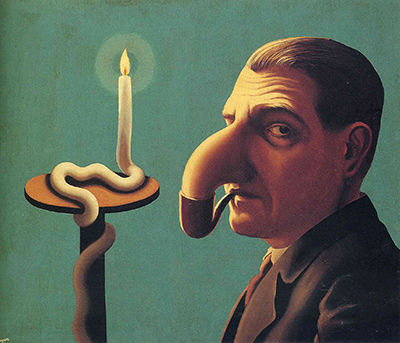
The man in René Magritte’s Philosopher’s Lamp holds a pipe in his mouth. His nose extends down into its bowl. Beside him, a candle burns on a round stand, with a length of pale wax curving across the top and hanging down beside the support. The sitter looks out towards us. His jacket, tie and neatly combed hair belong to the familiar setting of a portrait. The candle and pipe make it difficult to take that familiarity for granted. Both are easy to recognise, and both have taken forms that make their ordinary uses hard to imagine.
The Museo Nacional Thyssen-Bornemisza reproduced this painting under the French title La Lampe philosophique in the catalogue for The Magritte Machine. Its exhibition checklist dates the oil on canvas to 1936, gives the dimensions as 50 by 66 centimetres and credits a private collection in Belgium at the time of the exhibition. [1] [2]
At a Glance
- Original titleLa Lampe philosophique
- Date1936
- MediumOil on canvas
- Size50 × 66 cm
Selected works
Contents
Where the pipe meets the face
The man’s head takes up much of the right side. His forehead catches the light and the creases above his visible eye give his face an expression of concentration. The collar and lapels sit squarely beneath his chin. From the top of his head we can follow a series of recognisable shapes down towards the mouth. The long nose disrupts that descent. It reaches into the open space at the left and bends down before it meets the pipe.
A narrow light edge separates the skin from the dark bowl. The bowl curves back towards the face, and its stem ends at the lips. This makes a short loop from the nose to the bowl and back to the mouth. The lines are clear enough for us to follow what is happening even though the arrangement would interfere with the use of the pipe. The dark bowl has the scale of a familiar object, and the painter gives the much less familiar nose enough shading to seem equally solid.
The eye draws us back from that small circuit. Its pupil is directed towards the viewer even though the face turns towards the left. For a moment we share the attention of someone who seems to have noticed us looking. We can shift to the pipe, then return to the eye without leaving the contours of a painted face. That closeness also makes it difficult to take the nose as an isolated visual trick. It belongs to a person whose look makes us aware of our own position before the canvas.
The flame and the folded wax
On the left, the flame is a small upright shape surrounded by a pale glow. The top of the candle is nearly straight. Follow it down towards the stand and it curves sharply, runs sideways and doubles back across the round surface. Its last length falls over the edge, curling beside the support. The pale highlights run along those bends. They make the wax look rounded and substantial even as its course resembles something more flexible.
Watch: Understanding Magritte
Three complementary films introduce the artist, explore words and images, and examine a painting’s materials. These are broader Magritte comparisons, alongside the work discussed here.
René Magritte: Great Art Explained
An introduction to Magritte’s life, characteristic images and visual puzzles.
Watch on YouTubeThe stand is essential to the effect. Its round top is seen from above, so we can tell where the pale material lies across it and where it passes out in front. The straight support beneath it gives us a vertical reference for the dangling part of the candle. At the top of the picture, the flame still sits above a wick in a position we would expect. The longer we look below it, the less the rest of the candle resembles the thing a wick normally stands in.
There is a visual rhyme between the candle’s bend and the downward turn of the nose. Each begins close to a vertical line and moves sideways before changing direction again. Each also passes between a highlighted surface and a much darker one. The background gives the two curves enough open space to be seen together. The candle and the sitter can be compared even before the title suggests a relation between the person and the source of light.
The relative heights of the two main forms keep the painting from becoming a simple comparison of shapes. The flame is near the level of the man’s hair. The round stand is closer to the height of the pipe. The dark support then runs down beside the coat. Those pairings give us several points at which to cross the space in the middle. They also keep the faint halo at the upper left separate from the heavier shapes along the bottom.
A pipe in use and a pipe on its own
Magritte had already isolated a pipe in the 1929 oil The Treachery of Images, now at the Los Angeles County Museum of Art. There the painted pipe stands above a sentence in French that denies it is a pipe. The museum’s label uses that juxtaposition to draw attention to the difference between an object and an image of it. In Philosopher’s Lamp, the pipe is part of a portrait and the mouthpiece is at the sitter’s lips. The interference comes from the shape of the body attached to those lips. To understand the change, we have to look at what the painted pipe might allow the sitter to do. [3]
The Thyssen exhibition catalogue reads the portrait as a satire on a thinker absorbed in himself. The pipe’s little circuit gives that interpretation a basis in the arrangement of the picture. Our attention keeps returning to the same face, mouth and bowl. Yet the candle also offers a separate place to look. Its flame is high enough to draw the eye away from the sitter, and the irregular wax takes that eye down to the stand and back across the gap. The two shapes give the picture different routes of attention even as the sitter seems to occupy a closed one. [1]
The title can therefore change where we look for the lamp’s work. The little flame provides a visible source of light, with a light patch on the face nearest to it. The sitter’s eye, meanwhile, is directed out of that area. A familiar portrait might connect light with a fuller view of the person. Here, better light gives us a clearer view of an arrangement that becomes harder to explain as we follow it around.
Magritte artworks directory
| Name | Date | Medium |
|---|---|---|
| Memory of a Voyage | 1963 | Oil on canvas |
| The Blood of the World | 1927; also catalogued as 1926–27 | Oil on canvas |
| The Hunters at the Edge of Night | Paris, 1928 | Oil on canvas |
| The Empty Picture Frame (La saignée) | 1938–39 | Gouache on paper |
| The Glass House | 1939 | Gouache on paper |
| Oasis | 1926 in the illustrated Christie’s catalogue | Oil on canvas |
| Natural Encounters | 1945 | Oil on canvas |
| Attempting the Impossible | 1928 | Oil on canvas |
| On the Threshold of Liberty | 1930 | Oil on canvas |
| The Titanic Days | 1928 | Oil on canvas |
| The Voice of Space | 1931 | Oil on canvas |
| Unexpected Answer | 1932 in the museum catalogue, 1933 on the reverse | Oil on canvas |
| Elective Affinities | 1932 in MoMA’s checklist, also published as 1933 | Oil on canvas |
| The Human Condition II | 1935 | Oil on canvas |
| The Six Elements | 1929 | Oil on canvas |
| The Happy Donor | 1966 | Oil on canvas |
| Clairvoyance (Self Portrait) | Brussels, 1936 | Oil on canvas |
| Philosopher’s Lamp | 1936 | Oil on canvas |
| The Annunciation | Paris, 1930 | Oil on canvas |
| The Lost Jockey | Circa 1942 in the illustrated lot catalogue | Gouache on paper laid down on canvas |
| Homage to Mack Sennett | 1936 in the Thyssen catalogue | Oil on canvas |
| Discovery | 1927 | Oil on canvas |
| Collective Invention | 1935 in the later catalogue index | Oil on canvas |
| The Wonders of Nature | 1953 | Oil on canvas |
| The Balcony | Circa 1950, with 1950 inscribed on the reverse | Oil on canvas |
| The Pilgrim | 1966 | Oil on canvas |
| The Invention of Life | 1928 | Oil on canvas |
| The Therapist | 1941 | Gouache on paper |
| The Gradation of Fire | 1938 or 1939 in the catalogue index | Gouache on paper |
| A Friend of Order | 1964 | Oil on canvas |
| The Poetic World | 1939 in Hammacher’s illustrated monograph | Gouache |
| The Muscles of the Sky | Paris, 1927 | Oil on canvas |
| The Battle of the Argonne | 1959 | Oil on canvas |
| Meditation | 1936 | Oil on canvas |
| The Domain of Arnheim | 1962 | Oil on canvas |
| This Is Not an Apple | 1964 | Oil on Unilite |
| The Meaning of Night | Brussels, 1927 | Oil on canvas |
| The Pleasure Principle (Portrait of Edward James) | 1937 | Oil on canvas |
| Ready Made Bouquet | 1957 | Oil on canvas |
| Popular Panorama | 1926 | Oil on canvas |
| Memory of a Journey | 1955 in the Thyssen catalogue. Tentatively 1958 in the catalogue index. | Gouache on paper, as exhibited at the Thyssen |
| Sheherazade | 1947 | Gouache on paper |
| The Difficult Crossing | 1926 | Oil on canvas |
| The Fair Captive | 1948 in the catalogue raisonné | Oil on canvas |
| The Birth of the Idol | 1926 | Oil on canvas |
| Hegel’s Holiday | 1958 | Oil on canvas |
| Homesickness | 1941 | Oil on canvas |
| The Rape (Le Viol) | 1934 | Oil on canvas |
| The Art of Living | 1967 | Oil on canvas |
| Secret Life IV | 1928 | Oil on canvas |
| The Tomb of the Wrestlers | 1960 | Oil on canvas |
| Young Girl Eating a Bird (The Pleasure) | 1927 | Oil on canvas |
| The Central Story | 1928 | Oil on canvas |
| The Seducer | 1953 | Oil on canvas |
| The Telescope | 1963 | Oil on canvas |
| The Banquet | 1958 | Oil on canvas |
| The Empty Mask | 1928 | Oil on canvas |
| The Cultivation of Ideas | 1927 | Oil on canvas |
| The Enchanted Pose | 1927 | Oil on canvas |
| The Future of Statues | 1937 | Oil on plaster |
| The Return of the Flame | 1943 | Oil on canvas |
| The White Page | 1967 | Oil on canvas |
| The Large Family | 1963 | Oil on canvas |
| Black Magic | 1945 | Oil on canvas |
| Les Amants I | 1928 | Oil on canvas |
| Man in a Bowler Hat | 1964 | Oil on canvas |
| The Portrait | 1935 | Oil on canvas |
| The Sixteenth of September | 1956 | Oil on canvas |
| Heartstrings | 1960 | Oil on canvas |
| The Present | 1939; also dated 1938 or 1939 | Gouache on paper |
| Act of Violence | 1932 | Oil on canvas |
| Fashionable People | 1950, in the 2016 thesis caption | Medium unconfirmed · Attribution follows the published caption |
| The Representation | 1962 | Oil on canvas |
| Memory | 1948 | Gouache on paper |
| The Mysteries of the Horizon | 1955 | Oil on canvas |
| Portrait of Stephy Langui | 1961 | Oil on canvas |
| The Double Secret | 1927 | Oil on canvas |
| Every Day | 1966 | Oil on canvas |
| The Invisible World | 1954 | Oil on canvas |
| Dawn of Cayenne | 1926 | Oil painting |
| Clear Ideas | 1955 (inscribed); possible 1958 execution | Oil on canvas |
| The Face of Genius | 1926 / 1927 | Oil on canvas |
| Good Faith | 1965; earlier record 1964–65 | Oil on canvas |
| The Flash | 1959 | Gouache and pencil on paper |
| Perpetual Motion | 1935; earlier catalogue 1934 | Oil on canvas |
| Personal Values | 1952 | Oil on canvas |
| Not to Be Reproduced | 1937 | Oil on canvas |
| The Red Model | 1935 | Oil on canvas |
| The Menaced Assassin | 1927 | Oil on canvas |
| The Castle of the Pyrenees | 1959 | Oil on canvas |
| The Blank Signature | 1965 | Oil on canvas |
| The Listening Room | 1952 | Oil on canvas |
| Golconde | 1953 | Oil on canvas |
| Time Transfixed | 1938 | Oil on canvas |
| The Treachery of Images | 1929 | Oil on canvas |
| The False Mirror | 1929 | Oil on canvas |
| The Empire of Light | 1953–54 | Oil on canvas |
| The Human Condition | 1933 | Oil on canvas |
| Les Amants | 1928 | Oil on canvas |
| The Son of Man | 1964 | Oil on canvas |
Frequently Asked Questions
A man holds a pipe whose bowl meets his extended nose. Beside him, a burning candle curves over a round stand.
The Thyssen exhibition catalogue dates the oil on canvas to 1936.
Discussion
Look closely and compare your reading with others.
Reader Insights
Which line makes the pipe and nose look like a continuous shape?
How does the stand affect your reading of the candle?
Where do you look after meeting the sitter’s gaze?
Join the Conversation
Share a detail, comparison or question about Philosopher’s Lamp below.
References
- Museo Nacional Thyssen-Bornemisza. La máquina Magritte. Exhibition catalogue, catalogue entry 2 and the accompanying discussion. View source.
- Museo Nacional Thyssen-Bornemisza. The Magritte Machine. Exhibition list of works, La Lampe philosophique. View source.
- Los Angeles County Museum of Art. The Treachery of Images (This is Not a Pipe). Collection record and wall label, 78.7. View source.







