


 by Tom Gurney
Tom Gurney BSc (Hons) is an art history expert with over 20 years experience
Page created on / Page updated on
Email: tomgurney1@gmail.com / Phone: +44 7429 011000
The Return of the Flame
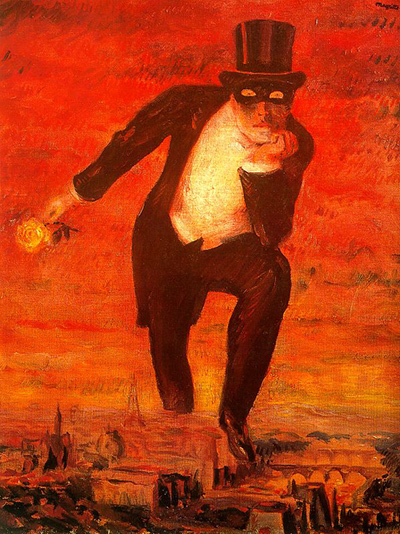
A masked man in a top hat looms above a city in René Magritte’s The Return of the Flame. One leg bends forward over the rooftops. One arm reaches out to the left, and at the end of it, close to the edge of the canvas, is a yellow rose. The sky around the figure is streaked with orange and red. Dark traces of buildings cling to the bottom of the composition, leaving most of the canvas to the man and the sky. The flower is small enough to miss on a first glance, even though it alters the meaning of the gesture.
Magritte painted Le Retour de flamme in oil on canvas in 1943. The French catalogue and motif index lists it as number 535 in volume II of the catalogue raisonné and gives the dimensions as unknown. The Art Gallery of New South Wales exhibited it as The Flame Rekindled. Its exhibition label identifies the figure as Fantômas, the masked criminal from French popular fiction, and relates the composition to the original cover of the first Fantômas novel. [1] [2]
At a Glance
- Original titleLe Retour de flamme
- Date1943
- MediumOil on canvas
- Catalogue numberSylvester II 535
Selected works
A figure above the rooftops
The top hat is close to the upper edge, almost directly above the foot that descends towards the city. A bent knee projects to the right and the opposite shoulder extends to the left. The figure occupies different parts of the picture at different heights, giving the pose a sense of motion. His other leg ends in the warm haze above the buildings. These limits are hard to reconcile with the ordinary position of a person on the ground. The darkness of the suit makes the man’s shape clear while the smaller marks below give us a measure of how large he appears.
The mask is a short band of dark paint with two light openings. The colours of the face below it are close to those of the surrounding sky. The lightest part of the figure is the broad expanse of shirt, which gathers the warm light into a compact area between the arms. It is edged by the jacket on both sides. The line from the shoulder down the outstretched sleeve is one of the longest diagonals in the upper half of the canvas. It carries the eye away from the mask towards the exposed hand.
The buildings are crowded together along the bottom. Individual marks suggest walls, towers and rooflines, with broader patches between them that catch the sky’s colour. There is little distance between one dark building and the next in the foreground. As the eye moves up into the picture, the marks become looser and the red and orange take over. The buildings remain recognisable enough to establish the point of view. Looking at them makes the man seem impossibly large, and looking at him makes the city seem like something he could cross in a single step.
Watch: Understanding Magritte
Three complementary films introduce the artist, explore words and images, and examine a painting’s materials. These are broader Magritte comparisons, alongside the work discussed here.
René Magritte: Great Art Explained
An introduction to Magritte’s life, characteristic images and visual puzzles.
Watch on YouTubeThe rose and the book cover
The New South Wales exhibition label describes the figure on the original Fantômas cover as a masked man in a top hat and tails looming over Paris with a bloody knife. Magritte retained the scale of the figure, the formal dress and the extended arm. The museum draws attention to the rose in the place where the cover gives the man a weapon. Because the position of the arm is still emphatic, the gesture retains something of the cover’s threat. The flower gives the viewer a second way to understand it. [2]
The flower sits in an uneven patch of yellow and orange, its centre picked out by a tight spiral of smaller marks. Dark strokes near it help separate the stem and leaves from the warm background. The brightness of the petals draws attention to the end of the long dark sleeve. Once we see what the man is holding, we can follow the same line back to the mask and consider the whole gesture again. A change in a small part of the picture affects the character of a figure who occupies almost the entire canvas.
The Royal Museums of Fine Arts of Belgium also relate the cover to Magritte’s The Menaced Assassin. Their exhibition dossier draws a parallel between the cover figure and the pose of a man in a bowler hat in that earlier painting. In The Return of the Flame, the top hat and the dark mask keep the resemblance close. The open sky and sweeping arm give the simple substitution room to register. Knowing the cover adds another layer to the image because we can mentally put the knife back into the hand and see how much its removal changes the scene. [3]
The colour of the sky
Streaks of dark red and brown cross the upper part of the painting at an angle. They leave brighter areas visible between them. Lower down, the orange becomes more even around the figure and then breaks again into separate strokes among the buildings. A few cooler or darker touches make the extent of the warm colour easier to see. Its presence on the man’s shirt and face brings the figure into the same light as the sky. The rose is caught up in that field of colour, which partly explains why it takes a moment to recognise.
Research on Galerie Lou Cosyn at Ghent University lists the painting among recent works shown by Magritte in July 1943. The catalogue number connects that record to the oil discussed here. The gallery history gives the painting a documented setting in the year it was made. Its borrowing from a popular novel belongs to another setting, one in which a bold silhouette and a few unmistakable props could identify a character before someone opened the book. Both settings help explain why it matters that Magritte kept the outline of the figure so legible. [1] [4]
The title can make the red sky and the bright bloom seem closely related. In the picture the eye can travel from one to the other by following the sleeve, then return to the rooftops under the man’s foot. That path through the painting leaves the masked figure poised between the action implied by his stride and the delicacy of what he holds.
Magritte artworks directory
| Name | Date | Medium |
|---|---|---|
| Memory of a Voyage | 1963 | Oil on canvas |
| The Blood of the World | 1927; also catalogued as 1926–27 | Oil on canvas |
| The Hunters at the Edge of Night | Paris, 1928 | Oil on canvas |
| The Empty Picture Frame (La saignée) | 1938–39 | Gouache on paper |
| The Glass House | 1939 | Gouache on paper |
| Oasis | 1926 in the illustrated Christie’s catalogue | Oil on canvas |
| Natural Encounters | 1945 | Oil on canvas |
| Attempting the Impossible | 1928 | Oil on canvas |
| On the Threshold of Liberty | 1930 | Oil on canvas |
| The Titanic Days | 1928 | Oil on canvas |
| The Voice of Space | 1931 | Oil on canvas |
| Unexpected Answer | 1932 in the museum catalogue, 1933 on the reverse | Oil on canvas |
| Elective Affinities | 1932 in MoMA’s checklist, also published as 1933 | Oil on canvas |
| The Human Condition II | 1935 | Oil on canvas |
| The Six Elements | 1929 | Oil on canvas |
| The Happy Donor | 1966 | Oil on canvas |
| Clairvoyance (Self Portrait) | Brussels, 1936 | Oil on canvas |
| Philosopher’s Lamp | 1936 | Oil on canvas |
| The Annunciation | Paris, 1930 | Oil on canvas |
| The Lost Jockey | Circa 1942 in the illustrated lot catalogue | Gouache on paper laid down on canvas |
| Homage to Mack Sennett | 1936 in the Thyssen catalogue | Oil on canvas |
| Discovery | 1927 | Oil on canvas |
| Collective Invention | 1935 in the later catalogue index | Oil on canvas |
| The Wonders of Nature | 1953 | Oil on canvas |
| The Balcony | Circa 1950, with 1950 inscribed on the reverse | Oil on canvas |
| The Pilgrim | 1966 | Oil on canvas |
| The Invention of Life | 1928 | Oil on canvas |
| The Therapist | 1941 | Gouache on paper |
| The Gradation of Fire | 1938 or 1939 in the catalogue index | Gouache on paper |
| A Friend of Order | 1964 | Oil on canvas |
| The Poetic World | 1939 in Hammacher’s illustrated monograph | Gouache |
| The Muscles of the Sky | Paris, 1927 | Oil on canvas |
| The Battle of the Argonne | 1959 | Oil on canvas |
| Meditation | 1936 | Oil on canvas |
| The Domain of Arnheim | 1962 | Oil on canvas |
| This Is Not an Apple | 1964 | Oil on Unilite |
| The Meaning of Night | Brussels, 1927 | Oil on canvas |
| The Pleasure Principle (Portrait of Edward James) | 1937 | Oil on canvas |
| Ready Made Bouquet | 1957 | Oil on canvas |
| Popular Panorama | 1926 | Oil on canvas |
| Memory of a Journey | 1955 in the Thyssen catalogue. Tentatively 1958 in the catalogue index. | Gouache on paper, as exhibited at the Thyssen |
| Sheherazade | 1947 | Gouache on paper |
| The Difficult Crossing | 1926 | Oil on canvas |
| The Fair Captive | 1948 in the catalogue raisonné | Oil on canvas |
| The Birth of the Idol | 1926 | Oil on canvas |
| Hegel’s Holiday | 1958 | Oil on canvas |
| Homesickness | 1941 | Oil on canvas |
| The Rape (Le Viol) | 1934 | Oil on canvas |
| The Art of Living | 1967 | Oil on canvas |
| Secret Life IV | 1928 | Oil on canvas |
| The Tomb of the Wrestlers | 1960 | Oil on canvas |
| Young Girl Eating a Bird (The Pleasure) | 1927 | Oil on canvas |
| The Central Story | 1928 | Oil on canvas |
| The Seducer | 1953 | Oil on canvas |
| The Telescope | 1963 | Oil on canvas |
| The Banquet | 1958 | Oil on canvas |
| The Empty Mask | 1928 | Oil on canvas |
| The Cultivation of Ideas | 1927 | Oil on canvas |
| The Enchanted Pose | 1927 | Oil on canvas |
| The Future of Statues | 1937 | Oil on plaster |
| The Return of the Flame | 1943 | Oil on canvas |
| The White Page | 1967 | Oil on canvas |
| The Large Family | 1963 | Oil on canvas |
| Black Magic | 1945 | Oil on canvas |
| Les Amants I | 1928 | Oil on canvas |
| Man in a Bowler Hat | 1964 | Oil on canvas |
| The Portrait | 1935 | Oil on canvas |
| The Sixteenth of September | 1956 | Oil on canvas |
| Heartstrings | 1960 | Oil on canvas |
| The Present | 1939; also dated 1938 or 1939 | Gouache on paper |
| Act of Violence | 1932 | Oil on canvas |
| Fashionable People | 1950, in the 2016 thesis caption | Medium unconfirmed · Attribution follows the published caption |
| The Representation | 1962 | Oil on canvas |
| Memory | 1948 | Gouache on paper |
| The Mysteries of the Horizon | 1955 | Oil on canvas |
| Portrait of Stephy Langui | 1961 | Oil on canvas |
| The Double Secret | 1927 | Oil on canvas |
| Every Day | 1966 | Oil on canvas |
| The Invisible World | 1954 | Oil on canvas |
| Dawn of Cayenne | 1926 | Oil painting |
| Clear Ideas | 1955 (inscribed); possible 1958 execution | Oil on canvas |
| The Face of Genius | 1926 / 1927 | Oil on canvas |
| Good Faith | 1965; earlier record 1964–65 | Oil on canvas |
| The Flash | 1959 | Gouache and pencil on paper |
| Perpetual Motion | 1935; earlier catalogue 1934 | Oil on canvas |
| Personal Values | 1952 | Oil on canvas |
| Not to Be Reproduced | 1937 | Oil on canvas |
| The Red Model | 1935 | Oil on canvas |
| The Menaced Assassin | 1927 | Oil on canvas |
| The Castle of the Pyrenees | 1959 | Oil on canvas |
| The Blank Signature | 1965 | Oil on canvas |
| The Listening Room | 1952 | Oil on canvas |
| Golconde | 1953 | Oil on canvas |
| Time Transfixed | 1938 | Oil on canvas |
| The Treachery of Images | 1929 | Oil on canvas |
| The False Mirror | 1929 | Oil on canvas |
| The Empire of Light | 1953–54 | Oil on canvas |
| The Human Condition | 1933 | Oil on canvas |
| Les Amants | 1928 | Oil on canvas |
| The Son of Man | 1964 | Oil on canvas |
Frequently Asked Questions
The Art Gallery of New South Wales identifies him as Fantômas.
Discussion
Look closely and compare your reading with others.
Reader Insights
Which details establish the figure’s scale relative to the city?
How does noticing the flower change the way you read the extended arm?
Where does the sky’s colour reappear in the figure?
Join the Conversation
Share a detail, comparison or question about The Return of the Flame below.
References
- Magritte. Toutes les œuvres, tous les thèmes. French catalogue raisonné and motif index, vol. II, p. 319, no. 535. View source.
- Art Gallery of New South Wales. Magritte, large-print exhibition labels, entry for The flame rekindled. View source.
- Royal Museums of Fine Arts of Belgium. Magritte, Broodthaers & l’art contemporain, French exhibition dossier. View source.
- Ghent University. Galerie Lou Cosyn (1941–1951), table 2. View source.







