


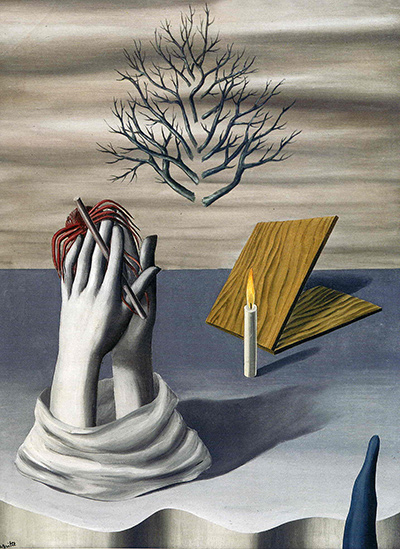


Dawn of Cayenne
Pale hands rise from a fold of white material, their fingers brought together around a thin rigid rod. A red spider spreads over them. Behind, bare branches hang against a grey sky, while a candle burns beside two angled wooden planes. Long shadows connect these improbable things to a surface whose front edge undulates across the picture.
This is René Magritte's 1926 oil painting Dawn of Cayenne, or L'aube à Cayenne, catalogued as Sylvester I 118. Philippe Roberts-Jones reproduced it in the Royal Museums' 1968 bulletin. A separate, later gouache returns to the subject; its paper support, smaller dimensions and history belong to another object. [1] [2]
At a Glance
Date and version
Contents
Hands without a complete figure
The hands are the most immediately human forms, yet they do not lead upwards to a face or downwards to a fully described body. Their wrists emerge from the folded white material, giving the group a definite base while leaving its larger physical situation unexplained.
Their pose can suggest prayer, but the object held among the fingers and the spider complicate that association. The hands remain close together, concentrating attention on a narrow area. Their pale surfaces make the red legs and darker rod especially visible.
Look at the relation between the fingers and the cloth-like base. The upper forms are long and comparatively slender; the folds below gather into a broader mound. This gives the group a sculptural presence. It seems to stand before us as an object, even though we recognise its principal parts as belonging to a living body.
The red spider and the rigid rod
The spider introduces an active pattern across the otherwise restrained colour scheme. Its thin legs reach around and over the fingers, making several small contacts. Their repeated curves contrast with the straighter rod passing through the group.
The rod provides another direction for the eye to follow. It is relatively simple beside the many fingers and legs around it. Its rigidity gives the cluster an additional structure without explaining why these objects have been brought together.
These differences become more noticeable when viewed slowly. At first, the hands may dominate the recognition of the group. The red form then asserts itself, and the rod draws attention through the overlaps. The arrangement combines bodily familiarity with relationships that remain difficult to translate into a single action.
Branches suspended in the sky
The bare branches occupy the upper centre. They spread outwards and upwards without a trunk rooted in the surface below. Their separated lower sections make the apparent suspension more pronounced: the viewer can follow familiar branching forms while finding their expected continuity interrupted.
The group of branches also answers the hands visually. Both divide into long, narrowing extensions, and both occupy positions that make them look detached from a larger body. This resemblance is available to the eye without requiring the two forms to become literal equivalents.
Notice the spaces between the branches. The sky remains visible through them, so their shape is made partly by dark lines and partly by the intervals those lines enclose. The hands, by contrast, form a denser, paler cluster. Their related outlines therefore coexist with a striking difference in visual weight.
Candle and wooden planes
The burning candle introduces a small, concentrated brightness beside the hands. Its flame is slight compared with the width of the grey sky, yet it remains easy to find. The upright white body also gives the lower part of the composition a relatively simple vertical accent.
Watch: Understanding Magritte
Three complementary films introduce the artist, explore words and images, and examine a painting’s materials. These are broader Magritte comparisons, alongside the work discussed here.
René Magritte: Great Art Explained
An introduction to Magritte’s life, characteristic images and visual puzzles.
Watch on YouTubeBehind it, two wooden planes meet at an angle. Their grain gives them a material identity distinct from skin, flame and branches. Their arrangement may recall open pages, but the visible surfaces retain the appearance of timber. The analogy makes their form easier to grasp without settling their function.
Together, candle and wood make a second cluster across from the hands. The two groups do not repeat one another exactly. Their different heights, surfaces and degrees of complexity establish a balance across the image, while the branches occupy the space above and between them.
Shadows and the uncertain surface
The shadows give the arrangement a degree of physical coherence. Even when the objects are difficult to explain, their darker extensions make them seem related to the same supporting surface. The pale hands and white candle acquire weight through their contrast with those darker areas.
The front edge of the surface creates a different uncertainty. Its wave-like contour does not resemble a simple rectangular tabletop. A darker vertical passage near the right edge adds another obstruction, reminding us that the lower setting is not fully described by ordinary still-life furniture.
Follow the shadows back towards the objects casting them. This is one of the painting's most persuasive routes into physical space. Then look upwards at the suspended branches, whose place remains harder to establish. The image combines convincing contacts with missing connections, allowing both conditions to persist within the same restrained setting.
Cayenne and the question of interpretation
Roberts-Jones associated the title and arrangement with Cayenne's prison context, bound hands and the possibility of liberation. His discussion is an interpretation of the painting's relationships, rather than a definitive list of symbols supplied by Magritte. The link between confinement and the hands is suggestive, but it should remain distinguishable from what the image directly shows. [1]
The title can therefore affect how we experience the still life without converting it into a literal view of a particular place. The grey sky, flame and isolated forms do not provide a detailed geographical setting. Their association is constructed through the image and its name, leaving room for an encounter that is more unsettling than a plainly illustrated narrative.
That openness is important to the picture's effect. The hands can seem devotional, restrained or exposed. The branches can appear broken or suspended. The candle offers a recognisable flame amid a setting that resists complete explanation. These possibilities arise from visible relationships, rather than from an obligation to give every object one permanent meaning.
The 1926 oil and the later gouache
Christie's catalogue for a 1957 gouache explicitly distinguishes it from the similarly titled 1926 oil, Sylvester I 118, shown in Magritte's 1927 Galerie Le Centaure exhibition. The later work revisits the arrangement on paper; it is not the canvas reproduced here. [2]
Returning to this earlier painting, the limited colour and sparse setting are especially striking. The red spider and yellowish flame punctuate broad areas of grey, blue and pale flesh. Each small colour accent helps connect attention to a particular object without supplying an answer to the whole arrangement.
The painting's power lies in that combination of economy and unresolved association. Hands, branches, candle and wood are given enough presence to be studied separately. Together, they establish a world in which physical clarity does not guarantee a clear explanation, and the gaps between things remain as compelling as the things themselves.
Magritte artworks directory
| Name | Date | Medium |
|---|---|---|
| Memory of a Voyage | 1963 | Oil on canvas |
| The Blood of the World | 1927; also catalogued as 1926–27 | Oil on canvas |
| The Hunters at the Edge of Night | Paris, 1928 | Oil on canvas |
| The Empty Picture Frame (La saignée) | 1938–39 | Gouache on paper |
| The Glass House | 1939 | Gouache on paper |
| Oasis | 1926 in the illustrated Christie’s catalogue | Oil on canvas |
| Natural Encounters | 1945 | Oil on canvas |
| Attempting the Impossible | 1928 | Oil on canvas |
| On the Threshold of Liberty | 1930 | Oil on canvas |
| The Titanic Days | 1928 | Oil on canvas |
| The Voice of Space | 1931 | Oil on canvas |
| Unexpected Answer | 1932 in the museum catalogue, 1933 on the reverse | Oil on canvas |
| Elective Affinities | 1932 in MoMA’s checklist, also published as 1933 | Oil on canvas |
| The Human Condition II | 1935 | Oil on canvas |
| The Six Elements | 1929 | Oil on canvas |
| The Happy Donor | 1966 | Oil on canvas |
| Clairvoyance (Self Portrait) | Brussels, 1936 | Oil on canvas |
| Philosopher’s Lamp | 1936 | Oil on canvas |
| The Annunciation | Paris, 1930 | Oil on canvas |
| The Lost Jockey | Circa 1942 in the illustrated lot catalogue | Gouache on paper laid down on canvas |
| Homage to Mack Sennett | 1936 in the Thyssen catalogue | Oil on canvas |
| Discovery | 1927 | Oil on canvas |
| Collective Invention | 1935 in the later catalogue index | Oil on canvas |
| The Wonders of Nature | 1953 | Oil on canvas |
| The Balcony | Circa 1950, with 1950 inscribed on the reverse | Oil on canvas |
| The Pilgrim | 1966 | Oil on canvas |
| The Invention of Life | 1928 | Oil on canvas |
| The Therapist | 1941 | Gouache on paper |
| The Gradation of Fire | 1938 or 1939 in the catalogue index | Gouache on paper |
| A Friend of Order | 1964 | Oil on canvas |
| The Poetic World | 1939 in Hammacher’s illustrated monograph | Gouache |
| The Muscles of the Sky | Paris, 1927 | Oil on canvas |
| The Battle of the Argonne | 1959 | Oil on canvas |
| Meditation | 1936 | Oil on canvas |
| The Domain of Arnheim | 1962 | Oil on canvas |
| This Is Not an Apple | 1964 | Oil on Unilite |
| The Meaning of Night | Brussels, 1927 | Oil on canvas |
| The Pleasure Principle (Portrait of Edward James) | 1937 | Oil on canvas |
| Ready Made Bouquet | 1957 | Oil on canvas |
| Popular Panorama | 1926 | Oil on canvas |
| Memory of a Journey | 1955 in the Thyssen catalogue. Tentatively 1958 in the catalogue index. | Gouache on paper, as exhibited at the Thyssen |
| Sheherazade | 1947 | Gouache on paper |
| The Difficult Crossing | 1926 | Oil on canvas |
| The Fair Captive | 1948 in the catalogue raisonné | Oil on canvas |
| The Birth of the Idol | 1926 | Oil on canvas |
| Hegel’s Holiday | 1958 | Oil on canvas |
| Homesickness | 1941 | Oil on canvas |
| The Rape (Le Viol) | 1934 | Oil on canvas |
| The Art of Living | 1967 | Oil on canvas |
| Secret Life IV | 1928 | Oil on canvas |
| The Tomb of the Wrestlers | 1960 | Oil on canvas |
| Young Girl Eating a Bird (The Pleasure) | 1927 | Oil on canvas |
| The Central Story | 1928 | Oil on canvas |
| The Seducer | 1953 | Oil on canvas |
| The Telescope | 1963 | Oil on canvas |
| The Banquet | 1958 | Oil on canvas |
| The Empty Mask | 1928 | Oil on canvas |
| The Cultivation of Ideas | 1927 | Oil on canvas |
| The Enchanted Pose | 1927 | Oil on canvas |
| The Future of Statues | 1937 | Oil on plaster |
| The Return of the Flame | 1943 | Oil on canvas |
| The White Page | 1967 | Oil on canvas |
| The Large Family | 1963 | Oil on canvas |
| Black Magic | 1945 | Oil on canvas |
| Les Amants I | 1928 | Oil on canvas |
| Man in a Bowler Hat | 1964 | Oil on canvas |
| The Portrait | 1935 | Oil on canvas |
| The Sixteenth of September | 1956 | Oil on canvas |
| Heartstrings | 1960 | Oil on canvas |
| The Present | 1939; also dated 1938 or 1939 | Gouache on paper |
| Act of Violence | 1932 | Oil on canvas |
| Fashionable People | 1950, in the 2016 thesis caption | Medium unconfirmed · Attribution follows the published caption |
| The Representation | 1962 | Oil on canvas |
| Memory | 1948 | Gouache on paper |
| The Mysteries of the Horizon | 1955 | Oil on canvas |
| Portrait of Stephy Langui | 1961 | Oil on canvas |
| The Double Secret | 1927 | Oil on canvas |
| Every Day | 1966 | Oil on canvas |
| The Invisible World | 1954 | Oil on canvas |
| Dawn of Cayenne | 1926 | Oil painting |
| Clear Ideas | 1955 (inscribed); possible 1958 execution | Oil on canvas |
| The Face of Genius | 1926 / 1927 | Oil on canvas |
| Good Faith | 1965; earlier record 1964–65 | Oil on canvas |
| The Flash | 1959 | Gouache and pencil on paper |
| Perpetual Motion | 1935; earlier catalogue 1934 | Oil on canvas |
| Personal Values | 1952 | Oil on canvas |
| Not to Be Reproduced | 1937 | Oil on canvas |
| The Red Model | 1935 | Oil on canvas |
| The Menaced Assassin | 1927 | Oil on canvas |
| The Castle of the Pyrenees | 1959 | Oil on canvas |
| The Blank Signature | 1965 | Oil on canvas |
| The Listening Room | 1952 | Oil on canvas |
| Golconde | 1953 | Oil on canvas |
| Time Transfixed | 1938 | Oil on canvas |
| The Treachery of Images | 1929 | Oil on canvas |
| The False Mirror | 1929 | Oil on canvas |
| The Empire of Light | 1953–54 | Oil on canvas |
| The Human Condition | 1933 | Oil on canvas |
| Les Amants | 1928 | Oil on canvas |
| The Son of Man | 1964 | Oil on canvas |
Frequently Asked Questions
They are arranged in a way that can recall open pages, but their grain and surfaces look like timber. The resemblance is useful without requiring a fixed identification.
Discussion
Look closely at the objects, their boundaries and the setting around them.
Reader Insights
Which connection between the hands and branches seems most compelling?
How does the small flame change the balance of the grey setting?
Which shadows make the objects feel most physically present?
Join the Conversation
Share a detail, comparison or question about Dawn of Cayenne below.
References
- Philippe Roberts-Jones, “Les poèmes visibles de René Magritte”, Royal Museums of Fine Arts of Belgium, Bulletin (1968), p. 66. Reproduction, 1926 date and attributed interpretation. View source.Splash image: Dawn of Cayenne (L’aube à Cayenne), 1926. The oil painting, Sylvester I 118, reproduced in the 1968 Royal Museums bulletin; distinct from the 1957 gouache.
- Christie's, L'aube à Cayenne, lot 453, separate 1957 gouache. Catalogue essay identifies the 1926 oil as Sylvester I 118 and records its 1927 exhibition. View source.







