



Act of Violence
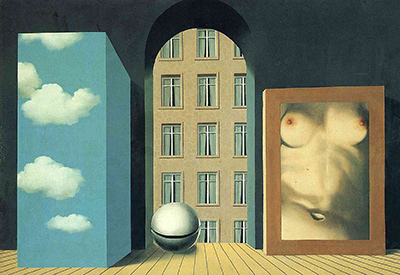
A cloud-filled sky occupies the face of a solid blue block. Beside it, an arched opening reveals a building patterned with windows. A silver bell rests on the timber floor, while a wooden frame encloses a cropped female torso. The arrangement is precise enough to recognise at once, yet its different kinds of enclosure refuse to fit into one ordinary room.
René Magritte's Act of Violence, or L'attentat, dates from 1932. The painting is oil on canvas, 70 × 100 centimetres, in the Groeningemuseum, Bruges, under inventory number 0000.GRO1631.I. The museum record and the Royal Museums' Dalí/Magritte exhibition guide identify the composition reproduced here. [1] [3]
At a Glance
Date and version
Act of Violence
1932 [1]Contents
A solid place for the sky
The block at the left gives the sky a surprisingly definite shape. Clouds that would normally extend across an atmosphere are confined within a straight-edged blue face. Its vertical sides and substantial-looking thickness make the object seem capable of standing on the floor.
That thickness is important. A flat picture of clouds could be understood as something hung or propped within a room. Here, the additional plane gives the sky-bearing form a more pronounced bodily presence. We recognise an image of open air while also reading the structure that contains it as an object occupying space.
Look from the cloud edges towards the block's corners. The soft, irregular forms stop at boundaries that remain hard and geometrical. The opposition is not difficult to see, but it changes what the sky appears able to do. An element associated with distance and openness has become a conspicuous part of the foreground arrangement.
The arched opening and the windows
The central arch offers another kind of enclosure. Its curved top interrupts the room's darker surrounding wall, drawing attention towards the facade visible beyond. Repeated rectangular windows establish a regular pattern inside that opening.
The view does not offer the expansive distance suggested by the clouds at the left. Instead, the building presents another close-looking surface, with many smaller openings divided by its architecture. The eye encounters an opening that is itself largely filled by a wall and its window pattern.
This produces an interesting exchange between the two parts of the composition. The sky is brought forward into a solid block, while the apparent route out of the room gives us a building. Each area remains readable in isolation, but together they frustrate a straightforward division between an interior filled with objects and an exterior open to the world.
A torso within a wooden frame
At the right, the torso introduces the most immediately bodily form. Its pale modelling differs from the blue block and the repetitive windows. Yet the wooden border gives it a strong rectangular limit, making it part of the painting's wider arrangement of contained views.
The figure is cropped so closely that the body exceeds what its frame permits us to see. There is no complete person standing beside the bell. The visible passage of flesh belongs to a larger body we can imagine, while the picture allows access only to this limited portion.
Compare the frame's thickness with the block's side. Both give a view an object-like boundary. The materials and contents differ, but their physical-looking edges bring the sky and torso into a relationship. The composition repeatedly asks us to consider what happens when something extensive is presented through a restrictive form.
Watch: Understanding Magritte
Three complementary films introduce the artist, explore words and images, and examine a painting’s materials. These are broader Magritte comparisons, alongside the work discussed here.
René Magritte: Great Art Explained
An introduction to Magritte’s life, characteristic images and visual puzzles.
Watch on YouTubeThe bell on the floor
The bell is smaller and more compact than its neighbours. Its curved surface catches the light, and a dark division helps distinguish it from a perfectly smooth sphere. It sits low in the composition, close to the foot of the arch.
Its rounded shape interrupts the more insistent verticals around it. Block, facade and frame direct attention upwards, while the bell gives us a comparatively contained object near the ground. It can be identified quickly, but its reason for being among these other things remains open.
Notice how its bright upper surface differs from the torso's warmer flesh and the block's blue plane. These contrasts make the bell feel materially specific. The painting's uncertainty does not arise because all its objects are vague. Their clarity is part of the problem: familiar things occupy a shared space without supplying a familiar explanation for their proximity.
Timber lines and shallow space
The floorboards establish a directional pattern beneath the objects. Their lines lead the eye into the room and give the upright forms a common support. The yellowish colour also provides a relatively warm lower band against the darker wall and blue block.
At the same time, the arrangement remains compressed. The facade fills much of the central opening, and the large foreground objects occupy a considerable portion of the available width. The image promises spatial depth through the arch and floor, then repeatedly brings attention back to surfaces.
Try following one floor line towards the opening before looking back at the block's side. The two passages establish different degrees of thickness and recession. Their combination makes the room convincing enough to enter imaginatively, while its contents keep that imagined entrance from becoming an entirely ordinary act of looking into a space.
What kind of violence?
The title can prompt an expectation of an event, but the composition presents a still arrangement. Its disturbances concern the treatment of familiar appearances: open sky is given a block-like body, a torso is restricted by a frame, and the apparent view through an arch ends in another architectural surface.
The Vlaamse Kunstcollectie discusses the image through these displaced, realistically painted elements, drawing particular attention to the contained sky and torso. That reading keeps interpretation close to the painting's visible organisation. It does not require us to assign a single political message to the bell or a fixed moral meaning to every colour. [2]
The effect can be understood as a pressure placed on ordinary relations between things. Each motif remains sufficiently familiar to identify. What has changed is its place, scale or boundary. The painting makes those changes feel exact, allowing the disturbance to persist after the first surprise has passed.
The painting in Bruges
The Groeningemuseum's account describes the Friends of Musea Brugge's acquisition through negotiations with Renée Lachowsky after Magritte's death. It also records the confirmation of a supporting government grant in July 1970. This is part of the painting's collection history, distinct from its 1932 date of creation. [1]
The return from that history to the image is especially rewarding because its organisation remains so economical. Four principal motifs occupy a limited space, yet their relationships continually redirect the eye. Sky, body, architecture and bell each offer something recognisable. Their assembly makes recognition the beginning of the encounter, rather than its conclusion.
Magritte artworks directory
| Name | Date | Medium |
|---|---|---|
| Memory of a Voyage | 1963 | Oil on canvas |
| The Blood of the World | 1927; also catalogued as 1926–27 | Oil on canvas |
| The Hunters at the Edge of Night | Paris, 1928 | Oil on canvas |
| The Empty Picture Frame (La saignée) | 1938–39 | Gouache on paper |
| The Glass House | 1939 | Gouache on paper |
| Oasis | 1926 in the illustrated Christie’s catalogue | Oil on canvas |
| Natural Encounters | 1945 | Oil on canvas |
| Attempting the Impossible | 1928 | Oil on canvas |
| On the Threshold of Liberty | 1930 | Oil on canvas |
| The Titanic Days | 1928 | Oil on canvas |
| The Voice of Space | 1931 | Oil on canvas |
| Unexpected Answer | 1932 in the museum catalogue, 1933 on the reverse | Oil on canvas |
| Elective Affinities | 1932 in MoMA’s checklist, also published as 1933 | Oil on canvas |
| The Human Condition II | 1935 | Oil on canvas |
| The Six Elements | 1929 | Oil on canvas |
| The Happy Donor | 1966 | Oil on canvas |
| Clairvoyance (Self Portrait) | Brussels, 1936 | Oil on canvas |
| Philosopher’s Lamp | 1936 | Oil on canvas |
| The Annunciation | Paris, 1930 | Oil on canvas |
| The Lost Jockey | Circa 1942 in the illustrated lot catalogue | Gouache on paper laid down on canvas |
| Homage to Mack Sennett | 1936 in the Thyssen catalogue | Oil on canvas |
| Discovery | 1927 | Oil on canvas |
| Collective Invention | 1935 in the later catalogue index | Oil on canvas |
| The Wonders of Nature | 1953 | Oil on canvas |
| The Balcony | Circa 1950, with 1950 inscribed on the reverse | Oil on canvas |
| The Pilgrim | 1966 | Oil on canvas |
| The Invention of Life | 1928 | Oil on canvas |
| The Therapist | 1941 | Gouache on paper |
| The Gradation of Fire | 1938 or 1939 in the catalogue index | Gouache on paper |
| A Friend of Order | 1964 | Oil on canvas |
| The Poetic World | 1939 in Hammacher’s illustrated monograph | Gouache |
| The Muscles of the Sky | Paris, 1927 | Oil on canvas |
| The Battle of the Argonne | 1959 | Oil on canvas |
| Meditation | 1936 | Oil on canvas |
| The Domain of Arnheim | 1962 | Oil on canvas |
| This Is Not an Apple | 1964 | Oil on Unilite |
| The Meaning of Night | Brussels, 1927 | Oil on canvas |
| The Pleasure Principle (Portrait of Edward James) | 1937 | Oil on canvas |
| Ready Made Bouquet | 1957 | Oil on canvas |
| Popular Panorama | 1926 | Oil on canvas |
| Memory of a Journey | 1955 in the Thyssen catalogue. Tentatively 1958 in the catalogue index. | Gouache on paper, as exhibited at the Thyssen |
| Sheherazade | 1947 | Gouache on paper |
| The Difficult Crossing | 1926 | Oil on canvas |
| The Fair Captive | 1948 in the catalogue raisonné | Oil on canvas |
| The Birth of the Idol | 1926 | Oil on canvas |
| Hegel’s Holiday | 1958 | Oil on canvas |
| Homesickness | 1941 | Oil on canvas |
| The Rape (Le Viol) | 1934 | Oil on canvas |
| The Art of Living | 1967 | Oil on canvas |
| Secret Life IV | 1928 | Oil on canvas |
| The Tomb of the Wrestlers | 1960 | Oil on canvas |
| Young Girl Eating a Bird (The Pleasure) | 1927 | Oil on canvas |
| The Central Story | 1928 | Oil on canvas |
| The Seducer | 1953 | Oil on canvas |
| The Telescope | 1963 | Oil on canvas |
| The Banquet | 1958 | Oil on canvas |
| The Empty Mask | 1928 | Oil on canvas |
| The Cultivation of Ideas | 1927 | Oil on canvas |
| The Enchanted Pose | 1927 | Oil on canvas |
| The Future of Statues | 1937 | Oil on plaster |
| The Return of the Flame | 1943 | Oil on canvas |
| The White Page | 1967 | Oil on canvas |
| The Large Family | 1963 | Oil on canvas |
| Black Magic | 1945 | Oil on canvas |
| Les Amants I | 1928 | Oil on canvas |
| Man in a Bowler Hat | 1964 | Oil on canvas |
| The Portrait | 1935 | Oil on canvas |
| The Sixteenth of September | 1956 | Oil on canvas |
| Heartstrings | 1960 | Oil on canvas |
| The Present | 1939; also dated 1938 or 1939 | Gouache on paper |
| Act of Violence | 1932 | Oil on canvas |
| Fashionable People | 1950, in the 2016 thesis caption | Medium unconfirmed · Attribution follows the published caption |
| The Representation | 1962 | Oil on canvas |
| Memory | 1948 | Gouache on paper |
| The Mysteries of the Horizon | 1955 | Oil on canvas |
| Portrait of Stephy Langui | 1961 | Oil on canvas |
| The Double Secret | 1927 | Oil on canvas |
| Every Day | 1966 | Oil on canvas |
| The Invisible World | 1954 | Oil on canvas |
| Dawn of Cayenne | 1926 | Oil painting |
| Clear Ideas | 1955 (inscribed); possible 1958 execution | Oil on canvas |
| The Face of Genius | 1926 / 1927 | Oil on canvas |
| Good Faith | 1965; earlier record 1964–65 | Oil on canvas |
| The Flash | 1959 | Gouache and pencil on paper |
| Perpetual Motion | 1935; earlier catalogue 1934 | Oil on canvas |
| Personal Values | 1952 | Oil on canvas |
| Not to Be Reproduced | 1937 | Oil on canvas |
| The Red Model | 1935 | Oil on canvas |
| The Menaced Assassin | 1927 | Oil on canvas |
| The Castle of the Pyrenees | 1959 | Oil on canvas |
| The Blank Signature | 1965 | Oil on canvas |
| The Listening Room | 1952 | Oil on canvas |
| Golconde | 1953 | Oil on canvas |
| Time Transfixed | 1938 | Oil on canvas |
| The Treachery of Images | 1929 | Oil on canvas |
| The False Mirror | 1929 | Oil on canvas |
| The Empire of Light | 1953–54 | Oil on canvas |
| The Human Condition | 1933 | Oil on canvas |
| Les Amants | 1928 | Oil on canvas |
| The Son of Man | 1964 | Oil on canvas |
Frequently Asked Questions
Yes. The collection interpretation identifies it as a silver bell, a recognisable everyday object within the unusual arrangement. [2]
It belongs to the Groeningemuseum collection in Bruges, inventory 0000.GRO1631.I. [1]
Discussion
Look closely at the objects, their boundaries and the setting around them.
Reader Insights
Which boundary most strongly changes the thing it contains?
How does the bell interrupt the geometry of the larger forms?
Does the arched opening make the room feel deeper or more confined?
Join the Conversation
Share a detail, comparison or question about Act of Violence below.
References
- Musea Brugge, L'attentat, 0000.GRO1631.I. Object dimensions, medium, collection and acquisition account. View source.Splash image: Act of Violence (L’attentat), 1932. Oil on canvas, 70 × 100 cm. Groeningemuseum, Bruges, 0000.GRO1631.I.
- Vlaamse Kunstcollectie, L'attentat, 1932. Collection metadata and interpretation of the sky, torso and bell. View source.
- Royal Museums of Fine Arts of Belgium, Dalí / Magritte, visitor's guide, p. 29. Reproduction labelled Act of Violence, 1932. View source.







