


 by Tom Gurney
Tom Gurney BSc (Hons) is an art history expert with over 20 years experience
Page created on / Page updated on
Email: tomgurney1@gmail.com / Phone: +44 7429 011000
The Domain of Arnheim
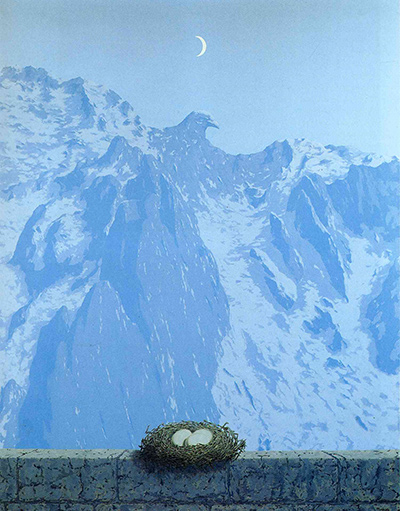
A nest with two eggs rests on a stone ledge in René Magritte’s The Domain of Arnheim. Beyond it, a snowy mountain range rises into a blue sky with a crescent moon. Near the centre of the ridge, a peak turns into the profile of a bird’s head. The beak is visible against the open sky. Lower down, the shadows and streaks of snow still belong to a mountainside. The eggs are close enough to count, and they give us a reason to see a bird in a form that otherwise belongs to the distance.
The picture shown here is the 1962 oil on canvas held by the Royal Museums of Fine Arts of Belgium, inventory 10707. It measures 146 by 114 centimetres and entered the collection in 1987 through the bequest of Georgette Magritte. The museum records the signature at lower right and a signature and title on the reverse. Magritte used Le Domaine d’Arnheim for several works. The crescent, two eggs and tall blue composition distinguish this canvas from the first oil of 1938. [1] [2] [3]
At a Glance
- Original titleLe Domaine d’Arnheim
- Date1962
- MediumOil on canvas
- Size146 × 114 cm
- CollectionRoyal Museums of Fine Arts of Belgium, 10707
Selected works
The ridge that becomes a bird
The highest range starts at the left. Broken patches of snow and blue shadow give these peaks a rough surface and make it possible to imagine how one slope turns behind the next. Follow the skyline towards the middle and its outline rises into a more compact shape. A short point bends down on the right, like a beak. It is easy to find once we know to look for it, though the changes of colour below it keep telling us we are looking at rock and snow.
The bird takes shape through different passages of the ridge. The head is comparatively small. From it, long slopes extend down and away, and the shadowed ridges can suggest the breadth of wings. This is easiest to see from a little distance, when the smaller patches of snow merge. Close to the picture, irregular lines interrupt much of the surface and lead the eye down into the valleys. The change in how much detail we can see affects which part of the image takes precedence. Magritte uses the outer contour to make the bird visible and the interior of the form to keep the mountains present.
The open space above the beak helps hold that reading. The sky is relatively even near the ridge, so the curve of the head is clear. A thin crescent sits higher up. Its small size and position make the sky feel much larger than the part immediately surrounding the bird’s profile. The moon also gives the eye somewhere to go after it reaches the beak. Following that route and then returning down the ridge makes the shape emerge again from the landscape.
Two eggs on the ledge
The ledge sets an entirely different scale. Its horizontal edge crosses the lower part of the canvas. The painted joints and irregular marks in the stone are easy to see because they are much nearer than the distant slopes. The nest sits along that edge, with uneven strands rising at its sides. The eggs take up only a small portion of the picture, yet their smooth light surfaces stand out from the dark fibres. They can be recognised from almost anywhere we choose to begin looking.
Watch: Understanding Magritte
Three complementary films introduce the artist, explore words and images, and examine a painting’s materials. These are broader Magritte comparisons, alongside the work discussed here.
René Magritte: Great Art Explained
An introduction to Magritte’s life, characteristic images and visual puzzles.
Watch on YouTubeBetween the ledge and the mountains there is no visible path or middle ground to join the two distances. The mountain can come down almost to the top of the wall in the picture without seeming immediately behind it. The eggs give us a familiar measure of size at the front. The ridge gives us something whose size has to be inferred from its peaks, from the extent of the snow and from the distant sky. The absence of a connecting surface lets the two scales remain very different while keeping the nest close to the bird in our view.
The ends of the ledge pass beyond the frame. Its front face stays dark under a narrow strip of paler stone at the top. From there the blue of the mountain rises into much lighter passages. The picture holds our attention around that meeting of colours. When we look back down from the snowy ridge, the dark nest draws the eye to the pale eggs. Looking up from the eggs makes the profile on the ridge easier to recognise.
The eggs overlap slightly, so even these two small forms have a near side and a far side. A similar layering happens along the crags, where the darker slopes stand forward of paler patches of snow. In the foreground we can see both kinds of edge in a single glance. The distant layering takes longer to follow. The change of scale lets a small arrangement of light shapes prepare us for a much larger one.
Poe’s title and Magritte’s versions
Christie’s account of the first oil cites Magritte’s May 1938 letter to Edward James, which links the title to Edgar Allan Poe’s story The Domain of Arnheim. The Belgian museum’s bulletin also connects Poe to Magritte’s description of a mountain taking the form of a bird with spread wings. Those accounts explain why the title belongs to the series. They also make clear how much of its effect depends on the arrangement of visible things. The painted mountain can be seen in detail as a landscape, and the same outline gives that landscape a shape we already recognise from another part of nature. [3] [4]
The 1938 oil makes use of the bird-shaped mountain and places two eggs in the foreground. The Brussels canvas returns to the idea with two eggs, a crescent and a cool, largely blue range of colours. The changes matter to the order in which the image comes into focus. Here the narrow white moon and the white eggs stand out at opposite ends of a tall view, and the bird’s head forms in the ridge between them. Our eyes can travel the whole height of the canvas without passing from the nest to a bird of any familiar size. The distances remain as much a part of the painting as each of the recognisable forms. [1] [3]
Magritte artworks directory
| Name | Date | Medium |
|---|---|---|
| Memory of a Voyage | 1963 | Oil on canvas |
| The Blood of the World | 1927; also catalogued as 1926–27 | Oil on canvas |
| The Hunters at the Edge of Night | Paris, 1928 | Oil on canvas |
| The Empty Picture Frame (La saignée) | 1938–39 | Gouache on paper |
| The Glass House | 1939 | Gouache on paper |
| Oasis | 1926 in the illustrated Christie’s catalogue | Oil on canvas |
| Natural Encounters | 1945 | Oil on canvas |
| Attempting the Impossible | 1928 | Oil on canvas |
| On the Threshold of Liberty | 1930 | Oil on canvas |
| The Titanic Days | 1928 | Oil on canvas |
| The Voice of Space | 1931 | Oil on canvas |
| Unexpected Answer | 1932 in the museum catalogue, 1933 on the reverse | Oil on canvas |
| Elective Affinities | 1932 in MoMA’s checklist, also published as 1933 | Oil on canvas |
| The Human Condition II | 1935 | Oil on canvas |
| The Six Elements | 1929 | Oil on canvas |
| The Happy Donor | 1966 | Oil on canvas |
| Clairvoyance (Self Portrait) | Brussels, 1936 | Oil on canvas |
| Philosopher’s Lamp | 1936 | Oil on canvas |
| The Annunciation | Paris, 1930 | Oil on canvas |
| The Lost Jockey | Circa 1942 in the illustrated lot catalogue | Gouache on paper laid down on canvas |
| Homage to Mack Sennett | 1936 in the Thyssen catalogue | Oil on canvas |
| Discovery | 1927 | Oil on canvas |
| Collective Invention | 1935 in the later catalogue index | Oil on canvas |
| The Wonders of Nature | 1953 | Oil on canvas |
| The Balcony | Circa 1950, with 1950 inscribed on the reverse | Oil on canvas |
| The Pilgrim | 1966 | Oil on canvas |
| The Invention of Life | 1928 | Oil on canvas |
| The Therapist | 1941 | Gouache on paper |
| The Gradation of Fire | 1938 or 1939 in the catalogue index | Gouache on paper |
| A Friend of Order | 1964 | Oil on canvas |
| The Poetic World | 1939 in Hammacher’s illustrated monograph | Gouache |
| The Muscles of the Sky | Paris, 1927 | Oil on canvas |
| The Battle of the Argonne | 1959 | Oil on canvas |
| Meditation | 1936 | Oil on canvas |
| The Domain of Arnheim | 1962 | Oil on canvas |
| This Is Not an Apple | 1964 | Oil on Unilite |
| The Meaning of Night | Brussels, 1927 | Oil on canvas |
| The Pleasure Principle (Portrait of Edward James) | 1937 | Oil on canvas |
| Ready Made Bouquet | 1957 | Oil on canvas |
| Popular Panorama | 1926 | Oil on canvas |
| Memory of a Journey | 1955 in the Thyssen catalogue. Tentatively 1958 in the catalogue index. | Gouache on paper, as exhibited at the Thyssen |
| Sheherazade | 1947 | Gouache on paper |
| The Difficult Crossing | 1926 | Oil on canvas |
| The Fair Captive | 1948 in the catalogue raisonné | Oil on canvas |
| The Birth of the Idol | 1926 | Oil on canvas |
| Hegel’s Holiday | 1958 | Oil on canvas |
| Homesickness | 1941 | Oil on canvas |
| The Rape (Le Viol) | 1934 | Oil on canvas |
| The Art of Living | 1967 | Oil on canvas |
| Secret Life IV | 1928 | Oil on canvas |
| The Tomb of the Wrestlers | 1960 | Oil on canvas |
| Young Girl Eating a Bird (The Pleasure) | 1927 | Oil on canvas |
| The Central Story | 1928 | Oil on canvas |
| The Seducer | 1953 | Oil on canvas |
| The Telescope | 1963 | Oil on canvas |
| The Banquet | 1958 | Oil on canvas |
| The Empty Mask | 1928 | Oil on canvas |
| The Cultivation of Ideas | 1927 | Oil on canvas |
| The Enchanted Pose | 1927 | Oil on canvas |
| The Future of Statues | 1937 | Oil on plaster |
| The Return of the Flame | 1943 | Oil on canvas |
| The White Page | 1967 | Oil on canvas |
| The Large Family | 1963 | Oil on canvas |
| Black Magic | 1945 | Oil on canvas |
| Les Amants I | 1928 | Oil on canvas |
| Man in a Bowler Hat | 1964 | Oil on canvas |
| The Portrait | 1935 | Oil on canvas |
| The Sixteenth of September | 1956 | Oil on canvas |
| Heartstrings | 1960 | Oil on canvas |
| The Present | 1939; also dated 1938 or 1939 | Gouache on paper |
| Act of Violence | 1932 | Oil on canvas |
| Fashionable People | 1950, in the 2016 thesis caption | Medium unconfirmed · Attribution follows the published caption |
| The Representation | 1962 | Oil on canvas |
| Memory | 1948 | Gouache on paper |
| The Mysteries of the Horizon | 1955 | Oil on canvas |
| Portrait of Stephy Langui | 1961 | Oil on canvas |
| The Double Secret | 1927 | Oil on canvas |
| Every Day | 1966 | Oil on canvas |
| The Invisible World | 1954 | Oil on canvas |
| Dawn of Cayenne | 1926 | Oil painting |
| Clear Ideas | 1955 (inscribed); possible 1958 execution | Oil on canvas |
| The Face of Genius | 1926 / 1927 | Oil on canvas |
| Good Faith | 1965; earlier record 1964–65 | Oil on canvas |
| The Flash | 1959 | Gouache and pencil on paper |
| Perpetual Motion | 1935; earlier catalogue 1934 | Oil on canvas |
| Personal Values | 1952 | Oil on canvas |
| Not to Be Reproduced | 1937 | Oil on canvas |
| The Red Model | 1935 | Oil on canvas |
| The Menaced Assassin | 1927 | Oil on canvas |
| The Castle of the Pyrenees | 1959 | Oil on canvas |
| The Blank Signature | 1965 | Oil on canvas |
| The Listening Room | 1952 | Oil on canvas |
| Golconde | 1953 | Oil on canvas |
| Time Transfixed | 1938 | Oil on canvas |
| The Treachery of Images | 1929 | Oil on canvas |
| The False Mirror | 1929 | Oil on canvas |
| The Empire of Light | 1953–54 | Oil on canvas |
| The Human Condition | 1933 | Oil on canvas |
| Les Amants | 1928 | Oil on canvas |
| The Son of Man | 1964 | Oil on canvas |
Frequently Asked Questions
The rock and snow form the outline of a bird’s head.
The eggs sit on the ledge in the foreground.
Discussion
Look closely and compare your reading with others.
Reader Insights
Which part of the ridge first begins to look like a bird?
How does the stone ledge affect your sense of how far away the mountains are?
How do the two eggs and the crescent guide your eye through the picture?
Join the Conversation
Share a detail, comparison or question about The Domain of Arnheim below.
References
- Royal Museums of Fine Arts of Belgium. Le Domaine d’Arnheim. French collection record, inventory 10707. View source.
- Royal Museums of Fine Arts of Belgium. Het Domein van Arnheim. Dutch collection record, inventory 10707. View source.
- Christie’s. Le domaine d’Arnheim. Illustrated record for the 1938 oil, lot 6328184, with the Edward James correspondence and later variants. View source.
- Royal Museums of Fine Arts of Belgium. Museum bulletin, 1985–88, no. 4. Illustrated notice for Le Domaine d’Arnheim. View source.







