


 by Tom Gurney
Tom Gurney BSc (Hons) is an art history expert with over 20 years experience
Page created on / Page updated on
Email: tomgurney1@gmail.com / Phone: +44 7429 011000
The Pilgrim
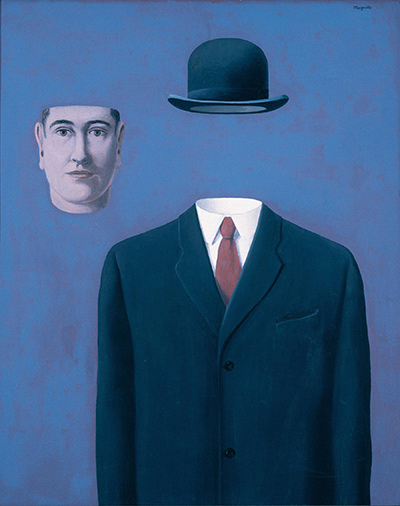
A dark suit, a bowler hat and a face appear against a blue ground in René Magritte’s The Pilgrim. The hat is suspended above the shirt collar. The face is off to the left, about level with the gap between them. We can recognise the parts of a portrait and imagine how they could fit together. Their actual positions give us two places to look for a person, one under the hat and the other where the eyes meet ours.
Magritte made Le Pèlerin in 1966. The index to the catalogue raisonné identifies it as number 1043 in volume III, an oil on canvas measuring 81 by 65 centimetres. Christie’s identifies the same catalogue number in the exhibition history of Baucis’s Landscape. Its account records that the two oils were shown with The Road to Damascus at the Iolas Gallery in Paris in 1966. [1] [2]
At a Glance
- Original titleLe Pèlerin
- Date1966
- MediumOil on canvas
- Size81 × 65 cm
- Catalogue numberSylvester III 1043
Selected works
The Gradation of Fire
1938 or 1939 in the catalogue indexThe Therapist
1941The Balcony
Circa 1950, with 1950 inscribed on the reverseThe Pilgrim
1966The place between hat and collar
The suit occupies most of the lower half of the picture. It is broad at the shoulders and extends out of view at the bottom. Two buttons and the break between the lapels give it a centre. The white collar carries that centre upwards to the red tie. The tie looks as though it has been knotted around a neck, and the shoulders give every appearance of supporting the garment. The upper edge of the shirt opens onto blue. That small oval is where the expectation of a body becomes hardest to sustain.
Above the shirt the bowler sits almost exactly where we would expect it to be. Its crown curves up into the blue. The brim stretches out at either side and turns slightly upwards near the ends. A lighter line along its lower edge gives it thickness. The hat looks like something that could be lifted from a head or placed back on one, and its position has the same symmetry as the collar. In between, there is enough space for a face. We have to leave that centre line to find the face Magritte gives us.
The blue in the interval belongs to the same field that surrounds the shoulder and the brim. There is no outline around the expected position of the head. Looking down from the hat, the white of the shirt comes abruptly into view. Looking up from the buttoned coat, we can follow the lapels and tie to a blue opening. The dark fabrics and white collar supply a precise edge around the gap without giving it a shape of its own.
A face at the side
The face is much smaller in area than the suit, but it draws attention quickly. The eyebrows, nose and reddish mouth are distinct against the pale skin. The eyes look out from the picture in much the way the eyes of a sitter might do. Above them, the head ends in a straight edge. That edge seems to anticipate the brim of the bowler, though it lies well to the left of it. Below, the contour closes around the chin without continuing into a neck.
Watch: Understanding Magritte
Three complementary films introduce the artist, explore words and images, and examine a painting’s materials. These are broader Magritte comparisons, alongside the work discussed here.
René Magritte: Great Art Explained
An introduction to Magritte’s life, characteristic images and visual puzzles.
Watch on YouTubeWhat makes the arrangement peculiar is how little effort it takes to connect the face to the clothes in imagination. The blue interval is about the right height, and the direction of the gaze suits the formal position of the shoulders. Yet there is also quite a lot of space between the face and the centre of the jacket. Moving only the eyes across that space can change whether we see two isolated objects or the displaced parts of a single person. The painting allows time for each of these impressions.
The red tie helps keep the garment in view as we make that comparison. Its angle is quite straight, with a wider patch of colour below the knot. The face has warmer colours in a smaller area around the lips and cheeks. Against the blue, both patches of warmth immediately stand out. They draw the eye across the gap without joining the face to the collar. Magritte gives us something to associate even at the points where the image leaves the parts apart.
Compare the widths of the three parts. The suit spreads almost across the canvas, leaving a slender strip of blue at its right. The hat is broad enough to cover the face if we bring them together in imagination. The face itself has a much smaller area of blue to its left than to its right. Those proportions make the separation readable at once. They also let the hat and face keep the sizes we expect from the shoulders and shirt below.
Three paintings shown together in 1966
Christie’s account of the Paris exhibition places The Pilgrim beside two oils in which Magritte also made the presence of the bowler-hatted figure difficult to locate. The Menil Collection holds the 1966 oil Baucis’s Landscape. Christie’s account describes the three paintings in relation to a text by Magritte’s friend Louis Scutenaire, who considered their titles as ways of approaching emptiness. The gap in The Pilgrim gives that idea a place in the composition. It has the particular dimensions of the space between a hat and a collar. The face nearby makes the absence more exact. [2] [3]
In The Happy Donor, painted the same year, a bowler and shoulders form the outline of a landscape with a crescent moon and a house. The outline is continuous, and it is what permits the landscape to take the shape of a person. In The Pilgrim, there is no continuous boundary to contain the space between hat and shirt. The face has a boundary of its own, some distance from the clothes. The two paintings make the familiar outline incomplete in different ways. A viewer looking for the person in The Pilgrim may find the eyes first, then begin the search again at the shoulder and the collar. [4]
The word pilgrim suggests someone on a journey. The blue ground offers no road, stopping place or landscape to put that journey into. The most definite change of position lies in the short distance from the face to the suit. We can cross it several times while the face keeps looking back. The title leaves that movement available without giving it a destination.
Magritte artworks directory
| Name | Date | Medium |
|---|---|---|
| Memory of a Voyage | 1963 | Oil on canvas |
| The Blood of the World | 1927; also catalogued as 1926–27 | Oil on canvas |
| The Hunters at the Edge of Night | Paris, 1928 | Oil on canvas |
| The Empty Picture Frame (La saignée) | 1938–39 | Gouache on paper |
| The Glass House | 1939 | Gouache on paper |
| Oasis | 1926 in the illustrated Christie’s catalogue | Oil on canvas |
| Natural Encounters | 1945 | Oil on canvas |
| Attempting the Impossible | 1928 | Oil on canvas |
| On the Threshold of Liberty | 1930 | Oil on canvas |
| The Titanic Days | 1928 | Oil on canvas |
| The Voice of Space | 1931 | Oil on canvas |
| Unexpected Answer | 1932 in the museum catalogue, 1933 on the reverse | Oil on canvas |
| Elective Affinities | 1932 in MoMA’s checklist, also published as 1933 | Oil on canvas |
| The Human Condition II | 1935 | Oil on canvas |
| The Six Elements | 1929 | Oil on canvas |
| The Happy Donor | 1966 | Oil on canvas |
| Clairvoyance (Self Portrait) | Brussels, 1936 | Oil on canvas |
| Philosopher’s Lamp | 1936 | Oil on canvas |
| The Annunciation | Paris, 1930 | Oil on canvas |
| The Lost Jockey | Circa 1942 in the illustrated lot catalogue | Gouache on paper laid down on canvas |
| Homage to Mack Sennett | 1936 in the Thyssen catalogue | Oil on canvas |
| Discovery | 1927 | Oil on canvas |
| Collective Invention | 1935 in the later catalogue index | Oil on canvas |
| The Wonders of Nature | 1953 | Oil on canvas |
| The Balcony | Circa 1950, with 1950 inscribed on the reverse | Oil on canvas |
| The Pilgrim | 1966 | Oil on canvas |
| The Invention of Life | 1928 | Oil on canvas |
| The Therapist | 1941 | Gouache on paper |
| The Gradation of Fire | 1938 or 1939 in the catalogue index | Gouache on paper |
| A Friend of Order | 1964 | Oil on canvas |
| The Poetic World | 1939 in Hammacher’s illustrated monograph | Gouache |
| The Muscles of the Sky | Paris, 1927 | Oil on canvas |
| The Battle of the Argonne | 1959 | Oil on canvas |
| Meditation | 1936 | Oil on canvas |
| The Domain of Arnheim | 1962 | Oil on canvas |
| This Is Not an Apple | 1964 | Oil on Unilite |
| The Meaning of Night | Brussels, 1927 | Oil on canvas |
| The Pleasure Principle (Portrait of Edward James) | 1937 | Oil on canvas |
| Ready Made Bouquet | 1957 | Oil on canvas |
| Popular Panorama | 1926 | Oil on canvas |
| Memory of a Journey | 1955 in the Thyssen catalogue. Tentatively 1958 in the catalogue index. | Gouache on paper, as exhibited at the Thyssen |
| Sheherazade | 1947 | Gouache on paper |
| The Difficult Crossing | 1926 | Oil on canvas |
| The Fair Captive | 1948 in the catalogue raisonné | Oil on canvas |
| The Birth of the Idol | 1926 | Oil on canvas |
| Hegel’s Holiday | 1958 | Oil on canvas |
| Homesickness | 1941 | Oil on canvas |
| The Rape (Le Viol) | 1934 | Oil on canvas |
| The Art of Living | 1967 | Oil on canvas |
| Secret Life IV | 1928 | Oil on canvas |
| The Tomb of the Wrestlers | 1960 | Oil on canvas |
| Young Girl Eating a Bird (The Pleasure) | 1927 | Oil on canvas |
| The Central Story | 1928 | Oil on canvas |
| The Seducer | 1953 | Oil on canvas |
| The Telescope | 1963 | Oil on canvas |
| The Banquet | 1958 | Oil on canvas |
| The Empty Mask | 1928 | Oil on canvas |
| The Cultivation of Ideas | 1927 | Oil on canvas |
| The Enchanted Pose | 1927 | Oil on canvas |
| The Future of Statues | 1937 | Oil on plaster |
| The Return of the Flame | 1943 | Oil on canvas |
| The White Page | 1967 | Oil on canvas |
| The Large Family | 1963 | Oil on canvas |
| Black Magic | 1945 | Oil on canvas |
| Les Amants I | 1928 | Oil on canvas |
| Man in a Bowler Hat | 1964 | Oil on canvas |
| The Portrait | 1935 | Oil on canvas |
| The Sixteenth of September | 1956 | Oil on canvas |
| Heartstrings | 1960 | Oil on canvas |
| The Present | 1939; also dated 1938 or 1939 | Gouache on paper |
| Act of Violence | 1932 | Oil on canvas |
| Fashionable People | 1950, in the 2016 thesis caption | Medium unconfirmed · Attribution follows the published caption |
| The Representation | 1962 | Oil on canvas |
| Memory | 1948 | Gouache on paper |
| The Mysteries of the Horizon | 1955 | Oil on canvas |
| Portrait of Stephy Langui | 1961 | Oil on canvas |
| The Double Secret | 1927 | Oil on canvas |
| Every Day | 1966 | Oil on canvas |
| The Invisible World | 1954 | Oil on canvas |
| Dawn of Cayenne | 1926 | Oil painting |
| Clear Ideas | 1955 (inscribed); possible 1958 execution | Oil on canvas |
| The Face of Genius | 1926 / 1927 | Oil on canvas |
| Good Faith | 1965; earlier record 1964–65 | Oil on canvas |
| The Flash | 1959 | Gouache and pencil on paper |
| Perpetual Motion | 1935; earlier catalogue 1934 | Oil on canvas |
| Personal Values | 1952 | Oil on canvas |
| Not to Be Reproduced | 1937 | Oil on canvas |
| The Red Model | 1935 | Oil on canvas |
| The Menaced Assassin | 1927 | Oil on canvas |
| The Castle of the Pyrenees | 1959 | Oil on canvas |
| The Blank Signature | 1965 | Oil on canvas |
| The Listening Room | 1952 | Oil on canvas |
| Golconde | 1953 | Oil on canvas |
| Time Transfixed | 1938 | Oil on canvas |
| The Treachery of Images | 1929 | Oil on canvas |
| The False Mirror | 1929 | Oil on canvas |
| The Empire of Light | 1953–54 | Oil on canvas |
| The Human Condition | 1933 | Oil on canvas |
| Les Amants | 1928 | Oil on canvas |
| The Son of Man | 1964 | Oil on canvas |
Frequently Asked Questions
The catalogue raisonné index records the oil in 1966.
A frontal face appears beside a dark jacket and below a bowler hat. Blue fills the space above the collar.
Discussion
Look closely and compare your reading with others.
Reader Insights
Which detail makes the hat and jacket look most like parts of the same figure?
Where does your eye go after meeting the face’s gaze?
What happens if you follow the blue from outside the figure into the space above the collar?
Join the Conversation
Share a detail, comparison or question about The Pilgrim below.
References
- Magritte. Toutes les œuvres, tous les thèmes. Catalogue raisonné index, vol. III, p. 432, no. 1043. View source.
- Christie’s. Le paysage de Baucis. Illustrated catalogue entry and exhibition history, lot 6469569. View source.
- The Menil Collection. Baucis’s Landscape (Le paysage de Baucis). Collection record, Y 207. View source.
- Musée d’Ixelles. L’heureux donateur. Collection record. View source.







