

 by Tom Gurney
Tom Gurney BSc (Hons) is an art history expert with over 20 years experience
Published on June 19, 2020 / Updated on August 29, 2026
Email: tomgurney1@gmail.com / Phone: +44 7429 011000
Why Fort Vimieux Matters
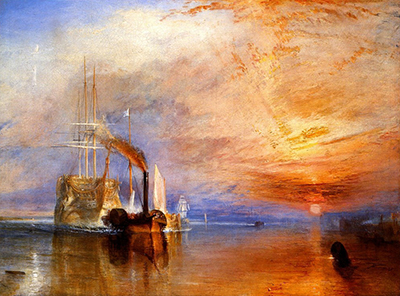
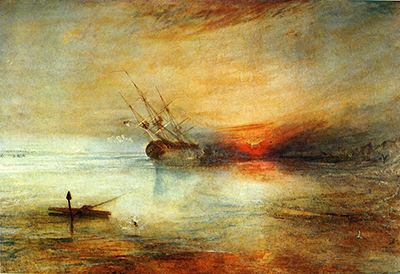
Fort Vimieux is one of Turner's most concentrated pictures of maritime danger: a stranded British warship, a French fort, a lowering sun, and the brief interval before darkness and a rising tide alter the fate of everyone in the scene. Painted in 1831 and now in a private collection, it belongs to the same broad phase of Turner's career as Calais Sands, Staffa, Fingal's Cave, and the later The Fighting Temeraire: works in which sea, weather and historical memory become inseparable. Its subject is not a celebrated fleet action or a formal naval triumph. It is a smaller, harsher episode from the Channel war of 1805, when British cruisers probed the fortified French coast and Napoleon's invasion flotilla pressed British anxieties to a high pitch.[1][2]
The painting matters partly because Turner makes a minor military incident feel elemental. The ship has run aground, but the sea is not raging. The apparent calm is the danger. Low water has left the vessel exposed, the guns onshore can find their range, and the red sun turns wet sand and shallow water into a burning field. The usual ingredients of marine painting are present--hull, mast, cloud, tide, smoke, shore--but Turner arranges them so that the central drama is suspense rather than impact. The ship may yet escape. The falling light and incoming water promise concealment and release. Until then, the crew must endure fire from land.[1]
The work also helps to correct a simple idea of Turner as only a painter of storms. Here he uses a quiet sea, a clear horizon and an almost ceremonial sunset to heighten unease. The stillness allows the viewer to measure the ship's vulnerability. The violence comes from distance: batteries, smoke, hot shot, the exposed angle of the grounded hull. Turner had long understood coastal water as a theatre where weather, labour, politics and chance meet. In Fort Vimieux, that understanding is sharpened by Napoleonic history and by his own repeated crossings between England and France.[5][13]
At a Glance
- ArtistJoseph Mallord William Turner
- TitleFort Vimieux
- Date1831
- MediumOil on canvas
- DimensionsApproximately 71.1 × 106.7 cm
- CollectionPrivate collection
- ExhibitionRoyal Academy, 1831, no. 406
- Historical placeVimereux, now Wimereux, near Boulogne
- Probable episodeBritish coastal action near Vimereux, July 1805
- Core dramaA grounded cruiser awaiting darkness and the rising tide
Contents
- Why Fort Vimieux Matters
- Object Identity and Title
- The 1831 Royal Academy Setting
- A French Coast Remembered Through War
- Wimereux, Boulogne and the Invasion Flotilla
- Reading the Stranded Ship
- Sunset, Tide and Artillery
- Turner's Coastal Memory
- Bonington and the Calais Shore
- From A Ship Aground to Fort Vimieux
Object Identity and Title
The modern title is Fort Vimieux, but the name is a historical tangle rather than a simple map label. The painting refers to Vimereux, now Wimereux, on the coast north of Boulogne-sur-Mer. The spelling "Vimieux" belongs to the older English form attached to the painting, and it should be retained as part of Turner's exhibition history rather than silently corrected. Sotheby's 2004 catalogue record identifies the canvas as Turner's work, exhibited at the Royal Academy in 1831, and traces it through nineteenth- and twentieth-century private and institutional ownership before its modern private collection status.[1]
The dimensions are usually given as about 71.1 by 106.7 centimetres, or roughly 28 by 42 inches.[3] That size is important. This is not a small travel study expanded only in the imagination; it is a full exhibition painting, scaled for public display and built to hold attention from across an Academy room. The format gives Turner room for the long grounded hull, the spread of shore and sea, the low horizon, and the sky that dominates the mood. It is horizontal enough to read as coastline, but compressed enough for the scene to feel trapped between the battery and the tide.
The 1831 Royal Academy catalogue did not present a concise title in the modern manner. Instead, the entry was accompanied by a long descriptive text explaining that, during reconnaissance on the French coast in 1805, a British cruiser grounded, came under fire from mobile artillery, shore batteries and Fort Vimieux, and had to wait for the rising tide to get away.[1][2] That catalogue wording does much of the narrative work that a title normally cannot do. It tells the viewer what kind of ship is involved, why it is in danger, where the fire is coming from, and why the changing tide matters.
Because Fort Vimieux is privately held, the Sotheby's record has unusual weight as the chief modern object authority. It supplies the known exhibition history, the principal provenance, a literature trail through Bell, Finberg, Wilton, Butlin and Joll, and a detailed interpretation of the subject.[1] Other public image records confirm the basic title, date, medium, measurements and private-collection status, but they do not replace the sale catalogue's fuller documentation.[3] The safest reading therefore begins with the 1831 exhibit and the modern catalogue record, then uses surrounding historical and artistic sources to explain the painting's world.
The 1831 Royal Academy Setting
The Royal Academy exhibition of 1831 opened in a politically charged year. Parliamentary reform was in the air, critics were pressing the Academy itself to reform, and the display at Somerset House gathered more than a thousand works by hundreds of exhibitors.[4] Turner was no outsider by this point. He was an Academician, a professor of perspective, and an artist whose annual exhibits were watched closely even by critics who found his handling difficult. A maritime painting with a Napoleonic subject would have carried strong public resonance only sixteen years after Waterloo and twenty-six years after the Channel invasion scare.
The Academy context also matters because Turner was thinking competitively and historically in that room. The 1831 exhibition is now often remembered for the charged relation between Turner and Constable, but Fort Vimieux belongs to a broader display culture in which large oils carried literary quotations, historical captions and patriotic references. Turner's long catalogue text gave viewers an entry into a scene that might otherwise look like an invented shipwreck. It placed the image in 1805, on the French coast, under fire, at the exact moment when a British vessel's survival depended on tide and time.[1][4]
The picture was not simply another sea view. It brought the Channel into the Academy as a contested border. British viewers in 1831 could remember, or had grown up hearing about, the years when Napoleon massed troops and boats near Boulogne. The French coast was not only a picturesque strip of sand and forts; it was the near edge of a threatened invasion. By choosing a grounded cruiser rather than a victorious fleet, Turner made that memory uneasy. The British ship is brave but vulnerable, and the French shore is not merely background. It is an active, firing edge.
This blend of pictorial splendour and military jeopardy helped the work attract admiring comment. Contemporary reviewers responded to its colour, theatricality and natural effect, and later accounts preserve praise from La Belle Assemblee, The Spectator and Library of the Fine Arts.[1][2] The enthusiasm is revealing. Turner was pushing marine painting towards greater chromatic intensity and atmospheric freedom, yet this was not dismissed as formless spectacle. Viewers could still grasp the anecdote, the tide, the vessel and the danger. The painting's radical colour worked because the narrative remained legible.
A French Coast Remembered Through War
The action behind Fort Vimieux belongs to the long crisis of 1803-05, when Napoleon assembled troops and vessels along the Channel coast in preparation for an invasion of Britain. The Pas-de-Calais archives describe the revival of the invasion project after the rupture of peace in 1803: camps were established along the coast, vessels were built or gathered, and ports including Boulogne-sur-Mer, Wimereux and Ambleteuse were developed for the flotilla.[5] The work's French setting is therefore not a generic coastline. It is part of a militarised coastal system.
Sotheby's notes that by July 1805 Napoleon's flotilla consisted of 1,337 armed and 154 unarmed vessels, organised into six large divisions, with the fourth under Captain Daugier occupying the port of Vimereux.[1] The exact numbers should be treated as catalogue evidence rather than decorative trivia. They help explain why a single grounded cruiser could stand for a larger confrontation. The British ship is not facing one picturesque fort alone. It is operating near a coast transformed into a guarded embarkation zone, where batteries, small craft and military roads made the shore itself into a weapon.
The British strategy in such waters often involved reconnaissance and provocation. Cruisers and small squadrons watched French movements, tested defences and tried to draw vessels beyond the safety of coastal batteries. Sotheby's connects Turner's subject with an action near Vimereux on 18 July 1805 involving a squadron that included Immortalite, Hebe and Arab.[1] Frick's account adds an important caution: the source named in the Lenox tradition as Naval Anecdotes has not been securely identified.[2] The painting can therefore be discussed as rooted in a known kind of Channel action, and probably in a specific incident, without forcing the evidence further than it goes.
This caution makes the picture more interesting, not less. Turner often built historical marine painting from a mixture of recorded event, remembered coast, compositional invention and atmospheric drama. Fort Vimieux is not a battle diagram. It does not ask the viewer to verify every gun position. Instead, it converts the pressures of 1805 into a scene of waiting: a vessel stranded within range, a crew dependent on tide, and a coast whose fortifications turn the setting sun into the colour of conflict.
Wimereux, Boulogne and the Invasion Flotilla
Wimereux lies only a short distance from Boulogne, and that geography matters. Boulogne was the symbolic centre of Napoleon's invasion preparations, but the nearby smaller harbours and batteries formed part of the same defensive and logistical network. The Pas-de-Calais account describes the scale of the mobilisation: troops and craft gathered along the Channel and North Sea coast, shipyards worked to provide flat-bottomed boats, and the ports around Boulogne, Wimereux and Ambleteuse were modified for the project.[5] Turner's fort therefore evokes a local structure within a much larger military system.
Local history identifies the Fort or Tour de Croy at Wimereux as a key element in that system. Histopale records Bonaparte's interest in the cove and tower in 1803, when he considered whether it could shelter flotilla vessels. The tower was armed and helped guard the entrance to the new harbour, forming part of a line of coastal fire with nearby defences such as the Fort de la Creche and the Fort de l'Heurt.[6] This is exactly the kind of fortified shore implied by Turner's catalogue text: not one romantic ruin, but a practical coastal battery able to threaten ships that came too close.
The historical setting also explains the painting's low-water drama. A vessel operating near an enemy coast did not need to be wrecked by a storm to be endangered. If it grounded, it could become a target. The Royal Academy text stresses the cruiser taking the ground and waiting to warp off with the rising tide.[1] That phrase turns tide into narrative clockwork. The ship is caught by one natural process and may be saved by another. Turner makes the situation visible through the slant of the hull, the exposed shore, the anchored lines of force and the broad gleam of wet sand.
By 1831 the invasion crisis had become history, but recent enough to remain emotionally charged. Trafalgar, Waterloo and Napoleon's exile had already entered British public memory, yet the Channel coast still carried the memory of alarm. Fort Vimieux looks backward from the Reform era to the wartime years, but it refuses simple closure. The enemy coast glows beautifully. The British ship is not triumphant. The danger is almost over, but not yet. This suspended timing is central to the painting's force.
Reading the Stranded Ship
The ship in Fort Vimieux lies canted on the sand, its hull tilted into a position that is both monumental and helpless. Sotheby's describes the vessel as secured by two anchors, one prominent in the foreground and another towards the distant beach.[1] These anchors are more than accessories. They show active seamanship under pressure. The crew has not surrendered to accident; it has stabilised the vessel, buying time until the incoming tide can lift the hull. Turner makes maritime knowledge part of the drama. Rescue is not miraculous. It depends on rigging, anchoring, timing and calm judgement.
The tilted ship also allows Turner to show vulnerability without sentimental excess. A warship is normally a sign of power. Here its guns, masts and mass cannot overcome the simple fact of grounding. Its strength has become exposed weight. The hull offers a target to the shore, and the masts, instead of announcing command of the sea, lean against a sky of unstable colour. Turner understood that maritime danger often comes from the reversal of expected relationships: water withdraws, land becomes lethal, a ship becomes almost architectural, and the coast becomes a battery.
The foreground reinforces the viewer's uneasy position. In Sotheby's description, shots from the shore have fallen short, while smoke on the horizon and an impact on the vessel register the ongoing exchange.[1] The viewer is not placed safely aboard the British ship or neutrally far away. The viewpoint is near the firing coast. That choice complicates any straightforward patriotic reading. We look at the stranded cruiser from the dangerous side, across the wet sand and shallow water that separate shore from hull. Turner's perspective makes us feel the exposure of the ship while also admitting the visual fascination of the enemy shore.
The ship's fate is therefore legible but unresolved. The catalogue text says it will be able to get off with the rising tide; the painting's moment still belongs to uncertainty.[1] The hull has not yet lifted. The sun has not yet disappeared. The guns have not fully fallen silent. Turner's art lies in holding the incident at the point where practical seamanship, fear and visual splendour overlap. The action is military, but its deepest tension is temporal: how long until dark, how long until water rises, how long until another shot strikes home.
Sunset, Tide and Artillery
Colour is the painting's most immediate force. The red descending sun stains the sky, sea and sand so intensely that military fire and natural light seem to answer one another. Sotheby's notes the fierce illumination cast across wet sand and calm water.[1] The effect is not merely picturesque. The setting sun becomes a second artillery. It exposes the ship, throws its forms into relief, and turns the ground around it into a field of glare. At the same time, its decline promises concealment. Light is danger before it becomes protection.
This double function of light is typical of Turner's mature marine painting. He rarely treats weather or sunlight as neutral atmosphere. In Fort Vimieux, the sunset carries narrative work. It measures the remaining time of visibility, binds the gun smoke to the sky, and transforms a military anecdote into a drama of colour. The French guns may fire heated shot, but the whole canvas seems heated by the sun. Turner finds an equivalence between human violence and natural intensity without confusing them. The cannon are historical; the colour is elemental.
The tide performs a similar double role. Low water has stranded the ship; rising water may free it. This is a subtle but crucial difference from storm-wreck imagery. Many marine pictures show water as overwhelming force. Here the lack of water is the immediate peril. The ship is exposed because the sea has withdrawn. The very calm that might look reassuring becomes a trap. Turner had spent decades studying coasts, harbours and shallow water. He knew that tidal timing could be as dramatic as wind.
The painting's artillery is therefore less visually dominant than its consequences. Smoke, flashes, fallen shot and the struck hull tell the story, but the guns themselves remain spatially separated from the viewer. This restraint keeps the composition from becoming a battlefield spectacle. Turner is interested in how war alters perception: a sunset becomes threatening, a calm sea becomes dangerous, and a fort on a distant shore dictates the emotional temperature of the entire scene. The viewer sees not only a ship under fire, but a landscape made hostile by circumstance.
Turner's Coastal Memory
Turner's relation to the French coast began long before Fort Vimieux. In 1802 he crossed to France, and the rough landing associated with Calais Pier became part of the lore surrounding his maritime imagination.[13] The National Gallery's account of Calais Pier places that 1803 Royal Academy picture within Turner's firsthand experience of Channel travel, Dutch marine precedent and contemporary critical debate.[13] Fort Vimieux does not simply repeat Calais Pier, but both works arise from the Channel as a zone of exchange, danger and spectacle. Exhibition histories devoted to Turner's marine art have repeatedly stressed that the sea remained a lifelong arena for him, from early Academy oils to the experimental seascapes of his later decades.[12]
The 1829 sketching connection gives Fort Vimieux a more immediate basis. Sotheby's records that Turner made a pen and ink study of the coast and fort in sketchbook CCLX, clearly inscribed "Vimereux", probably while gathering material for a projected series on the great rivers of Europe, later narrowed to French rivers.[1] That detail matters because it locates the painting in Turner's habit of converting travel observation into later studio invention. The 1805 incident may have been historical, but the coast was not purely second-hand. Turner had looked at it, noted it and stored it.
Turner's sketchbooks were not merely repositories of finished views. Tate's broader sketchbook material, as represented through Ian Warrell's published survey, emphasises how his notebooks record travel, fragments, impressions and ideas that could later feed major works.[15] Fort Vimieux fits that practice. A quick coastal notation from 1829 could become, through historical reading and pictorial imagination, a large oil shown two years later at the Academy. The process is typical Turner: observation first, then transformation.
This memory of coast also prevents the painting from feeling like abstract patriotism. Turner does not paint an imaginary French shore from nowhere. He anchors the event in the look of tidal flats, the low reach of batteries, the geometry of a grounded vessel and the light of a Channel sunset. The scene is theatrical, but it is not detached from observed coastal fact. Its power comes from the meeting of travel sketch, historical anecdote and marine instinct.
Bonington and the Calais Shore
The Sotheby's catalogue makes an important argument about Richard Parkes Bonington, suggesting that the composition of Fort Vimieux was probably inspired in part by Bonington's Calais beach scenes.[1] Bonington, who died young in 1828, had made the French coast newly vivid for British painting: low sands, figures, fishing craft, pearly skies and an elegant informality that Turner admired. The Art Fund's record for Bonington's French Coast with Fishermen describes just such a low-tide French beach with fisherfolk, baskets and reflective light, and notes that this type of work was later honoured by Turner's Calais Sands.[8]
Turner's Calais Sands at Low Water: Poissards Collecting Bait, exhibited in 1830 and now at Bury Art Museum, is the immediate bridge between Bonington and Fort Vimieux.[7][9] Bury identifies Calais Sands as one of the key works in its collection, while the Metropolitan Museum's cross-Channel Romanticism gallery places it among British and French works of the age.[7][9] Like Bonington's beach scenes, Turner's painting uses low water, shore labour and broad reflected light. But Turner intensifies the scale and chromatic force, making the beach an arena for sunset rather than merely a place of activity.
Fort Vimieux shares that low-shore language but changes its moral temperature. Instead of fisherwomen gathering bait, it gives us a warship under fire. Instead of daily labour, it gives reconnaissance and survival. Yet the visual structure remains related: shallow water, exposed sand, a wide horizon and colour spread across the ground. Turner takes a coastal mode associated with Bonington's delicacy and turns it towards national danger. The result is not a rejection of Bonington, but an enlargement of what that kind of French beach could carry.
The influence should not be overstated into direct borrowing. Turner was too independent, and the military subject transforms the field of meaning. Still, the comparison helps to explain why Fort Vimieux feels both warlike and lyrical. It is a Napoleonic memory painted through the same coastal light that had recently occupied Turner in Calais Sands. The red sunset is Turner's signature intensification: Bonington's shore becomes a stage for heat, smoke and impending dark.
From A Ship Aground to Fort Vimieux
Another close comparison is A Ship Aground, Yarmouth; Sample Study, a Tate/Art UK work dated about 1827-28.[10] Public metadata identifies it as oil on canvas, connected with the Turner Bequest and Tate/National Gallery accession numbers N02065 and NG2065.[10] A Tate commentary mirrored by Victorian Web notes that it is in the same format and degree of finish as Turner's initial versions for the Petworth pictures commissioned by the Earl of Egremont, and that Turner adapted the subject for the 1831 Fort Vimieux.[11]
This relationship is crucial because it shows Turner testing the visual problem before attaching it to the French coastal incident. A ship aground, lit by a setting sun, already had pictorial potential. It offered a large hull at an unusual angle, a plane of shallow water, and a tension between stillness and danger. Fort Vimieux adds artillery, geography and history. The later painting is not merely the same subject moved abroad; it is a conversion of a marine motif into a historically named drama.
The Petworth connection also matters. Turner's work for the Earl of Egremont encouraged a freer, more atmospheric handling of marine and coastal subjects. The National Trust records Turner's long relationship with Petworth and Egremont, including repeat visits, freedom to work and the remarkable concentration of Turner works associated with the house.[16] A Ship Aground belongs to the orbit of that patronage and experimentation. Fort Vimieux carries that experimental format into public exhibition, giving a private or semi-private compositional idea a sharper Academy identity.
Seen in that light, Fort Vimieux is a pivot between study and statement. Turner brings together a tried marine arrangement, a French coastal observation, a Napoleonic anecdote and the display ambitions of the Royal Academy. The painting's drama depends on that accumulation. The stranded ship is not an isolated invention; it is a motif Turner had already found productive, now charged by batteries, tide and wartime memory.
Napoleonic Memory Without Parade
Turner painted several works connected with Britain's wars against France, but he rarely reduces history to simple celebration. Royal Museums Greenwich describes his great Trafalgar commission as a symbolic compression of events, attentive not just to triumph but to the realities and human cost of naval combat.[14] Fort Vimieux is smaller in scale and status, yet it shares that refusal of easy martial clarity. The British ship may survive, but the image does not offer victory as a clean spectacle.
The choice of moment is telling. Turner does not paint the cruiser escaping, firing heroically, or returning to port. He paints it helplessly grounded. The crew's courage is implied by endurance rather than action. The French shore is distant, almost beautiful, but deadly. The sunset is magnificent, but it exposes danger. This is Napoleonic memory without parade: a reminder that the defence of Britain involved tedious, risky, often obscure work along hostile coasts, not only celebrated engagements.
That quality links the painting to Turner's broader moral imagination. His war pictures often dwell on aftermath, uncertainty or the pressure placed on ordinary bodies by large historical forces. The Field of Waterloo and War. The Exile and the Rock Limpet are very different works, but they too resist simple heroics.[1] Fort Vimieux treats naval war as a condition of exposure. A ship, for all its national symbolism, becomes dependent on tide and darkness. History is subject to weather.
The painting also asks viewers to think about the Channel as both barrier and bridge. Britain is defended by water, but British ships must enter dangerous shallows to watch the enemy coast. France is close enough to threaten and close enough to be studied, sketched and painted. This doubleness runs through Turner's art from Calais Pier onwards. The Channel is a passage, a frontier, a market for images, and a theatre of war. Fort Vimieux brings all four together.
Provenance and American Afterlife
The provenance of Fort Vimieux is unusually rich. Sotheby's records the painting with Turner and then with Thomas Griffith, the artist's dealer, where John Ruskin saw it on 3 February 1844.[1] It was bought either from Turner or perhaps from Griffith by Charles Meigh of Shelton, Staffordshire, and then sold at Christie's on 21 June 1850, where Colonel James Lenox bought it for 660 guineas.[1] It later entered the Lenox Library in New York, passed into the orbit of the New York Public Library, and was sold by Parke-Bernet in 1956 before reaching the family of the later private owner.[1][2]
That path gives the painting an important place in the American reception of Turner. Frick's account explains that James Lenox acquired two Turner paintings in 1845 and 1850, displayed them in the Lenox Library, and that these works later formed part of the institutional history leading into New York Public Library collections before their sale in 1956.[2] The Lenox catalogue described Fort Vimieux under the more explanatory title A Scene on the French Coast, with an English Ship-of-War stranded.[2] That alternate wording shows how nineteenth-century collectors valued the narrative clarity of the subject.
Lenox's ownership also links Fort Vimieux to Staffa, Fingal's Cave, another Turner painting with dramatic sea and weather. Frick notes that Lenox bought Staffa in 1845 and Fort Vimieux in 1850, making these among the earliest Turner paintings acquired for an American collection.[2] The pairing is suggestive: one work shows Scottish geological spectacle and steamer-age travel, the other a Napoleonic coastal incident. Together they offered American viewers Turner as painter of sea, weather, modern movement and historical drama.
The painting's later private status has made it less familiar than Turner's public masterpieces. It is not as easily encountered as The Fighting Temeraire, Calais Pier or Tate's unfinished sea paintings. Yet its documented provenance and exhibition history keep it firmly within the major Turner narrative. It was an Academy exhibit, a Ruskin-seen painting, a Meigh collection work, a Lenox treasure, and a twentieth-century sale highlight. Its relative invisibility today should not be mistaken for marginality.
Early Reception
The early reception of Fort Vimieux was strongly positive. Sotheby's preserves the response of La Belle Assemblee, which praised the picture as vividly natural and highly effective, and records that The Spectator regarded Turner's coast scenes as rich in beauty.[1] The most memorable response came from Library of the Fine Arts, whose critic singled out the hot shot, the blood-coloured sun, the frightened gull, the hiss of a ball in water and the stranded ship, before asking when Turner would show any sign of decline.[1][2]
Those details reveal what contemporary viewers noticed. They did not see only a red sky. They saw a complex dramatic apparatus: bird, ball, water, ship, sunset, artillery, feeling. The critic's language may sound theatrical, but it confirms that Turner's handling remained readable. His colour heightened the event rather than obscuring it. Even as his art moved towards greater atmospheric liberty, he could still command narrative attention.
The praise also complicates the later myth that Turner was simply misunderstood as his colour became freer. He certainly provoked criticism at many points in his career, and some late works met bafflement. But Fort Vimieux shows a moment when intense colour, historical drama and marine knowledge aligned in ways critics admired. The painting looked daring, but not unintelligible. Its red sun was not a sign of breakdown; it was the engine of the scene.
This positive reception may also reflect the subject's national charge. A British cruiser under French fire, enduring until tide and darkness allow escape, was a story well suited to postwar memory. Yet the critics' attention to colour and atmospheric detail suggests that patriotic recognition was only part of the appeal. Turner had made an image in which visual effect and historical incident reinforced one another. The painting could be admired both as a sea picture and as a wartime memory.
Looking at the Painting Now
Seen now, Fort Vimieux looks like a key work for understanding Turner's ability to turn maritime fact into atmospheric history. It is less famous than his best-known marine paintings, partly because it is privately held, but it draws together several major strands of his art: Channel travel, French coastal observation, Napoleonic memory, low-water beach painting, fiery sunset colour, and the drama of ships at the mercy of forces larger than themselves.[1][5][13]
Its power lies in balance. The scene is historically specific, yet visually open. It depends on a catalogue anecdote, yet it never feels like an illustration pinned to text. It contains patriotic danger, yet it avoids military triumphalism. It owes something to Bonington's French beaches and to Turner's own A Ship Aground, yet it becomes its own statement through artillery, tide and sunset.[8][11] This is Turner at his best: absorbing sources and occasions, then making them answer to the pressure of light.
The viewer should therefore approach Fort Vimieux not as a minor curiosity but as a sophisticated Channel painting. The title names a fort, but the subject is the whole condition of exposure: ship against shore, Britain against France, low tide against rising water, daylight against darkness, history against atmosphere. Turner does not need a great battle to make the sea historically charged. A grounded cruiser, a red sun and the expectation of the tide are enough.
Discussion
How does Turner make still water, a falling sun and a stranded hull convey the pressures of wartime coastal memory?
Reader Insights
How do sunset and the expected tide turn waiting into the central action?
What changes when a warship's strength becomes exposed weight?
Where does Napoleonic history give way to atmosphere and coastal observation?
Join the Conversation
Share a close observation or a source-based question for other readers.
References
- Sotheby's, Important British Pictures, lot 16, J. M. W. Turner, *Fort Vimieux*, 2004. https://www.sothebys.com/en/auctions/ecatalogue/2004/important-british-pictures-l04121/lot.16.html
- Frick Art Research Library, Stephen J. Bury, "Turner at East 70th Street before The Frick Collection." https://www.frick.org/blogs/chief_librarian/turner_east_70th_street_frick_collection
- Wikimedia Commons, *Turner - Fort Vimieux.jpg*. https://commons.wikimedia.org/wiki/File:Turner_-_Fort_Vimieux.jpg
- Paul Mellon Centre / Royal Academy Chronicle 250, Amy Concannon, "1831: Turner and Constable as 'Fire and Water'." https://chronicle250.com/1831
- Archives du Pas-de-Calais, "La flottille de Napoleon sur les cotes du Pas-de-Calais." https://www.archivespasdecalais.fr/Decouvrir/Decouvrir-en-images/Expositions-virtuelles/Napoleon-et-le-camp-de-Boulogne/La-flottille-de-Napoleon-sur-les-cotes-du-Pas-de-Calais
- Histopale, "Le Fort de Croy a Wimereux." https://histopale.net/les-communes/wimereux/le-fort-de-croy/
- Bury Council, "Bury Art Museum and Sculpture Centre." https://www.bury.gov.uk/tourist-information/galleries-and-museums/bury-art-museum-and-sculpture-centre
- Art Fund, Richard Parkes Bonington, *French Coast with Fishermen*, c.1825. https://www.artfund.org/our-purpose/art-funded-by-you/french-coast-with-fishermen
- Metropolitan Museum of Art, *Crossing the Channel: British and French Painting in the Age of Romanticism* photo gallery. https://www.metmuseum.org/exhibitions/listings/2003/british-and-french-painting/photo-gallery
- Wikimedia Commons after Art UK/Tate, *A Ship Aground, Yarmouth; Sample Study*, N02065. https://commons.wikimedia.org/wiki/File:Joseph_Mallord_William_Turner_(1775-1851)_-_A_Ship_Aground,_Yarmouth,_Sample_Study_-_N02065_-_National_Gallery.jpg
- Victorian Web, Tate commentary excerpt for *A Ship Aground, Yarmouth; Sample Study*. https://victorianweb.org/painting/turner/paintings/26.html
- Peabody Essex Museum, *Turner & the Sea*. https://www.pem.org/exhibitions/turner-the-sea
- National Gallery, *Calais Pier, with French Poissards preparing for Sea: an English Packet arriving*. https://www.nationalgallery.org.uk/paintings/joseph-mallord-william-turner-calais-pier
- Royal Museums Greenwich, "Turner's Only Royal Commission to Return to Public Display." https://www.rmg.co.uk/press-release/turners-only-royal-commission-return-public-display
- National Gallery, Joseph Mallord William Turner artist record. https://www.nationalgallery.org.uk/artists/joseph-mallord-william-turner
- National Trust, "JMW Turner at Petworth House and Park." https://www.nationaltrust.org.uk/visit/sussex/petworth/jwm-turner-at-petworth-house-and-park