


 by Tom Gurney
Tom Gurney BSc (Hons) is an art history expert with over 20 years experience
Published on June 19, 2020 / Updated on October 29, 2026
Email: tomgurney1@gmail.com / Phone: +44 7429 011000
Banana Harvest: Introduction
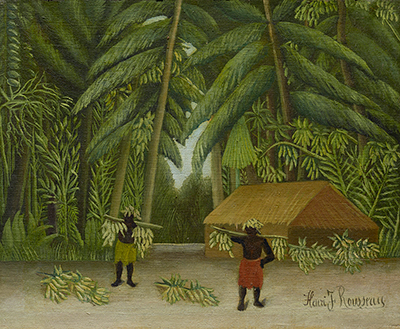
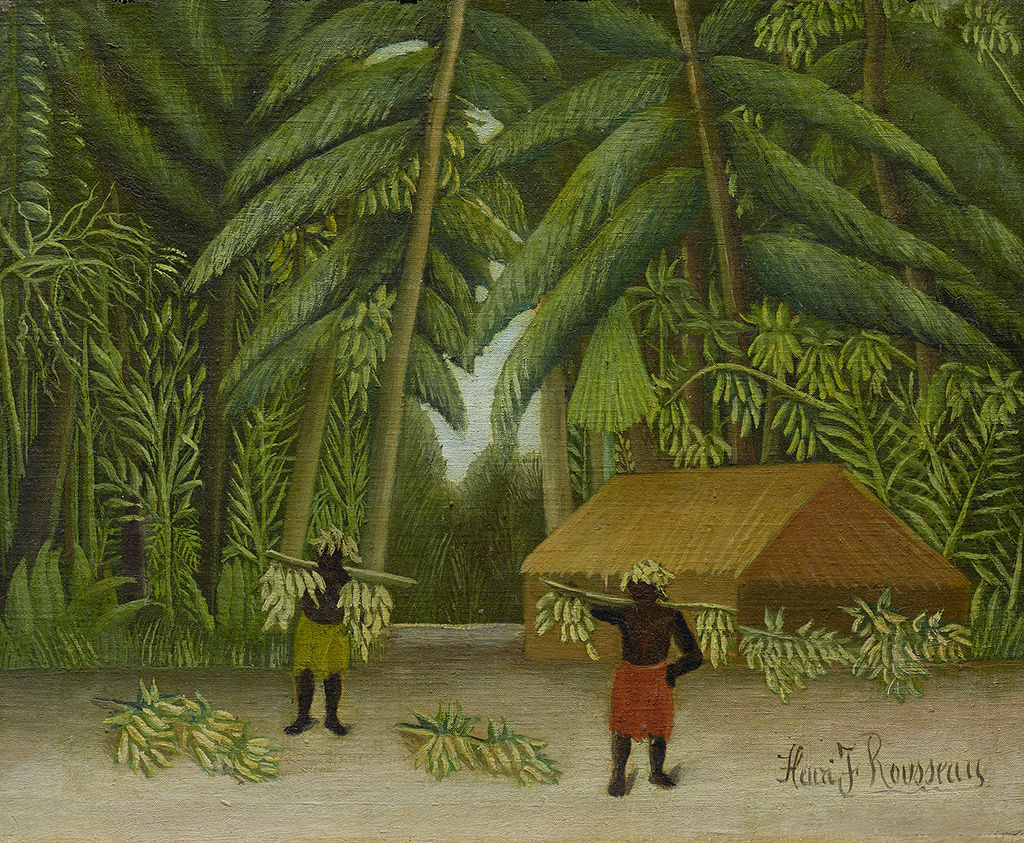
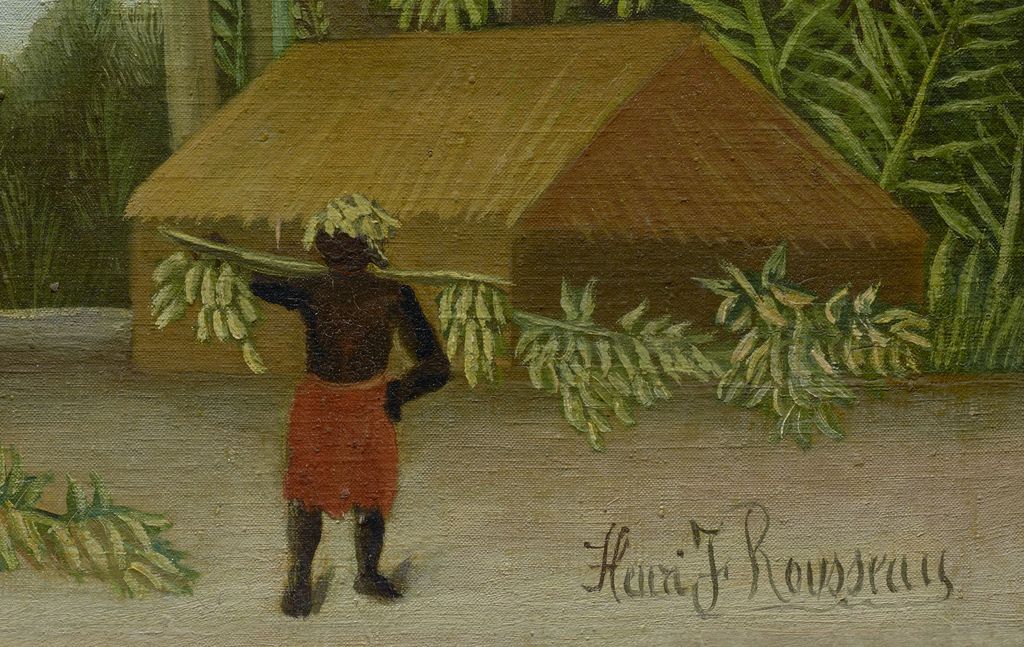
Two figures carry pale bunches of fruit beneath leaves that seem large enough to shelter them. A low hut stands behind the nearer carrier, while more bananas lie across the open ground. Henri Rousseau gives the work of gathering food a still setting: the figures face us, the roof stretches across the right of the picture, and almost everything above them belongs to the plants.
Banana Harvest, dated 1907–10 by the Yale University Art Gallery, is an oil painting on canvas measuring 36.83 × 45.09 cm. Yale holds it as the bequest of Paul Mellon, under accession number 2014.60.2. A whole inhabited landscape fits within this small rectangle, yet its tallest leaves and stems continue beyond the edges.[1]
At a Glance
- ArtistHenri Rousseau
- SubjectBanana Harvest
- ExploreTwo figures carrying the harvest; A forest built from repeated leaves
This work across Henri Rousseau’s career
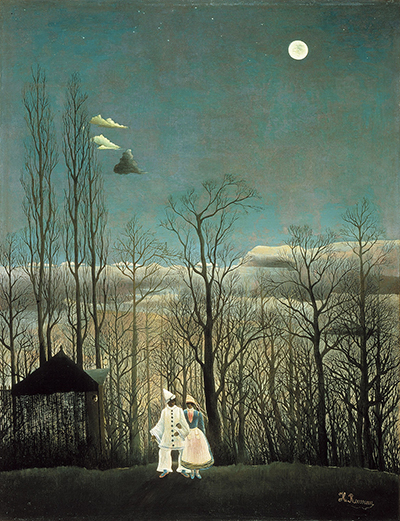
Carnival Evening
1886 [2]The Merry Jesters
1906 [7]The Snake Charmer
1907 [8]Banana Harvest (current article)
1907–1910 [9]Contents
- Two figures carrying the harvest
- A forest built from repeated leaves
- The hut and the open ground
- Parisian sources for an imagined landscape
- A quieter rhythm among the jungle paintings
- Banana Harvest at Yale
- Annotated details
Two figures carrying the harvest
The carriers occupy the lowest part of the scene, separated by a stretch of pale ground. The figure on the left wears yellow; the nearer figure on the right wears red. Their dark bodies stand out against the clearing, while the light fruit distinguishes their loads from the greenery behind them. Colour gives each figure a clear place without requiring a detailed face or an elaborate gesture.
Long poles extend across and above their shoulders, carrying hanging bunches. The fruit appears in several positions: high among the leaves, beside the carriers, and already gathered on the ground. These repetitions connect the immense plants with the small people below. The title's harvest becomes visible through the movement of fruit from one level of the picture to another. The action shown is carrying; neither figure is visibly cutting a bunch from a plant.
Both stand with their feet apart, their bodies presented largely towards the viewer. There is little suggestion of a stride caught halfway through. The poles make long, nearly horizontal accents across the upright bodies, and the hanging fruit pulls the eye down again. Work is being done, but Rousseau holds the workers in an arrangement that feels almost posed. We register the weight and spread of their burdens through the silhouettes rather than through a detailed account of muscular effort.
The difference in their positions adds depth. The red-clothed figure stands lower in the picture and appears larger; the yellow-clothed figure is farther back and to the left. Yet both remain clearly exposed in front of the foliage. We can see their relationship across the clearing more readily than we can trace a route through the forest. Their placement keeps the human activity legible within an otherwise crowded landscape.
A forest built from repeated leaves
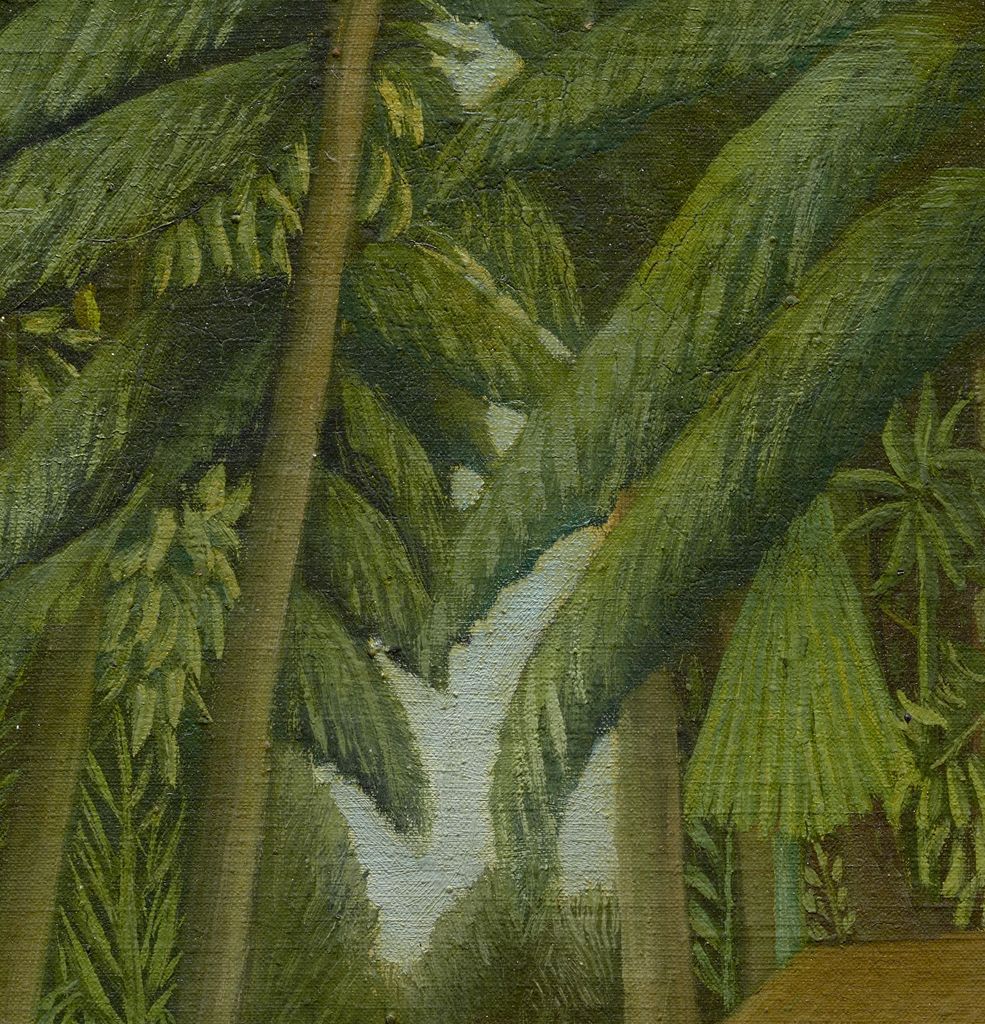
Above the figures, the painting changes its pace. Broad leaves curve down from tall stems, stretching across large portions of the canvas. Their central divisions and fine parallel markings make them look individually worked, even where one overlaps another. Dark gaps separate the leaf shapes, so that the greenery has structure as well as density. Looking upwards, the eye moves from one long blade to the next rather than finding an uninterrupted view into the distance.
The narrower plants at the sides create a different rhythm. Their small pointed leaves branch from thin stems, filling spaces beside the broad hanging forms. At the left edge, these repeated points climb in closely packed rows. On the right, finer foliage presses around the hut and its roof. Rousseau varies the size and direction of the leaves while maintaining their sharp outlines. The result is a forest whose abundance can be examined piece by piece.
The bananas introduce another repeated shape. Pale fingers gather into bunches against darker greens, sometimes hanging close to an upright stem, sometimes projecting into the space around the carriers. Their lighter colour allows the harvest to remain visible even where foliage surrounds it. The plants supply both the setting and the objects that organise the scene: each cluster of fruit directs attention towards another cluster, eventually leading back to the foreground.
Scale gives these repetitions their force. The people are small enough to stand beneath a single sweeping leaf, while the tallest stems disappear above the frame. This relationship makes the vegetation feel encompassing. The figures have a clearing in which to work, but their activity occupies only a narrow strip below a much larger plant world. Even the hut fits beneath the leaves rather than interrupting their upward reach.
Banana Harvest — Henri Rousseau.
The hut and the open ground
The thatched roof brings a broad patch of warm brown into the green. Its long sloping surface is comparatively simple, with fine strokes running down towards the eaves. At the right, the triangular end makes the building's shape easy to read. Around it, pointed leaves reach in several directions; against them, the roof supplies a steady, continuous plane.
The building also helps establish the figures' scale. Its eaves sit behind the nearer carrier's head and pole, bringing the dwelling into the same low zone as the work. Tall plants rise directly behind it. There is no distant settlement spreading towards a horizon, only this compact structure beside the clearing. We see enough architecture to recognise an inhabited place without being given a larger map of it.
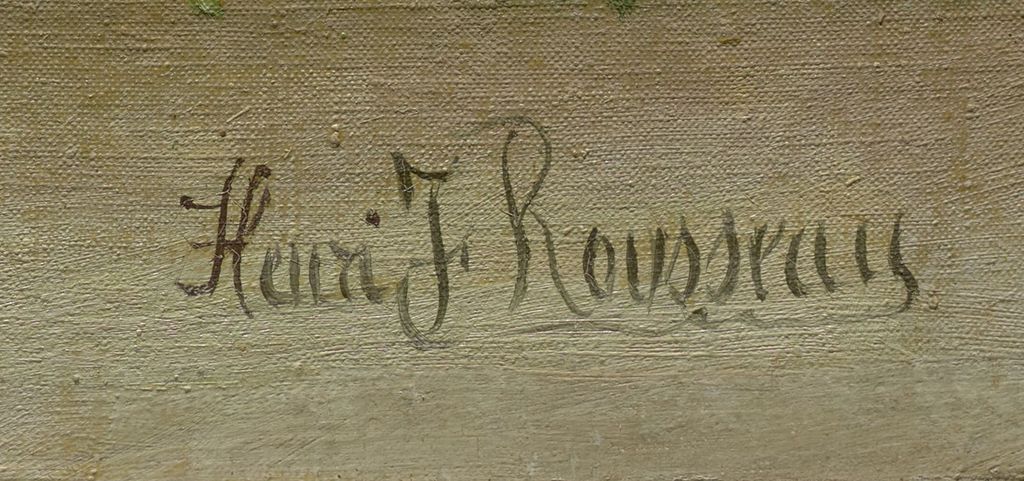
The ground offers the clearest breathing space. Bunches lying at the lower left and near the centre occupy it as separate, readable forms. Towards the bottom right, Rousseau's dark signature spreads across another open area. Behind the carriers, the pale ground narrows towards the trees. Higher up, a small irregular opening of sky breaks through the leaves near the centre. These two light spaces give the eye brief passages through the enclosing green.
Annotated Details from Banana Harvest
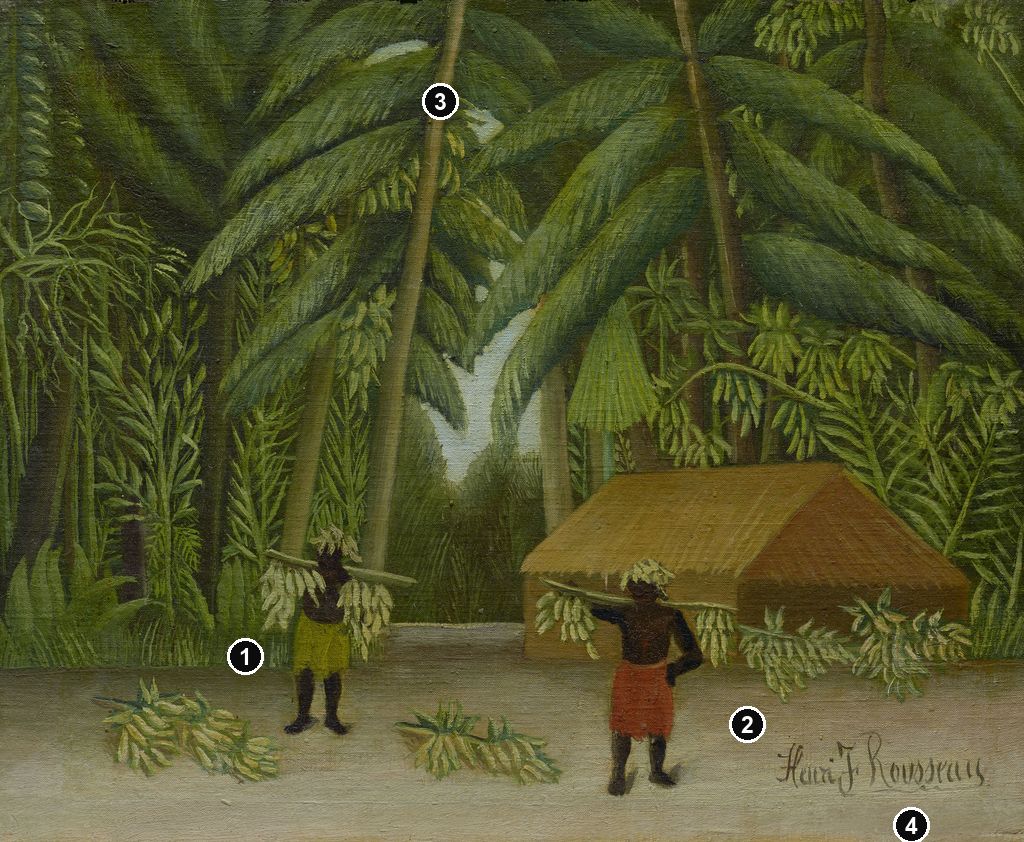
The numbered points identify visible features discussed in this article. Return from each detail to the whole composition. Henri Rousseau, Banana Harvest, 1907–10. Yale University Art Gallery, 2014.60.2. Bequest of Paul Mellon, B.A. 1929, L.H.D.H. 1967. Image source. CC0 / Public domain. Numbers added to the overview; details cropped from the original. No recolouring or retouching.
Details from BANANA HARVEST
Compare the two carriers with the marked leaves above them and the quieter patch of ground reserved for the signature.
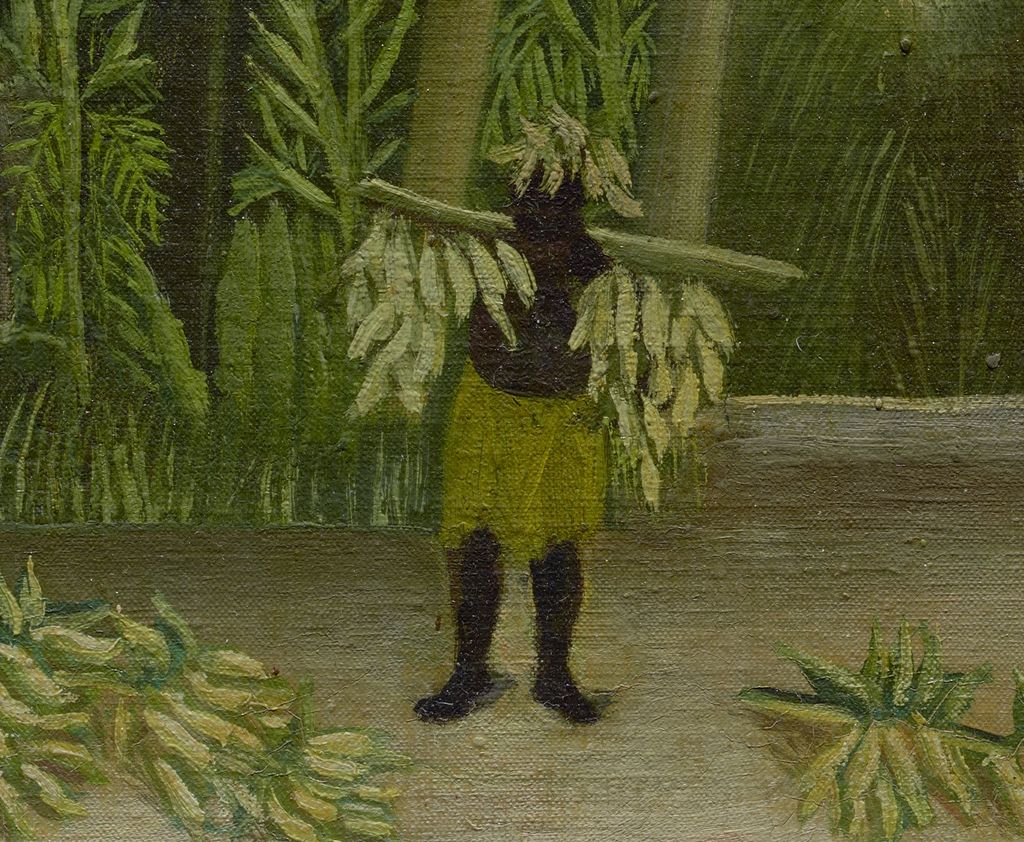
The yellow-clothed carrier
Pale bunches hang from a long pole above the yellow clothing. The separated feet and largely frontal body make the carrier read as a still, clearly arranged shape against the clearing.
The nearer carrier below the roof
Red clothing gives the larger carrier a warm accent below the thatched roof. The pole and hanging fruit spread sideways, linking this figure with the broader horizontal shape behind.
Marked leaves around an opening
Fine lines divide the broad leaves into many narrow passages. Overlapping blades enclose a small, irregular opening of pale sky rather than allowing an uninterrupted view into the distance.
The signature on open ground
Dark, extended letters occupy a clear patch of ground at the lower right. Their spacing contrasts with the crowded leaves above and keeps this corner of the clearing visibly open.
Parisian sources for an imagined landscape
Rousseau's tropical imagery developed through resources available in Paris. The Musée de l'Orangerie's account of his practice describes plants observed in the Jardin des Plantes glasshouses, natural-history displays, press illustrations and the popular exotic imagery circulated through the culture of colonial exhibitions. Those resources gave him material to transform into paintings, rather than evidence of a journey to the landscape represented here.[13]
The Musée Maillol's 2019 exhibition text likewise stresses the combination of different visual sources in his jungles. It describes his use of a Galeries Lafayette publication of wild animals and draws attention to changes of scale and combinations of plants and creatures that would not naturally live together. This explains a broader method of invention; it does not identify a particular illustration behind Banana Harvest.[14]
The painting's coherence comes from the relationships Rousseau establishes within it. Broad leaves make a canopy, the roof anchors the right side, and the pale fruit links the upper plants to the people below. These connections are visible without assigning the setting a country or naming its inhabitants. The scene invites close attention to human work within an imagined tropical environment, while leaving the particular identities of the workers unstated.
A quieter rhythm among the jungle paintings
Set beside Surprised!, Rousseau's tiger painting of 1891, Banana Harvest shows how differently dense foliage can behave. In Surprised!, slanting rain, bending branches and the tiger's crouched body gather energy across the surface. The National Gallery describes the uncertainty surrounding the animal's action: its pose can suggest either alarm or a threat to unseen prey.[4]
Here, the long carrying poles and the roof slow that movement. The figures stand upright on exposed ground, their loads spread out for us to see. The plants loom above them, but the immediate activity remains comprehensible. Gathering and carrying food occupy the space that a predator's movement commands in the earlier picture. The calm belongs to this arrangement of bodies, burdens and shelter; the painting gives us no account of the workers' lives beyond the scene.
Banana Harvest at Yale
Yale's provenance records the painting with the Zurich dealers Dr. Fritz Nathan and Dr. Peter Nathan, on the evidence of a label on its reverse. It then places the work with Rachel “Bunny” Lambert Mellon and Paul Mellon by March 1966, with their inventory number PM1297. Its present credit identifies Paul Mellon's bequest.[1]
Henri Rousseau artworks directory
This directory brings together works covered on this site and other works documented in the cited museum records and catalogues. Alternate titles share one entry; distinct versions remain separate. Historical dates for works without an article follow the cited catalogues. This is not a catalogue raisonné.
Frequently Asked Questions
Yale dates the painting 1907–10. This range is preferable to presenting 1910 as an established single year.[1]
It belongs to the Yale University Art Gallery, New Haven, as the bequest of Paul Mellon, accession number 2014.60.2.[1]
They carry long poles loaded with bunches of fruit. More harvested bananas lie on the ground. The picture does not show either figure cutting fruit from a plant.
The setting is not securely identified in the sources discussed here. Rousseau drew his tropical imagery from plants, displays and pictures available in Paris; these resources do not establish a real village as the subject of this painting.[13]
Discussion
Look again at the images and ideas explored in Banana Harvest. These editorial prompts invite your observations.
Reader Insights
How would the balance of the painting change if the carriers were as tall as the hut?
Follow the pale bunches of fruit from the plants to the ground. How do they connect otherwise separate areas of the picture?
Does the low roof make the forest feel more sheltering or more immense?
Join the Conversation
Share a detail, comparison or question about Banana Harvest below.
References
- Yale University Art Gallery. Banana Harvest, object record 192911, accession 2014.60.2; metadata, provenance and notes, accessed 23 October 2026. View source.
- Philadelphia Museum of Art, Carnival Evening,1963-181-64,object59593. View source.
- Musée de l’Orangerie / Juliette Degennes, Henri Rousseau,L’ambition de la peinture: Un artiste dans son époque (in French). View source.
- National Gallery, London. Surprised!, NG6421, “Overview,” “In-depth” and object details, accessed 23 October 2026. View source.
- Musée d’Orsay, La Guerre,RF19461 (in French). View source.
- MoMA, The Sleeping Gypsy. View source.
- Philadelphia Museum of Art, The Merry Jesters, 1950-134-176, object51097. View source.
- Musée d’Orsay, La Charmeuse de serpents, RF 1937 7 (in French). View source.
- Yale University Art Gallery, Bulletin2014,Acquisitions:BananaHarvest2014.60.2,printedp30. View source.
- Musée de l’Orangerie, La Carriole du Père Junier, RF 1960 26 (in French). View source.
- Solomon R. Guggenheim Museum / Cornelia Lauf, The Football Players,60.1583: current collection record. View source.
- MoMA, The Dream, 252.1954. View source.
- Musée de l'Orangerie. Henri Rousseau, l'ambition de la peinture, exhibition texts, 25 March–20 July 2026, “Un style à soi.” View source. (in French).
- Musée Maillol. Du Douanier Rousseau à Séraphine : Les grands maîtres naïfs, press dossier, 2019, section 6, “Les bêtes sauvages des Galeries Lafayette,” printed p. 17. View source. (in French).
- The Museum of Modern Art, Henri Rousseau: Essays (1985), selected catalogue entries, chronology and notes on early devotees. View source. Selected entries, chronology (pp.91–95) and early-devotee notes (pp.262–264) were consulted. Historical collection credits do not establish present ownership.
- Daniel Catton Rich, Henri Rousseau (The Museum of Modern Art, 1942), selected drawings and landscape studies; historical catalogue. View source. The dated 1942 publication is used for the two Quai d’Auteuil ink views; its Malakoff date differs from the 1985 catalogue.
- MANAS, Laval, Henri Rousseau, dit le Douanier, urban landscapes and preparatory study (in French). View source.
- National Gallery of Art, Self-Portrait (1895), pen-and-ink drawing, accession 1995.47.66. View source.
- The Museum of Modern Art, War (published January 1895), lithograph, accession 684.1943. View source.
- Barnes Foundation, Landscape and Four Young Girls, object 5521, BF855. View source.
 Henri Rousseau.jpg)
 Henri Rousseau.jpg)