


 by Tom Gurney
Tom Gurney BSc (Hons) is an art history expert with over 20 years experience
Published on June 19, 2020 / Updated on October 29, 2026
Email: tomgurney1@gmail.com / Phone: +44 7429 011000
Scene in Bagneux on the Outskirts of Paris: Introduction
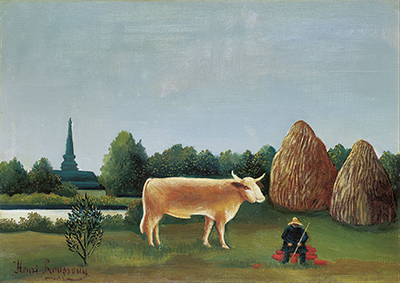
A cream-coloured cow occupies the middle of Henri Rousseau’s Scene in Bagneux on the Outskirts of Paris. Two enormous haystacks rise behind its head; a seated person, almost lost among little red patches, appears near its feet. Beyond them, water and trees stretch towards a pointed tower. The Ohara Museum of Art dates this small oil painting to 1909 and gives its dimensions as 33.0 × 46.3 cm.[1] Within that modest rectangle, Rousseau makes the animal feel as substantial as a building.
At a Glance
- ArtistHenri Rousseau
- SubjectScene in Bagneux on the Outskirts of Paris
- ExploreA place named, a scene arranged; The cow’s quiet command
This work across Henri Rousseau’s career
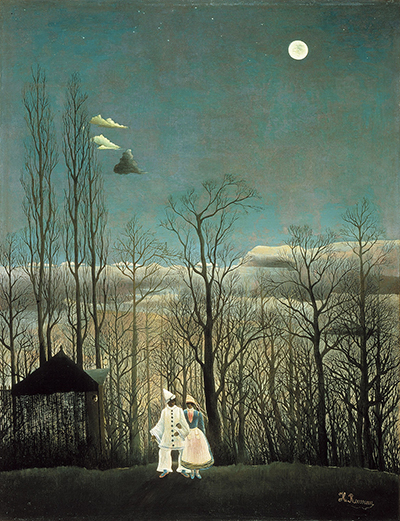
Carnival Evening
1886 [2]The Merry Jesters
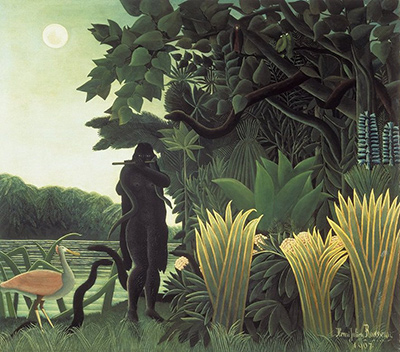
1906 [7]The Snake Charmer
1907 [8]Contents
- A place named, a scene arranged
- The cow’s quiet command
- Two stacks and a narrow interval
- The seated figure and the red ground
- Water, a sapling and the open sky
- How the small view holds together
- From an early exhibition to Ohara
- Annotated details
A place named, a scene arranged
The French title recorded by Art Platform Japan is Vue des environs de Paris, commune de Bagneux. Its catalogue-derived entry also records Rousseau’s signature at the lower left.[12] The place name supplies a setting, while the picture offers a concentrated arrangement of a few things: cow, stacks, seated figure, water, foliage and distant architecture. The churchlike tower is too small to identify securely from the painting alone.
There is remarkably little visible building for a view whose title invokes the outskirts of Paris. The distant tower and its low adjoining forms scarcely interrupt the trees. In front of them, the cow stands against a dense green belt, separated from the spectator by open ground. The picture therefore allows two experiences at once. We can look through it towards a settlement, or let our attention rest on the few foreground presences that almost fill its width. The second experience is stronger: the animal and stacks have an immediate weight that the remote architecture cannot rival.
The cow’s quiet command
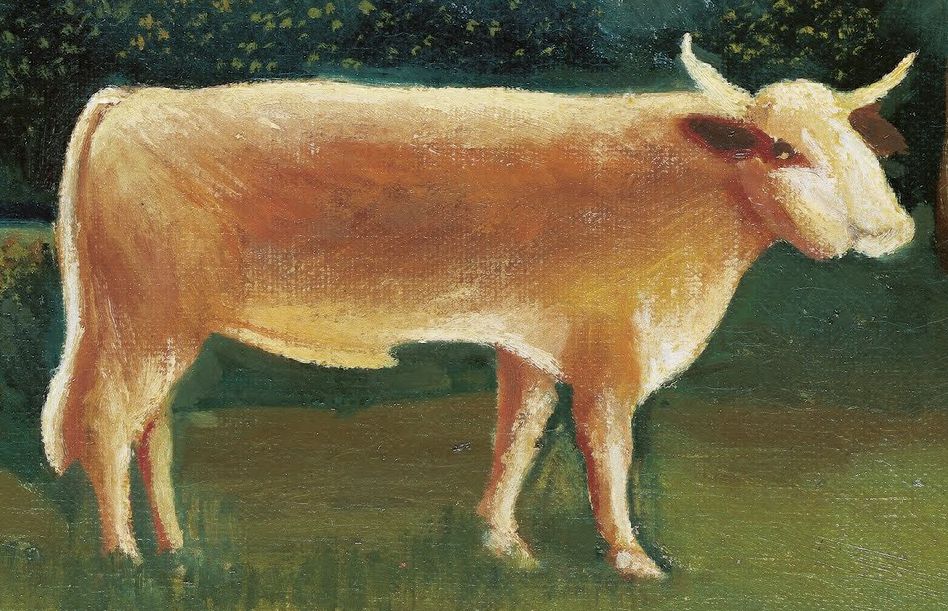
The cow’s back draws a long, nearly level line across the centre. Beneath it, the belly curves gently towards the legs, giving the body a rounded fullness. Pale highlights travel over the flank, while warmer ochre and brown gather along the back, underside and joints. These shifts give the animal solidity within its clear outline. Against the dark trees, the cream body appears to have been cut from the surrounding green.
Four separate legs carry that body. The openings between them are as useful to the composition as the limbs themselves: through those gaps, the ground continues uninterrupted. We can follow the cow’s shape around its underside without losing our sense of the field behind it. At the rear, the tail hangs close to the leftmost leg, ending in a dark tuft. The udder forms another small downward projection. Such details make the large, simple body particular without breaking its calm silhouette.
The head faces right, with a slight turn that brings its pale muzzle into view. Two light horns curve outwards, making a delicate flourish above the heavy neck. Their pointed ends echo the sharper forms elsewhere in the scene, yet the animal’s expression remains mild. Its stance contains no conspicuous movement: there is no bent neck reaching for grass, no raised hoof marking a step. Rousseau gives us a pause. The cow holds its ground while our eye travels from its tail to its head, then upwards to the stacks.
That stillness affects the whole scene. The cow is large enough to obstruct the distance, but its pale colour keeps it from becoming a dark barrier. Light seems to collect on its body. It also provides a measure for everything nearby: the seated figure becomes surprisingly small, and the stacks acquire an almost architectural scale.
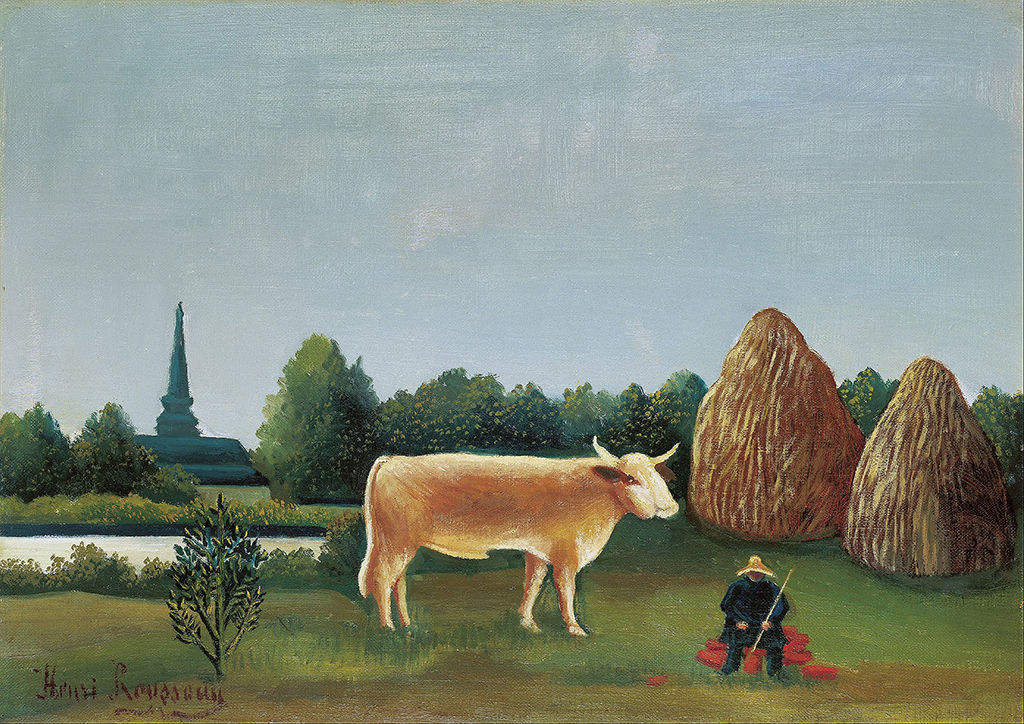
Scene in Bagneux on the Outskirts of Paris — Henri Rousseau.
Two stacks and a narrow interval
The larger haystack stands directly beyond the cow’s head. Its base broadens into the grass, while its top contracts to a rounded point. Long streaks of ochre, cream and brown run down its sides. The smaller stack repeats this shape farther right, with a lower summit and a slightly different lean. Seen together, they form a pair without becoming identical ornaments.
Their streaked surfaces contrast with the cow’s broad flank. On the animal, colour moves softly across a rounded body; on the stacks, individual marks descend in narrow, irregular lines. Their different textures prevent the warm colours from merging. The dark strip of ground at their bases further separates them from the lighter body in front.
Look at the interval around the horns and muzzle. It is a busy junction in an otherwise spacious painting. The animal’s head projects towards the stacks, the treeline slips behind it, and the larger stack rises abruptly above. A small patch of sky beside its summit makes the surrounding contours especially distinct. Rousseau gives each object enough room to remain legible, even where their silhouettes approach one another.
Across the picture, the tall stack also answers the pointed tower on the left. Both rise above the foliage, but their differences are striking: one is broad, warm and close, the other slender, dark and distant. The stack wins in sheer presence. The tiny spire helps us feel how far the eye has travelled beyond the cow’s field.
The seated figure and the red ground
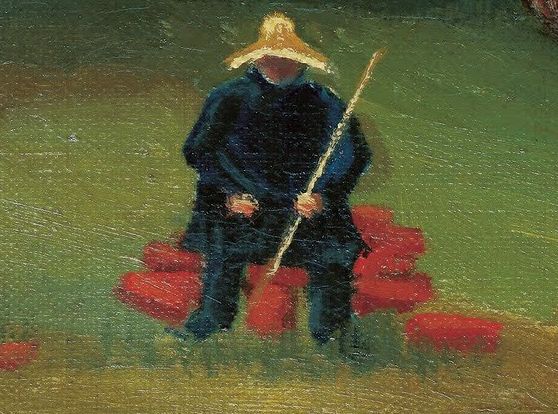
Only after studying the cow and stacks may the little seated person become fully apparent. A yellowish hat and a pale face sit above a compact dark blue or black body. A light rod or stick crosses the figure diagonally. Small red shapes, interspersed with darker round forms, spread across the ground nearby. Their brightness gives this otherwise subdued corner an unexpected intensity.
The figure’s occupation remains unclear. The hat, stick and coloured objects invite a story, but they do not establish gardening, cattle tending or another particular task. The pose is more securely visible than the activity: the body is low, close to the earth, and contained within a much smaller area than the cow. That contrast lets the human presence feel absorbed in a private concern while the animal stands openly across the field.
The diagonal stick is especially effective among so many steady horizontals and upright forms. It adds a brief slant to the lower right, where the stacks’ descending strokes already draw the eye downwards. The red patches then arrest that movement. Because red occurs so sparingly, these tiny marks can attract attention beside objects many times their size. The figure’s significance comes partly from that concentration of colour; it does not need a fully recoverable narrative to hold its place.
Water, a sapling and the open sky
A thin pale strip of water enters from the left behind the cow. Its brightness offers a second horizontal beneath the treeline, cooler and narrower than the animal’s body. Low plants interrupt its edge. The water does not open into a sweeping view: it slips behind the foreground subjects and disappears. That partial glimpse makes the landscape feel continuous beyond the limits of what we can see.
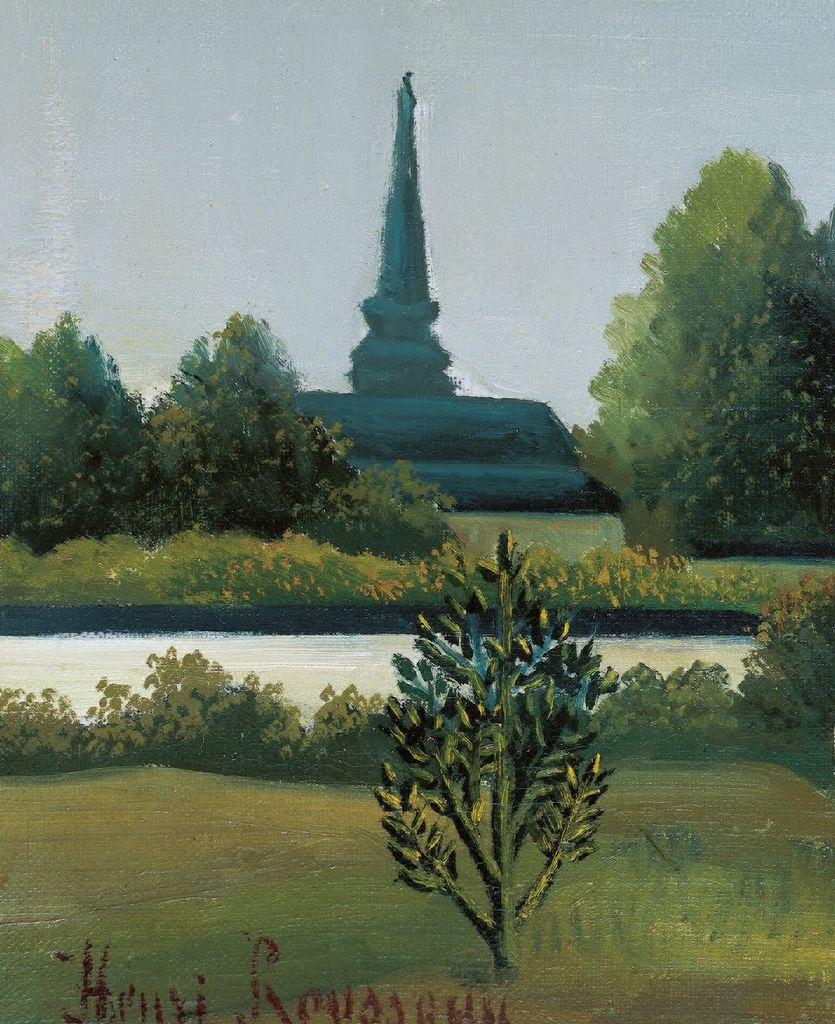
In the lower left, a small leafy sapling or shrub rises from the grass. Its branches are thin enough for patches of the background to show through. This open, divided shape differs from both the cow’s enclosed body and the solid stacks. It also stands much closer to us than the pointed tower. Looking between the two, we cross several layers: foreground growth, pale water, dark vegetation and remote architecture. Rousseau establishes considerable depth with relatively few overlapping forms.
The trees behind the cow make an irregular dark screen. Rounded crowns alternate with taller, narrower growth, and small yellow-green touches break up the mass. Their uneven upper edge softens the strong division between land and sky. Along that border, each taller tree or projecting point becomes noticeable because the sky gives it such a broad, uncluttered background.
The sky occupies about half the painting. Its pale green-blue expanse contains gentle variations, with little to interrupt the space above the cow. This height changes our experience of the lower half. The grass, water, animal and stacks appear gathered into a narrow inhabited band beneath a much larger atmosphere. The tallest stack reaches into that openness, but there is still ample air above it. The result feels spacious despite the large foreground forms.
Annotated Details from Scene in Bagneux on the Outskirts of Paris
The numbered points identify visible features discussed in this article. Return from each detail to the whole composition. Henri Rousseau, Scene in Bagneux on the Outskirts of Paris, 1909. Ohara Museum of Art, Kurashiki. Google Art Project reproduction via Wikimedia Commons. Image source. Public domain. Numbers added to a separate resized overview. Details cropped directly from the published original without enlargement, recolouring or retouching.
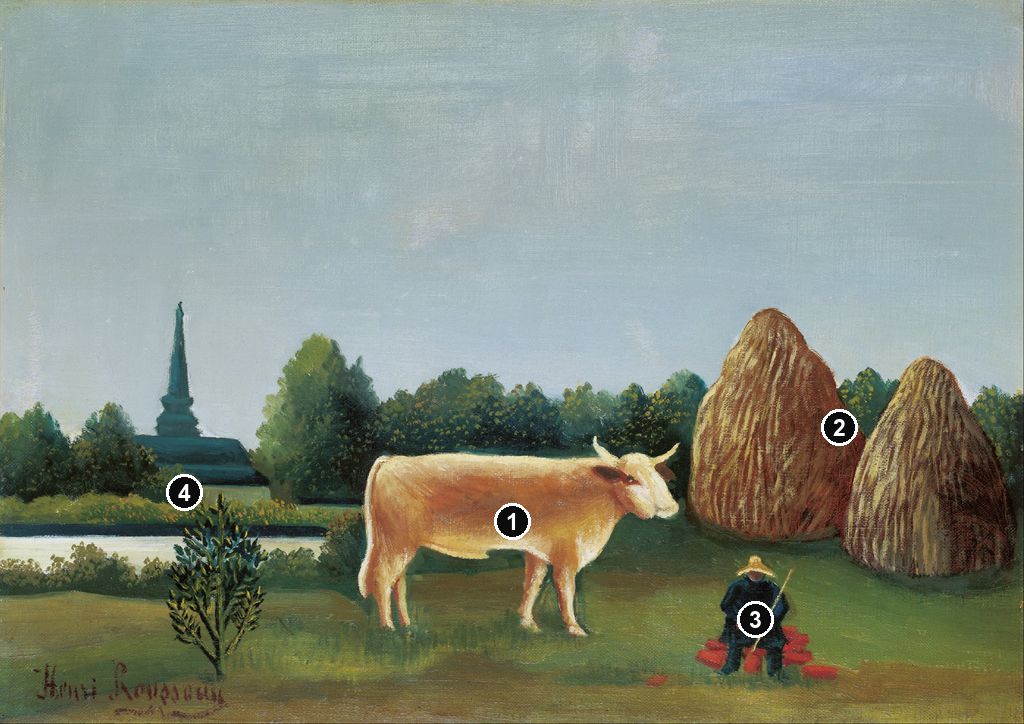
Details from SCENE IN BAGNEUX ON THE OUTSKIRTS OF PARIS
Compare the cow’s broad body and the stacks’ height with the small human presence and the layered distance at the left.
A pale cow holding the centre
The long back and rounded flank give the cow a substantial horizontal presence. Horns, udder, tail and separated legs make the calm silhouette particular against the darker ground.
Two stacks above a seated figure
Long pale streaks run down the unequal stacks. With the little seated figure below them, their height and broad bases acquire an almost architectural weight.
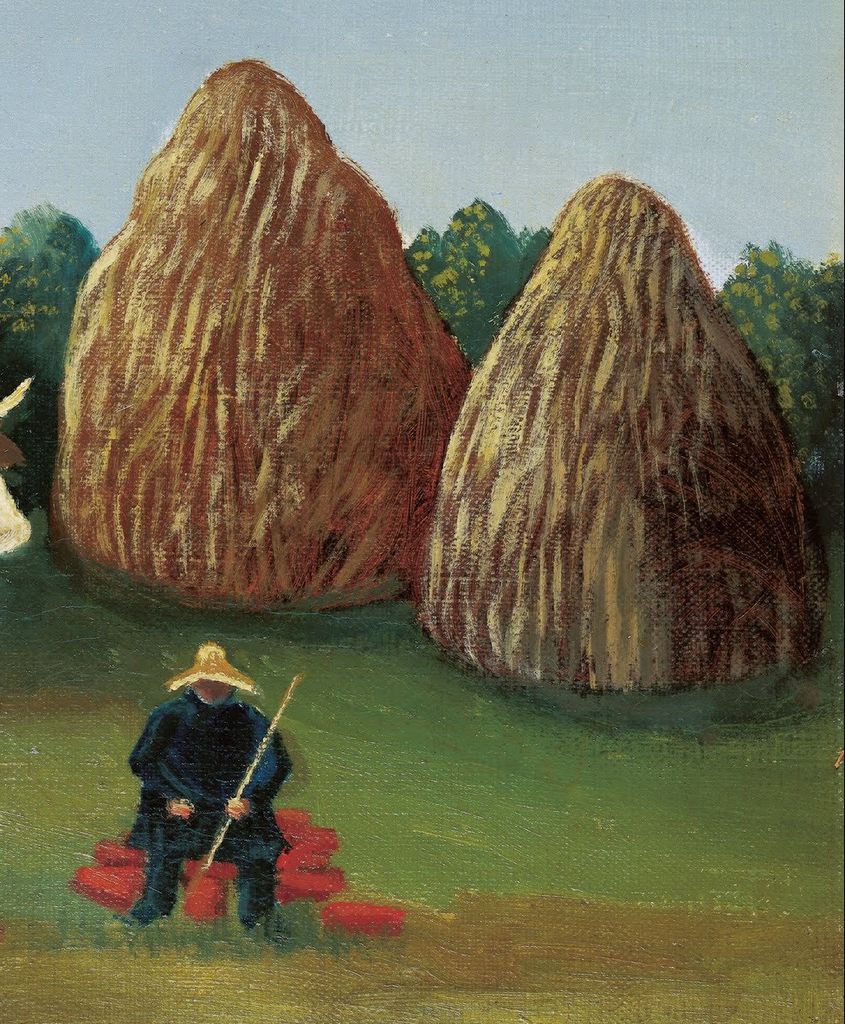
A hat, diagonal rod and red patches
A pale hat crowns the compact dark figure, and a thin rod crosses the body. Bright red patches gather around the seat without establishing a particular occupation or activity.
A near shrub and a distant tower
The open branches of the shrub rise close to the viewer. Behind them, pale water, darker vegetation and a slender tower form several distinct layers of distance.
How the small view holds together
The ground is more varied than a first glance suggests. Green passes into brown and yellow, small pale marks scatter across the field, and darker patches gather beneath or beside the main objects. These changes keep the foreground from becoming an empty platform. They also connect areas that the larger silhouettes divide: the colour beneath the cow continues towards the seated figure and around the bases of the stacks.
Rousseau’s arrangement balances different kinds of presence. The cow extends sideways, the stacks rise, the little shrub opens into separate leaves, and the figure contracts into a dark knot. Each asks the eye to move differently. Their shared setting makes these movements compatible, while the wide sky gives them breathing room. The discussion of Rousseau’s style and technique offers a wider context for this attention to contour and pictorial organisation.
The strongest relationship remains the one between the cow and the seated person. Their nearness creates the possibility of an encounter, yet neither visibly addresses the other. We are left watching two separate kinds of stillness. That unresolved proximity gives a modest field scene more interest than a neatly explained anecdote would provide.
From an early exhibition to Ohara
Art Platform Japan’s record, drawing on the Ohara Museum’s 2011 collection catalogue, lists the painting in the 1911 Indépendants Rousseau retrospective and the 1933 Kunsthalle Basel exhibition. Its provenance places it with André M. Lefèvre around 1923–65 and records its arrival at Ohara in 1972 through Minami Gallery, Tokyo. The same entry transcribes frame-back labels, including a description meaning “landscape with a cow”.[12]
The geographical title and the animal description offer different ways into the picture. One encourages us to search the distance for a recognisable place; the other brings us close to the creature standing across our view. The composition accommodates both, with the little tower just visible beyond a foreground that commands most of our attention.
Henri Rousseau artworks directory
This directory brings together works covered on this site and other works documented in the cited museum records and catalogues. Alternate titles share one entry; distinct versions remain separate. Historical dates for works without an article follow the cited catalogues. This is not a catalogue raisonné.
Frequently Asked Questions
The Ohara Museum of Art dates it to 1909.[1]
It belongs to the Ohara Museum of Art in Kurashiki, Japan. The museum records oil on canvas, 33.0 × 46.3 cm.[1]
The visible hat, diagonal stick and red objects do not establish a particular occupation. Calling the figure seated describes what can be seen without supplying an uncertain story.
Discussion
Look again at the images and ideas explored in Scene in Bagneux on the Outskirts of Paris. These editorial prompts invite your observations.
Reader Insights
Which attracts your eye first: the cow’s pale body or the little red patches around the seated figure?
How would the relationship between the animal and the stacks change if the sky occupied less space?
Does the distant tower make the field feel closer to a settlement, or emphasise its separation from one?
Join the Conversation
Share a detail, comparison or question about Scene in Bagneux on the Outskirts of Paris below.
References
- Ohara Museum of Art. Scene in Bagneux on the Outskirts of Paris, individual collection record, product 10. Accessed 23 October 2026. View source.
- Philadelphia Museum of Art, Carnival Evening,1963-181-64,object59593. View source.
- Musée de l’Orangerie / Juliette Degennes, Henri Rousseau,L’ambition de la peinture: Un artiste dans son époque (in French). View source.
- National Gallery, Surprised!, NG6421. View source.
- Musée d’Orsay, La Guerre,RF19461 (in French). View source.
- MoMA, The Sleeping Gypsy. View source.
- Philadelphia Museum of Art, The Merry Jesters, 1950-134-176, object51097. View source.
- Musée d’Orsay, La Charmeuse de serpents, RF 1937 7 (in French). View source.
- Musée de l’Orangerie, La Carriole du Père Junier, RF 1960 26 (in French). View source.
- Solomon R. Guggenheim Museum / Cornelia Lauf, The Football Players,60.1583: current collection record. View source.
- MoMA, The Dream, 252.1954. View source.
- National Center for Art Research, Japan, Art Platform Japan. Scene in Bagneux on the Outskirts of Paris, W1051583, updated 10 February 2026; reproducing the Ohara Museum of Art’s 2011 collection catalogue, p. 84. View source.
- The Museum of Modern Art, Henri Rousseau: Essays (1985), selected catalogue entries, chronology and notes on early devotees. View source. Selected entries, chronology (pp.91–95) and early-devotee notes (pp.262–264) were consulted. Historical collection credits do not establish present ownership.
- Daniel Catton Rich, Henri Rousseau (The Museum of Modern Art, 1942), selected drawings and landscape studies; historical catalogue. View source. The dated 1942 publication is used for the two Quai d’Auteuil ink views; its Malakoff date differs from the 1985 catalogue.
- MANAS, Laval, Henri Rousseau, dit le Douanier, urban landscapes and preparatory study (in French). View source.
- National Gallery of Art, Self-Portrait (1895), pen-and-ink drawing, accession 1995.47.66. View source.
- The Museum of Modern Art, War (published January 1895), lithograph, accession 684.1943. View source.
- Barnes Foundation, Landscape and Four Young Girls, object 5521, BF855. View source.
 Henri Rousseau.jpg)
 Henri Rousseau.jpg)