


 by Tom Gurney
Tom Gurney BSc (Hons) is an art history expert with over 20 years experience
Published on June 19, 2020 / Updated on October 29, 2026
Email: tomgurney1@gmail.com / Phone: +44 7429 011000
La Carriole du Père Junier: Introduction
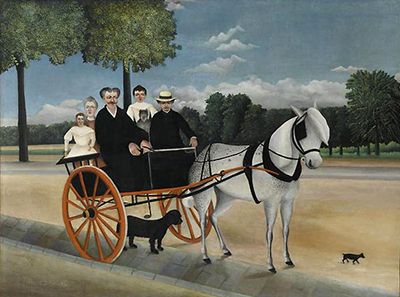
A white mare stands at the right of Henri Rousseau’s La Carriole du Père Junier, her pale body crossed by the dark lines of a harness. Behind her, a family occupies a black cart with brilliant red wheels. A tiny dog trots ahead while a much larger black dog stands beneath the vehicle. Painted in 1908, this oil on canvas measures 97 × 129 cm and belongs to the Musée de l’Orangerie in Paris. Its subject grew from a friendship in Rousseau’s own neighbourhood, and its unusual proportions emerged through his transformation of a photographic arrangement.[1][2]
At a Glance
- ArtistHenri Rousseau
- SubjectLa Carriole du Père Junier
- ExploreA portrait between neighbours; What the photographs establish
This work across Henri Rousseau’s career
Carnival Evening
1886 [3]The Merry Jesters
1906 [8]The Snake Charmer
1907 [9]Contents
- A portrait between neighbours
- What the photographs establish
- Three dogs and the scale of the mare
- A street with several kinds of space
- The artist inside the family group
- From the Junier household to the Orangerie
- Annotated details
A portrait between neighbours
Claude Junier and his wife Anna ran a grocery shop at 74 rue Vercingétorix, at the corner of rue Perrel, where Rousseau lived. Michel Hoog’s catalogue entry identifies Junier as a horse trainer as well as a shopkeeper, and names the white mare Rosa. Their acquaintance gives the painting a particular warmth: the man, horse and passengers belonged to a world the artist knew close to home.[2] The upright figures look ready for a commemorative portrait, while the cart and its animals retain the practical character of everyday transport.
The Orangerie relates that Junier sold vegetables which he collected each morning from market gardeners at Bagneux or Verrières-le-Buisson. Anna cooked for Rousseau, who owed the couple some money. When Junier acquired a horse of which he was particularly proud, they agreed that Rousseau would paint a picture.[1] This account places the work within an exchange of assistance, goods and artistic labour. It also explains why the mare commands so much of the canvas. A valued possession has become the splendid centre of a family occasion.
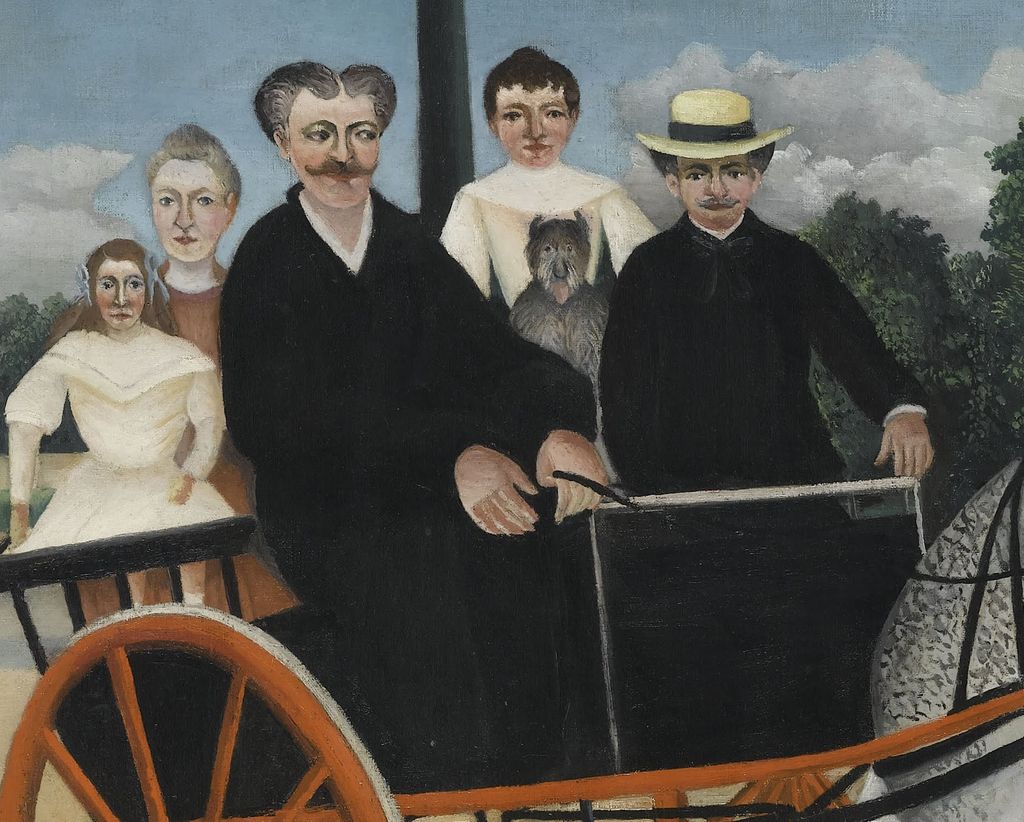
The sitters have a more specific identity than the title alone suggests. Hoog identifies the two men at the front as Claude Junier and Rousseau himself. Behind them are Madame Junier, her niece and her nephew’s child, seated on her lap.[2] The pale clothes of the rear passengers create a compact cluster above the black cart. The men’s dark coats connect their bodies to the vehicle, making the heads and the light straw hat especially prominent. Individual faces emerge from a tightly fitted arrangement of overlapping figures.
The recorded story gives the circumstances of the agreement without specifying a price.[1] Within this local exchange, the artist places himself among the people whose household he has been asked to portray.
What the photographs establish
The photographic basis of La Carriole du Père Junier is unusually well documented. In 1985 Hoog discussed three known photographs. One, formerly belonging to Robert Delaunay, bore traces of paint; another was in the J. J. Sweeney collection. A third had appeared in a private publication by A. Labrosse and in the Orangerie’s 1984 catalogue. The 1985 volume reproduces the Delaunay photograph and the third image, with captions attributing both to Anna Junier and identifying the latter as retouched.[2]
These reproductions make the relationship with the painting immediately recognisable. A wheeled cart occupies the left, the pale horse stands at the right, and trees rise behind the group. The more crowded first photograph and the clearer, retouched second image show different arrangements of people within this setting. The horse’s head, harness and long legs provide a particularly strong visual connection with the finished canvas. The photographs preserve the framework of an encounter that Rousseau could develop at greater size and in colour.
Hoog records that the camera, cart and mare remained in the same positions across all three photographs, while the people and dogs moved. He also observes that the painted figures’ poses correspond to none of the three known images. His explanation leaves two possibilities open: further photographs may have existed, or Rousseau may have arranged the figures himself.[2] Consequently, no single surviving photograph can be treated as a complete and exclusive blueprint for the picture. The evidence establishes dependence on photography while preserving a gap in the sequence of decisions.
One conspicuous alteration concerns the trees. In the photographic setting a trunk rises behind the horse’s head. Rousseau removed it and reorganised the greenery.[2] In the painting the mare’s white head stands clearly against darker foliage, with open sky above. The vertical trunks on the left become more distinct from the horse. The Fondation Beyeler’s gallery guide explains that the removal strengthens the second tree from the left as an axis within the composition.[12] A small subtraction therefore changes the balance of the whole scene.
The transformation extends beyond a rearrangement of recognisable things. The grainy photographic street becomes a sequence of broad coloured areas. Sky, foliage, road and pavement are easier to separate, while the red wheels establish a bright structure across the dark vehicle. Colour gives the family outing a clarity and ceremony quite different from the photographic reproductions. The source supplied objects and relationships; Rousseau’s canvas gives each of them a new degree of emphasis.
Three dogs and the scale of the mare
The dogs are among the smallest elements in the subject and among the most consequential in its construction. One is tucked into the crowded rear of the cart, another stands beneath it, and a tiny dark dog moves ahead of the mare. Their different positions carry the eye from the passengers down to the wheels and out along the road. Rousseau altered both their sizes and their placement from the photographic material, a change emphasised by the Orangerie and the Beyeler guide.[1][12]
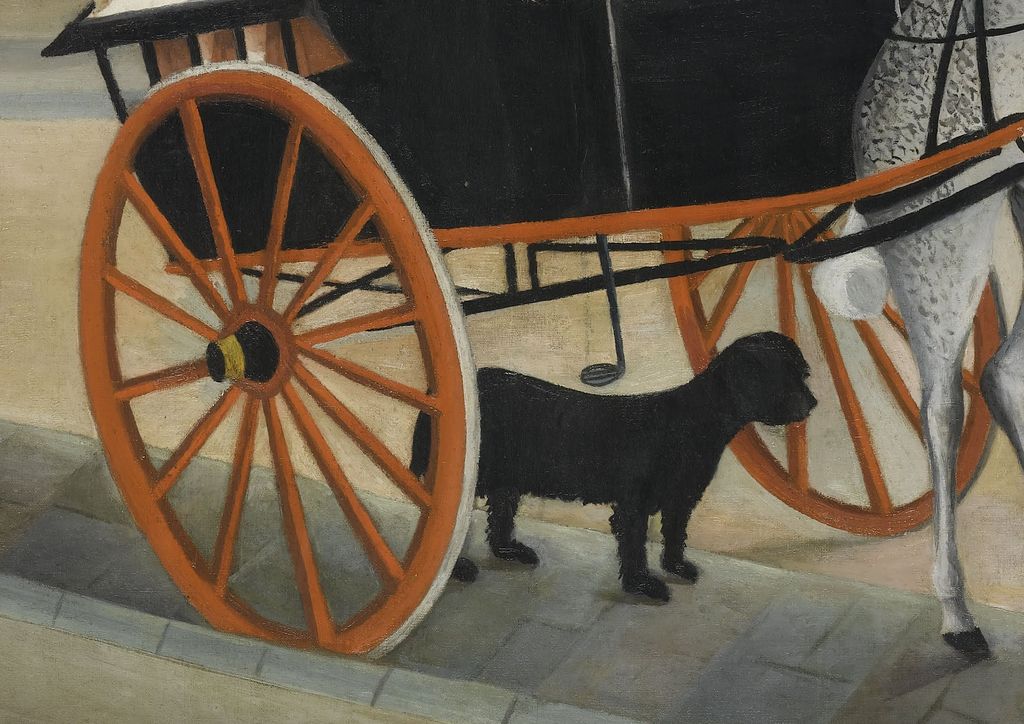
The black dog beneath the cart presents a broad, almost uninterrupted silhouette. Its horizontal back answers the vehicle’s lower edge, while its legs descend towards the pavement. Against the pale ground, the dark body fills what might otherwise read as a large opening beneath the passengers. The red wheels flank it, joining animal and vehicle into a strong group of shapes. The Beyeler guide interprets this dog as helping to anchor the cart; the Orangerie stresses its contribution to depth.[12][1] Both readings direct attention to the work the animal performs within the picture.
A recollection by Max Weber gives this decision a human dimension. According to the account transmitted by Daniel Catton Rich in 1946 and cited by Hoog, Weber saw the canvas while it was being painted. Rousseau planned to put the black dog in the area beneath the cart, which was to be completed last. When Weber questioned whether the dog would be too large for the available space, Rousseau replied in effect that the picture required it.[2] This is remembered conversation passed through later publications, rather than a verbatim record made in the studio. Even with that qualification, it is valuable evidence of how an early visitor understood Rousseau’s choice.
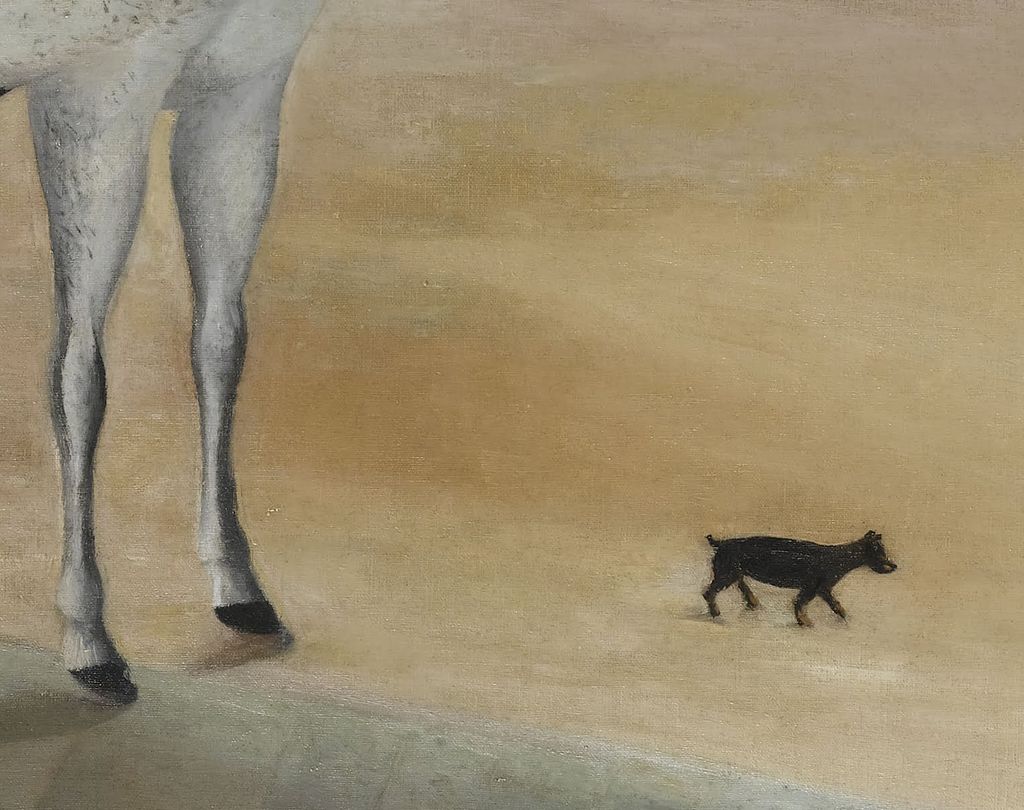
The small dog at the far right creates the opposite effect. Its low body and short legs make the mare tower above it. The eye measures one animal against the other before considering any consistent scale for the street. The Orangerie and Beyeler both connect the little dog with the mare’s monumental appearance.[1][12] Rosa’s long legs, lifted head and ample body seem more imposing because the dog occupies so little space nearby. A domestic animal acquires the presence usually reserved for a more ceremonious subject.
Yet this grandeur remains curiously light. The mare appears to touch the road with the tips of her hooves. Dark cast shadows sharpen those contacts while making the white legs seem almost suspended above the surface, an effect the Orangerie likens to dancing.[1] Her pose gives the scene its peculiar stillness: a horse ready to draw a cart appears delicately balanced, and the passengers remain composed above their brilliant wheels. The contrast invites a prolonged look at an otherwise ordinary moment.
Annotated Details from La Carriole du Père Junier
The numbered points identify visible features discussed in this article. Return from each detail to the whole composition. Henri Rousseau, La Carriole du Père Junier, 1908. Musée de l’Orangerie, Paris, RF 1960 26. Google Art Project reproduction published on Wikimedia Commons in 2012. Google Art Project reproduction via Wikimedia Commons. Image source. Public domain. Numbers added to a separate resized overview. Details cropped from the published original without enlargement, recolouring or retouching.
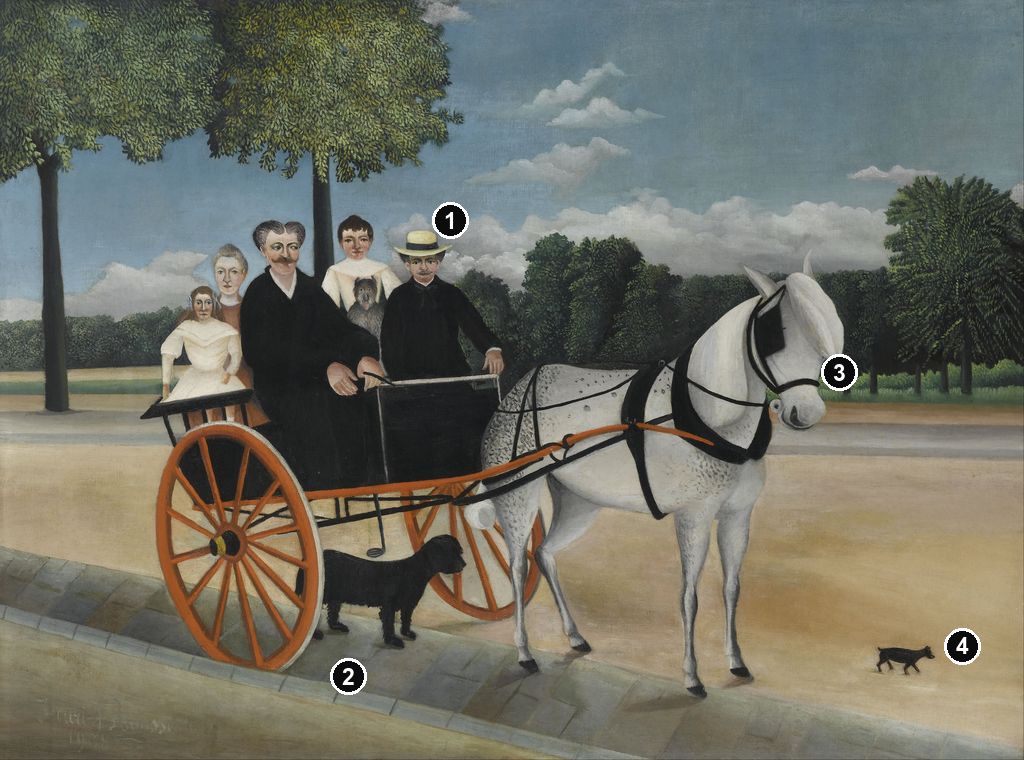
Details from LA CARRIOLE DU PÈRE JUNIER
Follow the passengers, dogs and horse to see how changes of scale and repeated shapes hold the outing together.
Faces gathered above the cart
The passengers’ faces gather above the black cart, with pale clothes behind the two men in dark coats. A dog sits among the rear passengers, adding another face to this tightly fitted group.
Wheels around a black silhouette
The black dog stands between the brilliant red wheels. Its broad body fills the opening beneath the cart, while the spokes create a much more open pattern around it.
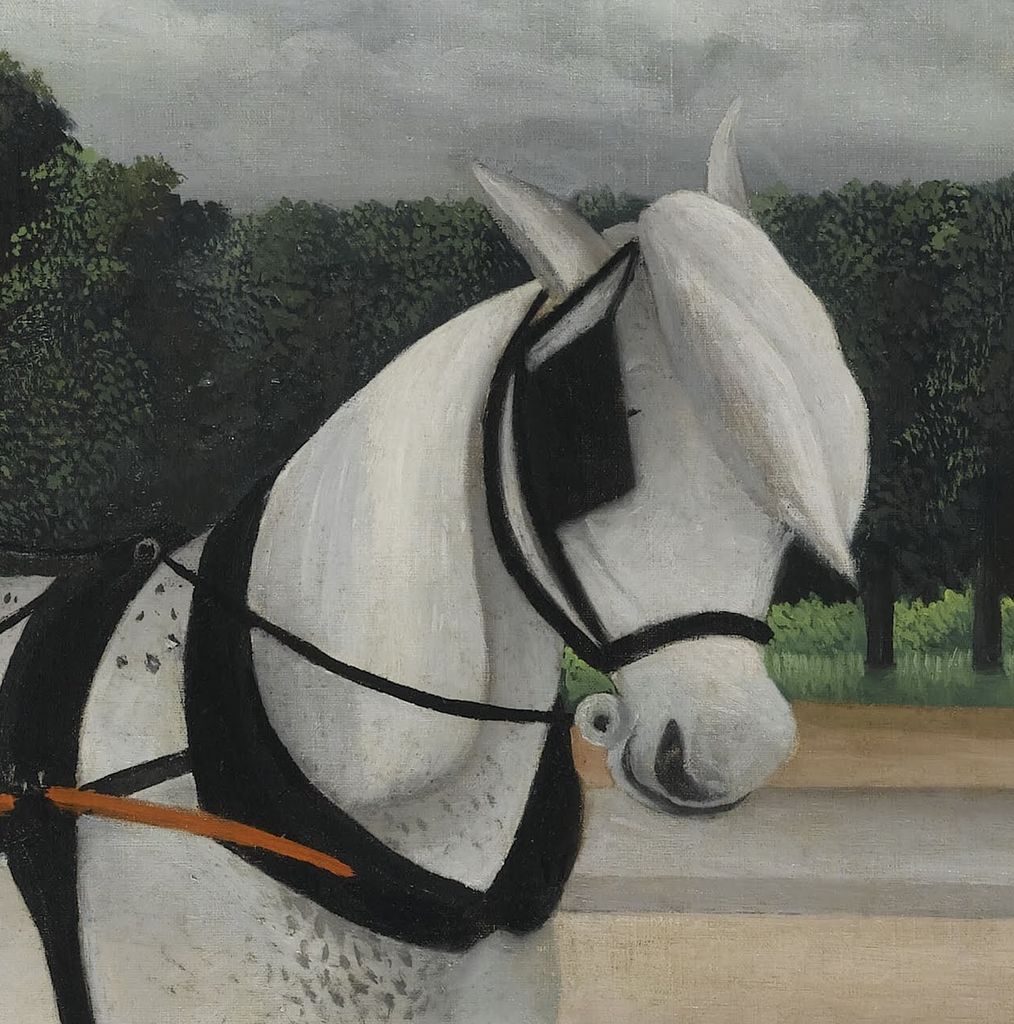
A white head against the trees
The mare’s pale head stands clearly against the darker foliage. Black straps divide her face into bold areas, and the long forelock makes the light shape especially distinct.
A tiny dog beside the mare’s hooves
The small dark dog occupies very little of the open road beside the mare’s long forelegs. The difference in their scale makes the horse seem monumental, even as her hooves touch the ground delicately.
A street with several kinds of space
The foreground pavement supplies one of the clearest cues to depth. Its edge cuts diagonally across the lower canvas, and the paved gutter forms a band between the viewer and the cart. This oblique structure can be followed into the scene, even while the passengers seem lined up towards us. Hoog explicitly contrasts the diagonal pavement and gutter with the frontal positioning of the people.[2] The painting allows different parts of the image to organise space in different ways.
At the cart, looking becomes more complicated. The large near wheel opens towards the viewer, displaying a pattern of red spokes. A second wheel is visible farther back, but the vehicle’s shallow black body offers little room for its occupants. Heads and shoulders gather vertically above it, while the mare stretches horizontally across the open road. The Beyeler guide draws attention to the tension between this flattened vehicle and the more solid impression made by the widely separated wheels.[12] Their bright outlines help us accept the cart as a substantial object even where its construction remains difficult to reconstruct.
Dora Vallier, as reported by Hoog, located a conspicuous problem with the spokes and wheel hub in a part of the vehicle obscured by the dog in Delaunay’s photograph.[2] Her observation proposes a connection between an interruption in the photographic information and an irregularity in the painting. It is a useful, limited explanation. It does not account for the enlarged black dog, the removal of the tree or the altered arrangement of the passengers, all of which belong to the picture’s broader reshaping of its source.
Across the upper half, the street settles into calm horizontal bands. Low greenery marks the distance behind the mare; a more open strip of road passes behind the cart. Above, small pale clouds lead towards the larger bank near the horizon. The trees at the left frame the family without enclosing the entire scene. Their dark canopy balances the horse’s pale body across an unusually generous area of sky. The result is spacious even where the vehicle itself feels crowded. This coexistence of open surroundings and tightly packed figures keeps the composition from resolving into a simple diagram of recession.
The artist inside the family group
Rousseau’s presence adds a second kind of authorship to the painted signature. The man in the straw hat sits beside Junier within the household’s portrait, while the lower-left inscription names and dates the work: Henri J. Rousseau, 1908.[2][1] The artist is both maker and participant. His insertion gives the image the intimacy of a shared occasion without requiring us to imagine what the sitters said or felt during its preparation.
Juliette Degennes, curator at the Orangerie, has discussed Rousseau’s signatures and occasional appearances within group portraits as ways of asserting his identity as a painter.[4] That broader interpretation is especially suggestive here. The signature records a professional act, and the seated figure places the person responsible for it among his neighbours. The commission joins artistic work to everyday companionship in a single scene.
The formality of the passengers can be compared with the standing figures in The Wedding Party, a comparison also made by Hoog.[2] In both paintings, pale garments punctuate a group of dark clothes, faces turn outwards, and a prominent black dog occupies the lower part of the image. The wedding group forms a tall arrangement within foliage; the Junier family stretches across a street behind the horse. The comparison reveals how much Rousseau could vary the setting and rhythm of a formal gathering. His more general working methods are explored in Style and Technique.
From the Junier household to the Orangerie
The work’s history begins with the family it depicts. The Orangerie records ownership by Claude Junier and then the Paris dealer Paul Rosenberg. By 1927 it belonged to Paul Guillaume, and it subsequently passed into Domenica Walter’s collection. The French state acquired it from her in 1959 with the assistance of the Société des Amis du Louvre. The museum record distinguishes that purchase from its physical entry into the Orangerie in 1977.[1]
The 1985 catalogue’s chronology records that the Salon d’Automne rejected the picture in 1908.[2] It was included in the 1911 posthumous presentation of Rousseau’s work at the Salon des Indépendants; Hoog lists it as number 46.[1][2] A portrait made within a neighbourhood exchange thus entered a wider public account of his achievement soon after his death. Its continued interest lies in the closeness of those two scales. A family’s horse and cart supply the material for an ambitious painting in which a wheel, dog or tree can alter the balance of the entire surface. The familiar outing remains legible, while every return to it reveals another adjustment between the people, animals and street.
Henri Rousseau artworks directory
This directory brings together works covered on this site and other works documented in the cited museum records and catalogues. Alternate titles share one entry; distinct versions remain separate. Historical dates for works without an article follow the cited catalogues. This is not a catalogue raisonné.
Frequently Asked Questions
He painted and signed it in 1908. The oil on canvas measures 97 × 129 cm and is in the Musée de l’Orangerie, Paris, under inventory number RF 1960 26.[1]
Yes. Michel Hoog’s catalogue identifies him as the man seated beside Claude Junier at the front of the cart. The remaining passengers are identified as Madame Junier, her niece and her nephew’s child.[2]
Several related photographs are documented, but the painted poses match none of the three known to the 1985 catalogue. Rousseau also removed a tree and changed the dogs’ proportions and positions. Further photographs may once have existed; the surviving evidence does not establish a single exclusive model.[2][1]
Discussion
Look again at the images and ideas explored in La Carriole du Père Junier. These editorial prompts invite your observations.
Reader Insights
How does the tiny dog change your sense of the mare’s size and weight?
Where does the street seem to recede, and where does the picture bring its subjects close to the surface?
How does knowing that Rousseau appears among the passengers affect your reading of the commission?
Join the Conversation
Share a detail, comparison or question about La Carriole du Père Junier below.
References
- Musée de l’Orangerie. La Carriole du Père Junier, current collection record, narrative notice, inscriptions, provenance and exhibitions, accessed 23 October 2026; inventory RF 1960 26. View source. (in French).
- Michel Hoog. “Old Junier’s Cart,” in Henri Rousseau: Essays, The Museum of Modern Art, 1985, entry 39, pp. 189–190, including photographs, figs. 1–2; chronology, pp. 94–95; notes-to-plates authorship credit, PDF p. 102. English translations from the French by Richard Miller. View source.
- Philadelphia Museum of Art, Carnival Evening,1963-181-64,object59593. View source.
- Juliette Degennes, Musée de l’Orangerie. Henri Rousseau, L’ambition de la peinture: Un artiste dans son époque, 2026, video transcript, p. 2, discussion of signatures, self-portraits and artistic identity. View source. (in French).
- National Gallery, Surprised!, NG6421. View source.
- Musée d’Orsay, La Guerre,RF19461 (in French). View source.
- MoMA, The Sleeping Gypsy. View source.
- Philadelphia Museum of Art, The Merry Jesters, 1950-134-176, object51097. View source.
- Musée d’Orsay, La Charmeuse de serpents, RF 1937 7 (in French). View source.
- Solomon R. Guggenheim Museum / Cornelia Lauf, The Football Players,60.1583: current collection record. View source.
- MoMA, The Dream, 252.1954. View source.
- Fondation Beyeler. Henri Rousseau: gallery guide, 2010, German edition, p. 9, “La carriole du père Junier” and “Bildfläche statt Bildraum.” View source. (in German).
- The Museum of Modern Art, Henri Rousseau: Essays (1985), selected catalogue entries, chronology and notes on early devotees. View source. Selected entries, chronology (pp.91–95) and early-devotee notes (pp.262–264) were consulted. Historical collection credits do not establish present ownership.
- Daniel Catton Rich, Henri Rousseau (The Museum of Modern Art, 1942), selected drawings and landscape studies; historical catalogue. View source. The dated 1942 publication is used for the two Quai d’Auteuil ink views; its Malakoff date differs from the 1985 catalogue.
- MANAS, Laval, Henri Rousseau, dit le Douanier, urban landscapes and preparatory study (in French). View source.
- National Gallery of Art, Self-Portrait (1895), pen-and-ink drawing, accession 1995.47.66. View source.
- The Museum of Modern Art, War (published January 1895), lithograph, accession 684.1943. View source.
- Barnes Foundation, Landscape and Four Young Girls, object 5521, BF855. View source.
 Henri Rousseau.jpg)
 Henri Rousseau.jpg)