


 by Tom Gurney
Tom Gurney BSc (Hons) is an art history expert with over 20 years experience
Published on June 19, 2020 / Updated on October 29, 2026
Email: tomgurney1@gmail.com / Phone: +44 7429 011000
The Banks of the Bièvre near Bicêtre: Introduction
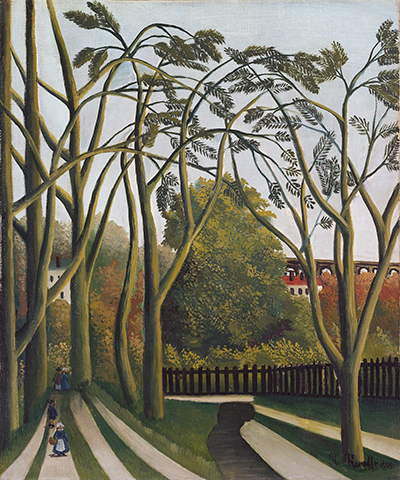
A woman carrying a basket walks beneath trees whose branches stretch across almost the whole sky. Beyond her, other figures follow the narrowing path into a green valley. Henri Rousseau makes this small corner of the Paris outskirts feel extensive: the eye travels between trunks, over foliage and towards a distant line of arches. The Banks of the Bièvre near Bicêtre, an oil painting on canvas dated about 1908–09 by the Metropolitan Museum of Art, joins a recognisable place to an unusually intricate arrangement of trees.[1]
Its invitation to take a quiet walk survives a closer look, although the walk becomes less straightforward. A fence crosses the middle distance. The water turns into a dark, sharply bounded channel. Overhead, branches loop and intersect with the deliberate clarity of a drawing. Rousseau gives the landscape both depth and a pattern that keeps returning the eye to the painted surface.
At a Glance
- ArtistHenri Rousseau
- SubjectThe Banks of the Bièvre near Bicêtre
- ExploreFollowing the path; Trees that open the sky
This work across Henri Rousseau’s career
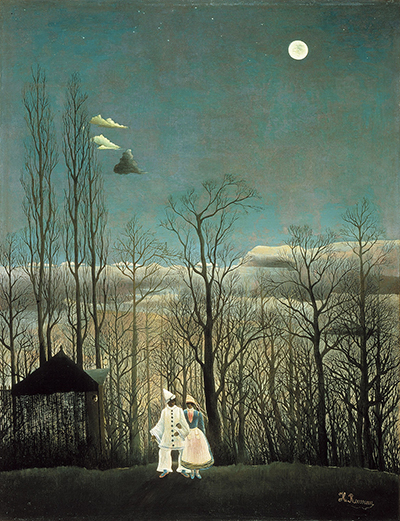
Carnival Evening
1886 [2]The Merry Jesters
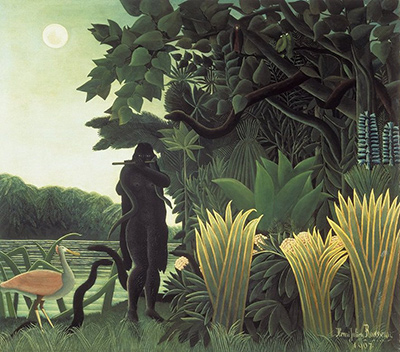
1906 [7]The Snake Charmer
1907 [8]Contents
- Following the path
- Trees that open the sky
- A river on the edge of Paris
- The date on the stretcher
- Observation, memory and possible sources
- Annotated details
Following the path
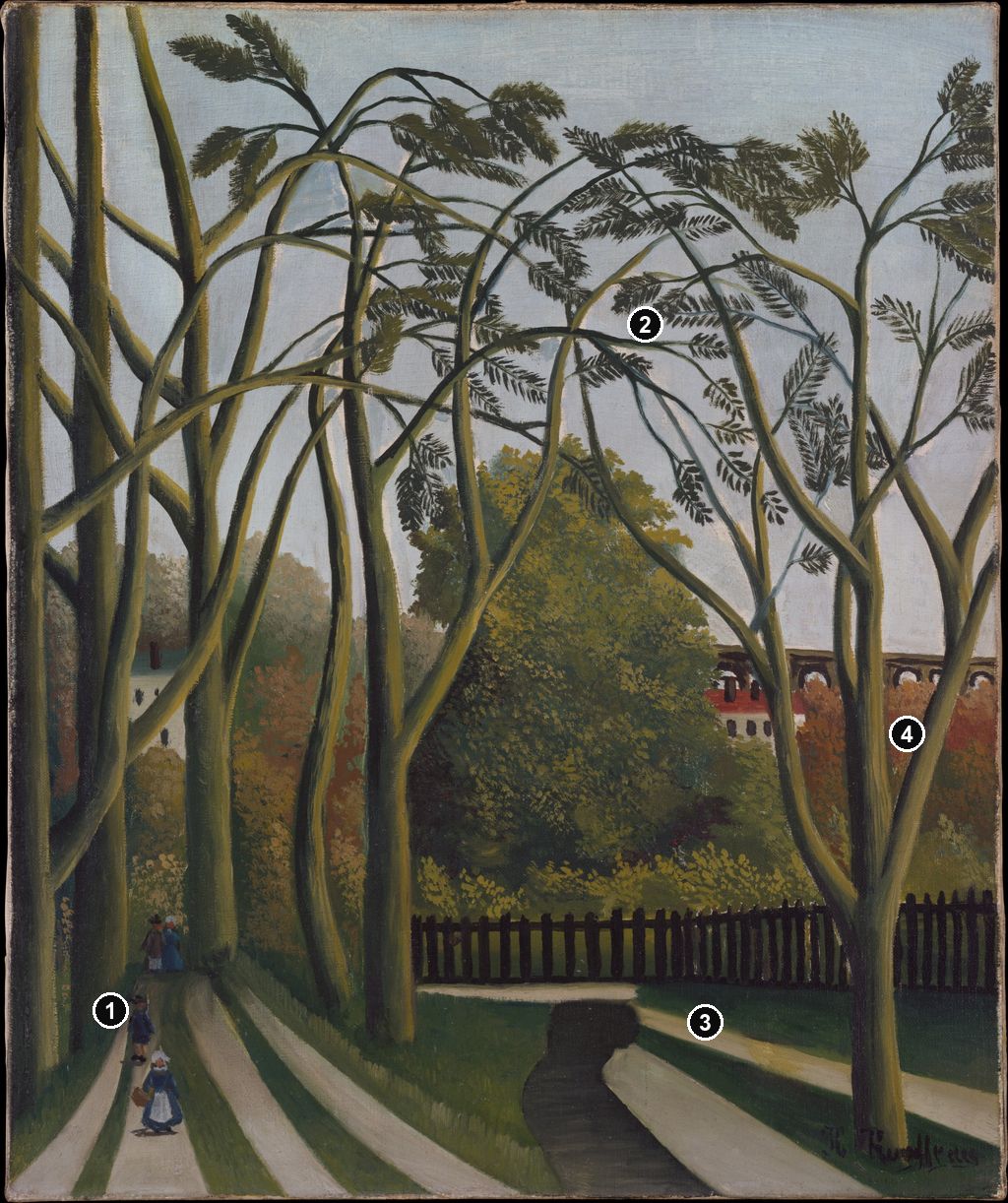
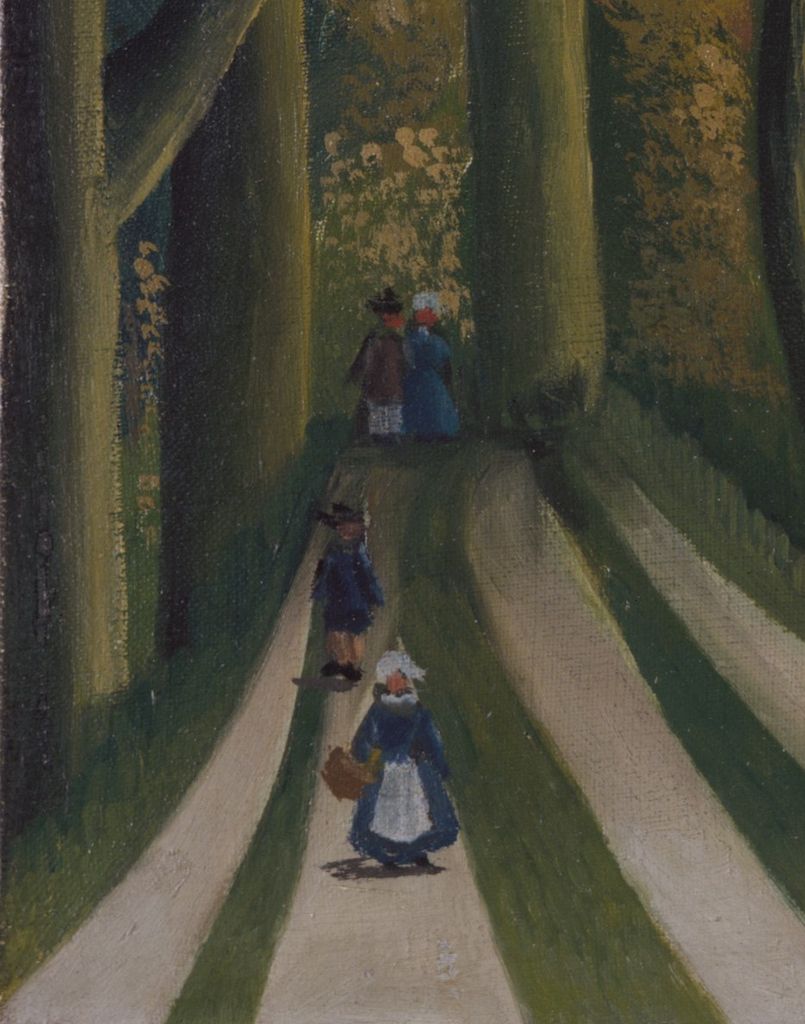
The path begins at the lower left, where its pale surface opens towards the viewer. A strip of green divides its two principal tracks; their converging edges make the distance immediately legible. The nearest woman, in a blue skirt and pale apron, is large enough for her clothing and basket to register. Further up, another figure is smaller, and the people beyond become little patches of dark and coloured paint. Their diminishing size measures the walk ahead.
The trees make that journey feel sheltered. Thick trunks rise close to the left edge, while others lean towards the centre. Some stand in front of the path's distant continuation, briefly interrupting its course. We can follow the general direction without seeing every step. This partial concealment matters: a landscape entirely open to inspection would offer less of the sense that another stretch lies just beyond the next tree.
On the right, a second pale bank follows the water. Here the eye takes a different route, passing around a dark bend that points towards the fence. The two passages do not resolve into a single broad avenue. One carries people into the trees; the other draws attention towards water and enclosure. The lower part of the picture is therefore more divided than the great sweep of branches overhead first suggests.
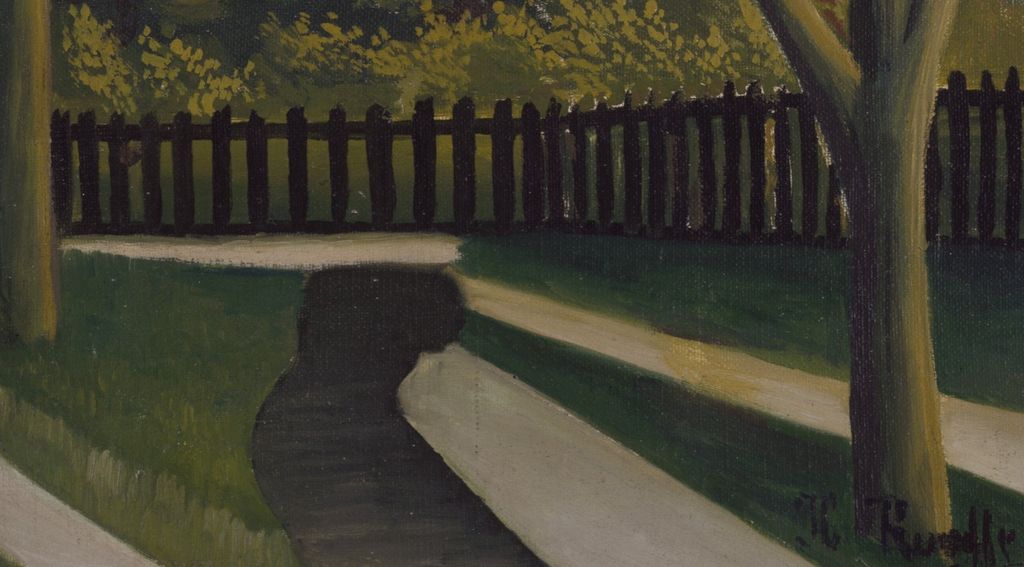
The fence brings a firm horizontal interruption. Its dark upright slats repeat the standing trunks in miniature, while the trees cross its line and rise far above it. A dark opening where the channel reaches this boundary gives the watercourse a destination. The small human route, the managed bank and the barrier establish an inhabited landscape. Walking here involves paths and edges already shaped by people.
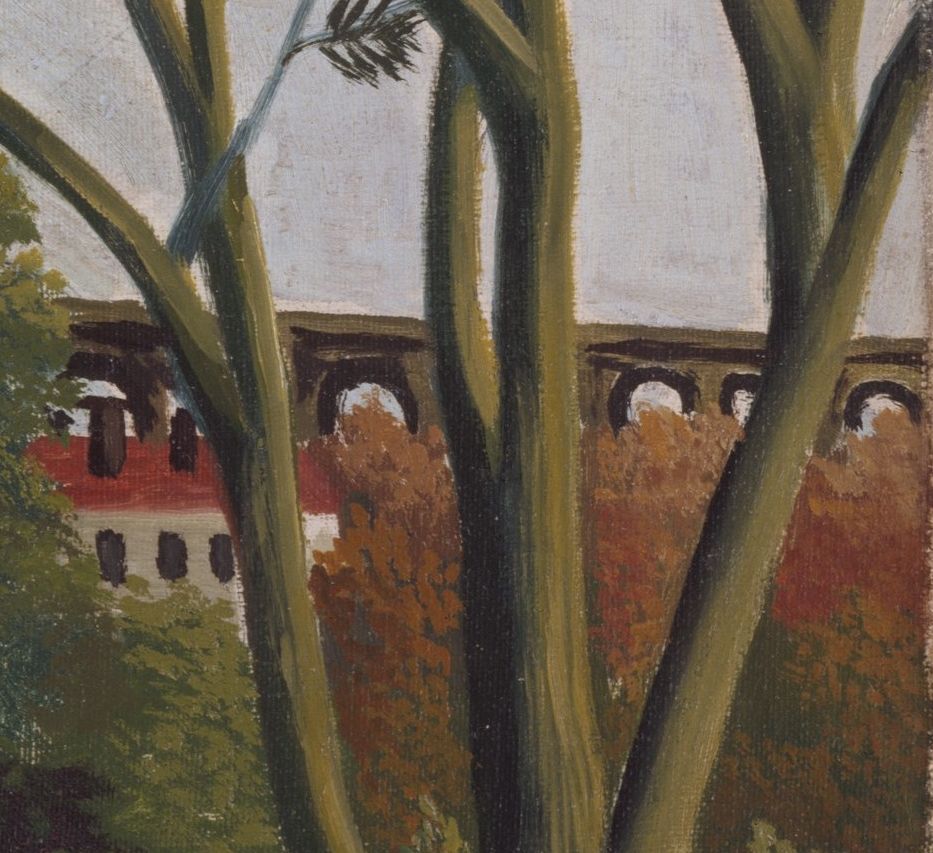
Above the fence, a rounded mass of foliage conceals much of the valley. Its position is almost central, but the view escapes around both sides. On the left, a pale gap and distant figures extend the promenade. On the right, a light building, a red roof and the aqueduct's arches appear between the trunks. Rousseau allows several small discoveries instead of giving the distant landmark an unobstructed stage.
Trees that open the sky
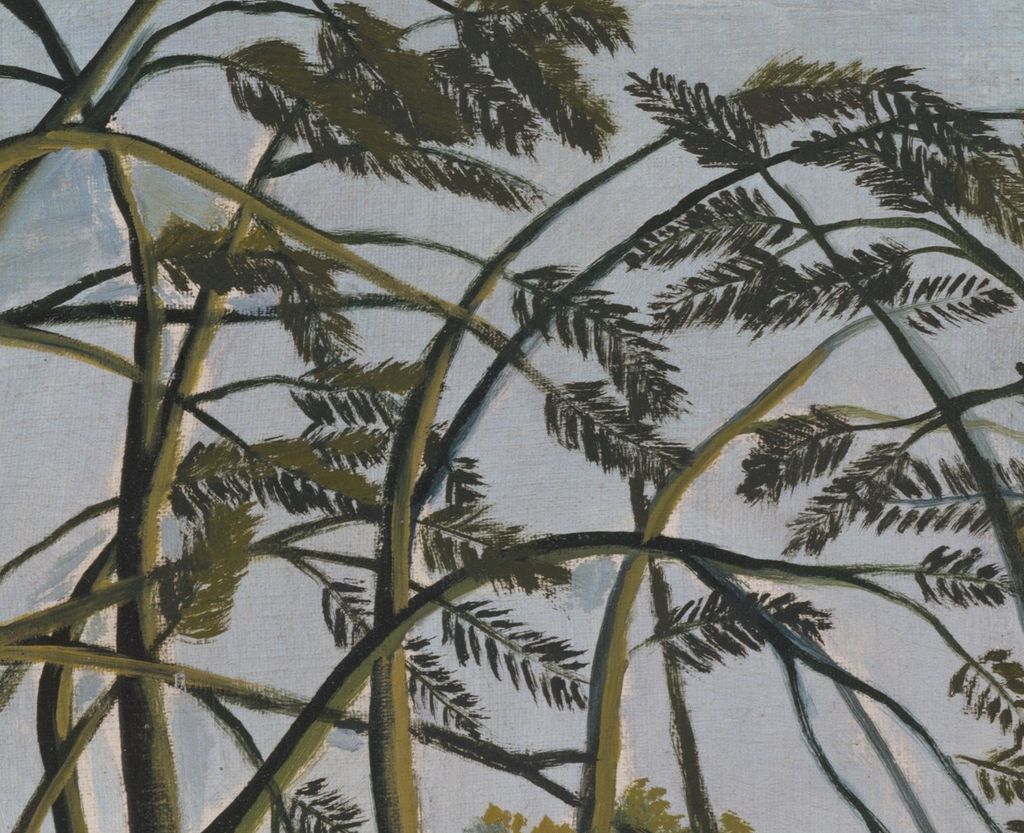
The foreground trees are distinctive because so much of their structure remains exposed. Long yellow-green trunks divide into arching limbs; narrow clusters of dark leaves hang from them at intervals. Those gaps let the pale blue-grey sky continue down between the branches. The canopy frames an opening while remaining a conspicuous network in its own right. At the top of the painting, one curved limb seems to lead directly into another, carrying the eye sideways after the path has pulled it backwards.
Light along the trunks gives them a rounded appearance. Their darker edges hold them apart from the sky, and the repeated shift from olive shadow to yellow-green light creates a gentle rhythm across the foreground. These are emphatic forms, yet they are less rigid than a row of posts. Their changes of direction make the space feel responsive to each new curve.
The foliage behind them uses a different vocabulary. The large central tree is built from many small touches of green and yellow. Its edge is soft and irregular beside the clean contours of the tall trunks. Lower shrubs gather into smaller, lighter clusters, while reddish-brown foliage warms the right-hand slope. This variation prevents the valley from becoming one continuous block of green.
Michel Hoog, writing in the 1985 Rousseau catalogue, drew attention to the sinuous branches and nuanced foliage, contrasting them with the sharply outlined vegetation of the jungle pictures.[12] The distinction is particularly helpful here. The dark foreground leaflets still form readable silhouettes, but the trees further away dissolve into accumulated touches. Rousseau changes the texture as the view recedes. Depth comes through the handling of leaves as well as the shrinking figures.
The red roof and nearby rusty foliage are small but effective interruptions. Seen through the green screen, they offer a point of warmth near the distant arches. The woman's blue clothing, by contrast, belongs to the cool range of the sky and water. Such small accents keep the lower path and the upper distance in conversation. A person close to us and a building far away can each claim attention without upsetting the landscape's quiet balance.
Annotated Details from The Banks of the Bièvre near Bicêtre
The numbered points identify visible features discussed in this article. Return from each detail to the whole composition. Henri Rousseau, The Banks of the Bièvre near Bicêtre, c. 1908–1909. The Metropolitan Museum of Art, 39.15. Gift of Marshall Field, 1939. Image source. CC0 / Public domain. Numbers added to the overview; detail views cropped from the original. No recolouring or retouching.
Details from THE BANKS OF THE BIÈVRE NEAR BICÊTRE
Compare the path, branches, fence and distant arches with their positions in the complete painting above.
Figures along the path
The nearest blue skirt and basket stand out against the pale track. Smaller figures appear higher up, so a short stretch of painted path suggests a longer walk.
A network of open branches
Branches fork and cross while grey-blue sky remains visible between them. Their exposed curves make an intricate pattern above the much denser foliage below.
The fence and the dark channel
The repeated fence posts run across the view while the dark channel bends towards them. Pale banks separate the water from the surrounding green ground.
Arches beyond the trees
The repeated pale openings are partly hidden by trunks and warm brown foliage. This small architectural rhythm contrasts with the varied curves of the much larger trees in front.
A river on the edge of Paris
Bicêtre was a working-class community on Paris's southern edge. The Met identifies the background structure as the seventeenth-century aqueduct at Arcueil. It also notes that the Bièvre was heavily polluted in Rousseau's time, despite surviving picturesque stretches; the river's course through the city is now underground.[1] This setting gives the tranquil greenery a more particular meaning. The painting belongs to a suburban waterway with a history of use, rather than to an untouched countryside.
That knowledge changes how the foreground reads. The straight banks, narrow channel and fence become as important to the character of the place as the trees. Nothing in the painted surface tells us how clean the water is. Its darkness cannot serve as a chemical record, any more than the foliage can certify the condition of the river. The image preserves an appealing prospect within a place whose environmental circumstances were more complicated.
The arches add a second kind of human presence. Their repeated openings are tiny beside the foreground branches, but their long horizontal course anchors the view. The trees grow in different directions; the masonry keeps its steady sequence across the background. Together with the fence and the figures, this landmark makes the valley a meeting of cultivated nature, movement and construction.
The contrast belongs to the everyday character of the scene: people walk beneath trees in a district associated with labour and pollution, and an artist finds an absorbing view there. Readers exploring Rousseau's suburban subjects can continue with Sawmill, Outskirts of Paris, another entry into the landscape beyond the centre of the city.
The date on the stretcher
The painting carries an unusually useful piece of evidence on its reverse. Hoog transcribed a label on the stretcher naming the banks of the Bièvre near Bicêtre, adding the season, spring, and the date 23 February 1909, followed by Rousseau's name.[12] The words attach this green landscape to a named locality and to the artist's own presentation of the work.
The precision of the written date has encouraged questions about the foliage. Hoog discussed earlier attempts to place the picture much sooner in Rousseau's career, including an argument that the inscription had been added later because the trees would not have looked so leafy on that February day. He rejected that reasoning, stressing the role of memory in Rousseau's landscapes.[12] His account records a dispute over how to interpret the label; it cannot turn the label into a record of a day's outdoor work.
Several moments may lie behind a painting of a familiar place: seeing it, making a preliminary study, arranging a composition, finishing the canvas and inscribing or labelling it. A dated label does not establish that all those activities happened together. Here the current museum date remains about 1908–09.[1] The spring designation is valuable as part of Rousseau's naming of the picture, without requiring us to reconstruct the weather on a particular morning.
The visible trees also resist the expectation of an instantaneous report. Their long bare intervals and precisely separated leaf clusters make a highly selective design. Each branching gesture is easy to follow, even where neighbouring limbs overlap. The result can recall a walk through a real place while allowing the artist considerable freedom over how that walk is pictured.
Observation, memory and possible sources
Rousseau's urban landscapes emerged from sustained attention to Paris and its surroundings. The museum in Laval discusses an outdoor preparatory study for a view of the Île Saint-Louis and the development of such compositions in the studio.[13] That example shows a practice in which observation and subsequent arrangement could work together. It does not establish a surviving study or an identical procedure for the Bièvre painting.
Hoog suggested two further possibilities for this particular view. He proposed a connection with Victor Hugo's verses about the Bièvre valley and thought that Rousseau might have used a postcard of the familiar site.[12] Both remain suggestions. His entry does not identify an original postcard or establish that Rousseau read those lines while planning the canvas. A literary resemblance and a possible visual aid have different evidential weight from the artist's surviving label.
The canvas itself rewards attention to choices that any source would leave open. The nearest trunks occupy a remarkable amount of the picture's height. The dense central foliage blocks the easiest route towards the horizon. The aqueduct is set low and partly hidden, so that the viewer finds it through the trees. These decisions give the landscape its particular pace. We move between a sweeping framework and a series of small, distant incidents.
Rousseau's suburban views also belonged to the practical range of his production. The Orangerie's 2026 exhibition account describes small canvases made for modest budgets and interiors, alongside his larger public ambitions.[14] At 54.6 × 45.7 centimetres, this canvas invites close looking. Rousseau consigned it to the dealer Ambroise Vollard in 1909; it entered the Met as Marshall Field's gift in 1939, accession 39.15.[1] Those facts give the painting a documented market and museum history without identifying its intended first buyer.
Its intimate scale suits the slow discovery of the view. The foreground woman is encountered first, the fence next, and the arches only after the eye has passed through layers of trunks and leaves. Even when the whole composition is familiar, those relationships keep shifting in emphasis. Rousseau has made a suburban walk available as an experience of looking: a clear path below, a restless tracery above, and a valley that remains partly concealed between them.
Henri Rousseau artworks directory
This directory brings together works covered on this site and other works documented in the cited museum records and catalogues. Alternate titles share one entry; distinct versions remain separate. Historical dates for works without an article follow the cited catalogues. This is not a catalogue raisonné.
Frequently Asked Questions
The Met identifies them as the seventeenth-century aqueduct at Arcueil.[1]
Hoog proposed a postcard source without identifying an exact original in his entry. It remains a scholarly possibility.[12]
Discussion
Look again at the images and ideas explored in The Banks of the Bièvre near Bicêtre. These editorial prompts invite your observations.
Reader Insights
Follow the path from the nearest woman towards the distance. Where do trees interrupt your progress, and how does the eye continue?
How does knowing the Bièvre was polluted affect your response to the painting's greenery and water?
Compare the exposed foreground branches with the dense central foliage. What different kinds of space do they create?
Join the Conversation
Share a detail, comparison or question about The Banks of the Bièvre near Bicêtre below.
References
- Metropolitan Museum of Art. The Banks of the Bièvre near Bicêtre, collection commentary and object details, accession 39.15, accessed 23 October 2026. View source.
- Philadelphia Museum of Art, Carnival Evening,1963-181-64,object59593. View source.
- Musée de l’Orangerie / Juliette Degennes, Henri Rousseau,L’ambition de la peinture: Un artiste dans son époque (in French). View source.
- National Gallery, Surprised!, NG6421. View source.
- Musée d’Orsay, La Guerre,RF19461 (in French). View source.
- MoMA, The Sleeping Gypsy. View source.
- Philadelphia Museum of Art, The Merry Jesters, 1950-134-176, object51097. View source.
- Musée d’Orsay, La Charmeuse de serpents, RF 1937 7 (in French). View source.
- Musée de l’Orangerie, La Carriole du Père Junier, RF 1960 26 (in French). View source.
- Solomon R. Guggenheim Museum / Cornelia Lauf, The Football Players,60.1583: current collection record. View source.
- MoMA, The Dream, 252.1954. View source.
- Michel Hoog. “Banks of the Bièvre near Bicêtre, Spring,” entry 54, in Henri Rousseau: Essays, Museum of Modern Art, 1985, p. 222 (PDF p. 227). The current Met identification of the aqueduct at Arcueil supersedes this entry's identification of the arches as Buc. View source.
- MANAS, Musées de Laval. “Henri Rousseau, dit le Douanier”, sections on urban views and Le Pont de Grenelle, accessed 23 October 2026. View source. (in French).
- Musée de l'Orangerie. Henri Rousseau, l'ambition de la peinture, exhibition texts, 25 March–20 July 2026, “Variations et déclinaisons. À la recherche du marché,” accessed 23 October 2026. View source. (in French).
- The Museum of Modern Art, Henri Rousseau: Essays (1985), selected catalogue entries, chronology and notes on early devotees. View source. Selected entries, chronology (pp.91–95) and early-devotee notes (pp.262–264) were consulted. Historical collection credits do not establish present ownership.
- Daniel Catton Rich, Henri Rousseau (The Museum of Modern Art, 1942), selected drawings and landscape studies; historical catalogue. View source. The dated 1942 publication is used for the two Quai d’Auteuil ink views; its Malakoff date differs from the 1985 catalogue.
- National Gallery of Art, Self-Portrait (1895), pen-and-ink drawing, accession 1995.47.66. View source.
- The Museum of Modern Art, War (published January 1895), lithograph, accession 684.1943. View source.
- Barnes Foundation, Landscape and Four Young Girls, object 5521, BF855. View source.
 Henri Rousseau.jpg)
 Henri Rousseau.jpg)