


 by Tom Gurney
Tom Gurney BSc (Hons) is an art history expert with over 20 years experience
Published on June 19, 2020 / Updated on October 29, 2026
Email: tomgurney1@gmail.com / Phone: +44 7429 011000
House on the Outskirts of Paris: Introduction
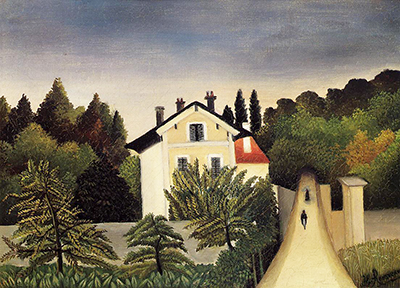
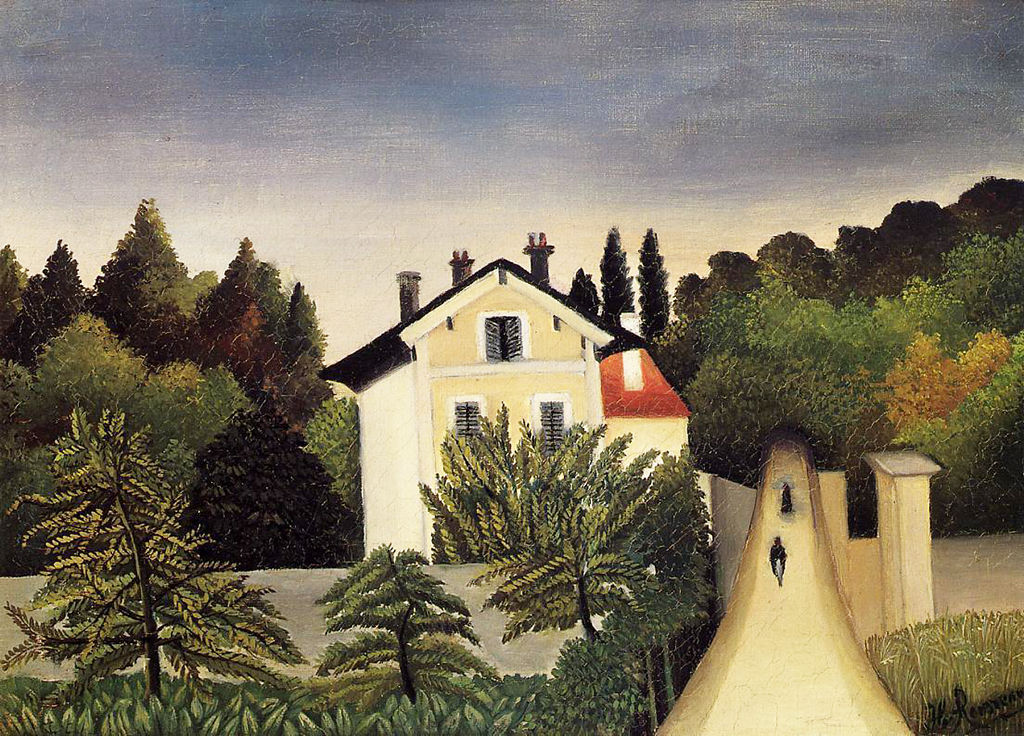
A pale house stands amid a garden so full of trees that its entrance disappears. Beside it, a narrow road runs away between high walls, carrying two tiny figures towards a dark opening in the greenery. Above everything stretches a broad, grey sky. In Henri Rousseau's House on the Outskirts of Paris, the building is firm and enclosed, the foliage restless with small shapes, the road an invitation to look into the distance. The painting belongs to Carnegie Museum of Art, Pittsburgh, which dates it to about 1905.[1]
At a Glance
- ArtistHenri Rousseau
- SubjectHouse on the Outskirts of Paris
- ExploreA small canvas with a spacious view; The house behind the garden
This work across Henri Rousseau’s career
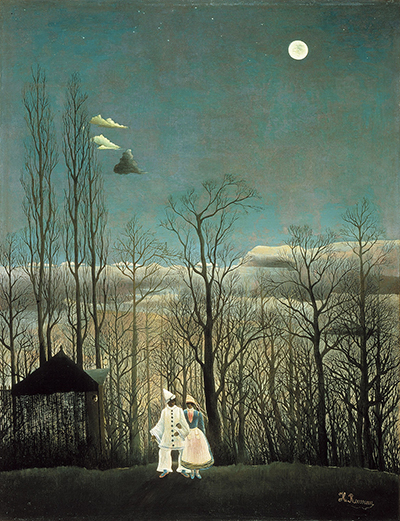
Carnival Evening
1886 [2]The Merry Jesters
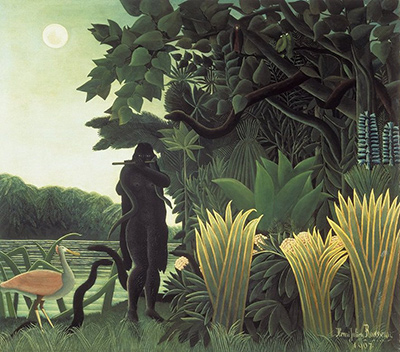
1906 [7]The Snake Charmer
1907 [8]Contents
- A small canvas with a spacious view
- The house behind the garden
- Three trees in the foreground
- The road and its two figures
- A sky larger than the house
- A landscape with the presence of a portrait
- From Max Weber to Pittsburgh
A small canvas with a spacious view
The picture is an oil painting on canvas measuring 33.02 × 46.36 cm. Its modest horizontal format holds a surprisingly expansive scene, largely because Rousseau leaves so much room above the roof. The house occupies the lower middle of the composition, slightly to the left, while the road opens towards the bottom edge on the right. The foreground plants seem close enough to inspect leaf by leaf; the distant walkers are reduced to dark marks. That movement between near detail and distant scale gives the view its reach.[1]
The date remains approximate. The 1985 exhibition catalogue Henri Rousseau placed the painting around 1902, whereas Daniel Catton Rich's 1942 book reproduced it with a 1905–07 date. Carnegie's present record gives about 1905. These are different datings of the same composition, whose distinctive house, three foreground trees and walled road make it readily recognisable across the reproductions.[12][13][1]
The title offers a broad location rather than the address of a named property. It suits the mixture visible here: a substantial house and enclosing walls, dense planting and a lane with little traffic. The scene feels inhabited without becoming busy. Its interest lies in how these ordinary elements have been brought together, and in the space Rousseau gives them to occupy.
The house behind the garden
The front of the house is the brightest large shape in the painting. Pale peach walls are divided by white edging around the windows and across the façade, while the sloping roof makes a dark, sharply defined cap. The upper window sits below the peak of the gable; two lower windows form a pair beneath it. Their black slatted shutters introduce a repeated pattern within the broad, quiet wall. At this scale, those shutters remain conspicuous enough to give the front a particular character.
Rousseau also shows the long pale side wall extending towards the left. The building therefore has volume as well as a frontal face. Yet the garden makes its exact boundaries harder to follow. Bushes rise across the lower windows, a dark mass of foliage presses against the left side, and a taller screen divides the house from the road. There is no uninterrupted route for the eye from the foreground to a front door. We see the property across its planting and boundary wall, as someone passing outside might see it.
On the right, a red roof gives a warm accent to the attached lower section. Its colour is stronger than the restrained pink of the main façade, but its area is small. The white upright shape against the red repeats the light trim elsewhere on the building. Above, three chimney stacks interrupt the main roofline, while two tall, narrow trees stand beyond it. Masonry and foliage share the same upward movement: the stacks are blunt and hard edged, the trees tapering and irregular. Together they keep the house from sitting as a single closed triangle beneath the sky.
House on the Outskirts of Paris — Henri Rousseau.
Three trees in the foreground
Three separate trees spread across the nearest part of the garden. The left tree is the tallest and most open, with branches sloping out from a dark trunk. The small middle tree has a more compact, tiered outline. The tree to the right spreads into a broad fan of leafy branches that crosses the pale wall and the vegetation behind. Their differences matter. They give the foreground a sequence of distinct forms, each with its own balance of trunk, branch and leaf.
Small light leaf shapes sit along the dark branches, making their structures easy to follow. Around their feet, longer pointed leaves fill the bottom edge. Behind them, the vegetation grows into dense rounded masses. Rousseau sets several ways of describing growth side by side: clearly separated sprays, a compact little tree, soft mounds of bushes and tall pointed crowns. The garden seems abundant because its parts retain such different outlines.
A pale horizontal boundary wall passes behind the three trees. It supplies a calm band through an otherwise intricate area and allows the dark trunks to register clearly. Branches spread across it as though across a light screen. The wall also separates the nearest garden from the house, slowing the passage into the picture. To move visually towards the building, we must work through overlapping trees and bushes. The road next door offers a much more direct journey.
The road and its two figures
At the bottom right, the road begins as a broad wedge of cream. Its edges draw together steeply as it passes between the walls and disappears beneath a dark arch of foliage. One substantial pillar rises on the right, its pale cap and upright face catching the eye. The wall then recedes towards a smaller upright near the distant opening. These plain built forms turn the lane into a long, enclosed corridor beside the garden.
The two people make that corridor legible as a place of human movement. The nearer figure has a small reddish head above a dark body and divided legs. Farther up the road, the second person is a shorter, more compact shape. Their difference in size helps establish distance even though neither receives the descriptive attention given to a branch or shutter. They animate the lane without providing a story about who they are or where they are going.
The road's rapid narrowing sits beside the broad horizontal garden wall. Looking across the foreground, the eye encounters a sequence of trees and a level pale band; looking along the road, it is pulled abruptly into depth. Rousseau lets both experiences remain strong. The viewer can linger over the garden's surface or follow the lane towards its dark endpoint. This contrast gives the small painting much of its spatial energy.
The 1985 catalogue judged Rousseau's handling of the receding street as a difficulty in perspective.[12] The visible arrangement also invites attention on its own terms. The lane is unusually emphatic, almost a separate strip of space running beside the densely planted property. Its open surface relieves the crowded garden and gives the tiny figures a clear setting. The painting's sense of distance depends on that division between an obstructed view of the house and an unobstructed path towards the horizon.
A sky larger than the house
The sky takes up a generous part of the canvas. Grey extends across the top, lightening towards a muted pink near the trees and roof. Cloud shapes are broad and soft, with few of the small divisions that fill the garden below. After following the repeated leaves, the eye can rest in this much less articulated space. It enlarges the scene while giving the precise outlines of the roof, chimneys and pointed trees something quiet to stand against.
The sky's subdued colour and breadth give the scene an atmosphere of suspended stillness. The red roof and pale façade gain warmth against it, while the uppermost dark trees seem almost cut into its lighter lower band. Along the right edge, rounded crowns rise into a continuous bank of foliage. On the left, individual pointed trees leave more broken intervals of sky. The two sides surround the house without forming an exact symmetry.
These differences keep the scene from becoming a diagram of a building in a garden. The house is clear enough to recognise at once, but the surrounding growth varies in density and height. The road opens a separate passage, and the sky spreads beyond all the enclosing walls. The property is bounded; the painted view remains spacious.
A landscape with the presence of a portrait
In discussing this picture, the 1985 catalogue relayed Susan Leonard's comparison between Rousseau's treatment of buildings and a portrait: the house appears to possess an individual presence.[12] That is a useful way of looking at the façade. Its shutters, white divisions and peaked roof offer a memorable arrangement of features. The shrubs partly conceal it, but its pale front remains the scene's centre of attention. The people passing along the lane are much less individually described.
The same catalogue proposed affinities with landscapes by Cézanne and Corot.[12] Such comparisons place Rousseau's ordinary house, trees and road within a wider conversation about constructing a landscape. They do not establish a copied model for this painting. The strongest introduction to the picture remains its own arrangement: the bright building held within dark vegetation, the foreground trees displayed against a wall, and the lane opening a deep, narrow channel at one side.
The Musée de l'Orangerie's 2026 exhibition account describes Rousseau's small landscapes and still lifes as part of a varied production suited to customers with modest homes and budgets. It also connects his suburban subjects with observations made around Paris.[14] This provides a setting for the painting's intimate scale without identifying a particular commission or buyer at the moment it was made. Readers exploring this part of his work can continue with Banks of the Bièvre near Bicêtre, another of his views of the Parisian periphery.
From Max Weber to Pittsburgh
The 1985 catalogue identifies House on the Outskirts of Paris as Max Weber's first purchase from Rousseau, made in 1908. Its provenance lists Weber and then Mrs Max Weber, both at Great Neck, New York. The purchase date belongs to the painting's history of ownership; it is distinct from the approximate date of execution. The catalogue also records its acquisition for the Pittsburgh museum in 1969 through the generosity of the Sarah Mellon Scaife family.[12] Carnegie retains that family credit in its current collection record, where the painting bears accession number 69.10.[1]
The same historical catalogue lists appearances in New York in 1910 and 1913, followed by several American exhibitions in 1942.[12] The little suburban view thus had a public life beyond its place in Weber's collection. Within its small rectangle, an ordinary property becomes a self-contained world of enclosure and openness. The shutters keep the interior hidden, the plants fill the garden, and two small people continue along the pale road beneath an immense sky.
Henri Rousseau artworks directory
This directory brings together works covered on this site and other works documented in the cited museum records and catalogues. Alternate titles share one entry; distinct versions remain separate. Historical dates for works without an article follow the cited catalogues. This is not a catalogue raisonné.
Frequently Asked Questions
It belongs to Carnegie Museum of Art in Pittsburgh. The museum records oil on canvas, 33.02 × 46.36 cm, accession number 69.10, acquired through the generosity of the Sarah Mellon Scaife Family.[1]
The 1985 exhibition catalogue identifies Max Weber as the buyer in 1908 and calls it his first purchase from the artist.[12]
Discussion
Look again at the images and ideas explored in House on the Outskirts of Paris. These editorial prompts invite your observations.
Reader Insights
Does your eye settle first on the house, the three foreground trees or the pale road? What draws it there?
How would the scene's sense of distance change without the two small figures?
What does the broad sky contribute to a view otherwise filled with walls and vegetation?
Join the Conversation
Share a detail, comparison or question about House on the Outskirts of Paris below.
References
- Carnegie Museum of Art. House on the Outskirts of Paris, current collection record, accession 69.10, and official object image; accessed 23 October 2026. View source.
- Philadelphia Museum of Art, Carnival Evening,1963-181-64,object59593. View source.
- Musée de l’Orangerie / Juliette Degennes, Henri Rousseau,L’ambition de la peinture: Un artiste dans son époque (in French). View source.
- National Gallery, Surprised!, NG6421. View source.
- Musée d’Orsay, La Guerre,RF19461 (in French). View source.
- MoMA, The Sleeping Gypsy. View source.
- Philadelphia Museum of Art, The Merry Jesters, 1950-134-176, object51097. View source.
- Musée d’Orsay, La Charmeuse de serpents, RF 1937 7 (in French). View source.
- Musée de l’Orangerie, La Carriole du Père Junier, RF 1960 26 (in French). View source.
- Solomon R. Guggenheim Museum / Cornelia Lauf, The Football Players,60.1583: current collection record. View source.
- MoMA, The Dream, 252.1954. View source.
- The Museum of Modern Art. Henri Rousseau, 1985, catalogue entry 26, p. 156, and colour plate p. 157 (PDF pp. 161–162). View source.
- Daniel Catton Rich. Henri Rousseau, The Museum of Modern Art, 1942, p. 44 (PDF p. 49), illustration and caption, House, Outskirts of Paris. View source.
- Musée de l'Orangerie. Henri Rousseau, l'ambition de la peinture, exhibition text, 25 March–20 July 2026, “Variations et déclinaisons. À la recherche du marché”; accessed 23 October 2026. View source. (in French).
- The Museum of Modern Art, Henri Rousseau: Essays (1985), selected catalogue entries, chronology and notes on early devotees. View source. Selected entries, chronology (pp.91–95) and early-devotee notes (pp.262–264) were consulted. Historical collection credits do not establish present ownership.
- Daniel Catton Rich, Henri Rousseau (The Museum of Modern Art, 1942), selected drawings and landscape studies; historical catalogue. View source. The dated 1942 publication is used for the two Quai d’Auteuil ink views; its Malakoff date differs from the 1985 catalogue.
- MANAS, Laval, Henri Rousseau, dit le Douanier, urban landscapes and preparatory study (in French). View source.
- National Gallery of Art, Self-Portrait (1895), pen-and-ink drawing, accession 1995.47.66. View source.
- The Museum of Modern Art, War (published January 1895), lithograph, accession 684.1943. View source.
- Barnes Foundation, Landscape and Four Young Girls, object 5521, BF855. View source.
 Henri Rousseau.jpg)
 Henri Rousseau.jpg)