

 Buy Art Prints Now
from Amazon
* As an Amazon Associate I earn from qualifying purchases.
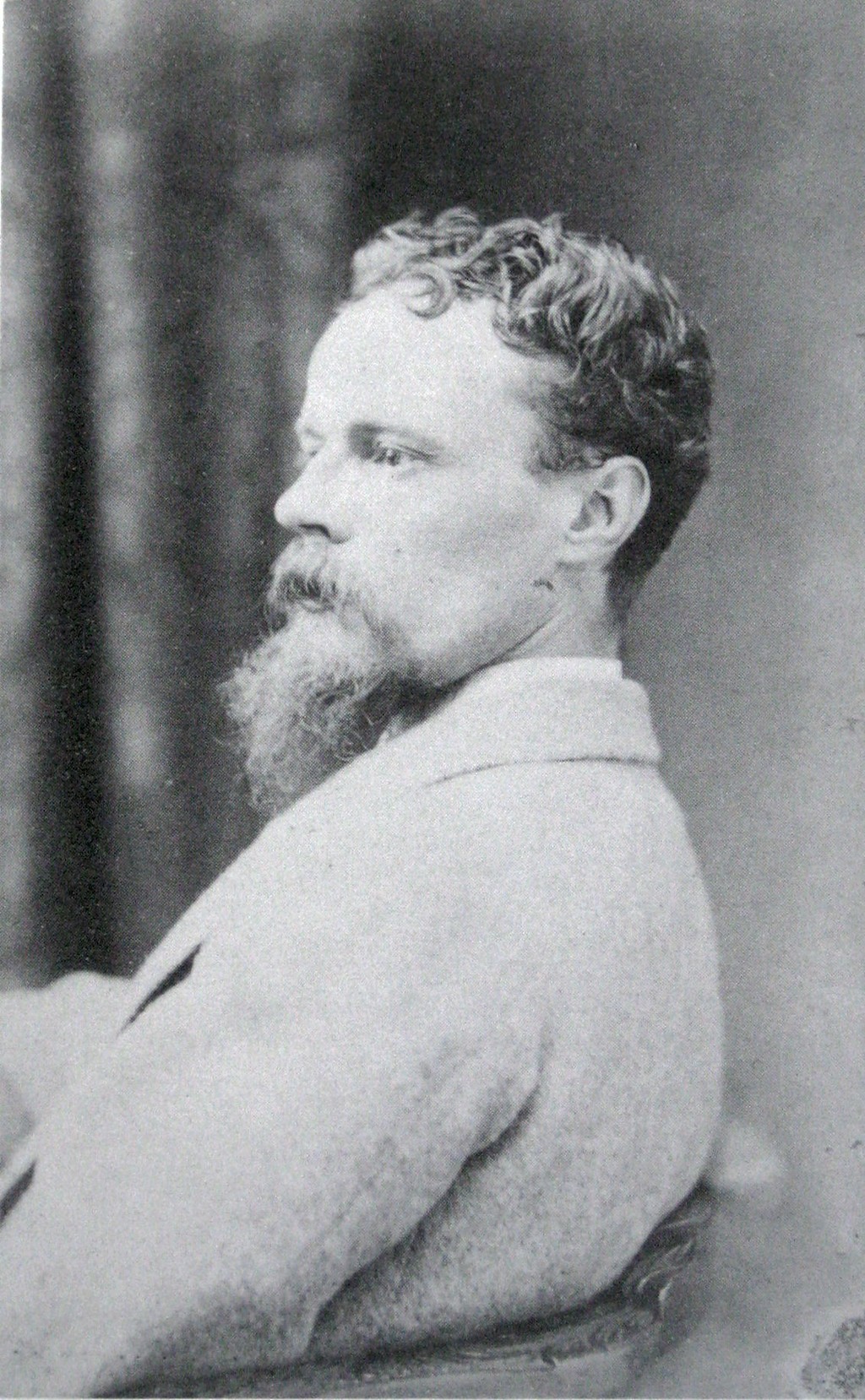
Portrait of John Atkinson Grimshaw, 1870 — public domain.
 by Tom Gurney
Tom Gurney BSc (Hons) is an art history expert with over 20 years experience
Page Created: August 31, 2026 / Page Updated: September 16, 2026
Email: tomgurney1@gmail.com / Phone: +44 7429 011000
John Atkinson Grimshaw Biography: Introduction
John Atkinson Grimshaw built a Victorian career from an unlikely starting point. Art UK’s authority record fixes his life dates as 1836–1893 and identifies the Leeds-born artist represented in public collections.[7] He worked as a railway clerk, learned to paint without an academy education and left secure employment in 1861. Within a decade he had become one of his city’s most successful artists. His moonlit streets, rivers and harbours made his reputation, yet they represent only part of a practice that also included precise early landscapes, interiors, portraits, literary subjects and late snow scenes.[1][2]
That range matters because the familiar image of a solitary “painter of moonlight” can hide the choices behind his career. Grimshaw adjusted his subjects as his circumstances and market changed, moving between Leeds, the Yorkshire coast and a London studio while supporting a large family. Financial pressure, repeated bereavement and changing taste all shaped his working life. The paintings’ stillness was therefore not withdrawal from modern Britain: it was a deliberately poetic way of looking at its railways, streets, warehouses, ports and artificial lights.[1][3]
At a Glance
- Born6 September 1836 in Leeds, England
- TrainingLargely self-taught while employed as a railway clerk
- MarriageFrances Theodosia Hubbarde in 1858
- Full-time careerLeft railway work in 1861; first known Leeds exhibition in 1862
- Principal homesLeeds and Knostrop Old Hall, with a second home in Scarborough from 1876 to 1879
- Died31 October 1893 at Knostrop, Leeds
John Atkinson Grimshaw in context
Pre-Raphaelite Brotherhood
1848–c.1854Aesthetic Movement
c.1860–1900Impressionism
c.1860–1886Symbolism
c.1880–1910John William Inchbold
1830–1888James McNeill Whistler
1834–1903John Atkinson Grimshaw
1836–1893James Tissot
1836–1902Claude Monet
1840–1926Arthur E. Grimshaw
1864–1913Contents
- Introduction
- Childhood, Work and Self-Education
- From Railway Clerk to Artist
- Knostrop and a Leeds Identity
- Moonlight and Commercial Success
- Scarborough, Loss and the Coast
- Ports, London and the Modern City
- Pressure, Process and a Wider Range
- Family, Final Years and Death
Childhood, Work and Self-Education
Grimshaw was born in central Leeds to David and Mary Grimshaw. A detailed local history traces moves made by the family during his childhood, including periods in Sheffield and Norwich, before a return to Leeds. He received no sustained artistic schooling. By the early 1850s he was working as a clerk for a railway company and painting in the hours left to him. The railway was both a source of dependable income and part of the industrial world that would later enter his art indirectly through stations, bridges, warehouses and the movement of goods.[1][6]
Accounts of his youth emphasise resistance from his strict Baptist parents and encouragement from people outside the family. Some anecdotes cannot be independently checked, but the larger pattern is well supported: Grimshaw developed his ability away from the academy, sold pictures before he resigned his clerkship and learned through close study of nature and other artists’ work. The experience helps explain the intense observation of leaves, moss, stone and weather in his early pictures without turning self-teaching into a romantic miracle.[1][2]
His marriage to his cousin Frances Theodosia Hubbarde, commonly called Fanny, in 1858 formed an important domestic partnership. Institutional accounts credit Frances with encouraging his decision to paint full-time. Their marriage also placed artistic ambition inside the practical demands of a growing household. Biography should not reduce her to a supportive figure, but the available records make clear that Grimshaw’s career developed within a shared family economy rather than in isolation.[1][5]
From Railway Clerk to Artist
In 1861 Grimshaw left the railway. The Scarborough Museums chronology records his first known exhibition in Leeds the following year. His early landscapes and still lifes responded to the Ruskinian ideal of close fidelity to nature and to the detailed surfaces associated with Pre-Raphaelite painting. Museo Thyssen-Bornemisza also points to the example of John William Inchbold, another Leeds-born painter. Delicate branches, individual plants and carefully differentiated textures show the value Grimshaw placed on sustained observation at this stage.[1][2]
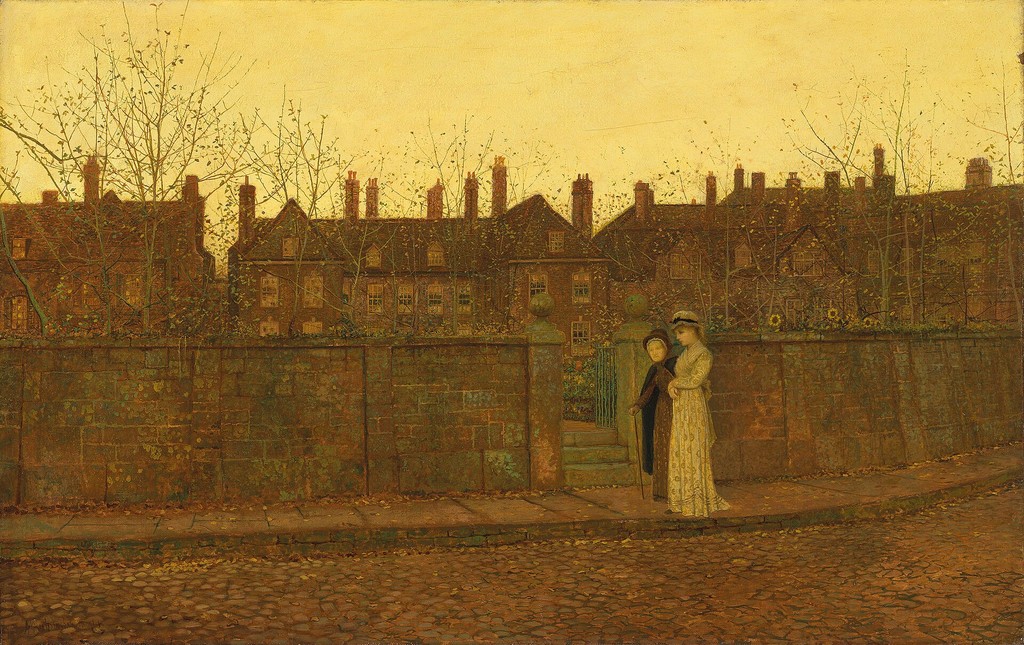
Success brought a move to the greener outskirts of Leeds. A local account places Grimshaw and Frances at Cliff Road, Headingley, around 1863, close to Woodhouse Ridge and the Meanwood Valley. These surroundings offered lanes, walls, trees and gathered natural specimens that could be studied at close range. By about 1865 he was moving away from the most painstaking version of his early manner, though precision never disappeared. Instead, he increasingly made colour, atmosphere and the distribution of light carry a scene.[2][6]
This change was not a simple rejection of nature for fantasy. The landscapes and seasons guide shows how autumn leaves, winter weather and remembered country lanes remained active throughout his career. What altered was their role: detail became part of a larger tonal design capable of making a familiar place feel suspended between observation and recollection.
Knostrop and a Leeds Identity
Around 1870 Grimshaw took Knostrop Old Hall, a seventeenth-century house east of central Leeds, as the family’s principal home. Sources differ over whether he initially rented or purchased it, so the secure point is its long importance as home, studio and pictorial resource. Rooms, gardens, conservatory plants, stonework and neighbouring lanes reappeared in his interiors and outdoor scenes. The house was not simply a retreat from industrial Leeds; it gave him a controlled setting from which to transform the city’s contrasts.[1][5]
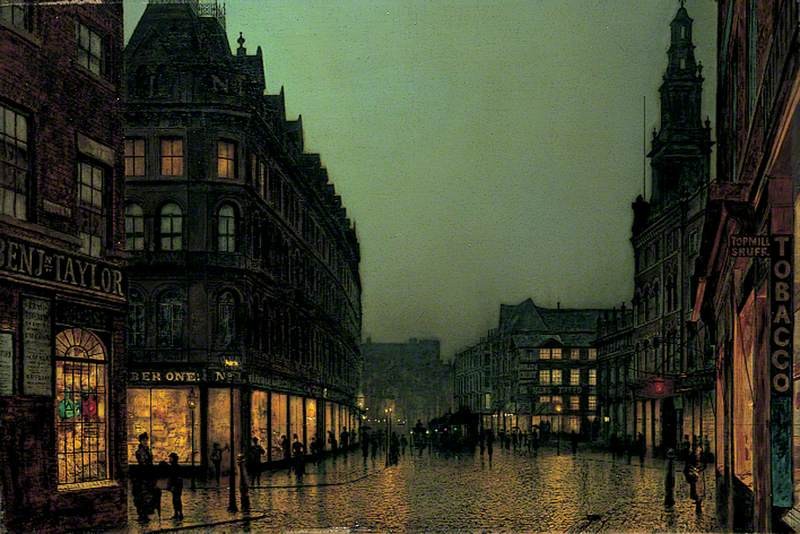
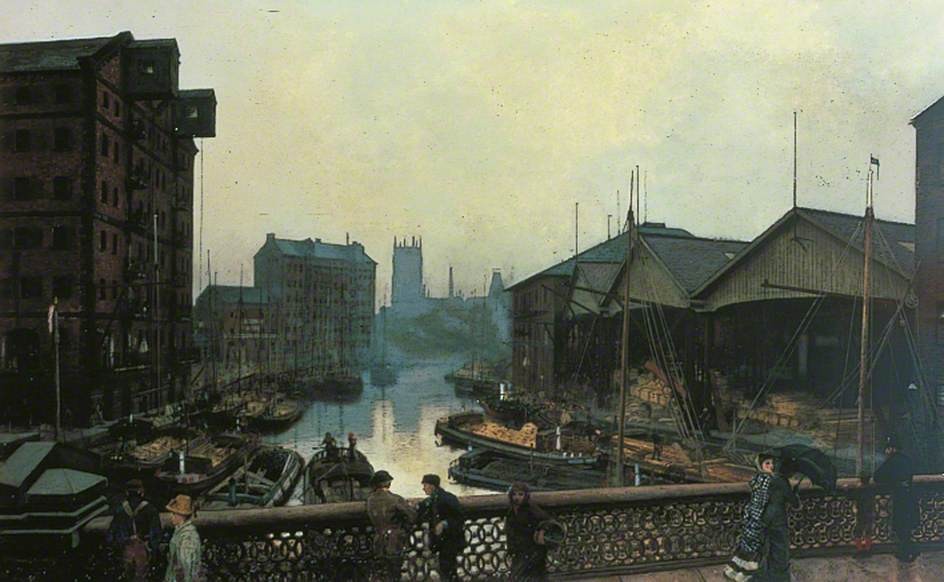
His public identity remained strongly connected to Leeds. He painted central streets such as Boar Lane and Park Row as well as Roundhay, Headingley and the River Aire. In these pictures, new gas lighting, wet paving and shop windows coexist with bare branches and an often distant moon. The Leeds Museums learning resource for Leeds Bridge asks viewers to notice warehouses, boats, factory structures and workers around the River Aire. Such details locate his atmospheric art in a working city rather than an imaginary past.[8]
The Leeds and Yorkshire essay follows that relationship across the city, Knostrop, Whitby and Scarborough. Leeds Art Gallery now holds the largest public collection of Grimshaw’s work, a concentration that reflects both his local significance and sustained institutional study.[4]
Moonlight and Commercial Success
The Scarborough guide dates Grimshaw’s first known moonlight scene, a view of Whitby Harbour, to 1867. During the 1870s moonlight became a defining subject. He learned to balance cool skies with warm windows and lamps, and to make reflections break across water or polished roads. Grimshaw called such works his “moonlights”; the broader term nocturne connects them to a nineteenth-century interest in night as a subject with its own harmonies.[1][3]
These paintings were commercially successful, but repetition did not mean exact duplication. He returned to harbour fronts, suburban lanes, leafless trees, silhouetted figures and familiar architectural forms, altering their arrangement, weather and illumination. That method served private clients who recognised the type while allowing him to keep testing small differences in colour and atmosphere. The moonlight and nocturnes guide examines those recurring structures and the way natural and artificial light share the same scene.
Institutional sources also note that he exhibited relatively little at the Royal Academy: Museo Thyssen-Bornemisza records five paintings there between 1874 and 1876. His career depended primarily on private buyers rather than continuous approval from London institutions. That distinction helps explain why commercial demand and direct relationships with collectors mattered so much to his production.[2]
Scarborough, Loss and the Coast
Family bereavement preceded Grimshaw’s closest engagement with Scarborough. Three of the Grimshaws’ young children died during 1874, in deaths associated by the current museum guide with diphtheria. In 1876 the family took a second home overlooking the sea. Grimshaw named it Castle-by-the-Sea after Henry Wadsworth Longfellow’s poem, linking a real residence to the literary imagination that also shaped many painting titles.[1]
The Yorkshire coast expanded his visual field. Scarborough, Whitby and nearby fishing places allowed him to study moonlight on open water, harbour signals and the movement of working boats. Scarborough Lights and ‘Burning Off’, a Fishing Boat at Scarborough, both dated 1877, place modern coastal activity inside carefully controlled light. The museum guide identifies the latter’s blaze as a harbour flare used to warn boats of dangerous conditions. Romance and working knowledge occupy the same image.[1]
Scarborough was also a place of commercial experiment and social connection. The brewer Thomas Jarvis, who rented the house to Grimshaw, became an important collector. Yet the arrangement did not last. Severe debts forced the family to give up Castle-by-the-Sea in 1879. The episode resists a simple success narrative: Grimshaw’s fame and productivity could coexist with financial instability.[1]
Ports, London and the Modern City
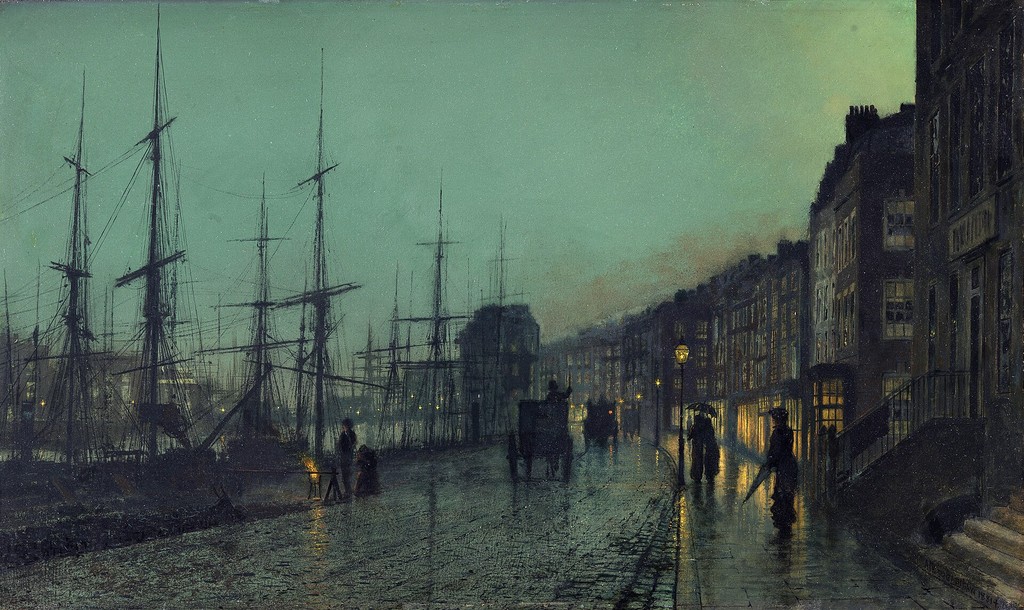
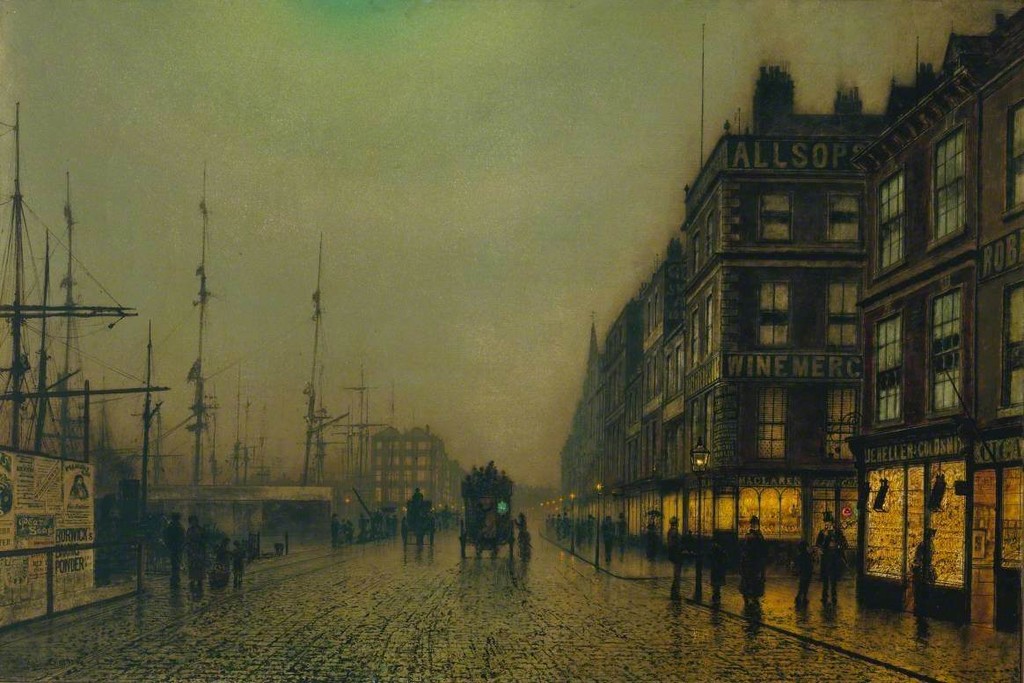
After Scarborough, Grimshaw broadened his urban repertoire. He painted the ports of Liverpool, Glasgow and Hull, where forests of masts, shopfronts and damp quays described the infrastructure of trade. Figures are often small, and labour is not narrated as an anecdote, but warehouses, ships, carts and lit commercial streets keep the scenes anchored in a modern economy. The ports and docklands essay considers how those settings combine observed commerce with deliberate theatricality.
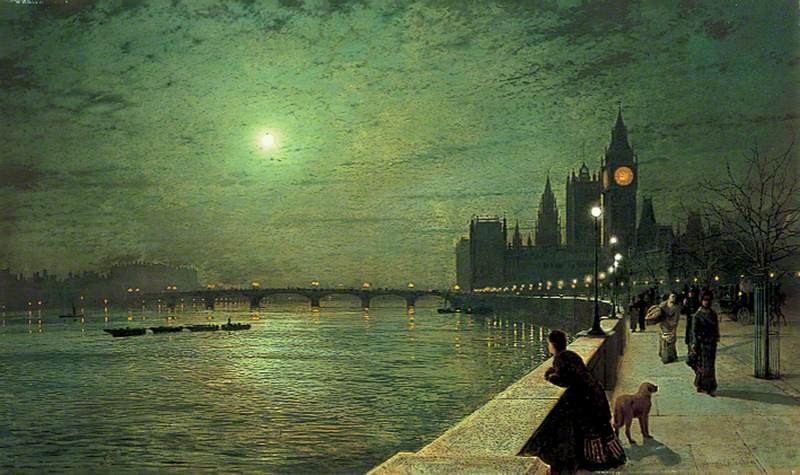
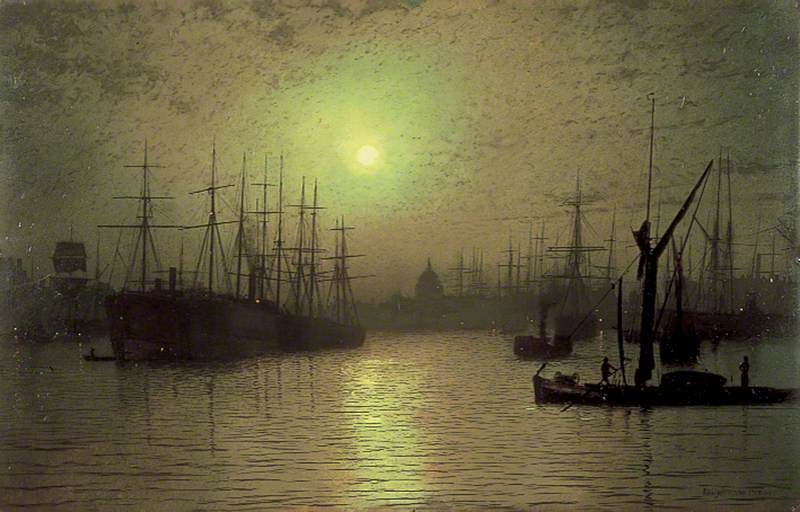
In 1880 Grimshaw took a London studio for about two years, leaving his family based at Knostrop. Chelsea, Westminster and the Thames supplied new arrangements of bridge, embankment, river traffic and reflected light. His pictures do not offer an exhaustive social report of London; they select moments in which the metropolis becomes legible through atmosphere. That selection is an artistic argument, not evidence that the city itself was quiet.[1][2]
The friendship and mutual respect between Grimshaw and James McNeill Whistler is often used to place him within a wider history of the nocturne. Museum biographies preserve Whistler’s later acknowledgement that Grimshaw’s moonlit pictures challenged his own claim to have originated the modern nocturne. The story is useful when treated as evidence of recognition, not as a contest over who invented night painting.[2][3]
Pressure, Process and a Wider Range
Financial pressure intensified after 1879. The Scarborough guide reports that Grimshaw was producing about one painting a week in the early 1880s to meet debts. Repeated motifs and adaptable formats made that pace possible. They also complicate judgements of quality: the conditions could produce uneven work, but they did not prevent major paintings or experiments in new subjects.[1]
Possible use of photography, a camera obscura or other optical assistance has long been discussed. Museo Thyssen-Bornemisza says photography interested him and that he may have used a camera obscura to develop compositions. Leeds Museums likewise describes an interest in photography. Neither source establishes one universal procedure, so claims about lenses or image transfer should remain qualified. The technique, light and photography essay separates what institutions document from what close looking can reasonably suggest.[2][3]
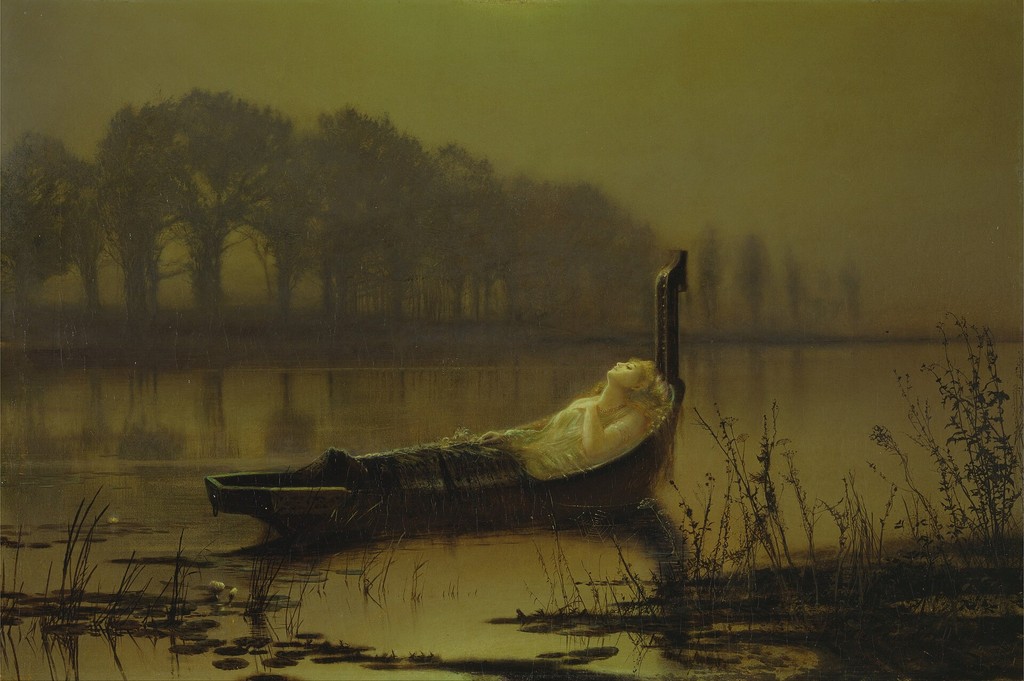
Grimshaw’s output ranged beyond nocturnes. He painted domestic interiors and portraits, often using rooms and gardens at Knostrop. He also drew on Tennyson, Milton, Keats and other poets, and later explored mythological or classical subjects. Leeds Libraries notes that Iris was his last Royal Academy exhibit in 1886. These works show an artist testing different markets and ambitions rather than endlessly repeating one successful formula.[5]
Family, Final Years and Death
John and Frances had a large family marked by severe loss. Leeds Libraries records sixteen children, of whom six survived into maturity. Several became artists, including Arthur, Louis, Wilfred and Elaine Grimshaw. Their work must remain distinct from their father’s: a familiar nocturnal subject or a shared surname is not enough to settle attribution. The artistic family and legacy guide sets out those identities and the need for object-level evidence.[2][5]
Grimshaw continued to work at Knostrop through the early 1890s. The Scarborough chronology identifies snow scenes as a new direction in 1892, and Leeds Museums highlights Knostrop Cut, Leeds, Sunday Night from 1893 as an elegiac work from his final year. He died at Knostrop on 31 October 1893, aged fifty-seven. The same institutional chronology stresses that he painted until his death.[1][3]
Leeds City Art Gallery organised a retrospective in 1897. His reputation later declined as Victorian painting fell from favour, but collection-building and scholarship restored attention to the range and modernity of his work. Leeds Museums credits curator Alexander Robertson’s research from the late 1970s with a major role in that revival. The gallery’s 2025–26 nocturnes exhibition continued the reassessment by presenting moonlight, photography and artificial illumination as part of modern visual culture rather than mere Victorian nostalgia.[3]
The paintings and artworks guide brings those strands together. Seen across a lifetime, Grimshaw’s achievement lies not only in making moonlight beautiful. It lies in turning the changing surfaces of industrial Britain—stone, glass, fog, water, gaslight and wet streets—into a sustained inquiry about how modern places are perceived and remembered.
Follow John Atkinson Grimshaw's career through four stages
Railway work, self-education and exact nature
Born in Leeds, Grimshaw painted while employed as a railway clerk and became a full-time artist in 1861. Early birds, blossom, rock and landscape show close natural observation shaped by Ruskinian and Pre-Raphaelite ideas.
Knostrop, Yorkshire and a nocturnal language
A first known Whitby moonlight in 1867 preceded the move to Knostrop Old Hall. Cool skies, bare branches and warm artificial light became a flexible language for Leeds streets, lanes, water and autumn.
Scarborough, family loss, debt and working harbours
Castle-by-the-Sea widened Grimshaw's coastal subjects and connected atmospheric painting to fishing and harbour activity. Financial pressure ended the Scarborough years in 1879 and intensified production.
The Thames, mature nocturnes and a wider final range
A London studio brought Westminster, Chelsea and the Thames into the repertoire. Port scenes, interiors, literary subjects and late snow paintings show continuing experiment until Grimshaw's death at Knostrop in 1893.
Researched works directory
This searchable evidence census contains 88 distinct records assembled from public collection data and a reproducible Wikidata snapshot. It is not a catalogue raisonné, not a claim of complete oeuvre coverage, and it keeps works with repeated titles as separate objects.
| Name | Date | Medium |
|---|---|---|
| A Dead Linnet | 1862 | Painting |
| A House in a Clearing | 1870 | Painting |
| A Moonlit Evening | 1880 | Painting |
| A Moonlit Lane | 1874 | Painting |
| A Mossy Glen | 1864 | Painting |
| A View of Hampstead, London | 1882 | Painting |
| A Wooded Valley | Date unknown | Painting |
| A Yorkshire Home | 1878 | Painting |
| An Autumn Idyll | 1885 | Painting |
| Autumn Glory: The Old Mill | 1869 | Painting |
| Autumn Regrets | 1882 | Painting |
| Baiting the Lines, Whitby | 1884 | Painting |
| Boar Lane, Leeds | 1881 | Painting |
| Bowder Stone, Borrowdale | 1865 | Painting |
| Briggate, Leeds | 1891 | Painting |
| 'Burning Off', a Fishing Boat at Scarborough | 1877 | Painting |
| Canny Glasgow | 1887 | Painting |
| Evening Glow | 1884 | Painting |
| Evening Scene by the Docks, Hull | Date unknown | Painting |
| Fiamella | 1883 | Painting |
| Glasgow Docks | 1886 | Painting |
| Gloucester Docks | 1885 | Painting |
| Golden Visions | 1870 | Painting |
| Greenwich, Half Tide | 1884 | Painting |
| In Peril (The Harbour Flare) | 1879 | Painting |
| In the golden gloaming | Date unknown | Painting |
| In the Golden Mists of Autumn | 1884 | Painting |
| In the Golden Olden Times | 1870 | Painting |
| Ingleborough from under White Scar, Yorkshire Limestone Strata | 1868 | Painting |
| Iris | 1886 | Painting |
| Knostrop Old Hall at Dusk | 1870 | Painting |
| Leeds Bridge | 1880 | Painting |
| Lights in the Harbour, Scarborough | 1879 | Painting |
| Liverpool Docks | 1892 | Painting |
| Liverpool Docks by Night | 1892 | Painting |
| Liverpool Docks (panel 1 of 5) | Date unknown | Painting |
| Liverpool Docks (panel 2 of 5) | Date unknown | Painting |
| Liverpool Docks (panel 3 of 5) | Date unknown | Painting |
| Liverpool Docks (panel 4 of 5) | Date unknown | Painting |
| Liverpool Docks (panel 5 of 5) | Date unknown | Painting |
| Liverpool Quay by Moonlight | 1887 | Painting |
| Moonlight Scene near Leeds | 1881 | Painting |
| Night Scene, Rouen | 1893 | Painting |
| Nightfall down the Thames | 1880 | Painting |
| Nightfall in Scarborough Harbour, North Yorkshire | 1884 | Painting |
| November Morning, Knostrop Hall, Leeds | 1883 | Painting |
| Old English House by Moonlight | Date unknown | Painting |
| Park Row, Leeds | 1882 | Painting |
| Princes Dock, Hull | Date unknown | Painting |
| Quai de Paris, Rouen | 1893 | Painting |
| Reflections on the Thames, Westminster | 1880 | Painting |
| Reflections on the Thames, Westminster, London | 1880 | Painting |
| Roundhay Park Lake | Date unknown | Painting |
| Salthouse Dock, Liverpool | Date unknown | Painting |
| Salthouse Dock, Liverpool, 1884 | Date unknown | Painting |
| Scarborough Lights | 1877 | Painting |
| Shipping on the Clyde | 1881 | Painting |
| Sic transit gloria mundi (The Burning of the Spa Saloon) | 1876 | Painting |
| Silver Moonlight | 1880 | Painting |
| Silver Moonlight | 1886 | Painting |
| Snow and Mist (Caprice in Yellow Minor) | 1892 | Painting |
| Stapleton Park, near Pontefract | Date unknown | Painting |
| Sunday Night, Knostrop Cut, Leeds | 1893 | Painting |
| Thames Moonlight | 1880 | Painting |
| The Custom House, Liverpool, Looking North | Date unknown | Painting |
| The Custom House, Liverpool, Looking South | Date unknown | Painting |
| The Harbour at Whitby by Moonlight | 1879 | Painting |
| The Head of Gertrude Grimshaw | 1874 | Painting |
| 'The Ironbound Shore' | 1869 | Painting |
| The Lady of Shalott | 1875 | Painting |
| The Parable of the Lost Sheep | Date unknown | Painting |
| The Rector's Garden, Queen of the Lilies | 1877 | Painting |
| The Seal of the Covenant | 1868 | Painting |
| The Sun's Farewell | Date unknown | Painting |
| The Thames by Moonlight with Southwark Bridge, London | 1884 | Painting |
| Thro' the Wood | Date unknown | Painting |
| Tree Shadows on the Park Wall, Roundhay, Leeds | 1872 | Painting |
| Under the Beeches | 1892 | Painting |
| Under the Silvery Moonbeams | Date unknown | Painting |
| View of Heath Street by Night | 1882 | Painting |
| View of Scarborough | 1876 | Painting |
| View of Southwark Bridge at Night | 1882 | Painting |
| Whitby | 1878 | Painting |
| Whitby Docks | 1876 | Painting |
| Whitby Harbor | 1874 | Painting |
| Windermere | 1863 | Painting |
| Woodland near Leeds | Date unknown | Painting |
| Yew Court, Scalby, near Scarborough | 1875 | Painting |
Frequently Asked Questions
Yes, in the sense that he did not receive a conventional academy training. He developed his early practice while employed as a railway clerk, studying nature and learning from contemporary art. “Self-taught” should not imply that he worked without influences: Ruskinian naturalism, Pre-Raphaelite detail and the example of John William Inchbold all informed his early work.[1][2]
His paintings had begun to sell, and Frances encouraged his artistic ambition. He resigned in 1861 to work as a painter full-time. The decision exchanged a secure salary for a career dependent largely on private clients.[1][2]
Leeds remained his principal base. He lived in Wortley and Headingley before taking Knostrop Old Hall around 1870. From 1876 to 1879 the family also used Castle-by-the-Sea in Scarborough, and in 1880 he took a London studio for roughly two years.[1][6]
Leeds Libraries records sixteen children, with six surviving into maturity. Several of those children became painters, but their works should not be attributed to John Atkinson Grimshaw solely because their subjects or manner resemble his.[5]
Discussion
Use this evidence-led guide as a starting point for close looking rather than a final verdict.
Share an observation about John Atkinson Grimshaw Biography or a source that adds useful context.
Reader Insights
Which work most clearly complicates the familiar label of painter of moonlight?
Where do place, market, family or literary culture most productively alter your reading?
Which source or surviving object would you investigate next?
Join the Conversation
Add your reading below, keeping observations specific and evidence clear.
References
- Scarborough Museums and Galleries, Atkinson Grimshaw: At Home in Yorkshire large-print guide, accessed 31 August 2026.
- Museo Nacional Thyssen-Bornemisza, John Atkinson Grimshaw artist record, accessed 31 August 2026.
- Leeds Museums and Galleries, Don’t Let’s Ask for the Moon exhibition release, accessed 31 August 2026.
- Leeds Museums and Galleries, Collections Development Policy, accessed 31 August 2026.
- Leeds Libraries, “The Portraits of John Atkinson Grimshaw”, accessed 31 August 2026.
- The Thoresby Society, “John Atkinson Grimshaw (1836–1893)”, accessed 31 August 2026.
- Art UK, John Atkinson Grimshaw artist authority record, accessed 31 August 2026.
- Leeds Museums and Galleries via MyLearning, “Leeds Bridge by John Atkinson Grimshaw”, accessed 31 August 2026.