

 Buy Art Prints Now
from Amazon
* As an Amazon Associate I earn from qualifying purchases.
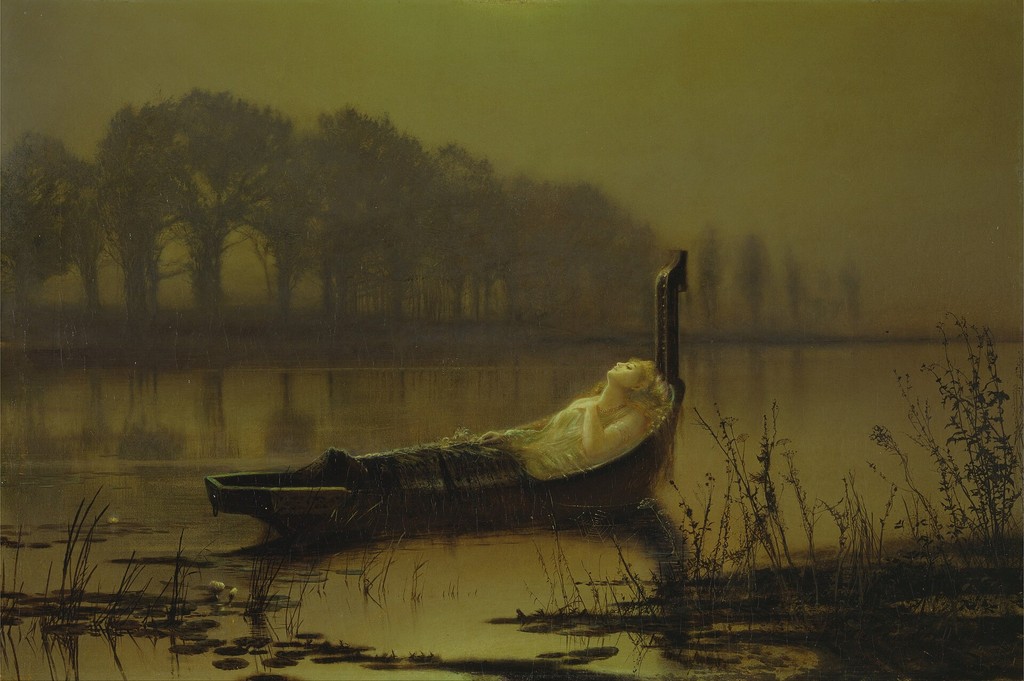
The Lady of Shalott — public domain.
 by Tom Gurney
Tom Gurney BSc (Hons) is an art history expert with over 20 years experience
Page Created: August 31, 2026 / Page Updated: September 16, 2026
Email: tomgurney1@gmail.com / Phone: +44 7429 011000
John Atkinson Grimshaw: Figures, Interiors and Literature: Introduction
John Atkinson Grimshaw is so closely associated with moonlit streets that his rooms and figure subjects can seem like a separate career. They are not. The same attention to controlled illumination, colour relationships and carefully arranged detail appears in both. A window takes the place of a moon; polished furniture or fabric answers the reflective road; a solitary woman becomes the point around which a whole setting is balanced.
These paintings also reveal how widely Grimshaw drew on language. Titles invoke Milton, Tennyson and the Romantic poets, while Iris turns a classical messenger into the centre of an autumnal fantasy. Yet titles, settings and sitters require different kinds of evidence. A sketchbook note can support an identification, resemblance can only suggest one, and a literary title may add meaning without describing a literal episode. Reading the works well begins by keeping those distinctions visible.
At a Glance
- Broader practicePortraits, domestic interiors, fairy compositions and neoclassical subjects accompanied the better-known city scenes[4]
- Key domestic settingRooms, garden and conservatory spaces associated with the Grimshaw family’s homes[1]
- Best-supported sitterFrances Grimshaw in In the Pleasaunce, linked by a sketchbook note[1]
- Proposed modelAgnes Leefe, identified in several works through family evidence and facial comparison rather than certainty[1]
- Literary rangeMilton, Tennyson, Keats, Shelley, Wordsworth and Browning appear through reading, titles or interpretation[1][3]
- Major classical workIris, painted and exhibited at the Royal Academy in 1886[2]
Contents
- Introduction
- More than a nocturne painter
- Interiors as constructed worlds
- Identifying the sitters
- Knostrop rooms and gardens
- Castle-by-the-Sea and domestic display
- When a title opens a poem
- Iris: classical story, fairy appearance
- Figures as mood and narrative
- Reading evidence and atmosphere together
More than a nocturne painter
Museo Nacional Thyssen-Bornemisza places portraits, interiors, fairy subjects and neoclassical compositions within Grimshaw’s established range.[4] This matters because the figure paintings are not curiosities invented after his principal achievement. They form a substantial alternative way of joining light, setting and mood.
Leeds Libraries notes that women dominate the portraits, though men also appear.[1] Some women occupy richly furnished rooms; others stand in gardens or imaginary spaces. Their clothing and posture can attract attention, but the surrounding objects remain active. Plants, patterned textiles, ceramics, windows and furniture establish a visual environment rather than a neutral portrait backdrop.
The Paintings and Artworks guide shows how these subjects fit beside landscapes and urban views. Grimshaw’s range is broad, but it is not disconnected: exact detail and tonal orchestration bind seemingly different genres together.
Interiors as constructed worlds
The domestic pictures should not be read as unedited photographs of Victorian rooms. Leeds Libraries associates a group with familiar spaces at Knostrop, including interiors, a garden and a conservatory.[1] Objects in them may have belonged to the household, yet Grimshaw still chose where a sitter stood, how a room opened toward daylight and which surfaces would carry colour.
In close-looking terms, such rooms behave like stages. A window or doorway establishes a bright zone; furnishings slow the eye through repeated shapes; a seated or standing figure concentrates the emotional register. Detailed description can suggest material abundance while careful spacing prevents the objects from overwhelming the person.
That distinction is important. A painting may preserve evidence of taste and domestic surroundings without recording every item in its ordinary position. Grimshaw designed an experience of the room. The relation between observation and arrangement is considered further in Technique, Light and Photography.
Identifying the sitters
Not every female figure can be named. Leeds Libraries says Frances Theodosia Grimshaw, known as Fanny, is thought to have modelled for some interiors.[1] A more specific connection survives for In the Pleasaunce: a sketchbook instruction links Fanny to a garden composition. That contemporary note provides stronger support than resemblance alone.
Agnes Leefe requires more qualified language. Family photographs, age comparisons and a drawing said to portray her have been used to propose Agnes as the face in Summer and Il Penseroso.[1] The same source describes her as the reputed model for Iris, while Leeds Museums calls that identification probable.[1][2] Neither term means proven. “Possibly Agnes Leefe” or “often identified as Agnes Leefe” respects the evidence better than an unqualified name.
Leeds Libraries identifies Anna Leefe as the model in The Chorale.[1] Even where a name is documented, however, portraiture is only part of the painting’s purpose. Costume, gesture, furnishings and title may turn an individual sitter into a bearer of domestic, seasonal or literary associations.
Knostrop rooms and gardens
Knostrop Old Hall became Grimshaw’s main family setting from about 1870. The exact terms of its early occupancy are not uniform across accounts, but its repeated presence in the art is clear. Leeds Libraries connects the group to the house, garden and conservatory, naming Summer, Spring, In the Pleasaunce and Il Penseroso among the relevant works.[1]
The seasons enter these interiors through more than their titles. In Summer, a woman at a window is surrounded by warm light; Spring places a figure among plants and early-day illumination. These are institutional descriptions.[1] Close looking can then ask how the window divides inside from outside, how foliage carries colour across that boundary and how the sitter’s stillness affects the room’s pace.
In the Pleasaunce moves into the garden and has the firmer Fanny association supplied by the sketchbook. Il Penseroso is less settled in both sitter and location: Leeds Libraries discusses Frances in the conservatory but also presents evidence used to associate Agnes with the face, and it allows that the conservatory might relate to Knostrop or the Scarborough house.[1] Preserving that uncertainty is more informative than selecting one answer.
The Leeds and Yorkshire essay places Knostrop within Grimshaw’s geography without turning every interior into a literal inventory of the house.
Castle-by-the-Sea and domestic display
The Scarborough house called Castle-by-the-Sea created another setting in which home and imagination overlapped. Scarborough Museums explains that Grimshaw named it after Henry Wadsworth Longfellow’s poem, immediately giving a real residence a literary frame.[3] Leeds Libraries locates The Chorale in a room there and identifies Anna Leefe as its model.[1]
The account describes Japanese fans, blue-and-white ceramics, textiles, a Persian carpet and an album of prints around the figure.[1] These details can be read as signs of contemporary collecting and display, but their pictorial task is equally important. Pattern, texture and colour form a dense field against which the sitter remains legible.
Dulce Domum offers a different domestic image: a piano player and a listener in an elaborate room. The work was begun in 1876 and completed in 1885, and inscriptions on its reverse refer to difficulty and labour without explaining a single cause.[1] Family loss, financial strain and the challenge of the painting have all been suggested, but the inscription does not choose among them. The long interval belongs to the object’s history; any exact emotional explanation remains interpretation.
When a title opens a poem
Literary language operates at several levels in Grimshaw’s art. Leeds Libraries connects Il Penseroso to Milton and records Grimshaw’s admiration for Tennyson as well as his reading of Shelley and Keats. It also notes titles drawn from Wordsworth, Shelley and Browning.[1] Scarborough Museums independently identifies Tennyson and Keats as inspirations.[3]
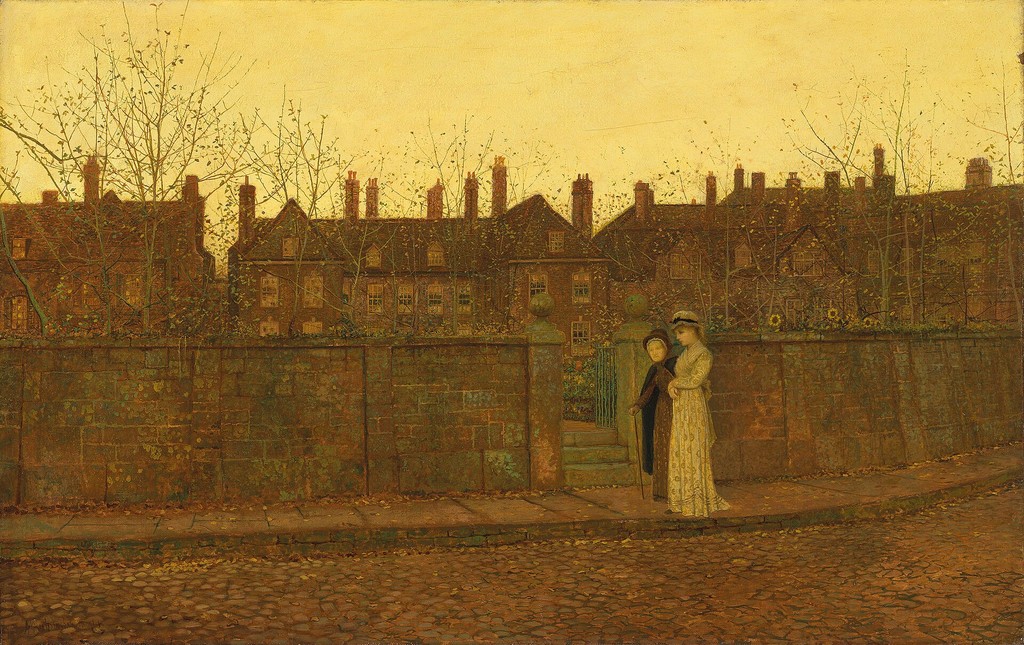
A title can redirect a familiar view. In the Gloaming is partly based on Knostrop, but Scarborough Museums links it to Tennyson’s Locksley Hall. The same source explains that the painting was once known as A Yorkshire Home before the title written by Grimshaw on the reverse clarified its identity.[3] The literary name does not erase the Yorkshire elements. It makes the setting carry recollection, loss and poetic association beyond topography.
The family’s naming practices deepen this context. Institutional accounts connect several children’s names, including Lancelot and Elaine, with Tennysonian characters.[1][3] That evidence shows literature operating within domestic life, not merely being attached later by critics. It does not prove that every suggestive title encodes one particular poem; each association still needs its own support.
Iris: classical story, fairy appearance
Iris demonstrates why appearance alone can misclassify a subject. Leeds Museums notes that the hovering, winged figure has often been treated as a fairy. An inscription by Grimshaw on the back instead supplies a story in which Iris, Juno’s messenger, pauses before a water lily during an autumn errand and is transformed into a rainbow for disobedience.[2] The inscription makes the intended framework classical.
Painted in 1886, Iris was shown at the Royal Academy that year, Grimshaw’s final appearance there.[2] The museum describes luminous colour, autumn tones and the central figure as crucial to the work’s effect. Close looking can distinguish those visible choices—the curved pose, iridescent wings, golden surround and barren woodland—from the biographical question of who modelled. Agnes Leefe is probable, not certain.[1][2]
The painting also unites strands that can otherwise seem separate. Autumn belongs to Grimshaw’s seasonal vocabulary; reflected light recalls his landscapes; the nude figure addresses the respectable classical tradition; and the written narrative controls interpretation. Landscapes and Seasons follows the natural setting, while this page keeps the myth and figure central.
Figures as mood and narrative
Figures do not always function as portraits. In a room, a person may direct attention toward a window, book, instrument or plant. In a lane, a single walker can establish scale and intensify the surrounding quiet. Scarborough Museums notes Grimshaw’s repeated use of a lone woman across social classes in the lane scenes.[3] That recurrence should not be mistaken for one continuing character.
Close-looking interpretation starts with what a figure does within the composition. Is the face individuated, or turned away? Does the body create movement or pause it? Are clothing and accessories described as personal attributes, or do they echo colours elsewhere? Such questions avoid inventing a biography for an unidentified person.
The surviving archive helps set limits. Leeds Libraries preserves a sketch of the artist’s son Arthur, family watercolours, photographs, letters and notices alongside research material.[5] Those records can confirm some identities and relationships, while other figures remain anonymous or proposed. The Artistic Family and Legacy guide separates John Atkinson Grimshaw’s work from that of the children who later became artists themselves.
Reading evidence and atmosphere together
The figure paintings reward a double attention. Documents can establish a title, exhibition, inscription, setting or sitter association. Visual analysis can explain how colour, pose and objects operate on the painted surface. Literary study can identify a poem or myth that changes the work’s register. Problems arise when one kind of evidence pretends to be another.
Grimshaw’s interiors are particularly vulnerable to sentimental assumptions because they often appear calm and luxurious. Their elegance is visible; claims about the sitter’s feelings are not. Likewise, a winged figure may look fairy-like while an inscription identifies a classical messenger. A remembered room may incorporate real objects without being a comprehensive domestic record.
Keeping those categories separate does not reduce the paintings’ mystery. It gives the mystery a firmer foundation. Grimshaw could work from recognisable people, houses and texts, then arrange them into images whose meanings remain more spacious than a catalogue entry.
Researched works directory
This searchable evidence census contains 88 distinct records assembled from public collection data and a reproducible Wikidata snapshot. It is not a catalogue raisonné, not a claim of complete oeuvre coverage, and it keeps works with repeated titles as separate objects.
| Name | Date | Medium |
|---|---|---|
| A Dead Linnet | 1862 | Painting |
| A House in a Clearing | 1870 | Painting |
| A Moonlit Evening | 1880 | Painting |
| A Moonlit Lane | 1874 | Painting |
| A Mossy Glen | 1864 | Painting |
| A View of Hampstead, London | 1882 | Painting |
| A Wooded Valley | Date unknown | Painting |
| A Yorkshire Home | 1878 | Painting |
| An Autumn Idyll | 1885 | Painting |
| Autumn Glory: The Old Mill | 1869 | Painting |
| Autumn Regrets | 1882 | Painting |
| Baiting the Lines, Whitby | 1884 | Painting |
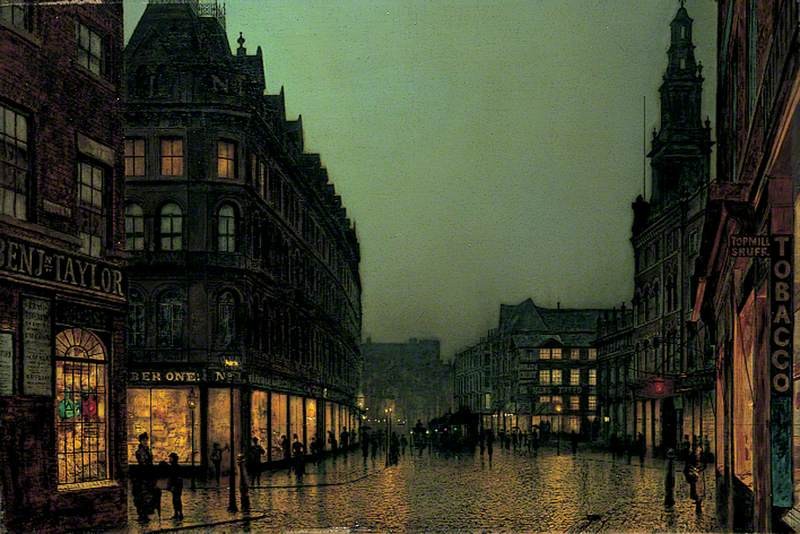
| Boar Lane, Leeds | 1881 | Painting |
| Bowder Stone, Borrowdale | 1865 | Painting |
| Briggate, Leeds | 1891 | Painting |
| 'Burning Off', a Fishing Boat at Scarborough | 1877 | Painting |
| Canny Glasgow | 1887 | Painting |
| Evening Glow | 1884 | Painting |
| Evening Scene by the Docks, Hull | Date unknown | Painting |
| Fiamella | 1883 | Painting |
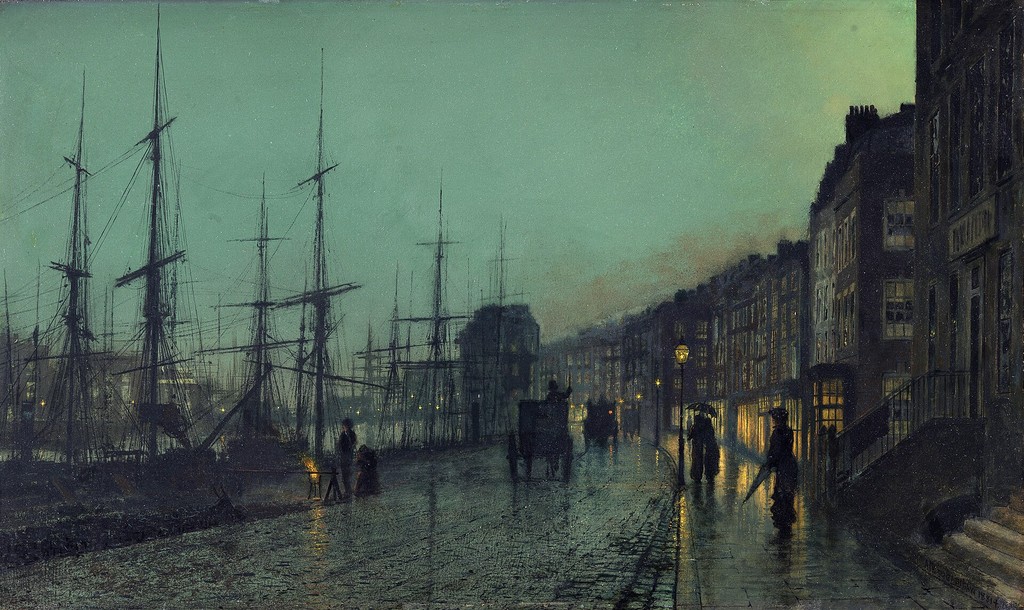
| Glasgow Docks | 1886 | Painting |
| Gloucester Docks | 1885 | Painting |
| Golden Visions | 1870 | Painting |
| Greenwich, Half Tide | 1884 | Painting |
| In Peril (The Harbour Flare) | 1879 | Painting |
| In the golden gloaming | Date unknown | Painting |
| In the Golden Mists of Autumn | 1884 | Painting |
| In the Golden Olden Times | 1870 | Painting |
| Ingleborough from under White Scar, Yorkshire Limestone Strata | 1868 | Painting |
| Iris | 1886 | Painting |
| Knostrop Old Hall at Dusk | 1870 | Painting |
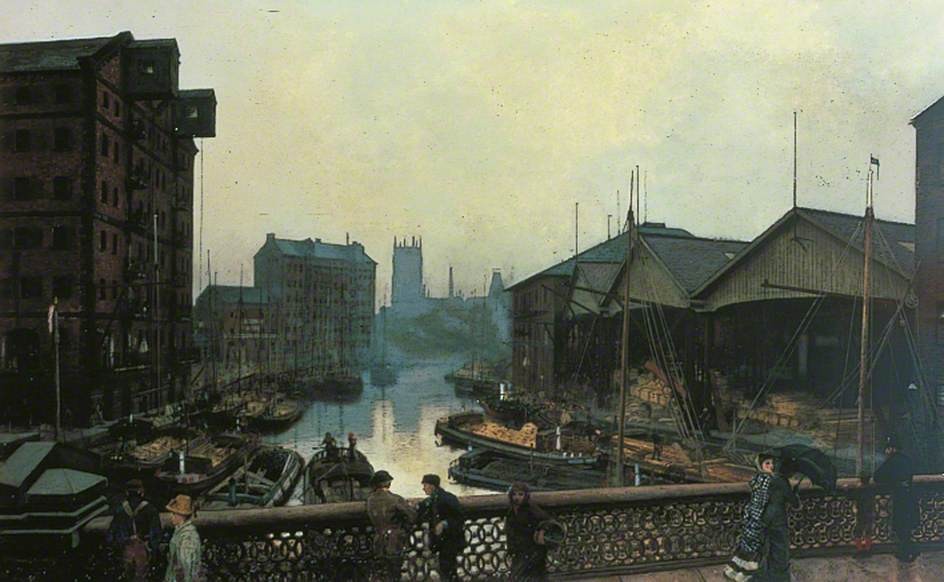
| Leeds Bridge | 1880 | Painting |
| Lights in the Harbour, Scarborough | 1879 | Painting |
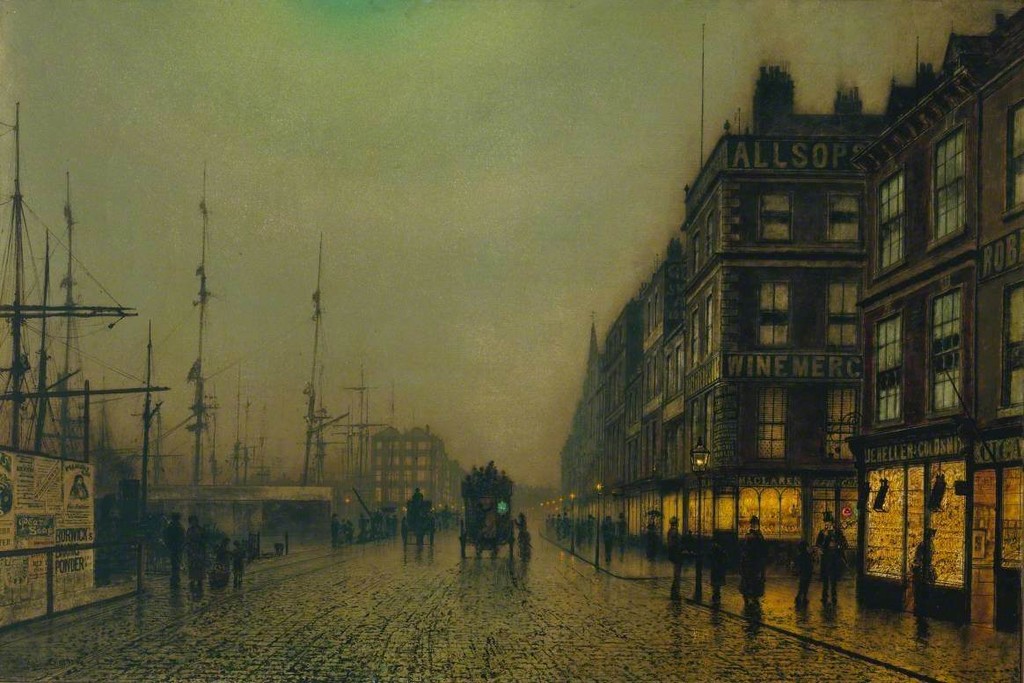
| Liverpool Docks | 1892 | Painting |
| Liverpool Docks by Night | 1892 | Painting |
| Liverpool Docks (panel 1 of 5) | Date unknown | Painting |
| Liverpool Docks (panel 2 of 5) | Date unknown | Painting |
| Liverpool Docks (panel 3 of 5) | Date unknown | Painting |
| Liverpool Docks (panel 4 of 5) | Date unknown | Painting |
| Liverpool Docks (panel 5 of 5) | Date unknown | Painting |
| Liverpool Quay by Moonlight | 1887 | Painting |
| Moonlight Scene near Leeds | 1881 | Painting |
| Night Scene, Rouen | 1893 | Painting |
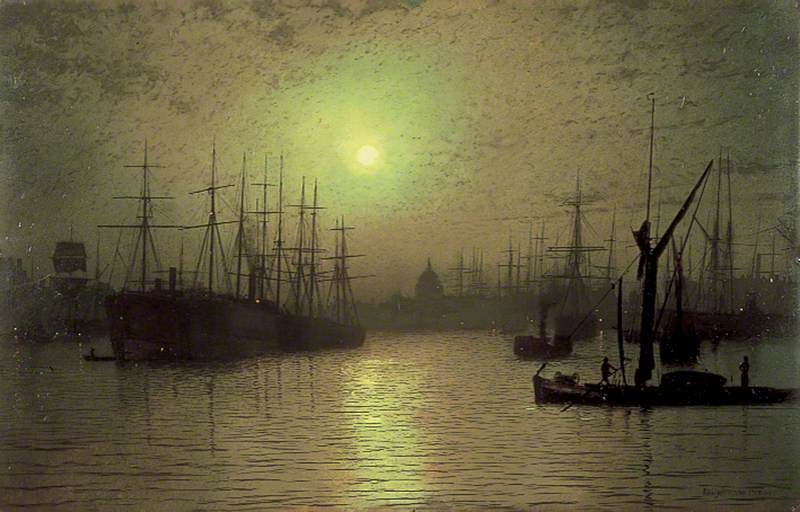
| Nightfall down the Thames | 1880 | Painting |
| Nightfall in Scarborough Harbour, North Yorkshire | 1884 | Painting |
| November Morning, Knostrop Hall, Leeds | 1883 | Painting |
| Old English House by Moonlight | Date unknown | Painting |
| Park Row, Leeds | 1882 | Painting |
| Princes Dock, Hull | Date unknown | Painting |
| Quai de Paris, Rouen | 1893 | Painting |
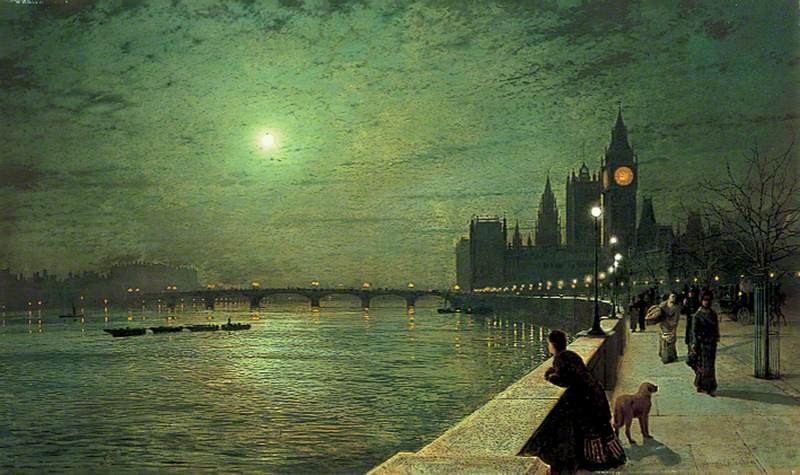
| Reflections on the Thames, Westminster | 1880 | Painting |
| Reflections on the Thames, Westminster, London | 1880 | Painting |
| Roundhay Park Lake | Date unknown | Painting |
| Salthouse Dock, Liverpool | Date unknown | Painting |
| Salthouse Dock, Liverpool, 1884 | Date unknown | Painting |
| Scarborough Lights | 1877 | Painting |
| Shipping on the Clyde | 1881 | Painting |
| Sic transit gloria mundi (The Burning of the Spa Saloon) | 1876 | Painting |
| Silver Moonlight | 1880 | Painting |
| Silver Moonlight | 1886 | Painting |
| Snow and Mist (Caprice in Yellow Minor) | 1892 | Painting |
| Stapleton Park, near Pontefract | Date unknown | Painting |
| Sunday Night, Knostrop Cut, Leeds | 1893 | Painting |
| Thames Moonlight | 1880 | Painting |
| The Custom House, Liverpool, Looking North | Date unknown | Painting |
| The Custom House, Liverpool, Looking South | Date unknown | Painting |
| The Harbour at Whitby by Moonlight | 1879 | Painting |
| The Head of Gertrude Grimshaw | 1874 | Painting |
| 'The Ironbound Shore' | 1869 | Painting |
| The Lady of Shalott | 1875 | Painting |
| The Parable of the Lost Sheep | Date unknown | Painting |
| The Rector's Garden, Queen of the Lilies | 1877 | Painting |
| The Seal of the Covenant | 1868 | Painting |
| The Sun's Farewell | Date unknown | Painting |
| The Thames by Moonlight with Southwark Bridge, London | 1884 | Painting |
| Thro' the Wood | Date unknown | Painting |
| Tree Shadows on the Park Wall, Roundhay, Leeds | 1872 | Painting |
| Under the Beeches | 1892 | Painting |
| Under the Silvery Moonbeams | Date unknown | Painting |
| View of Heath Street by Night | 1882 | Painting |
| View of Scarborough | 1876 | Painting |
| View of Southwark Bridge at Night | 1882 | Painting |
| Whitby | 1878 | Painting |
| Whitby Docks | 1876 | Painting |
| Whitby Harbor | 1874 | Painting |
| Windermere | 1863 | Painting |
| Woodland near Leeds | Date unknown | Painting |
| Yew Court, Scalby, near Scarborough | 1875 | Painting |
Frequently Asked Questions
Yes. Institutional accounts include portraits and figure interiors within his practice, and Leeds Libraries identifies a substantial group centred on women in domestic settings.[1][4]
She was probably a model for some works, and a sketchbook note strongly links her to In the Pleasaunce. Other identifications rely on comparison or tradition, so Frances should not be named automatically in every interior.[1]
Agnes Leefe is the probable or reputed model in current Leeds accounts, but the identification is not conclusive.[1][2] The classical subject is firmer because Grimshaw wrote its narrative on the painting.
Leeds and Scarborough sources connect him especially with Tennyson and Keats. Leeds Libraries also records associations with Milton, Shelley, Wordsworth and Browning through reading or titles.[1][3]
They contain rooms and objects associated with Knostrop and Castle-by-the-Sea, but they are composed paintings. Setting evidence can be strong while the precise placement, sitter identity or emotional story remains interpretive.[1]
Discussion
Use this evidence-led guide as a starting point for close looking rather than a final verdict.
Share an observation about John Atkinson Grimshaw: Figures, Interiors and Literature or a source that adds useful context.
Reader Insights
Which work most clearly complicates the familiar label of painter of moonlight?
Where do place, market, family or literary culture most productively alter your reading?
Which source or surviving object would you investigate next?
Join the Conversation
Add your reading below, keeping observations specific and evidence clear.
References
- Leeds Libraries, “The Portraits of John Atkinson Grimshaw”, accessed 31 August 2026.
- Leeds Museums and Galleries, “Iris (1886) by John Atkinson Grimshaw”, accessed 31 August 2026.
- Scarborough Museums and Galleries, Atkinson Grimshaw: At Home in Yorkshire large-print guide, accessed 31 August 2026.
- Museo Nacional Thyssen-Bornemisza, “John Atkinson Grimshaw”, accessed 31 August 2026.
- Leeds Libraries, The Atkinson Grimshaw Collection research guide, accessed 31 August 2026.