

 Buy Art Prints Now
from Amazon
* As an Amazon Associate I earn from qualifying purchases.
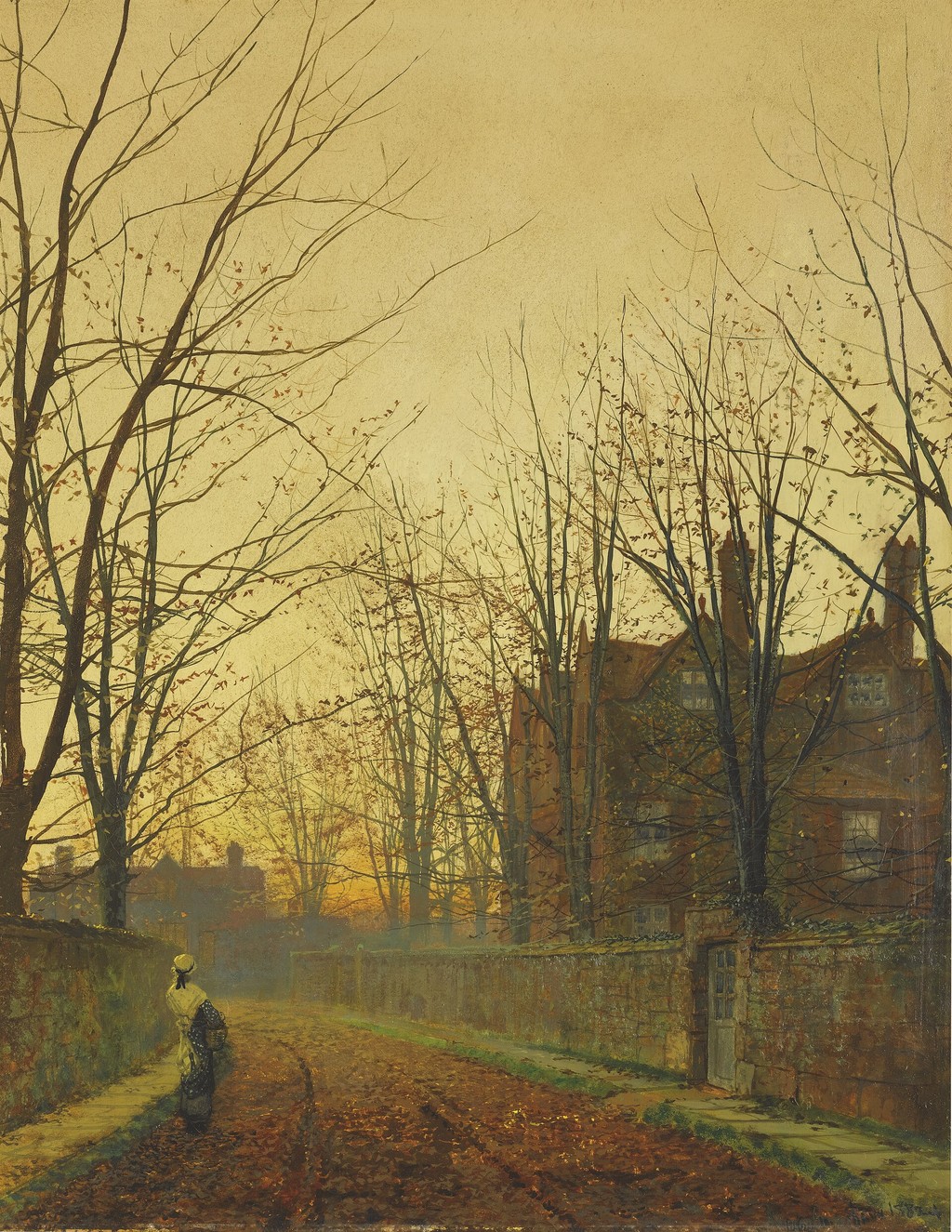
Late October — public domain.
 by Tom Gurney
Tom Gurney BSc (Hons) is an art history expert with over 20 years experience
Page Created: August 31, 2026 / Page Updated: September 16, 2026
Email: tomgurney1@gmail.com / Phone: +44 7429 011000
John Atkinson Grimshaw: Landscapes and Seasons: Introduction
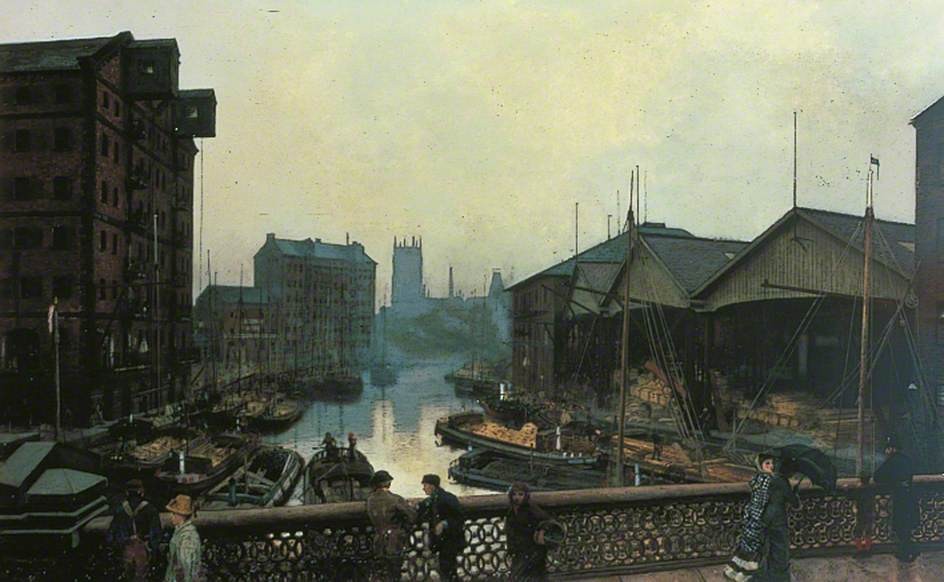
John Atkinson Grimshaw’s landscapes reveal a career shaped by more than moonlit cities. Early paintings attend closely to birds, moss, rock and woodland; later views turn lanes, houses and trees into arrangements of autumn colour or evening light. Season is not simply weather laid over a fixed place. It changes what can be seen, how a road recedes and whether a familiar building feels inhabited, distant or remembered. Following this strand from the 1860s to the snow scenes of his final years shows how close observation continued inside Grimshaw’s increasingly atmospheric art.[1][2]
At a Glance
- Early mannerDetailed naturalism associated with Ruskinian and Pre-Raphaelite ideas
- Formative settingsHeadingley, Meanwood, Adel woods, the Lake District and the Yorkshire coast
- Recurring seasonsAutumn most persistently, followed by evening, mist and late winter snow
- Characteristic motifsLeaf-strewn lanes, bare branches, old walls, wooded clearings and distant houses
- Object anchorA House in a Clearing (1870), Minneapolis Institute of Art
- Essential cautionSome scenes record named places; others recombine familiar elements
Contents
- Introduction
- Nature before the Famous Nocturnes
- Headingley Woods and Collected Detail
- A House in a Clearing
- Autumn as Colour and Structure
- Gloaming between Day and Night
- Knostrop and the Composite Lane
- Winter and the Late Snow Pictures
- Reading Place, Season and Invention
Nature before the Famous Nocturnes
Grimshaw’s earliest known direction was grounded in exact looking. The Museo Nacional Thyssen-Bornemisza relates these works to John Ruskin’s ideal of fidelity to nature and to the minute Pre-Raphaelite manner of the Leeds painter John William Inchbold. Its biography places a change away from that initial style around 1865.[2] “Change” should not be confused with rejection. The later pictures still depend on a practiced awareness of leaf shape, stone edge, branch structure and gradations of light.
The researched record makes the early emphasis visible through titles and dates. A Dead Linnet (1862), Windermere (1863), A Mossy Glen (1864) and Bowder Stone, Borrowdale (1865) precede many of the city scenes for which Grimshaw became famous.[6] Their subjects move from a single bird to woodland and large-scale topography. That variety suggests an artist testing how natural detail could carry both factual specificity and mood.
For the full chronological setting, see the biography. The important continuity here is visual: later atmosphere remains convincing because Grimshaw first learned to discriminate among small forms rather than treating “nature” as an undifferentiated background.
Headingley Woods and Collected Detail
Around 1863 Grimshaw and his family moved to Cliff Road in Headingley, then a greener environment beyond central Leeds. The Thoresby Society describes walks through Woodhouse Ridge, Meanwood Valley and Adel woods, where wild flowers, moss and birds’ eggs were gathered for him to paint. It also notes the tall trees, stone walls, large houses and winding lanes that he would revisit in later pictures.[4]
This local account clarifies how several kinds of landscape could coexist in one neighbourhood. A painter might encounter close woodland study, a villa behind a boundary wall and a road leading towards more settled ground within a single walk. Grimshaw’s subsequent lane scenes often depend on that meeting of vegetation and architecture. Trees do not merely frame an untouched countryside; they screen houses, cross walls and measure the road’s depth.
The Leeds and Yorkshire essay follows those locations as regional history. Seen through landscape, Headingley matters because it provided a vocabulary that could be reused without every canvas claiming to document one exact viewpoint.
A House in a Clearing
A House in a Clearing is recorded as an 1870 oil on canvas in the Minneapolis Institute of Art, accession 69.71.[5] The exact digital file links back to the museum’s object record, making its title, date, medium and collection more secure than those of many privately held landscapes.
In a close-looking observation, the house does not dominate the whole field. Vegetation occupies much of the foreground and edges, while openings among the trees disclose the building. The viewer must locate architecture through natural cover. That relationship makes the clearing active: it is not empty space but an interval that permits the house to be seen.
The composition also complicates a simple opposition between domestic refuge and wild nature. The building introduces habitation, yet distance and screening prevent immediate access. Branches, ground cover and changing light mediate the encounter. Grimshaw would later use walls, gates and trees in related ways, allowing familiar structures to appear near enough to recognise but withheld enough to sustain uncertainty.
Autumn as Colour and Structure
Autumn became one of Grimshaw’s most durable organising ideas. The works census includes Autumn Glory: The Old Mill (1869), Autumn Regrets (1882), An Autumn Idyll (1885) and In the Golden Mists of Autumn (1884).[6] These titles do not prove that every object survives with equally dependable documentation, but they demonstrate how insistently the season entered his naming and subject choices.
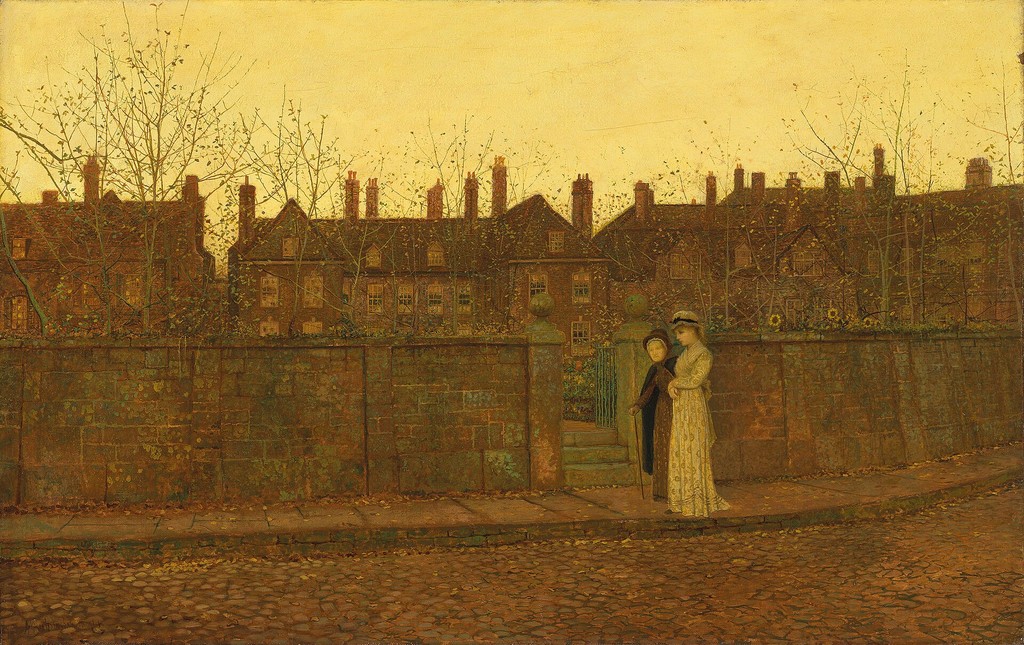
Autumn offered more than a warm palette. Thinning foliage reveals branch patterns and opens views towards walls or houses. Fallen leaves roughen a road that might otherwise become a smooth corridor. Low light can make the sky luminous while the foreground drops into shadow. In close-looking terms, gold, brown and green often divide space: bright leaves hold the middle distance, darker trunks interrupt it, and a pale opening draws the eye onward.
Leeds Museums’ discussion of Iris identifies rich autumn tones, bare trees, soft mist and reflected light as central to that 1886 classical picture.[3] The example shows how season crossed categories. Autumn could organise a figure subject just as effectively as a lane or garden, linking landscape atmosphere with myth and narrative.
Gloaming between Day and Night
“Gloaming” names twilight, the interval when daylight is failing but night has not taken control. It suited Grimshaw because it allowed detail and uncertainty to coexist. The Scarborough Museums guide discusses In the Gloaming (1878), also once known as A Yorkshire Home, and connects its literary frame to Tennyson’s Locksley Hall. The artist’s title is recorded on the reverse, while aspects of Knostrop Old Hall contribute to the setting.[1]
That evidence resists a purely topographical reading. A home associated with the artist’s life becomes part of a poetic construction. In close-looking terms, twilight helps the shift: architecture remains legible, but reduced contrast lets foliage, ground and sky merge at their boundaries. Place feels remembered because the time of day withholds complete information.
The moonlight and nocturnes guide begins where these transitional conditions deepen into night. Gloaming is not merely a weaker nocturne, however. Its remaining daylight permits seasonal colour to remain active, especially the golds and dull greens that darkness would compress.
Knostrop and the Composite Lane
Knostrop Old Hall became Grimshaw’s principal family home from about 1870 and entered paintings in many forms. Scarborough Museums explains that lane pictures could combine views and buildings, sometimes drawing upon aspects of Knostrop rather than reproducing one road exactly. Its account of Silver Moonlight treats the scene as an assembled image and notes the recurring solitary woman.[1]
This method changes what viewers should ask of a landscape. Identifying a doorway or roof may reveal a source, but it does not make every adjoining tree and bend topographically exact. Grimshaw could move a familiar feature into a different spatial and seasonal arrangement. Repetition then becomes a means of variation: a wall seen under amber leaves is not the same pictorial proposition as the wall under a silver moon.
The technique, light and photography essay considers repeated motifs and possible optical aids without claiming a universal procedure. For landscape, the documented point is simpler. Familiar material was adaptable, and atmosphere depended on how those pieces were recomposed.
Winter and the Late Snow Pictures
Scarborough Museums dates the beginning of Grimshaw’s snow scenes to 1892, only a year before his death.[1] The online census records Snow and Mist (Caprice in Yellow Minor) and Under the Beeches in that year.[6] Their appearance near the end of the chronology makes winter a late experiment rather than the foundation of his seasonal practice.
Snow changes the value structure of a landscape. Whereas a nocturne places its brightest accents in sky, moon or lamps, a snowy ground can become a broad pale field. Mist reduces distant contrast, and bare trees stand out through line rather than foliage. Those are close-looking principles, not claims about undocumented pigments or studio procedure.
The subtitle Caprice in Yellow Minor also directs attention to colour and musical analogy rather than meteorological reporting. It suggests that winter could be treated as a tonal arrangement, with observed conditions transformed through an artistic title. Grimshaw was still widening his seasonal language in his final working years.
Reading Place, Season and Invention
A useful first question is whether the source identifies a location. A House in a Clearing has a stable object record but a general title; In the Gloaming carries evidence linking it to Knostrop and a literary text; some census entries name precise Yorkshire sites, while others remain simply wooded valleys or moonlit lanes.[1][5][6] These differences should remain visible.
Next, examine what the season does to space. Does foliage conceal a building or reveal it? Does snow brighten the ground? Does twilight fuse edges that midday would separate? Finally, distinguish observation from inference. A painting can visibly use a bare tree to divide a luminous sky, but that feature alone cannot prove where the tree stood or which preparatory tool recorded it.
The paintings and artworks guide places these landscapes beside ports, streets, interiors and figures. The comparison shows why the rural work is indispensable. It preserves the natural attention from which Grimshaw developed, while demonstrating that mood, modernity and repeated design were never confined to the city.
Researched works directory
This searchable evidence census contains 88 distinct records assembled from public collection data and a reproducible Wikidata snapshot. It is not a catalogue raisonné, not a claim of complete oeuvre coverage, and it keeps works with repeated titles as separate objects.
| Name | Date | Medium |
|---|---|---|
| A Dead Linnet | 1862 | Painting |
| A House in a Clearing | 1870 | Painting |
| A Moonlit Evening | 1880 | Painting |
| A Moonlit Lane | 1874 | Painting |
| A Mossy Glen | 1864 | Painting |
| A View of Hampstead, London | 1882 | Painting |
| A Wooded Valley | Date unknown | Painting |
| A Yorkshire Home | 1878 | Painting |
| An Autumn Idyll | 1885 | Painting |
| Autumn Glory: The Old Mill | 1869 | Painting |
| Autumn Regrets | 1882 | Painting |
| Baiting the Lines, Whitby | 1884 | Painting |
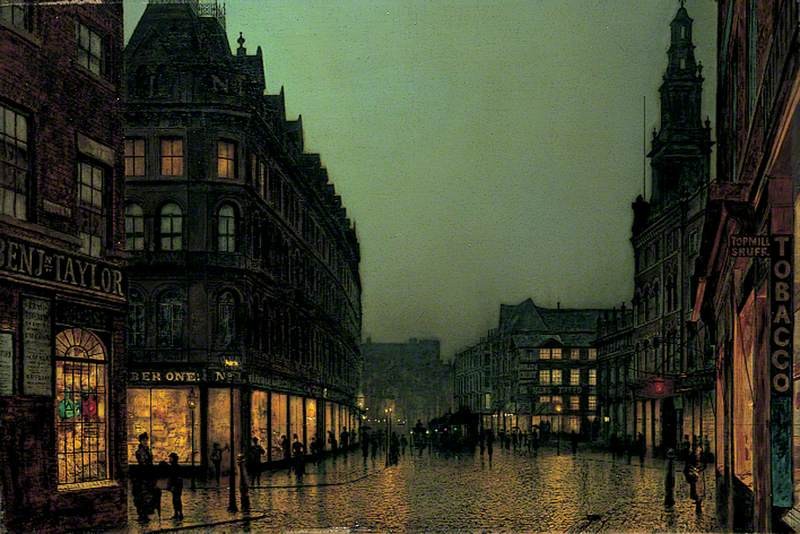
| Boar Lane, Leeds | 1881 | Painting |
| Bowder Stone, Borrowdale | 1865 | Painting |
| Briggate, Leeds | 1891 | Painting |
| 'Burning Off', a Fishing Boat at Scarborough | 1877 | Painting |
| Canny Glasgow | 1887 | Painting |
| Evening Glow | 1884 | Painting |
| Evening Scene by the Docks, Hull | Date unknown | Painting |
| Fiamella | 1883 | Painting |
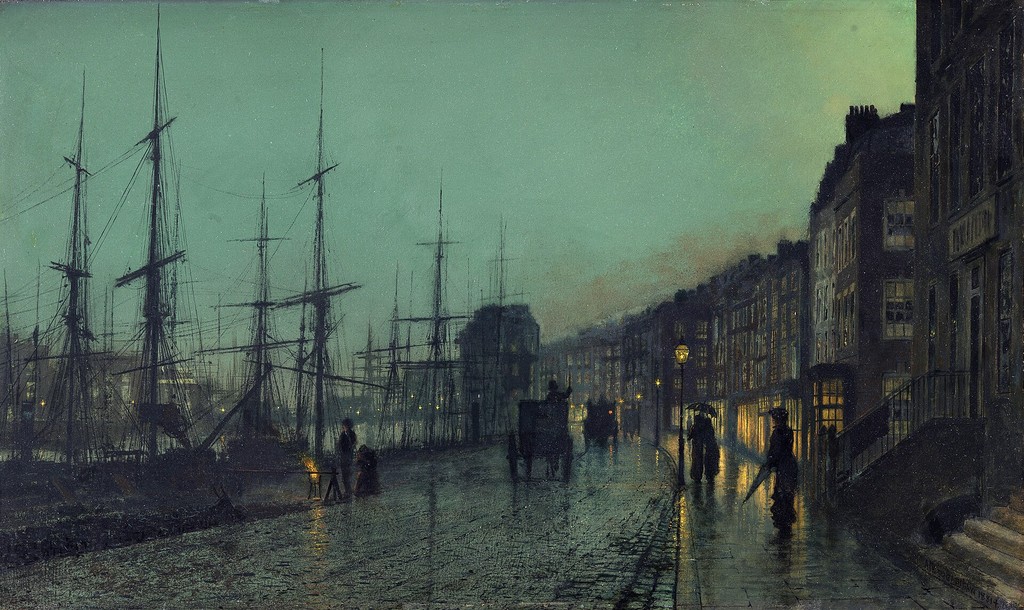
| Glasgow Docks | 1886 | Painting |
| Gloucester Docks | 1885 | Painting |
| Golden Visions | 1870 | Painting |
| Greenwich, Half Tide | 1884 | Painting |
| In Peril (The Harbour Flare) | 1879 | Painting |
| In the golden gloaming | Date unknown | Painting |
| In the Golden Mists of Autumn | 1884 | Painting |
| In the Golden Olden Times | 1870 | Painting |
| Ingleborough from under White Scar, Yorkshire Limestone Strata | 1868 | Painting |
| Iris | 1886 | Painting |
| Knostrop Old Hall at Dusk | 1870 | Painting |
| Leeds Bridge | 1880 | Painting |
| Lights in the Harbour, Scarborough | 1879 | Painting |
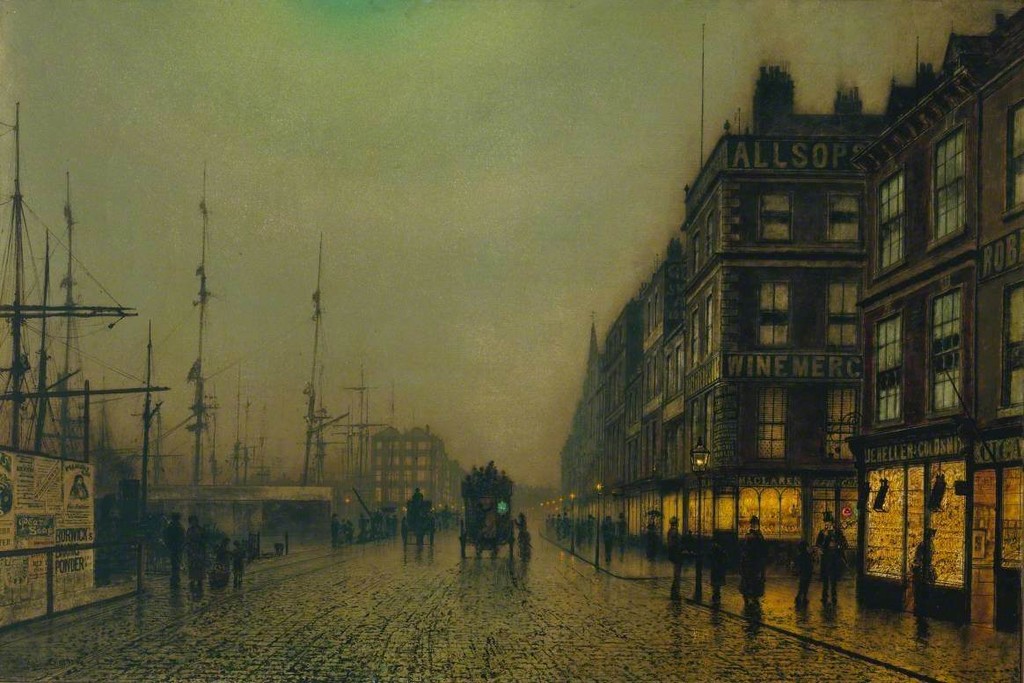
| Liverpool Docks | 1892 | Painting |
| Liverpool Docks by Night | 1892 | Painting |
| Liverpool Docks (panel 1 of 5) | Date unknown | Painting |
| Liverpool Docks (panel 2 of 5) | Date unknown | Painting |
| Liverpool Docks (panel 3 of 5) | Date unknown | Painting |
| Liverpool Docks (panel 4 of 5) | Date unknown | Painting |
| Liverpool Docks (panel 5 of 5) | Date unknown | Painting |
| Liverpool Quay by Moonlight | 1887 | Painting |
| Moonlight Scene near Leeds | 1881 | Painting |
| Night Scene, Rouen | 1893 | Painting |
| Nightfall down the Thames | 1880 | Painting |
| Nightfall in Scarborough Harbour, North Yorkshire | 1884 | Painting |
| November Morning, Knostrop Hall, Leeds | 1883 | Painting |
| Old English House by Moonlight | Date unknown | Painting |
| Park Row, Leeds | 1882 | Painting |
| Princes Dock, Hull | Date unknown | Painting |
| Quai de Paris, Rouen | 1893 | Painting |
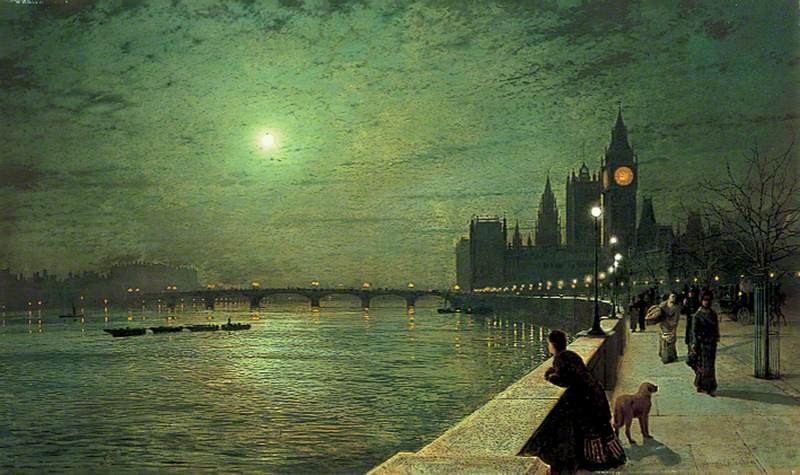
| Reflections on the Thames, Westminster | 1880 | Painting |
| Reflections on the Thames, Westminster, London | 1880 | Painting |
| Roundhay Park Lake | Date unknown | Painting |
| Salthouse Dock, Liverpool | Date unknown | Painting |
| Salthouse Dock, Liverpool, 1884 | Date unknown | Painting |
| Scarborough Lights | 1877 | Painting |
| Shipping on the Clyde | 1881 | Painting |
| Sic transit gloria mundi (The Burning of the Spa Saloon) | 1876 | Painting |
| Silver Moonlight | 1880 | Painting |
| Silver Moonlight | 1886 | Painting |
| Snow and Mist (Caprice in Yellow Minor) | 1892 | Painting |
| Stapleton Park, near Pontefract | Date unknown | Painting |
| Sunday Night, Knostrop Cut, Leeds | 1893 | Painting |
| Thames Moonlight | 1880 | Painting |
| The Custom House, Liverpool, Looking North | Date unknown | Painting |
| The Custom House, Liverpool, Looking South | Date unknown | Painting |
| The Harbour at Whitby by Moonlight | 1879 | Painting |
| The Head of Gertrude Grimshaw | 1874 | Painting |
| 'The Ironbound Shore' | 1869 | Painting |
| The Lady of Shalott | 1875 | Painting |
| The Parable of the Lost Sheep | Date unknown | Painting |
| The Rector's Garden, Queen of the Lilies | 1877 | Painting |
| The Seal of the Covenant | 1868 | Painting |
| The Sun's Farewell | Date unknown | Painting |
| The Thames by Moonlight with Southwark Bridge, London | 1884 | Painting |
| Thro' the Wood | Date unknown | Painting |
| Tree Shadows on the Park Wall, Roundhay, Leeds | 1872 | Painting |
| Under the Beeches | 1892 | Painting |
| Under the Silvery Moonbeams | Date unknown | Painting |
| View of Heath Street by Night | 1882 | Painting |
| View of Scarborough | 1876 | Painting |
| View of Southwark Bridge at Night | 1882 | Painting |
| Whitby | 1878 | Painting |
| Whitby Docks | 1876 | Painting |
| Whitby Harbor | 1874 | Painting |
| Windermere | 1863 | Painting |
| Woodland near Leeds | Date unknown | Painting |
| Yew Court, Scalby, near Scarborough | 1875 | Painting |
Frequently Asked Questions
His early record is strongly weighted towards natural subjects and detailed landscape. Museums connect that phase to Ruskinian and Pre-Raphaelite ideas, before a change of manner around 1865 and the later rise of urban nocturnes.[2][6]
Autumn offered colour, mist, exposed branches and leaf-strewn ground, all useful for structuring depth and atmosphere. Its persistence is visible in dated titles across several decades, although surviving online records are not a complete catalogue.[3][6]
Some contain recognisable buildings or local features, but museum interpretation shows that he also assembled lanes from recurring views and architectural elements. Each work must be checked individually rather than assumed to be literal topography.[1]
A House in a Clearing (1870) has a linked Minneapolis Institute of Art record with medium and accession data. Its documented identity makes it a useful anchor for close looking.[5]
The current Scarborough Museums chronology places the beginning of his snow scenes in 1892. That date should be treated as the institution’s documented milestone, not proof that no earlier winter study ever existed.[1]
Discussion
Use this evidence-led guide as a starting point for close looking rather than a final verdict.
Share an observation about John Atkinson Grimshaw: Landscapes and Seasons or a source that adds useful context.
Reader Insights
Which work most clearly complicates the familiar label of painter of moonlight?
Where do place, market, family or literary culture most productively alter your reading?
Which source or surviving object would you investigate next?
Join the Conversation
Add your reading below, keeping observations specific and evidence clear.
References
- Scarborough Museums and Galleries, Atkinson Grimshaw: At Home in Yorkshire large-print guide, accessed 31 August 2026.
- Museo Nacional Thyssen-Bornemisza, John Atkinson Grimshaw, accessed 31 August 2026.
- Leeds Museums and Galleries, “Iris (1886) by John Atkinson Grimshaw”, accessed 31 August 2026.
- The Thoresby Society, “John Atkinson Grimshaw (1836–1893)”, accessed 31 August 2026.
- Wikimedia Commons / Minneapolis Institute of Art, A House in a Clearing, accessed 31 August 2026.
- Wikidata, John Atkinson Grimshaw, accessed 31 August 2026.