


 Buy Art Prints Now
from Amazon
* As an Amazon Associate I earn from qualifying purchases.
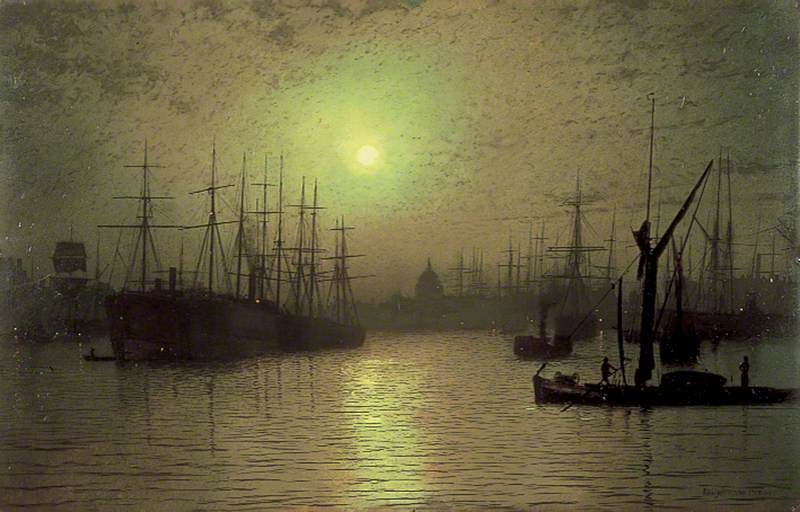
Nightfall down the Thames — Leeds Art Gallery, public domain.
 by Tom Gurney
Tom Gurney BSc (Hons) is an art history expert with over 20 years experience
Page Created: August 31, 2026 / Page Updated: September 16, 2026
Email: tomgurney1@gmail.com / Phone: +44 7429 011000
John Atkinson Grimshaw Paintings and Artworks: Introduction
John Atkinson Grimshaw is best known for moonlit streets and harbours, but those pictures are only one part of a varied career. He began with minutely observed natural subjects, then painted country houses, autumn lanes, industrial cities, rivers, docks, interiors, portraits and literary or classical figures. The recurring thread is his control of atmosphere: light makes a place legible while also making it strange. This guide maps that range, introduces three securely identified works and explains how to use the researched directory without mistaking it for a complete catalogue.[1][4]
At a Glance
- Principal mediumOil painting on supports including canvas, board and cardboard or millboard
- Early interestsDetailed natural observation, wooded landscapes and Yorkshire scenery
- Signature subjectsMoonlit streets, suburban lanes, rivers, harbours and docklands
- Other subjectsInteriors, portraits, literary narratives and classical or fairy-like figures
- Key placesLeeds, Scarborough, Whitby, Liverpool, Glasgow and London
- Directory scope88 distinct online discovery records, not a catalogue raisonné
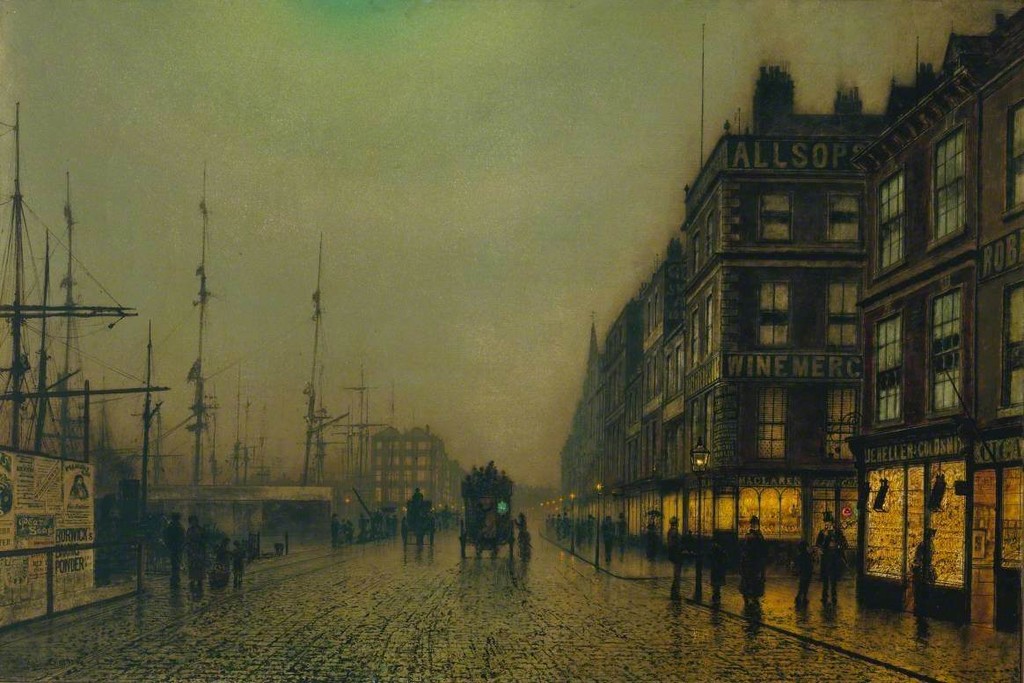
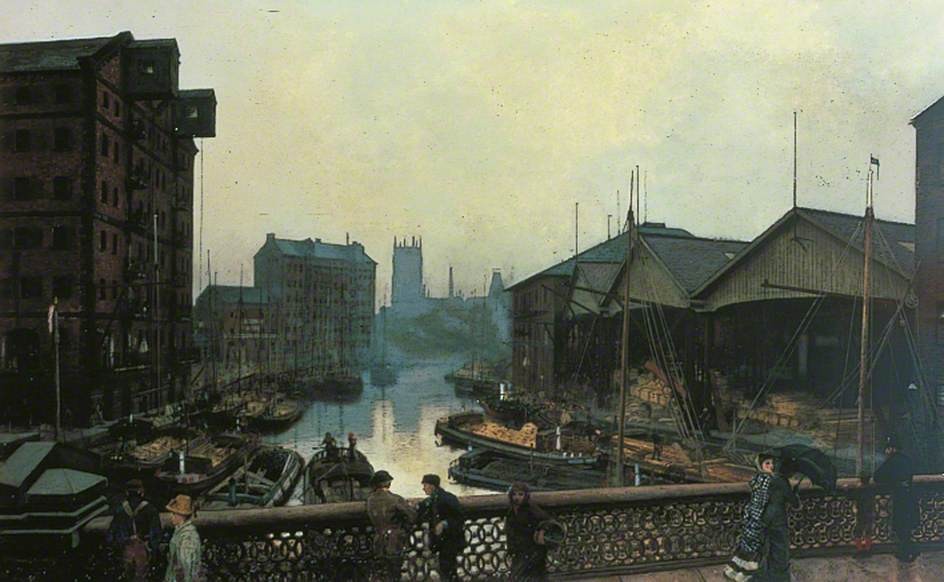
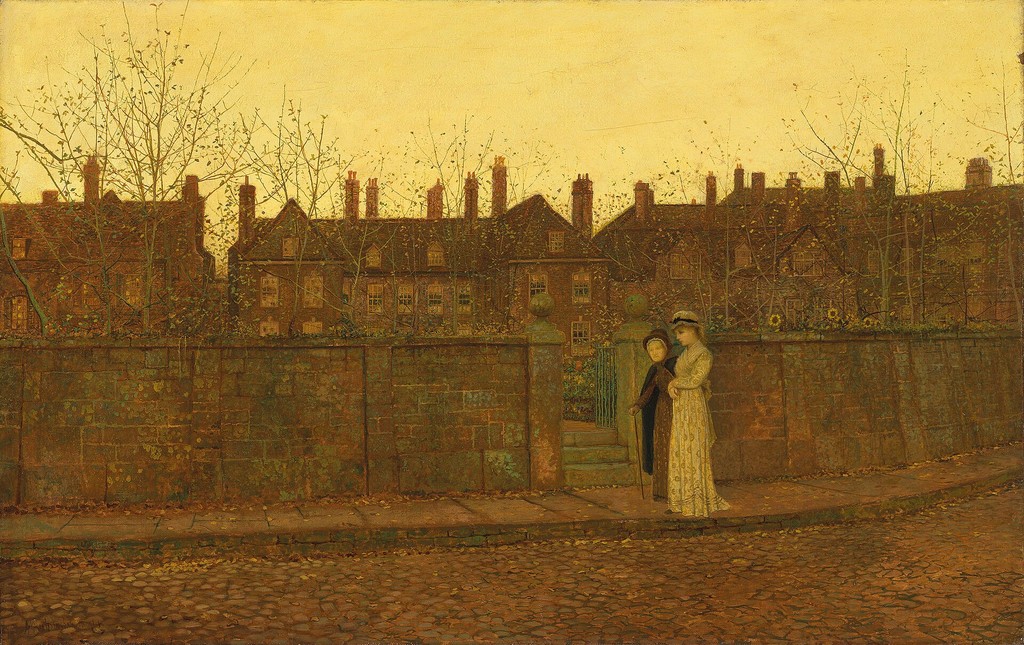
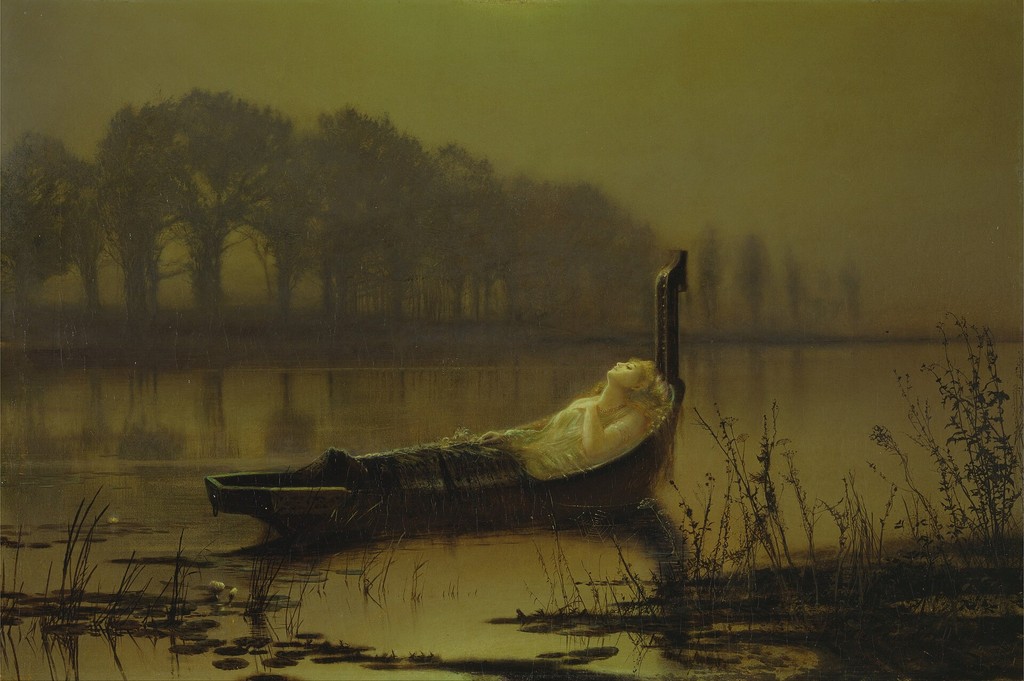
Selected John Atkinson Grimshaw works
Contents
- Introduction
- A Wider Practice Than the Nocturnes
- Early Naturalism and Close Observation
- Moonlight as a Pictorial System
- City Streets and Civic Modernity
- Ports, Rivers and Moving Goods
- Landscape, Season and Domestic Space
- Figures, Poetry and Classical Subjects
- Three Secure Object Studies
- How to Use the Works Directory
A Wider Practice Than the Nocturnes
Grimshaw’s reputation rests on nocturnes because they made a recognisable visual language out of Victorian streets after dark. Bare branches cross luminous skies; wet roads and rivers repeat small points of light; a solitary figure or carriage gives scale to an otherwise suspended scene. Yet the Museo Thyssen-Bornemisza biography also identifies landscapes, portraits, interiors and neoclassical or fairy subjects within his output.[4] The range matters because the nocturnes did not appear from nowhere. Their precision, patterned surfaces and carefully staged depth belong to a practice first trained on leaves, stone, water and buildings.
The most useful way to approach the paintings is therefore by connected strands rather than by one label. The moonlight and nocturnes guide follows his best-known effects. Landscapes and seasons returns to daylight, foliage, snow and autumn. Figures, interiors and literature examines subjects that the familiar image of a “painter of moonlight” can conceal.
Early Naturalism and Close Observation
Grimshaw was self-taught, and institutional accounts describe his early work in relation to John Ruskin’s demand for fidelity to nature and the meticulous example of Pre-Raphaelite painting. The Thyssen biography says that he had moved away from that early manner by about 1865, but the habit of close observation remained useful.[4] Titles in the researched census—including A Dead Linnet, A Mossy Glen, Windermere and Ingleborough from under White Scar, Yorkshire Limestone Strata—show how birds, wooded ground, distant topography and geological form entered the early record.[12]
These works should not be treated merely as an apprenticeship before the “real” Grimshaw. They establish the material attention that later gives a moonlit road its leaf litter, a harbour its rigging or a house its sharply profiled roof. They also anchor his career in northern landscapes before his repeated treatment of London and commercial ports. The shift was an expansion of subject and market, not a clean break between nature and the modern city.
Moonlight as a Pictorial System
Scarborough Museums dates Grimshaw’s first known moonlight scene of Whitby Harbour to 1867 and describes the Yorkshire coast as a place where he developed his study of light on water.[3] By the 1870s, nocturnes had brought commercial recognition. Their success encouraged repeated types: harbour lights, moonlit lanes, amber horizons and figures moving beneath trees. Repetition does not make every picture interchangeable. Changes of setting, weather, tide, architecture and the distribution of artificial light alter how each scene works.
In these paintings, illumination is rarely a single source. Moon, gas lamps, shop windows, reflected sky and the pale surface of water may pull in different directions. Darkness suppresses detail selectively, so a viewer reads a scene through intervals of clarity. The result can feel timeless, yet the locations often belong to a modern network of railways, streets, shipping and trade. That productive tension—between observed infrastructure and poetic suspension—is central to Grimshaw’s art rather than an incidental mood.[3][4]
City Streets and Civic Modernity
Grimshaw repeatedly painted Leeds, the city in which he was born and spent much of his life. Leeds Museums and Galleries states that its holdings have grown into the largest public collection of his work, making the city essential both to his history and to his present public visibility.[2] Leeds Bridge (1880), for example, places the River Aire among warehouses, factory buildings, boats, lifting equipment and a skyline marked by a chimney. The museum’s learning resource stresses the economic and social activity implied by those forms, even though atmosphere softens their outlines.[8]
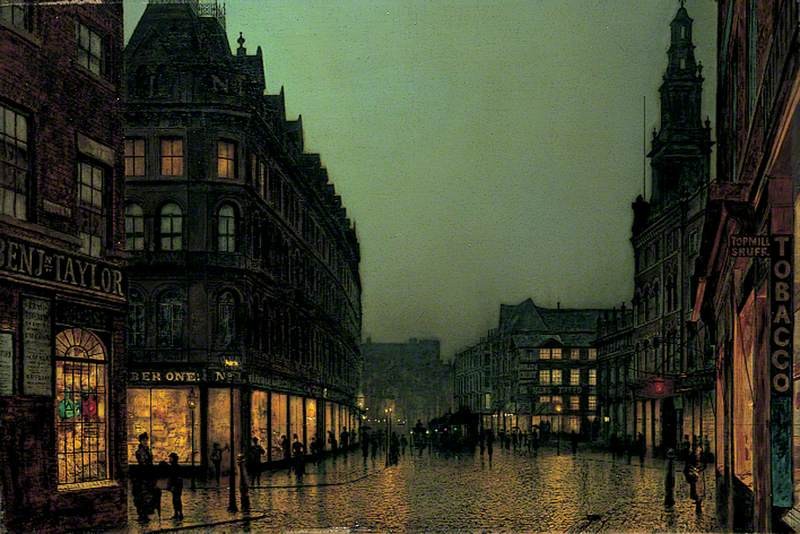
That balance distinguishes a Grimshaw cityscape from a straightforward topographical record. Streets may be identifiable, but they are reorganised through light, spacing and selective detail. Boar Lane, Leeds compresses illuminated shopfronts, traffic and pedestrians into a long urban corridor. View of Heath Street by Night extends the street type to suburban London, where architecture and a steep road are held together by the evening light.[7] For the wider local context, see Leeds and Yorkshire.
Ports, Rivers and Moving Goods
Liverpool, Glasgow, Hull, Whitby and Scarborough gave Grimshaw another form of modern landscape. Quays and docks combine deep perspective with masts, warehouses, carts, wet paving and water. Liverpool Quay by Moonlight, now at Tate, makes a commercial street and its shipping legible through points of reflected light rather than through bright daytime description.[7] The figures are small, but their presence prevents the quay from becoming an empty fantasy.
The ports were working environments tied to the movement of goods and people. Grimshaw often poeticised them, but poetry does not remove their economic function. Scarborough Museums interprets its coastal pictures as modern everyday landscapes given romantic and nostalgic atmosphere, and notes that the growing Victorian middle class supplied a ready market.[3] Ports and docklands considers that relationship in depth. It also distinguishes a fishing harbour’s flares and local labour from the larger mercantile systems suggested by Liverpool and Glasgow.
Landscape, Season and Domestic Space
Autumn is almost as persistent in Grimshaw’s titles as moonlight. Bare branches, copper leaves, low sun and mist let him test restricted colour while preserving fine surface incident. Works such as Autumn Glory: The Old Mill, An Autumn Idyll and In the Golden Mists of Autumn indicate that season could organise both mood and composition.[12] Late snow scenes broadened the palette further; the Scarborough guide records that he began painting them in 1892.[3]
Knostrop Old Hall, rented by the family from about 1870, supplied architecture, gardens and an imaginative home ground. Elements of the house could recur within lane scenes or literary settings rather than serving as literal documents. That mobility between observed place and constructed atmosphere is important: a recognisable building might be adjusted to fit a pictorial rhythm. Country house, suburban lane and interior are consequently not isolated genres. They are different stages on which Grimshaw tested enclosure, distance and changing light.
Figures, Poetry and Classical Subjects
Human figures in the nocturnes are often small and mobile, but Grimshaw also made portraits and figure-centred compositions. Iris (1886) is a particularly useful correction to the idea that he painted only quiet streets. Leeds Museums explains that the winged figure represents the classical messenger Iris, not simply a fairy, and connects the picture’s gold, iridescent colour and autumn setting to a written narrative recorded on the work.[9] Its subject, scale of figure and chromatic intensity place it far from the restrained architecture of a dock scene.
Literature also shaped the titles and settings of paintings such as The Lady of Shalott and In the Gloaming. Scarborough Museums links the latter to Tennyson’s Locksley Hall while noting its partial basis in Knostrop Old Hall.[3] These pictures do not abandon observation. Instead, observed rooms, trees and fabrics become frameworks for poetry, myth or memory. Their place in the career shows that atmosphere could serve narrative as well as topography.
Three Secure Object Studies
Three dedicated object guides provide fixed points within the broader directory. Boar Lane, Leeds is an oil on canvas in Leeds Art Gallery. Its public date is given as about 1879 because cataloguing sources vary between 1879 and 1881; the qualification preserves that variance rather than manufacturing precision.[10] The painting joins a named city street to the light, traffic and commerce of a nocturne.
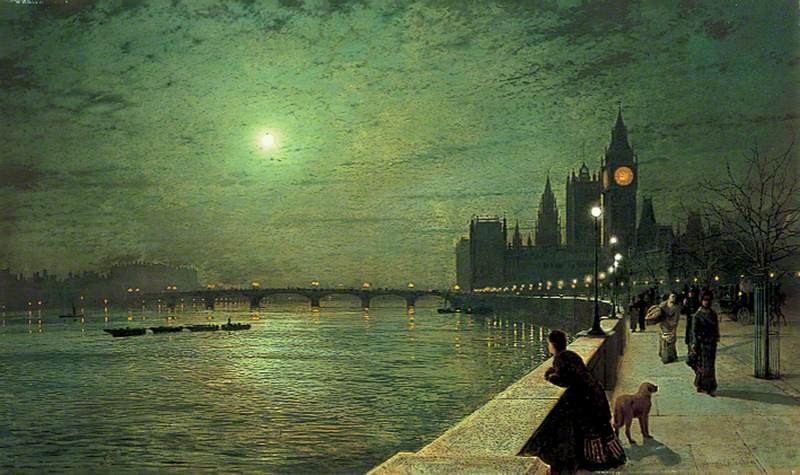
Reflections on the Thames, Westminster, London is dated 1880 and is also held by Leeds Art Gallery.[11] Its broad river format makes reflection an organising structure: buildings and vessels occupy one register while broken light animates the water below. The work belongs to Grimshaw’s London period without reducing the Thames to a neutral backdrop.
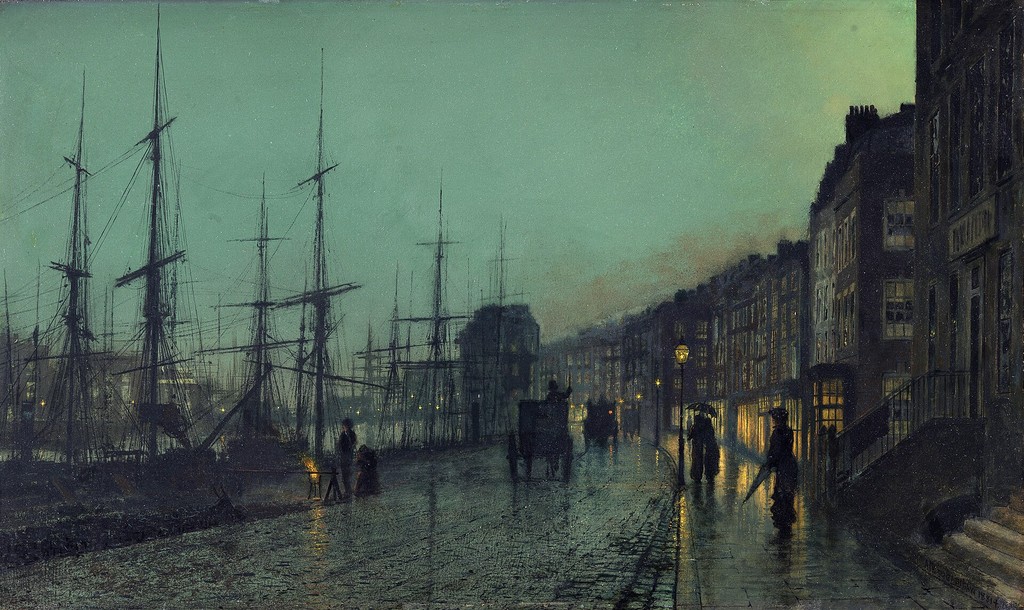
Shipping on the Clyde is dated 1881 and belongs to the Carmen Thyssen-Bornemisza Collection, on loan to the Museo Nacional Thyssen-Bornemisza.[5] Painted on cardboard or millboard, it demonstrates that a comparatively modest support can carry an ambitious harbour scene. Read together, the three works connect the commercial street, metropolitan river and international port while keeping their object identities and collection histories distinct.
How to Use the Works Directory
The directory rendered below contains 88 distinct records discovered through a dated Wikidata creator-statement census.[12] Every accepted row is classified broadly as a painting. That uniform label reflects the available structured data, not a claim that every support, technique or version has been fully catalogued. Dates marked “unknown” remain unknown, and similarly titled objects remain separate when their Wikidata identities differ. Two entries called Silver Moonlight, for example, are retained because their records point to works dated 1880 and 1886.
This is an online discovery tool, not a catalogue raisonné or a declaration of absolute completeness. Public structured data can omit privately held works, duplicate titles, translate names unevenly or change as institutions revise records. The directory is best used to identify a possible work and then continue to its holding museum, object record or scholarly catalogue. The three linked records above have dedicated pages because their titles, dates, collections and images were separately locked; the other 85 rows are not silently promoted to the same evidential status.
Researched works directory
This searchable evidence census contains 88 distinct records assembled from public collection data and a reproducible Wikidata snapshot. It is not a catalogue raisonné, not a claim of complete oeuvre coverage, and it keeps works with repeated titles as separate objects.
| Name | Date | Medium |
|---|---|---|
| A Dead Linnet | 1862 | Painting |
| A House in a Clearing | 1870 | Painting |
| A Moonlit Evening | 1880 | Painting |
| A Moonlit Lane | 1874 | Painting |
| A Mossy Glen | 1864 | Painting |
| A View of Hampstead, London | 1882 | Painting |
| A Wooded Valley | Date unknown | Painting |
| A Yorkshire Home | 1878 | Painting |
| An Autumn Idyll | 1885 | Painting |
| Autumn Glory: The Old Mill | 1869 | Painting |
| Autumn Regrets | 1882 | Painting |
| Baiting the Lines, Whitby | 1884 | Painting |
| Boar Lane, Leeds | 1881 | Painting |
| Bowder Stone, Borrowdale | 1865 | Painting |
| Briggate, Leeds | 1891 | Painting |
| 'Burning Off', a Fishing Boat at Scarborough | 1877 | Painting |
| Canny Glasgow | 1887 | Painting |
| Evening Glow | 1884 | Painting |
| Evening Scene by the Docks, Hull | Date unknown | Painting |
| Fiamella | 1883 | Painting |
| Glasgow Docks | 1886 | Painting |
| Gloucester Docks | 1885 | Painting |
| Golden Visions | 1870 | Painting |
| Greenwich, Half Tide | 1884 | Painting |
| In Peril (The Harbour Flare) | 1879 | Painting |
| In the golden gloaming | Date unknown | Painting |
| In the Golden Mists of Autumn | 1884 | Painting |
| In the Golden Olden Times | 1870 | Painting |
| Ingleborough from under White Scar, Yorkshire Limestone Strata | 1868 | Painting |
| Iris | 1886 | Painting |
| Knostrop Old Hall at Dusk | 1870 | Painting |
| Leeds Bridge | 1880 | Painting |
| Lights in the Harbour, Scarborough | 1879 | Painting |
| Liverpool Docks | 1892 | Painting |
| Liverpool Docks by Night | 1892 | Painting |
| Liverpool Docks (panel 1 of 5) | Date unknown | Painting |
| Liverpool Docks (panel 2 of 5) | Date unknown | Painting |
| Liverpool Docks (panel 3 of 5) | Date unknown | Painting |
| Liverpool Docks (panel 4 of 5) | Date unknown | Painting |
| Liverpool Docks (panel 5 of 5) | Date unknown | Painting |
| Liverpool Quay by Moonlight | 1887 | Painting |
| Moonlight Scene near Leeds | 1881 | Painting |
| Night Scene, Rouen | 1893 | Painting |
| Nightfall down the Thames | 1880 | Painting |
| Nightfall in Scarborough Harbour, North Yorkshire | 1884 | Painting |
| November Morning, Knostrop Hall, Leeds | 1883 | Painting |
| Old English House by Moonlight | Date unknown | Painting |
| Park Row, Leeds | 1882 | Painting |
| Princes Dock, Hull | Date unknown | Painting |
| Quai de Paris, Rouen | 1893 | Painting |
| Reflections on the Thames, Westminster | 1880 | Painting |
| Reflections on the Thames, Westminster, London | 1880 | Painting |
| Roundhay Park Lake | Date unknown | Painting |
| Salthouse Dock, Liverpool | Date unknown | Painting |
| Salthouse Dock, Liverpool, 1884 | Date unknown | Painting |
| Scarborough Lights | 1877 | Painting |
| Shipping on the Clyde | 1881 | Painting |
| Sic transit gloria mundi (The Burning of the Spa Saloon) | 1876 | Painting |
| Silver Moonlight | 1880 | Painting |
| Silver Moonlight | 1886 | Painting |
| Snow and Mist (Caprice in Yellow Minor) | 1892 | Painting |
| Stapleton Park, near Pontefract | Date unknown | Painting |
| Sunday Night, Knostrop Cut, Leeds | 1893 | Painting |
| Thames Moonlight | 1880 | Painting |
| The Custom House, Liverpool, Looking North | Date unknown | Painting |
| The Custom House, Liverpool, Looking South | Date unknown | Painting |
| The Harbour at Whitby by Moonlight | 1879 | Painting |
| The Head of Gertrude Grimshaw | 1874 | Painting |
| 'The Ironbound Shore' | 1869 | Painting |
| The Lady of Shalott | 1875 | Painting |
| The Parable of the Lost Sheep | Date unknown | Painting |
| The Rector's Garden, Queen of the Lilies | 1877 | Painting |
| The Seal of the Covenant | 1868 | Painting |
| The Sun's Farewell | Date unknown | Painting |
| The Thames by Moonlight with Southwark Bridge, London | 1884 | Painting |
| Thro' the Wood | Date unknown | Painting |
| Tree Shadows on the Park Wall, Roundhay, Leeds | 1872 | Painting |
| Under the Beeches | 1892 | Painting |
| Under the Silvery Moonbeams | Date unknown | Painting |
| View of Heath Street by Night | 1882 | Painting |
| View of Scarborough | 1876 | Painting |
| View of Southwark Bridge at Night | 1882 | Painting |
| Whitby | 1878 | Painting |
| Whitby Docks | 1876 | Painting |
| Whitby Harbor | 1874 | Painting |
| Windermere | 1863 | Painting |
| Woodland near Leeds | Date unknown | Painting |
| Yew Court, Scalby, near Scarborough | 1875 | Painting |
Frequently Asked Questions
He painted moonlit streets and harbours, but also detailed landscapes, country houses, autumn lanes, rivers, docks, interiors, portraits and literary or classical figures. Museum biographies emphasise this broader range even while recognising the nocturnes as the foundation of his fame.[3][4]
No. Early natural studies, daylight landscapes, seasonal scenes and figure compositions form substantial strands of the surviving record. Iris is a vivid classical subject, while titles such as Windermere and A Mossy Glen point to early landscape interests.[9][12]
Successful motifs were repeated and adjusted for a private market. A moonlit lane or harbour could recur with altered architecture, figures, weather and light. Related compositions should therefore be compared closely, not assumed to be duplicate records.[3]
Leeds Museums and Galleries states that it holds the largest public collection of his work. Individual paintings are also held by institutions including Tate, Scarborough Museums and Galleries and Museo Nacional Thyssen-Bornemisza.[2][5][6]
Discussion
Use this evidence-led guide as a starting point for close looking rather than a final verdict.
Share an observation about John Atkinson Grimshaw Paintings and Artworks or a source that adds useful context.
Reader Insights
Which comparison best reveals the range of Grimshaw's paintings across daylight and night?
Where do tonal structure and open-air colour coexist rather than replace one another?
Which object would you add to the selected group, and what would it change?
Join the Conversation
Add your reading below, keeping observations specific and evidence clear.
References
- Art UK, John Atkinson Grimshaw (1836–1893), accessed 31 August 2026.
- Leeds Museums and Galleries, Collections Development Policy, accessed 31 August 2026.
- Scarborough Museums and Galleries, Atkinson Grimshaw: At Home in Yorkshire, accessed 31 August 2026.
- Museo Nacional Thyssen-Bornemisza, John Atkinson Grimshaw, accessed 31 August 2026.
- Museo Nacional Thyssen-Bornemisza, Shipping on the Clyde, accessed 31 August 2026.
- Tate, Liverpool Quay by Moonlight, accessed 31 August 2026.
- Tate, View of Heath Street by Night, accessed 31 August 2026.
- Leeds Museums and Galleries via MyLearning, Leeds Bridge, accessed 31 August 2026.
- Leeds Museums and Galleries, Iris (1886), accessed 31 August 2026.
- Art UK, Boar Lane, Leeds, accessed 31 August 2026.
- Art UK, Reflections on the Thames, Westminster, London, accessed 31 August 2026.
- Wikidata, John Atkinson Grimshaw, accessed 31 August 2026.