

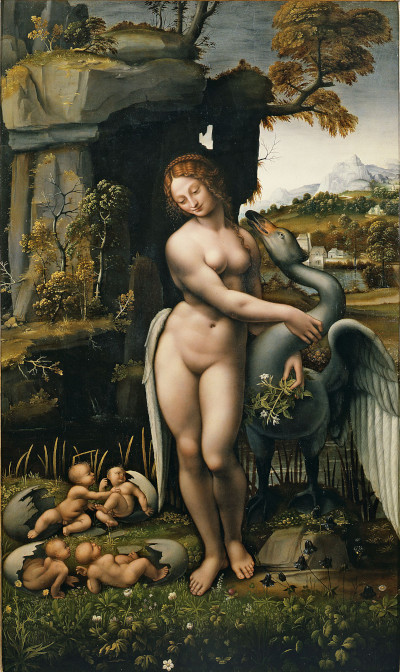
Leda and the Swan
Leonardo da Vinci's Leda and the Swan is not a surviving painting that can be visited in a museum today. It is a lost project, reconstructed from drawings by Leonardo, copies after his design, and later evidence about the way the composition circulated. That distinction matters more here than almost anywhere else in Leonardo's catalogue. A careless title can make the page sound as if a complete autograph painting by Leonardo still exists. A careful account begins with Leonardo's pursuit of the subject, the fame of the lost design and the family of studies and versions that now stand in place of one settled object.
The myth itself comes from antiquity. Leda, queen of Sparta, is approached by Jupiter, or Zeus, in the form of a swan. Renaissance artists often treated the subject as a way to combine classical learning, erotic mythology, anatomy, landscape, and symbolic fertility. Leonardo's interest seems to have been both pictorial and experimental. The subject offered a full-length female figure, a complex pose, a bird, children, eggs, water, plants, and a landscape setting. It let him test movement, hair, flesh, botany, and narrative in one strange, compressed invention.
The safest way to understand the page is therefore as a reconstruction of a lost artistic problem. Leonardo made studies connected with Leda; later artists copied or adapted the composition; museums preserve several important pieces of the surviving trail. The original, however, is gone.
At a Glance
- SubjectLeda and the Swan
- CategoryLost Leonardo project known through drawings and later copies
- Surviving originalNo; Leonardo's original painting is lost
- Direct Leonardo evidenceRoyal Collection Trust and Boijmans drawings/studies
- Official copy lanesGalleria Borghese and Kassel
- Caveated comparison lanesUffizi / Spiridon Leda and Wilton House / Cesare da Sesto
- Image cautionThe image illustrates the copy tradition; it does not settle source, rights or attribution questions.
Contents
- Why Leonardo's Leda is a lost work
- The drawings and the development of the idea
- Copies after the lost composition
- What the copies can and cannot tell us
- Leda, myth and Renaissance invention
- How to read the named versions
- Why Leda and the Swan matters
Why Leonardo's Leda is a lost work
The Royal Collection Trust records Leonardo's Head of Leda drawings as studies for the lost painting of Leda and the Swan [1] [2]. These are not copies by later artists. They are direct evidence that Leonardo worked through aspects of Leda's figure, especially the head and hair. One RCT record describes a small pen-and-ink drawing of Leda's head, turned downward, with elaborate braids coiled around the ears [1]. Another RCT record presents a sheet of head studies in black chalk, pen and ink, and explains that Leonardo worked on the subject over a long span before the standing Leda entered the French royal collection and was destroyed around 1700 [2].
That is the core claim. Leonardo's Leda was a real artistic project, but the principal painting no longer survives. The image shown is not a surviving Leonardo painting. The surviving materials are evidence around the lost work.
The named collections cannot be flattened into a single autograph title. Uffizi, Wilton House, Borghese and Kassel belong to different lanes in the afterlife of Leonardo's idea, with different artists, evidence and confidence levels.
The drawings and the development of the idea
Leonardo seems to have worked with more than one version of the composition. Some evidence points to a kneeling Leda, while other copies and studies relate to a standing Leda. The head studies in the Royal Collection are especially important because they show Leonardo solving one of the most characteristic parts of the figure: the elaborate hairstyle. In the RCT description, Leonardo gives less attention to the face's emotional detail than to the interlaced structure of the hair [1] [2]. That is wonderfully Leonardo. The head becomes a knot of observation, design and technical play.
Other drawings help widen the picture. Museum Boijmans Van Beuningen preserves a Leonardo drawing of Leda and the Swan, dated circa 1505-1507, in black chalk, pen and brown ink [4]. The museum's account places the sheet within the preparatory material associated with Leonardo's projected painting. It also keeps an important caution alive: it is uncertain how far Leonardo's work on the painting advanced beyond preliminary studies [4]. That uncertainty remains central. Leonardo developed the subject, and copies after his design survive; neat claims about a finished painting need specific source support.
The Royal Collection's plant-study material also helps. A record for a botanical sheet explains that Leonardo's plant studies around this period were probably prompted by work toward a Leda painting, whose foreground would have included abundant plants and flowers [3]. The same source notes that several painted copies after the lost Leda agree in the central group but differ in the backgrounds, suggesting that they may have been made from a cartoon in which the background was not fully fixed [3]. That is a crucial insight. It turns the page away from a single-object story and toward a workshop, cartoon and copy-tradition story.
Copies after the lost composition
Because the original is lost, later copies and versions carry much of the visual evidence. These copies are not interchangeable. Some follow a standing Leda composition, others preserve a kneeling or children-focused variant, and each has its own attribution and collection history.
The Galleria Borghese offers the strongest official copy-source context for the standing composition. Its object page identifies Leda, inventory 434, as a copy after Leonardo da Vinci, executed before 1517 in tempera on panel [5]. The Borghese record states that the painting was long considered to be by Leonardo but is now understood as one of the significant copies of the lost Leda. It also notes that the work belongs to an iconographic tradition derived from a Leonardo original, perhaps a cartoon, and that nine copies are now known [5]. That is exactly the kind of language this page needs: copy after Leonardo, not surviving Leonardo.
The Kassel lane is different but just as useful. The Gemäldegalerie Alte Meister Kassel records Leda mit ihren Kindern, inventory GK 966, by Giovanni Pietro Rizzoli, known as Giampietrino [6]. It dates the work to the 1520s through the late 1530s, gives the medium as oil, and records the dimensions as 128 x 105.5 cm [6]. Kassel's catalogue text links the main figure back to Leonardo's designs and explains that Leonardo was concerned with both standing and kneeling Leda compositions [6]. This makes Kassel the safer governing source for the kneeling or children-focused branch of the tradition. It is not a Leonardo painting, but a Giampietrino work connected to Leonardo's invention.
The Wilton House lane needs caveats. Web Gallery of Art lists a Leda and the Swan by Cesare da Sesto, dated 1505-10, in oil on panel, at Wilton House, Salisbury, and describes it as a copy after Leonardo's lost painting [7]. The Borghese object page also names the Pembroke collection at Wilton House as a comparison lane [5]. That supports Wilton as a recognized copy-tradition example, but not as a secure autograph Leonardo claim.
The Uffizi lane is also caveated. The Borghese page identifies the Uffizi's so-called Spiridon Leda, inventory 1890 no. 9953, as part of the group of early and faithful derivations [5]. That is useful comparison evidence, but the object facts and attribution still need to rest on cited records rather than on an image filename or collection label alone.
What the copies can and cannot tell us
The copies show that Leonardo's Leda composition mattered. They suggest that artists in or near Leonardo's circle had access to drawings, cartoons, or perhaps an unfinished or finished painting. They help recover the pose, the figure group, the swan, the children, the eggs and some of the visual grammar of the lost project.
But copies are not transparent windows. They can preserve one element and change another. The RCT plant-study record is especially helpful here because it explains that known painted copies agree in the central group but differ in the backgrounds [3]. That means the repeated central figure may come from a shared design, while the surroundings could reflect later invention or workshop completion. The background of one copy cannot be treated as Leonardo's finished landscape without strong evidence.
The same caution applies to attribution. A copy after Leonardo can be important without being by Leonardo. A student or follower can preserve a lost idea while also changing technique, finish, colour, scale or mood. The right question is not simply, Is this Leonardo? It is, What part of Leonardo's lost invention does this object preserve, and what part belongs to the later copyist?
The account therefore stays calm. It does not need to promise a recovered masterpiece. The story is already strong: a lost Leonardo project survives through a web of studies and copies, a substantial art-historical subject in its own right.
Leda, myth and Renaissance invention
The subject is difficult. Leda's myth involves Jupiter approaching her as a swan, and many modern readers will rightly notice the sexual violence embedded in the story. The account does not romanticize that violence or turn it into a decorative anecdote. Renaissance mythological art often used classical stories to explore the body, desire and transformation, but the language here needs to remain plain and careful.
Leonardo's interest probably lay less in illustration alone than in invention. The Leda project gave him a way to join opposites: human and animal, myth and nature, erotic subject and botanical precision, mother and children, movement and poise. In the surviving studies, the head and hair become almost sculptural. In the copy tradition, the eggs and children transform the myth into a scene of strange fertility. In the plant studies, nature crowds forward as a symbolic and observational field.
That combination is why Leda belongs beside Leonardo's other ambitious lost or unfinished projects. Like The Battle of Anghiari, it asks us to reconstruct a major invention from fragments, copies, drawings and later testimony. Like the Saint Anne, it shows Leonardo returning to a complicated figure group over time. Like the Mona Lisa, it turns landscape and living form into a continuous visual problem. But unlike the Mona Lisa, the painting itself is no longer available to anchor the story.
How to read the named versions
Uffizi, Wilton House, Galleria Borghese and Kassel all belong in the discussion, but not with the same evidentiary weight.
The Borghese copy can be treated as a source-backed object. Its official record gives a clear copy-after-Leonardo framework, an inventory number and a physical object in the Borghese collection [5]. The Kassel work can also be treated as a source-backed object: Giampietrino's Leda mit ihren Kindern, GK 966 [6]. These two lanes are the firmest object anchors.
Wilton House is best introduced through the Cesare da Sesto copy/version lane [7]. Uffizi can be mentioned as the Spiridon Leda lane named by the Borghese source, while remaining secondary to records that directly identify the object being discussed [5].
This gives readers a useful map without pretending the evidence is simpler than it is. Borghese and Kassel carry the strongest official object weight here. Wilton and Uffizi remain part of the tradition, but with softer wording.
Why Leda and the Swan matters
Some lost-work pages feel speculative because the evidence is too thin. Leda and the Swan is different. The original is lost, but the surrounding evidence is substantial: Leonardo drawings, botanical studies, a Raphael copy lane, museum copy records, and major later versions. The problem is not whether there is enough to discuss; the problem is how to discuss it without turning copies into an autograph painting.
The result is not a catalogue entry for one surviving object. It is an explanation of a lost Leonardo invention: why the original mattered, why the copies differ, and how museums use drawings and derivatives to reconstruct a vanished work.
Leda and the Swan shows how unevenly Leonardo's ideas survived. Some works were finished, some abandoned, some copied, some transformed by pupils, some lost and reconstructed from traces. This subject sits in that uneasy zone. It is not a secure painting like the Annunciation, nor a conserved wall painting like The Last Supper, nor a single famous drawing like the Vitruvian Man. It is a constellation of evidence.
That constellation deserves careful treatment because it shows both the force of Leonardo's invention and the fragility of its survival.
It also offers a useful model for approaching other Renaissance losses. A lost work is not empty simply because the central object has disappeared. Drawings, copies, inventories and museum records can still define the shape of a problem. The task is to keep those traces in their proper order, so that evidence remains evidence rather than wishful reconstruction.
Frequently Asked Questions
Discussion
Where does Leonardo's lost Leda become clearest: in the head studies, the plant studies, the Borghese copy, the Kassel lane, or the way the copies differ?
Reader Insights
How can a vanished Leonardo project be explained without making it feel like a surviving painting?
Which details seem to carry Leonardo's design most clearly, and which belong to later copyists?
How much weight do Borghese, Kassel, Wilton and Uffizi each carry?
Join the Conversation
Share your reading of Leonardo's Leda and the Swan below.
References
- Royal Collection Trust, The head of Leda, RCIN 912515, accessed 30 July 2026.
- Royal Collection Trust, The head of Leda, RCIN 912516, accessed 30 July 2026.
- Royal Collection Trust, A branch of blackberry, and a stem of bird's-foot trefoil, RCIN 912420, accessed 30 July 2026.
- Museum Boijmans Van Beuningen, Leda and the Swan, accessed 30 July 2026.
- Galleria Borghese, Leda, copy after Leonardo da Vinci, inventory 434, accessed 30 July 2026.
- Gemäldegalerie Alte Meister Kassel, Leda mit ihren Kindern, GK 966, accessed 30 July 2026.
- Web Gallery of Art, Leda and the Swan by Cesare da Sesto, accessed 30 July 2026.