

 by Tom Gurney
Tom Gurney BSc (Hons) is an art history expert with over 20 years experience
Published on June 19, 2020 / Updated on August 2, 2026
Email: tomgurney1@gmail.com / Phone: +44 7429 011000
Portrait of a Musician
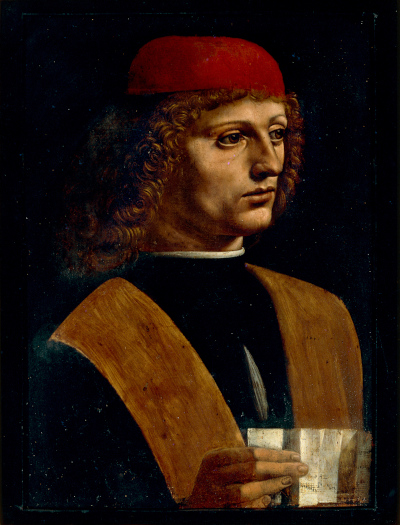
Portrait of a Musician is Leonardo’s Milanese portrait of a young man in a red cap holding a sheet of musical notation. The head is modelled with exceptional force, while the lower section remains less resolved. That contrast gives the painting much of its tension: a vivid face, a restored attribute and an identity that remains unproven.
The musical clue was not always visible. For centuries the picture was read differently, sometimes as a portrait of Ludovico Sforza or as a more generic learned man. A restoration in 1905 removed later overpaint and brought the hand and musical scroll back into view. Since then the sitter has been understood as a musician, although his name remains unproven.[1] [2]
The painting matters partly because it stayed in Milan. The Ambrosiana describes it as the only painting by Leonardo on wood to have remained in the city. It probably entered the institution with Count Galeazzo Arconati’s 1637 donation, alongside the Codex Atlanticus. A portrait that might once have belonged to Leonardo’s Milanese court world is therefore still housed in the city where that world took shape.[1]
At a Glance
- ArtistLeonardo da Vinci
- TitlePortrait of a Musician / Ritratto di Musico [1]
- DateAbout 1485 / first Milan period [2]
- MediumOil on panel [1]
- Dimensions44.7 × 32 cm [1]
- CollectionPinacoteca Ambrosiana, Milan [1]
- Inventory99 [1]
- SubjectUnidentified musician; sitter hypotheses unresolved [1]
- Key evidence1905 restoration revealed the hand and musical scroll [1]
Contents
- Introduction
- At a Glance
- A Leonardo Portrait That Stayed in Milan
- What the 1905 Restoration Changed
- The Face, the Hand and the Unfinished Lower Edge
- Who Might the Musician Be?
- The Score, the Pen and the Problem of Performance
- Light, Chiaroscuro and the Unequal Pupils
- Place Among the Milan Portraits
- Attribution, Caution and What Not to Overstate
A Leonardo Portrait That Stayed in Milan
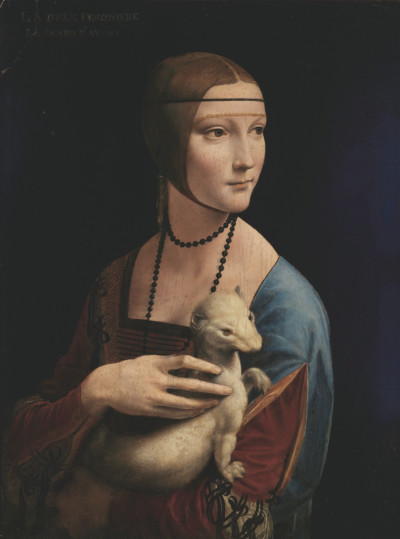
Leonardo moved to Milan in the early 1480s after his Florentine formation in Verrocchio’s workshop. The Museo Leonardiano places his move to Ludovico il Moro’s court in 1482 and notes that he worked there as an engineer, set designer, painter and sculptor. During those years, it lists the works now known as the Musician, Lady with an Ermine and La Belle Ferronnière among the portraits associated with his Milanese period.[4]
The National Gallery’s account of its 2011 exhibition, Leonardo da Vinci: Painter at the Court of Milan, makes the same Milanese setting central. The exhibition focused on Leonardo as a painter at the Sforza court in the late 1480s and 1490s, when his study of anatomy, expression and perception fed directly into his paintings. It included the Ambrosiana Portrait of a Musician among the rare surviving works from that world.[3]
The Ambrosiana gives the painting an especially local status. It calls the panel the only painting by Leonardo on wood that remained in Milan, and connects its probable institutional arrival with Arconati’s 1637 donation. That does not prove the painting’s first owner or original commission. It does, however, keep the modern viewer close to the geography of the work: Milan is not only the place where the portrait was probably made, but also the place where it has long been preserved.[1]
The sitter’s world was a court where music, poetry, engineering, stage design and painting overlapped. Leonardo was not simply producing isolated likenesses. He was working in a culture that valued performance, learned display and inventive representation. A portrait of a musician belongs naturally to that environment, even when the musician’s identity is not secure.
What the 1905 Restoration Changed
The history of the title begins with a physical change in the painting’s appearance. Ambrosiana documents and later viewers did not always see the lower section as we see it now. The Google Arts story created with the Veneranda Biblioteca Ambrosiana explains that ancient Ambrosiana documents described the figure generically as a “dottore” or as a duke of Milan. In the nineteenth century, the mysterious sitter was often identified with Ludovico il Moro.[2]
That reading depended on a missing clue. The lower right part of the panel had been covered by overpaint, concealing the hand and musical notation. In 1905, restoration removed that overpaint and revealed the hand holding the sheet. The title Portrait of a Musician then became the more convincing name for the picture.[1] [2]
The 1905 restoration changed the problem without solving it. The visible hand and score made the sitter’s musical role far more convincing, but they did not supply a name. The sheet identifies a field of activity, not an individual.
The restored hand is evidence, not a shortcut. It is one of the most important facts about the object because it changed the interpretation of the portrait. It also shows how dependent portrait history can be on condition, overpaint and later intervention: the same face generated different identities before and after the lower section was visible.
The Face, the Hand and the Unfinished Lower Edge
The portrait is dominated by the head. The young man turns slightly, his red cap pressing down over dark, curling hair. Light catches the forehead, nose, cheek, lips and chin, then slips into deep shadow around the far side of the face. The expression is concentrated rather than open. He does not smile, perform or address the viewer directly.
The lower part of the painting has a different character. The hand and sheet are crucial to the title, but the area around them does not have the same finish as the face. That unevenness has encouraged discussion of the picture’s state and of how much of the lower portion was completed. A responsible reading should not turn those differences into a current attribution crisis. The Ambrosiana presents the painting under Leonardo’s name and directs attention to the precise hand, the scroll and the powerful modelling of the head.[1]
The hand is not merely an accessory. It brings the sitter’s profession into the picture and makes the lower section active. The viewer is asked to move from the face to the score and back again. The face suggests inward attention; the sheet points to music as a social and intellectual practice.
The painting’s small scale intensifies the effect. At 44.7 x 32 cm, it is a compact panel rather than a large public image.[1] The sitter appears close, but the dark field and unresolved lower portion keep him withheld. Leonardo gives us enough to feel the presence of a person, not enough to finish the person’s story.
Who Might the Musician Be?
Three names dominate the current reader-facing debate: Franchino Gaffurio, Josquin des Prez and Atalante Migliorotti. They should be introduced as hypotheses, not as answers.
Gaffurio was chapel master at Milan Cathedral and worked in the same Milanese environment as Leonardo and Ludovico Sforza. The Ambrosiana names him as one proposed identification.[1] The appeal is clear: a major musician in Milan is an obvious candidate for a Milanese portrait of a musician. The weakness is also clear. The cited institutional sources do not present a document connecting Gaffurio to the panel.
Josquin des Prez is another proposal. He was a Franco-Flemish singer and composer who also worked in Milan during the period connected with Leonardo and Ludovico. The Ambrosiana includes him among the named possibilities.[1] As with Gaffurio, the identification depends on historical plausibility and musical status rather than conclusive object-specific evidence.
Atalante Migliorotti has become an especially interesting modern proposal. The Ambrosiana describes him as a Tuscan musician, a friend of Leonardo, who came with him to the Milanese court as a singer and skilled lyre player.[1] The Google Arts story adds a suggestive detail: in a list of sketches to take to Milan, Leonardo mentions a “portrait of Atalante”, which could connect the Ambrosiana painting to a known person in Leonardo’s circle.[2]
That connection remains conditional. A note about a portrait of Atalante is not the same as an inscription on this panel. It gives the hypothesis unusual interest because it joins Leonardo’s own working records to a musician who travelled in the right orbit, but it does not close the case.
The safest conclusion is therefore simple and useful: the sitter was almost certainly understood as a musician after the restoration revealed the hand and score, but his exact identity is unknown. The possible names enrich the painting, but none can carry more certainty than the evidence allows.
The Score, the Pen and the Problem of Performance
The musical sheet does more than rename the sitter. It changes the kind of person the portrait appears to show. A duke’s portrait normally asserts rank. A generic doctor or scholar might be defined by learning. A musician holding a score is linked to performance, practice and sound.
The Google Arts story describes the young man as holding a partition sheet and a pen. The detail matters because it leaves open whether he is a composer, a singer, a performer or a cultivated court musician.[2] A score can be read, copied, received, performed or composed. The painting does not show an instrument in action. It shows a moment of possession and attention.
This restraint is very Leonardo. The portrait does not dramatise music through movement or open emotion. Instead, it compresses music into a small object held at the lower edge of the panel. The sitter’s face remains the field of psychological interest, while the score quietly redirects interpretation.
The restored sheet also connects the portrait to the broader Milanese court. Leonardo himself worked closely with musicians and court entertainments, according to the National Gallery’s account of the Milan exhibition.[3] The Portrait of a Musician is not evidence that Leonardo abandoned painting for music. It shows how one art could touch another in the courtly environment that supported his experiments.
Light, Chiaroscuro and the Unequal Pupils
The Ambrosiana highlights the painting’s powerful chiaroscuro and the sculptural quality of the sitter’s facial features.[1] Those observations identify one of the portrait’s central visual effects. The face is modelled by transitions between light and darkness rather than by hard outline alone. The head feels carved out of shadow, but it remains soft enough to suggest living flesh.
One detail makes the portrait especially Leonardo-like: the pupils are different sizes. The Ambrosiana notes that the pupil in the left eye is slightly smaller than the one in the right. It connects this observation with Leonardo’s own studies of how pupils dilate as light fades, presenting the painting as a scientific observation translated into paint.[1]
The claim needs precision. The painting does not illustrate a modern optical experiment. It does show Leonardo’s interest in observation entering portraiture at a very small scale. Instead of treating eyes as identical signs, he allows them to register a change in light. The result is not a technical diagram but a more alert image of perception.
The sitter’s gaze is therefore both psychological and physical. We read it as concentration, but its power also depends on anatomy, light and the mechanics of vision. Leonardo’s Milanese portraits often make the mind visible through movement or attention. Here, the evidence of attention is compressed into the face itself.
Place Among the Milan Portraits
The National Gallery press release describes Leonardo’s Milanese years as the setting for a group of portraits that changed the genre. It singles out Portrait of a Musician as Leonardo’s only portrait of a man and places it beside Lady with an Ermine and La Belle Ferronnière.[3]
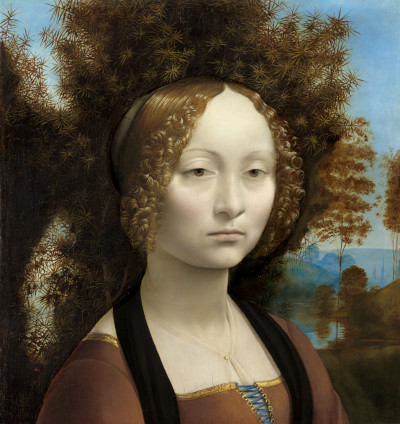
The comparison works only when the differences are preserved. Lady with an Ermine has a securely identified sitter, Cecilia Gallerani, and a living animal that turns with her. La Belle Ferronnière has an unidentified female sitter, a parapet and a famously misapplied title. Ginevra de’ Benci offers an earlier Florentine contrast. Portrait of a Musician is smaller and more abrupt, with a male sitter, a restored musical attribute and unfinished passages.
Together, these works show Leonardo expanding portraiture beyond status alone. A portrait could record rank, but also attention, perception and the activity of the mind. It could include an object, animal or gesture that opens a second field of meaning. In the Musician, that second field is sound.
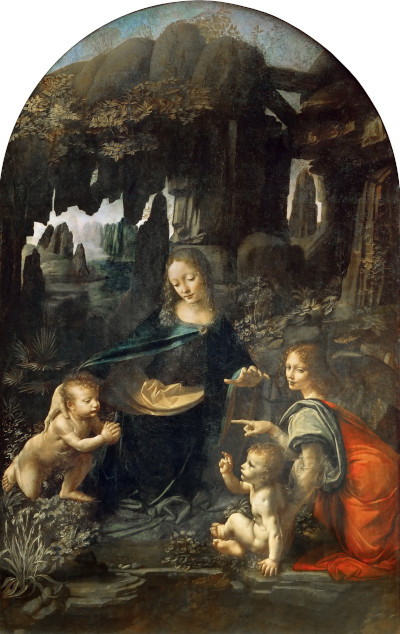
The painting also belongs near The Virgin of the Rocks, because both works come from Leonardo’s first Milanese environment. The Google Arts story points to similarities with the first version of The Virgin of the Rocks and with the style of Leonardo’s late Florentine works, especially the strong chiaroscuro and sculptural form.[2] The portrait looks back to Florence while becoming part of Milan.
Attribution, Caution and What Not to Overstate
The Ambrosiana presents the painting as a work by Leonardo. The Google Arts story says the panel is now universally attributed to him, while acknowledging that uncertainty about both subject and artist existed before the twentieth-century restoration clarified the lower section.[2] The National Gallery included the painting in its Milan exhibition among Leonardo’s rare surviving works from the Sforza period.[3]
The available institutional evidence supports Leonardo as the governing attribution. It does not support an invented division of labour between Leonardo and assistants. Visible differences in finish can be discussed without implying that the current attribution is unstable.
The same restraint applies to condition. The painting has survived with a complex surface history, including the overpaint removed in 1905. But the sources used here do not support a detailed treatment history beyond that central restoration fact. Claims about being among Leonardo’s best-preserved paintings, about successful restoration in general, or about specific damage should wait for a conservation source.
The portrait is strongest when its evidence is kept in separate layers: secure object facts, probable provenance, restored visual evidence, plausible sitter names and unresolved identity. Its uncertainty is not a weakness if those layers remain clear.
The Musician is quieter and less settled than Leonardo’s most famous portraits, but its questions are historically productive. It brings Milanese portrait practice into contact with music, optics, court sociability and the afterlife of restoration in one concentrated panel.[1] [3]
Artist Up Close
Look first at the eyes. They are not treated as flat dark points. One pupil is slightly smaller than the other, a difference the Ambrosiana connects with Leonardo’s study of dilation under changing light.[1] The portrait asks viewers to see looking itself as a physical event.
Then move to the hand and musical sheet. This area was hidden by overpaint until the 1905 restoration. Without it, the painting invited very different identifications. With it, the sitter becomes a musician, but not a named one.[1] [2]
Finally, compare the finish of the head with the lower passage. The contrast helps explain why the picture feels both vivid and incomplete. For a related drawing-focused page on Leonardo’s handling of gesture, see Study of Hands.
Frequently Asked Questions
Discussion
Use this space to discuss Portrait of a Musician by Leonardo da Vinci, its source evidence and how it fits into Leonardo da Vinci's wider cluster.
Keep comments focused on close looking, attribution language, object evidence and page-specific caveats.
Reader Insights
Which detail on this page most changes how you read the work?
How does this page connect to Leonardo's paintings, drawings, inventions or workshop context?
Where should the wording stay cautious because the source evidence is qualified?
Join the Conversation
Share your reading of Portrait of a Musician by Leonardo da Vinci below.
References
- Veneranda Biblioteca Ambrosiana, “Portrait of a Musician”, accessed 28 July 2026.
- Google Arts & Culture / Veneranda Biblioteca Ambrosiana, “Portrait of a Musician”, accessed 28 July 2026.
- The National Gallery, London, “Leonardo Da Vinci: Painter at the Court of Milan”, accessed 28 July 2026.
- Museo Leonardiano di Vinci, “Leonardo’s biography”, accessed 28 July 2026.