

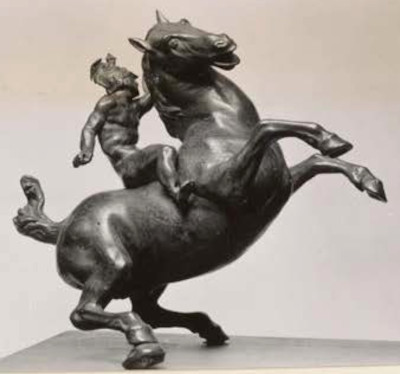
Rearing Horse and Mounted Warrior is the title used here for the small bronze better known in the Museum of Fine Arts, Budapest, as Horse and Rider. It is one of the most intriguing objects connected with Leonardo da Vinci's sculptural imagination, but it also needs careful wording. The Budapest museum identifies the statuette as Attributed to Leonardo da Vinci, not as a secure, undisputed autograph sculpture by Leonardo [1].
That distinction is the heart of the page. The bronze is important because it sits at the intersection of Leonardo's horse studies, Renaissance small bronzes, later connoisseurship, technical examination and the unresolved problem of Leonardo as a sculptor. It should not be introduced as a simple lost-and-found masterpiece. It is better understood as a source-rich, debated object whose value lies partly in the questions it forces us to ask.
The object is held by the Museum of Fine Arts, Budapest, with inventory number 5362. The Budapest Leonardo Project gives its basic object facts as a bronze Horse and Rider, attributed to Leonardo da Vinci, first half of the 16th century, height 24.4 cm [1]. Those facts are strong enough to support a focused page. They are not strong enough to erase the debate around authorship.
The page title, Rearing Horse and Mounted Warrior, describes the motif: a rearing horse and a mounted figure. The source-backed object is the Budapest Horse and Rider, distinct from the separate disputed wax-sculpture page and from the wider body of equestrian imagery associated with Leonardo.
At a Glance
- ObjectBudapest Horse and Rider, locally titled Rearing Horse and Mounted Warrior
- AttributionAttributed to Leonardo da Vinci; attribution debated
- DateFirst half of the 16th century
- MediumBronze
- Height24.4 cm
- InstitutionMuseum of Fine Arts, Budapest
- Inventory5362
- Technical caveatSixteenth-century casting date does not prove Leonardo authorship
- Image cautionThe image illustrates the Budapest bronze discussion; it does not settle attribution or object interpretation.
Contents
- Why a small bronze matters
- Provenance and early history
- The birth of the Leonardo attribution
- Drawings, horses and the question of models
- Technical examination and what it proves
- The rider and the horse
- Rustici and the problem of Leonardesque sculpture
- Attribution limits
- Why it remains worth a page
Why a small bronze matters
Leonardo's surviving reputation rests mainly on paintings, drawings, notebooks and engineering designs. Yet sculpture was part of the artistic world in which he trained. Verrocchio's workshop moved easily between painting, metalwork, relief, modelling and monumental sculpture. Leonardo also spent years thinking about horses: the Sforza monument in Milan, later equestrian monument ideas, horse anatomy, rearing poses and battle movement all recur in his drawings.
That is why a small bronze horse and rider can become such a charged object. If it were by Leonardo, or even if it were cast after a model by Leonardo, it would provide rare material evidence for his three-dimensional thinking. If it is instead a later object shaped by Leonardo's drawings, it is still valuable as evidence of how his ideas circulated among sculptors and collectors.
The Budapest exhibition framed the problem in exactly this way. The museum presented the statuette with Leonardo drawings and related sculpture, asking whether the bronze was merely inspired by Leonardo's ideas or whether it could bear his own hand [2]. That question is more honest than a headline attribution. It lets the object remain powerful without pretending the evidence is simpler than it is.
Provenance and early history
The Budapest Leonardo Project gives a useful provenance outline. The Hungarian sculptor István Ferenczy purchased the Budapest Horse and Rider in Rome between 1818 and 1824, together with other Renaissance and Baroque small bronzes; its earlier provenance is unknown [1]. This is an important limit. The object does not come down to us through a documented Leonardo workshop inventory or a clear Renaissance ownership chain.
In 1846, Ferenczy offered his collection of small bronzes for sale to the Hungarian National Museum, but the sale did not happen. At that time he listed the Budapest Horse and Rider as an Athenian Greek statuette [1]. The Museum of Fine Arts, Budapest purchased Ferenczy's collection in 1914 [1]. Only after that did the statuette enter the modern attribution story that would connect it with Leonardo.
This provenance does not disqualify the object, but it affects the strength of the claim. For an attribution to Leonardo, the gap before the nineteenth century is a serious problem. It means the argument cannot rest on documentation alone. It must depend on style, technical evidence, comparison with Leonardo drawings and the history of scholarly interpretation.
The birth of the Leonardo attribution
In 1916, Simon Meller, keeper of collections at the Museum of Fine Arts, Budapest, published the statuette as a model intended by Leonardo for the Trivulzio Monument [1]. The museum's later account notes that this attribution was received favourably but with reservations, and that debate continued over whether the object was made by Leonardo himself or reflected his influence [1].
Zoltán Kárpáti's attribution essay is especially helpful because it does not tell a triumphalist story. It describes how the bronze moved in and out of favour, how opinions divided between rejection and optimism, and how the lack of a secure surviving Leonardo sculpture makes the problem unusually difficult [3]. That methodological caution should shape the public page.
The central difficulty is simple: if no sculpture is universally accepted as Leonardo's autograph work, then there is no secure sculptural baseline against which to compare the Budapest bronze. Scholars can compare it with Leonardo's drawings, with his known interest in equestrian monuments, and with later sculptors such as Giovanni Francesco Rustici. But comparison is not the same as proof.
Drawings, horses and the question of models
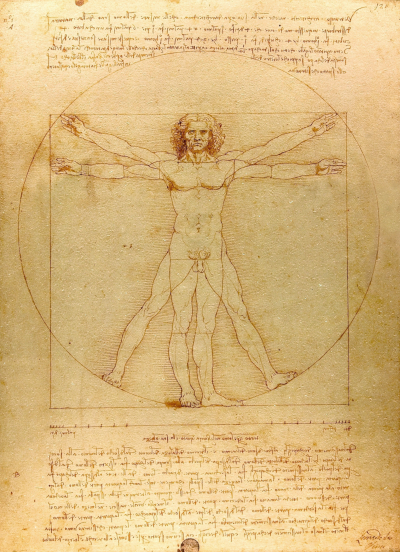
Leonardo returned repeatedly to horses. His notebooks and drawings include studies for equestrian monuments, horse anatomy, rearing horses and mounted figures. The 2018 Budapest exhibition placed the bronze in conversation with drawings by Leonardo and works by Rustici and others [2]. This is exactly the right kind of context, as long as it is not overused.
Related drawings help explain why the bronze has attracted Leonardo scholars. They show that the motif belongs to Leonardo's world of ideas. They also show that Leonardo's rearing horses were not a passing interest. He studied the body of the horse as a living machine of weight, tension, balance and movement.
But a drawing comparison cannot automatically assign a bronze to Leonardo's hand. A sculptor after Leonardo could work from drawings, models or workshop memory. A later sixteenth-century artist could preserve a Leonardesque idea without being Leonardo. The drawings therefore serve as context, not as a shortcut to certainty.
Technical examination and what it proves
The 2009 National Gallery of Art exhibition in Washington, The Budapest Horse, is one of the safest technical/contextual sources for this page [4]. The NGA states that the Budapest Rearing Horse and Mounted Warrior was shown with related small bronzes in an exhibition devoted to exploring the possible attribution of the so-called Budapest Horse to Leonardo [4]. The exhibition included explanatory panels on technical examination conducted at the National Gallery [4].
The Budapest timeline states that technical examinations carried out in Washington proved the statuette to be a sixteenth-century cast [1]. That finding is important. It separates the Budapest bronze from some related variants that have been understood as later productions. It gives the object a historical seriousness that a modern cast would lack.
But a sixteenth-century casting date does not prove Leonardo authorship. It can support the possibility that the bronze belongs to the Renaissance world around Leonardo's ideas. It cannot, by itself, identify the modeller. Technical evidence strengthens the object's historical standing, but the attribution remains debated.
The rider and the horse
One of the most interesting aspects of the bronze is the relationship between the rearing horse and the mounted figure. The horse is energetic, compact and forceful. The mounted warrior complicates the object because questions have been raised about proportion, pairing and interpretation. Kárpáti's essay discusses the history of doubt around whether the horse and rider were conceived together, and the technical evidence surrounding their casting [3].
The rider belongs to the longstanding attribution discussion, but the sources do not settle the question with certainty. Royal or chivalric readings, including interpretations connected with Francis I, remain interpretations rather than secure identifications.
The phrase Mounted Warrior is useful because it describes what viewers see. It is also limited: it does not prove who the rider represents, what monument the group may have served, or whether Leonardo modelled it.
Rustici and the problem of Leonardesque sculpture
Giovanni Francesco Rustici is important because he worked in a sculptural language that can come close to Leonardo's world. The Budapest exhibition included related sculpture by Rustici and described the broader problem of making a free-standing sculpture of a rearing horse and rider [2]. Kárpáti's essay also notes interpretations that connect the Budapest bronze with Rustici or with a sculptor working from Leonardo's ideas [3].
That context is central to the attribution problem. If the bronze feels Leonardesque, it may be because Leonardo made it, because a sculptor close to Leonardo made it, because someone worked after Leonardo's models, or because later viewers have projected Leonardo's drawings onto a related Renaissance object.
Those possibilities are part of the object's interest. The evidence is better understood as a map of a historical problem than as a courtroom verdict.
Attribution limits
The unqualified phrase by Leonardo da Vinci is too strong for the current evidence. A more accurate formulation is Attributed to Leonardo da Vinci; attribution debated.
The bronze should not be described as Leonardo's only surviving sculpture. The Budapest sources themselves make clear that the question is contested, and Kárpáti's essay emphasizes the problem of judging any sculpture as Leonardo's when no unquestionably documented statue by him survives [3].
The National Gallery's technical examination should not be treated as proof of authorship. It supports the object's early casting date and significance, but authorship remains a separate question [1] [4].
This Budapest bronze should also remain distinct from the separate Horse and Rider wax-sculpture page, whose evidence is private, promotional, auction-based and disputed. The Budapest bronze has a different source context and stronger institutional grounding.
Why it remains worth a page
Even with all these caveats, the Budapest bronze deserves careful coverage. It has been discussed for more than a century. It belongs to a major public museum. It has an institutional exhibition and research project around it. It was examined technically and shown internationally. It sits near some of the biggest questions in Leonardo studies: how ideas move between drawing and sculpture, how Renaissance workshop models survive, and how scholars make attributions when documents are missing.
That makes it more than a curiosity. It is a case study in attribution itself.
Leonardo's art often survives as an argument between object, document and idea. The Rearing Horse and Mounted Warrior is almost pure argument: a small bronze whose form pulls us toward Leonardo, whose provenance begins too late for comfort, whose technical evidence supports early casting but not authorship, and whose scholarly history moves between conviction and caution.
The most honest page is therefore not a celebration of a rediscovered sculpture. It is a disciplined explanation of a debated object.
Frequently Asked Questions
Discussion
Where does the Budapest bronze feel most compelling: in its rearing horse, its technical history, its Leonardo drawing context, or its unresolved attribution?
Reader Insights
How should a page balance a long Leonardo attribution with explicit scholarly caution?
What does an early casting date prove, and what does it leave unresolved?
Which links between Leonardo's drawings and the bronze seem most persuasive?
Join the Conversation
Share your reading of Rearing Horse and Mounted Warrior below.
References
- Museum of Fine Arts, Budapest / Szépművészeti Múzeum Leonardo Project, The Statuette, accessed 30 July 2026.
- Museum of Fine Arts, Budapest / Szépművészeti Múzeum Leonardo Project, The Exhibition, accessed 30 July 2026.
- Zoltán Kárpáti, A Brief History of an Attribution, Budapest Leonardo Project, accessed 30 July 2026.
- National Gallery of Art, The Budapest Horse, accessed 30 July 2026.