 by Tom Gurney
Tom Gurney BSc (Hons) is an art history expert with over 20 years experience
Published on June 19, 2020 / Updated on November 22, 2026
Email: tomgurney1@gmail.com / Phone: +44 7429 011000
Banner of Misericòrdia: Introduction
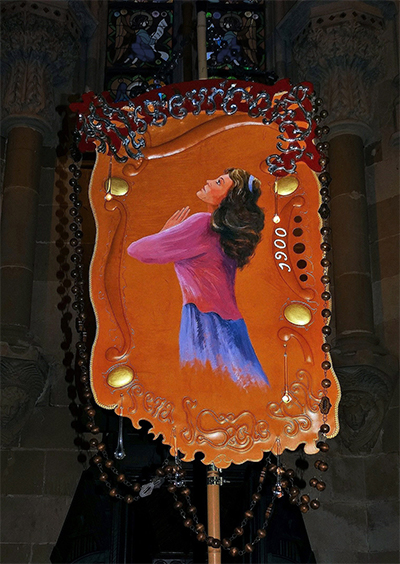
On 29 April 1900, a group of people from Reus who lived in Barcelona carried a banner designed by Antoni Gaudí through their home city to the shrine of Our Lady of Mercy. The banner had a different image on each face. One showed the shepherd girl of the local apparition story in prayer. The other carried the emblems of the two places the pilgrims called home. A photograph published in Reus shows Gaudí among the group accompanying it. At the shrine the pilgrims left the banner as an offering. [1] [2] [3]
At a Glance
- DesignerAntoni Gaudí. [3]
- Date and occasion29 April 1900, Holy Year pilgrimage to the Sanctuary of Misericòrdia, Reus. [1] [4]
- Made forPeople from Reus living in Barcelona. [1] [3]
- MaterialsWorked and painted leather, metal ornament and a bamboo pole, as described in 1900. [3]
- SurvivalThe original disappeared in the 1936 sanctuary fire. Period photographs and descriptions survive, and a reconstruction was made in 2003–07. [2] [3] [5] [6]
This work across Antoni Gaudí’s career
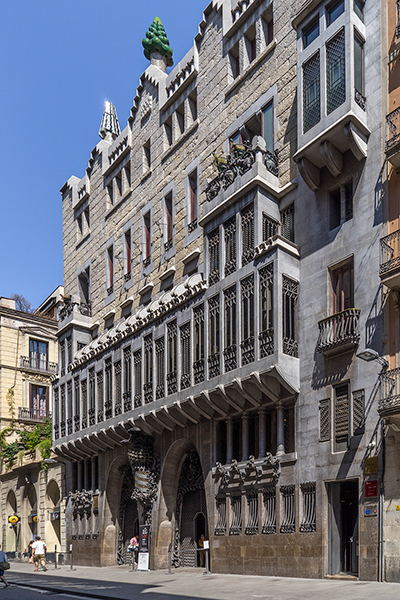
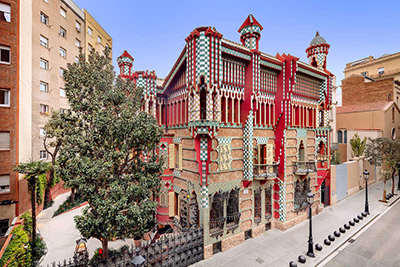
Casa Vicens
1883–1885: Original summer houseSagrada Família
1883–1926: Gaudí’s tenurePalau Güell
1886–1890: Main building campaignPark Güell
1900–1914: Residential estate worksCasa Batlló
1904–1906: RemodellingCasa Milà
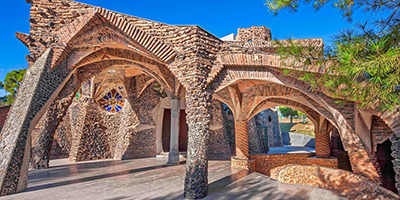
1906–1912: Apartment houseChurch of Colònia Güell
1908–1915: From the start of building work to the opening of the lower churchContents
From Barcelona to the Shrine
Early in April, La Veu de Catalunya reported that Barcelona's Reus-born residents were organising to attend the pilgrimage as a group. Gaudí had drawn up their banner, and the paper already envisaged it hanging in the shrine afterwards. On 27 April, La Vanguardia announced a three-hour public viewing at Barcelona's Episcopal Palace before a blessing at noon. La Veu described Bishop Josep Morgades blessing the finished work in the throne room. Visitors there could study the painting and read the inscriptions. Two days later the banner had to identify its bearers in a procession. [3] [4]
The Reus Municipal Archive's account records special trains from Barcelona for the pilgrimage and reduced fares on the Lleida–Reus–Tarragona line. The procession set out from the Hospital de Sant Joan, passed the Plaça de Prim and went along the streets leading to the Passeig de Misericòrdia. Nearly fifty flags and banners represented the participating associations. Only three were presented to the Virgin afterwards, including Gaudí's. The size of the gathering helps explain the banner's double duty. It had to have a recognisable shape among dozens of other standards in the street, then make sense on its own as a gift left with the shrine. [1] [3]
The Holy Year fell in the final year of the nineteenth century, a connection the banner made explicit in its lettering. The streets were closely watched that Sunday. In its report after the event, La Vanguardia describes Civil Guards posted along the route and cavalry at either end of the procession. Sala and Jové connect the security to fears of a Catalanist demonstration. The banner's local Catalan and civic emblems would have been visible in that setting. Once the bearers returned to Barcelona, their petition for mercy stayed at the shrine, attached to the names of the two cities. [1] [3]
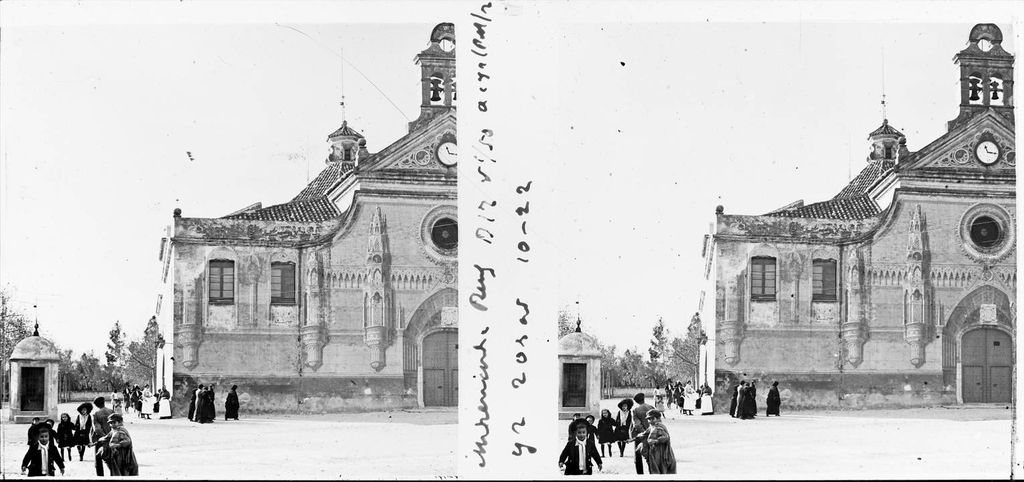
Josep Salvany’s 1911 stereograph shows the pilgrimage church of Misericòrdia, the Reus procession’s destination in 1900. Josep Salvany i Blanch, Biblioteca de Catalunya. Image source. Public domain. Resized for the web.
The Shepherd Girl and the Rosary
In the July photograph of the front, the bowed head and upper body of a girl stand out inside a border that breaks into loops below the panel. The Semanario Católico de Reus of 21 April, describing the piece while it was being made, identifies her as Isabel Besora and says Aleix Clapés had begun painting her on leather in an attitude of supplication. Six days later La Veu de Catalunya credited Clapés with the painted figure on the banner exhibited in Barcelona. The reports give him a specific part in Gaudí's design, and the July reproduction preserves the outline of his contribution with little of the paint's detail. [3] [5]
In the local tradition, the Virgin appeared to a young girl near Reus during a time of plague. The town council's surviving record from late 1592 refers to building a chapel where the Virgin was said to have appeared to a girl. The details that make her the shepherdess Isabel Besora belong to the story's later development. Gaudí's banner uses that familiar version. The shepherdess occupies the broad surface, where her posture can be seen from the street. The Virgin appears above her, on the pole, in a small figure whose open mantle the Reus weekly describes as held by two angels. The separation gives the design its vertical movement, from the girl's appeal up to the source of the mercy she asks for. [1] [3]
Watch films on Gaudí’s architecture
Explore the Sagrada Família, Casa Milà and Casa Batlló, then consider Gaudí’s place in European Art Nouveau.
Gaudí, Sagrada Família
Beth Harris and Steven Zucker look at the façades, branching columns and the Gothic precedents behind the basilica. The film records the building around its 2010 consecration.
Watch on YouTubeThe April weekly describes pierced and embossed leather and a rosary made with aluminium and bronze. It also describes the painted aluminium Virgin as a lost-wax casting, made by replacing a wax model with molten metal. The report places the name of Jesus and a cross above her. The bamboo shaft and the use of aluminium make sense in a piece meant to be carried. From a distance the looped rosary would have helped define its outline. Up close, its beads recalled an object of prayer that the pilgrims would have recognised by touch. [3]
The work drew on several trades. La Veu credits Octavi Domènech, proprietor of the Los Metales foundry, in connection with the metal rosary work on leather. It also names a decorator, Campos, whom Teresa-M. Sala and Xavier Jové were unable to identify in their 2024 study. They raise Claudi Hoyos as a possible explanation for the printed name, while leaving the suggestion unconfirmed. The contemporary account supports Domènech's involvement without assigning every fitting to him. Between the shaping of the leather, the painting and the several kinds of metalwork, there was ample scope for more than one workshop hand. [3]
The Rose of Reus
On the reverse, the July reproduction shows a field filled with ornament and crossed by the upright shaft. The April Reus weekly described Barcelona's arms in gilded and silvered leather, with the rose of Reus applied over them. La Veu called the shield Catalan and also identified the rose. In a later version of the apparition story, the Virgin leaves a rose on the girl's cheek. The emblem can thus bring the shepherdess to mind even when her image is out of sight. The Reus paper described the rose as worked platinum. Sala and Jové suggest it was probably silver. The monochrome reproduction gives little evidence of either the heraldic colours or the identity of the metal. [1] [3]
The city's rose and the names Barcelona and Reus, reported along the sides, made the banner's allegiance unusually specific. The Catalan appeal “per a nantrus”, meaning “for us”, has a local turn of speech. It follows the same invocation of Mercy that the newspapers record on the front, where the appeal is for the nineteenth century. The reports vary in how they render the wording, and La Veu also records the full date, 29 April 1900, on the front. One face marks a moment in the calendar. The other gives the petition the voice of a community that can name itself. [3]
What Survives
The Semanario Católico de Reus published several kinds of view. Alexandre Anguera's street photograph appeared on 26 May. In the closer view published on 9 June, the historian Jaume Massó identifies Gaudí at the left of the group. The paired views on page 477 of the 21 July issue show both faces, with the upper metalwork still hard to resolve. The early April notice establishes that a design had been drawn. The photographs show the work that went into the street. [2] [3]
Reus's municipal accounts link the original's disappearance to the fire at the sanctuary in 1936, during the Spanish Civil War. The Fundació Antonio Gaudí records a reconstruction made between 2003 and 2007 using documentary research and specialist craft work, including leatherwork by Enric Ferrer Solà. The foundation lists the reconstruction at the crypt of the Sagrada Família in Barcelona. It gives an idea of how the leather and metal can work together in three dimensions. Its colours and finishes embody the reconstruction team's decisions, where the old photographs leave room for judgment. [2] [3] [5] [6]
The surviving banner of the Orfeó Feliuà comes from a different commission, for a choir in Sant Feliu de Codines. Sala and Jové matched its workshop plaque to the September 1902 press. A report in El Diario Catalán identifies the choir's town and credits Gaudí with the design and Hoyos, Esteva i Cia. with execution. Its millwheel and musical motifs belong to that commission. Conservation of the choir's original has included cleaning the cork and leather in 2012 and further surface cleaning at the Museu Nacional d’Art de Catalunya in 2021. [3] [7]
Browse the buildings and designs
Explore Gaudí’s buildings, landscapes and designed objects, alongside lost works and projects known through documents. The entries identify collaborative and attributed work where relevant.
| Name | Date | Place, use and survival |
|---|---|---|
| Casa Vicens | 1883–85, original house | Summer house with a later enlargement. |
| Güell Pavilions and Estate | 1880s | Estate entrance and service buildings. The site and gardens changed in later campaigns. |
| Palau Güell | 1886–90, main campaign | Restored urban mansion in the Raval. |
| Teresian College | Late 1880s | College and convent adapted from an earlier project. The existing annex chapel is by Gabriel Borrell i Cardona. |
| Casa Calvet | Late 1890s | Textile premises and dwellings. |
| Torre Bellesguard | Early 1900s | House and site works beside traces of an earlier royal residence. |
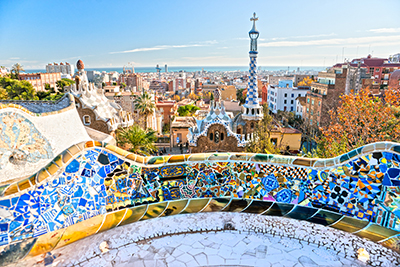
| Park Güell | c. 1900–14, estate works | Partly realised residential estate, later a public park. |
| Gaudí House Museum | Early 1900s; Gaudí lived here 1906–25 | Estate show house designed by Francesc Berenguer, later Gaudí’s residence. |
| Portal Miralles | Early 1900s | Surviving estate gateway and a length of enclosing wall. |
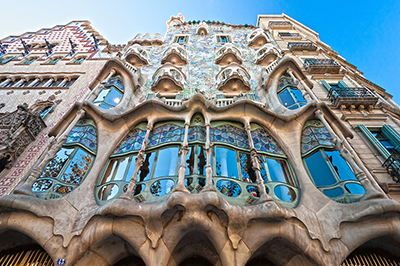
| Casa Batlló | 1904–06, remodelling | Remodel of an existing residential building. |
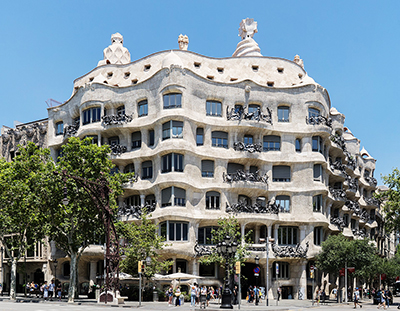
| Casa Milà | 1906–12 | Apartment block, later restored. |
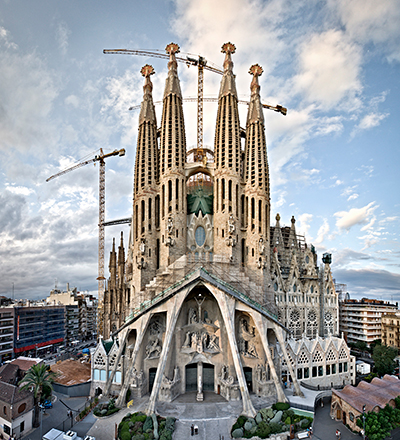
| Sagrada Família | Begun 1882; Gaudí from 1883 | Basilica built in successive campaigns under Gaudí and other architects. |
| Sagrada Família Schools | Early 1900s, original school | School subsequently rebuilt and relocated on the site. |
| Plaça Reial Lampposts | 1878 commission; installed 1879 | Municipal street furniture. |
| Sant Pacià Mosaic Pavement | Late 1870s | Tessellated church pavement. |
| Nau Gaudí and the Mataró Workers’ Cooperative | 1883, bleach hall | Mataró. Restored bleach hall and a separate surviving latrine building within a larger scheme. |
| Bodegas Güell | 1890s | Garraf. Winery and service buildings, with drawings credited by the architects’ archive to Gaudí and Francesc Berenguer. |
| Church of Colònia Güell | Begun 1908; lower church opened 1915 | Santa Coloma de Cervelló. Lower church of a partly realised design. |
| Jardins Artigas | Early 1900s | La Pobla de Lillet. Restored riverside garden. |
| Xalet del Catllaràs | Early 1900s | La Pobla de Lillet. Lodge associated with the mines. Research published by the Consell distinguishes Gaudí’s design from decisions made in execution. |
| First Mystery of Glory at Montserrat | Early 1900s, first campaign | Montserrat. Monument to the Resurrection in a larger devotional ensemble, executed in phases. |
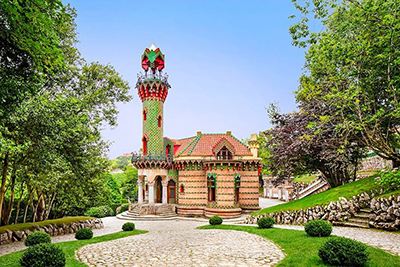
| El Capricho de Gaudí | 1880s | Comillas. Summer villa, subsequently restored. |
| Puerta de los Pájaros | Early 1900s, attributed | Comillas. Casa del Moro boundary gate, locally attributed to Gaudí. |
| Casa Botines | 1891 drawings; building work in 1892 | León. Commercial and residential building, later converted to new uses. |
| Episcopal Palace of Astorga | 1889–93 under Gaudí; finished 1913 | Astorga. Palace begun under Gaudí and finished by Ricardo García-Guereta. |
| Gaudí’s Restoration of Mallorca Cathedral | Early 1900s | Palma. Liturgical intervention in an existing cathedral. |
| Bar Torino | 1902, Passeig de Gràcia interior | Barcelona, Passeig de Gràcia. Lost collaborative bar interior. |
| Compañía Trasatlántica Pavilion | 1888, Barcelona exposition | Barcelona, 1888 Universal Exposition. Lost exhibition building. |
| Banner of Misericòrdia | 1900 | Reus. Lost pilgrimage banner designed by Gaudí with a painting by Aleix Clapés. |
| Franciscan Missions in Tangier | Early 1890s | Tangier. Documented unbuilt mission complex. |
| Hotel Attraction and Its Attribution | Posthumous drawings of the 1950s | New York. Unbuilt hotel associated with Gaudí through posthumous drawings. The commission is uncertain. |
| Capilla de Nuestra Señora de los Ángeles | 1922 correspondence; later proposal | Rancagua. The historic proposal was unbuilt. A later Chilean project drew on Gaudí’s Barcelona chapel design. |
Frequently Asked Questions
Discussion
Look again at the images and ideas explored in Banner of Misericòrdia. These editorial prompts invite your observations.
Reader Insights
How might the banner's two faces have changed what people noticed as it approached and passed them in the street?
What does the use of local speech add to the reverse alongside the rose and the two city names?
Which details would you trust a period photograph to establish, and which would you look for in a contemporary description?
Join the Conversation
Share a detail, comparison or question about Banner of Misericòrdia below.
References
- Salvador Palomar, “La coronació de 1904 i les solemnitats festives a Misericòrdia al segle XX”, in Ezequiel Gort, Salvador Palomar and Josefina Roma, Misericòrdia: la societat reusenca i les festes, Arxiu Municipal de Reus, 2005, pp. 77–79 and 94–95. View source.
- Jaume Massó, “Antoni Gaudí i el santuari de Misericòrdia”, Reusdigital.cat, 16 September 2015, with issue dates for the photographic record in the Semanario Católico de Reus. View source.
- Teresa-M. Sala and Xavier Jové, Història d'un Gaudí ocult: l’estendard de l’Orfeó Feliuà, Edicions de la Universitat de Barcelona, 2024, pp. 27–31 (including La Veu de Catalunya, 3 and 27 April 1900, p. 2, and Semanario Católico de Reus, 21 April and 21 July 1900, July image on p. 477), pp. 55–58 and 131–132. View source.
- La Vanguardia, notice of the viewing and blessing of the Reus pilgrims' banner, 27 April 1900, p. 3. View source.
- Ajuntament de Reus, “Antoni Gaudí i Misericòrdia”, in “R03: Sabies què?”. View source.
- Fundació Antonio Gaudí, “Estandarte de La Misericordia”, reconstruction project record, 2003–07, in Intervencions en obres de Gaudí. View source.
- Ajuntament de Sant Feliu de Codines, “L'estendard feliuà al Museu Nacional d'Art de Catalunya de Barcelona (MNAC)”, record of the loan from the municipal museum. View source.