 by Tom Gurney
Tom Gurney BSc (Hons) is an art history expert with over 20 years experience
Published on June 19, 2020 / Updated on November 22, 2026
Email: tomgurney1@gmail.com / Phone: +44 7429 011000
Gaudí’s Death and Funeral: Introduction
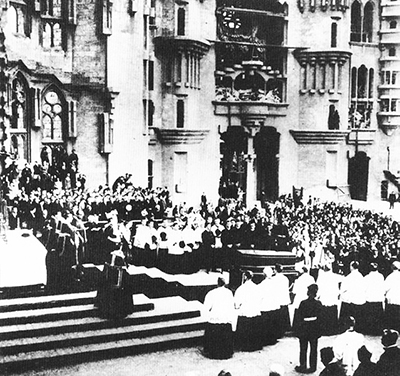
On Monday 7 June 1926, a tram struck Antoni Gaudí as he crossed Barcelona’s Gran Via. He died on Thursday 10 June at the Hospital de la Santa Creu. On Saturday 12 June, his coffin was carried from the hospital through the old city to Barcelona Cathedral, then across the Eixample to the unfinished Sagrada Família. There he was buried in the crypt. A photograph taken by Josep Maria Sagarra near the Liceu shows the clergy passing between close ranks of spectators on La Rambla. [1]
At a Glance
- Accident7 June 1926, on the Gran Via near Carrer de Bailèn, Barcelona. [1] [2]
- Death10 June 1926, at the Hospital de la Santa Creu. [1]
- Funeral12 June 1926, from the hospital via Barcelona Cathedral to the Sagrada Família. [1]
- BurialChapel of Our Lady of Mount Carmel, in the crypt of the Sagrada Família. [1]
Contents
- The walk from the Sagrada Família
- Recognition and the hospital
- Mourning before the funeral
- From La Rambla to the crypt
- The centenary in Barcelona
The walk from the Sagrada Família
Gaudí set out towards the oratory of Sant Felip Neri, a small church in the old city that he visited regularly. La Publicitat reported that he was following this familiar route when he was struck near the junction of Carrer de Bailèn and the Gran Via de les Corts Catalanes. Sant Felip Neri was a place of prayer and confession for Gaudí. The reports establish his destination and leave his plans for that evening open. [1] [2]
On 9 June, while Gaudí was alive, La Publicitat described two stages in his transfer. He was first taken to the Casa de Socors, an emergency aid station on the Ronda de Sant Pere. The paper reported that the staff there treated him and that the gravity of his injuries prompted his transfer to the Hospital de la Santa Creu, where he was admitted to the trauma ward. The hospital’s admissions index, catalogued by the Biblioteca de Catalunya, places his admission on 7 June and records it as entry 1788. The hospital was the old Santa Creu in the city centre. [2] [3]
The reports give different people credit for what happened in the street. La Vanguardia on 11 June blamed passing drivers for failing to help and described the hospital transfer as the work of the public relief service. On 12 June the same paper reported that the temple board and Gaudí’s executors intended to thank a Civil Guard who, they said, compelled a driver to take the injured man to the aid station and stayed until ambulance staff took over. An account in the Saturday evening La Veu de Catalunya described stretcher bearers taking him to Santa Creu despite instructions to go to the Hospital Clínic. Its author took the diversion as a sign of providence. The papers establish the hospital destination, while leaving the exact handover and the motives of the drivers open. [4] [5] [6]
Recognition and the hospital
The familiar story of a celebrated architect taken for a beggar grew from a real uncertainty about his name. La Publicitat reported that the aid station’s notice gave another name. It also spoke to the custodian priest at the Sagrada Família, who recalled the alarm when Gaudí failed to return at his usual time. The paper places the search on Monday evening and describes Gaudí as identified by the time he was moved to another hospital room on Tuesday morning. La Vanguardia credited friends at the temple with making enquiries until they found him. The Saturday evening account in La Veu credited the doctors with recognising him once he was at Santa Creu. These reports allow for several stages between the search, personal recognition and an entry under his own name. They leave the exact hour and the first recogniser uncertain. [2] [3] [4] [6]
The hospital became a meeting point for family, fellow architects and the people who ran the building project. La Publicitat reported that members of the temple board discussed moving Gaudí to a private clinic and that physicians thought the transfer too risky. The story that Gaudí chose to stay at the hospital of the poor had roots in the early tributes. In the Saturday evening paper an essay recalled that he had spoken of wanting to die at Santa Creu, while Josep F. Ràfols saw the hospital as a fitting place for a man who embraced poverty. In the report written while Gaudí was alive, the objection to moving him came from the doctors. It places his assistants Domènec Sugranyes and Francesc de Paula Quintana with him as he received the sacraments. La Vanguardia named his nephew Francesc Bonet, the architect Bonaventura Conill and the temple chaplain, Gil Parés, among those with him during his final illness. [2] [4] [6]
Gaudí died on the afternoon of 10 June. The Biblioteca de Catalunya catalogue identifies that date in the hospital’s death register. A separate handwritten death entry reproduced by the Sagrada Família gives the date and place, attributes the death to traumatic injuries and records that he received the sacraments and was buried at the temple. It also records him as seventy-four, although the birth date of 25 June 1852 given by the Consell Gaudí means that he was still seventy-three. [7] [8] [9]
The death report in La Vanguardia gives two different times on the same page, 5:10 and 5:30 in the afternoon. The next day the newspaper printed the findings of the forensic doctors Bravo Moreno and Trias. Their report described bleeding that put pressure on the brain and spinal cord, and blood around the heart that impeded its movement, in the context of severe injuries to vital organs. This published opinion is firmer evidence of the fatal trauma than the changing bedside reports. The latter give some sense of how people waited and hoped over those three days, even as physicians recognised how gravely he had been injured. [4] [5]
Watch films on Gaudí’s architecture
Explore the Sagrada Família, Casa Milà and Casa Batlló, then consider Gaudí’s place in European Art Nouveau.
Gaudí, Sagrada Família
Beth Harris and Steven Zucker look at the façades, branching columns and the Gothic precedents behind the basilica. The film records the building around its 2010 consecration.
Watch on YouTubeMourning before the funeral
In its evening edition of 11 June, the Catalan-language La Veu de Catalunya gathered its tributes under La mort d’Antoni Gaudí. The priest Carles Cardó understood the architect’s arrival among anonymous patients as the end of a life of chosen poverty. He drew two obligations from the death: finish the church and practise the virtues he admired in its architect. On the same page the temple board used the newspaper to invite individuals and associations to the burial and acknowledged the many offers of help and messages of condolence. The page carried both a religious interpretation of the death and practical arrangements for the people who were already coming to pay their respects. [10]
La Vanguardia also described Gaudí’s faith and austerity, but made room for a survey of buildings such as Casa Calvet, Casa Batlló and Casa Milà and recalled his instruction of workers in the temple workshops. After the funeral, Manuel Vega y March wrote in the same paper about the architect’s experiments with structural equilibrium and light and shadow. Where Cardó drew a lesson from the circumstances in which Gaudí died, Vega y March asked his readers to consider the study that lay behind forms some had taken for caprice. Both approaches made the building still rising in Barcelona central to how the architect would be remembered. [4] [10] [11]
The hospital set aside its doctors’ room for the public vigil. La Vanguardia reported that the condolence sheets filled with signatures and described patrons, clergy and workers taking part in the mourning. The Saturday morning La Veu recorded that delegations from streets along the proposed route told the temple board their shops would close and asked neighbouring businesses to join them. The organisers chose a plain oak coffin and planned a liturgical ceremony. Barcelona’s mayor attended in his civic capacity. The civil governor reported a royal order permitting burial in the crypt, while La Veu reported that the diocese had received authorisation from Rome. [5] [10] [12]
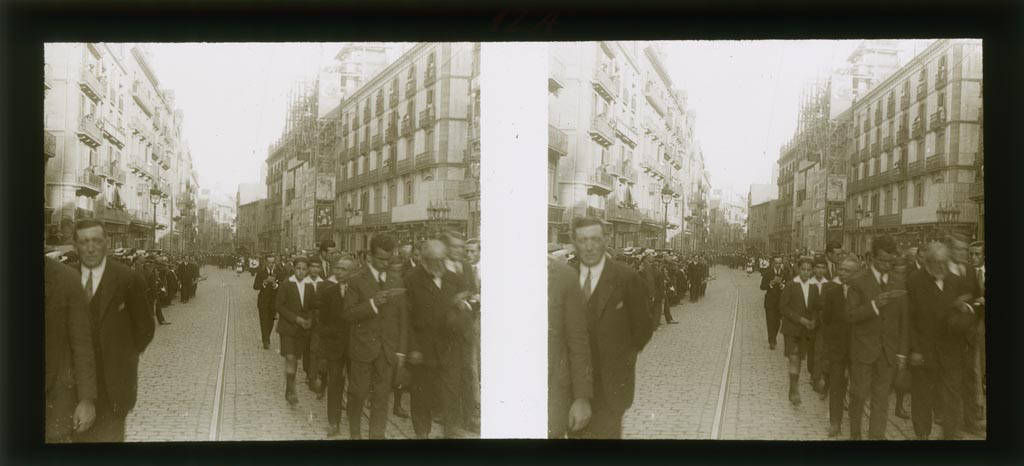
Crowds watched the funeral procession pass through Barcelona in June 1926. The stereograph records the public scale of the burial. Josep Domènech i Sàbat. Image source. Public domain. Resized for the web.
From La Rambla to the crypt
On 12 June the procession left the hospital by Carrer del Carme. A pair of horses drew the hearse along La Rambla, then through Carrer de Ferran and Plaça de Sant Jaume towards the cathedral. Architecture students took the coffin from the hearse and carried it inside. The Sunday papers give different names for the door by which it entered, but agree that the cathedral clergy received it and held a service there. The officials withdrew at the cathedral’s main entrance as clergy from the Sagrada Família took charge for the rest of the journey. Sagarra’s photograph near the Liceu shows how closely the spectators stood around the open lane kept for the procession. [1] [11] [13]
The crowd grew again as the procession passed through central Barcelona towards Carrer de Casp. Both Sunday papers noticed the black bow on Casa Calvet, which Gaudí had designed. La Vanguardia reported that a worker stepped up to the hearse at Carrer de Claris and laid down a bunch of broom. La Veu described closed businesses and black cloths hanging from the balconies of modest homes near the temple. Such observations give substance to the newspapers’ emphasis on the breadth of the mourning. People could join the cortege, watch it from home or mark its passage with a gesture of their own. A single attendance figure would obscure those different kinds of participation. [11] [13]
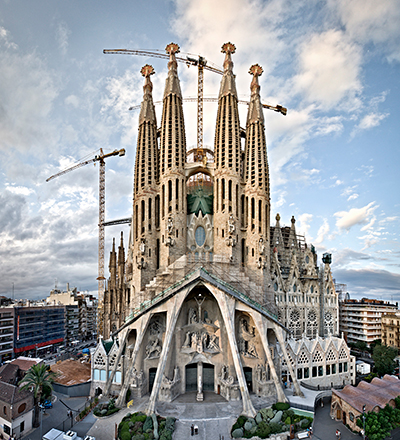
The last stretch ended at a building site. In Sagarra’s photograph of the arrival, the hearse approaches a gap in the works enclosure, with the unfinished church rising beyond the crowd. La Vanguardia reported that workers from the temple lifted the coffin from the hearse onto the catafalque. After the clergy’s prayers, the Orfeó Català sang a responsory by Tomás Luis de Victoria. The coffin was then carried down to the crypt, where Gaudí was buried in the chapel of Our Lady of Mount Carmel. The accounts differ on when mourners passed the grave and when it was closed. Both describe the limits of a small underground space after a procession that had filled streets and squares. [1] [11] [13]
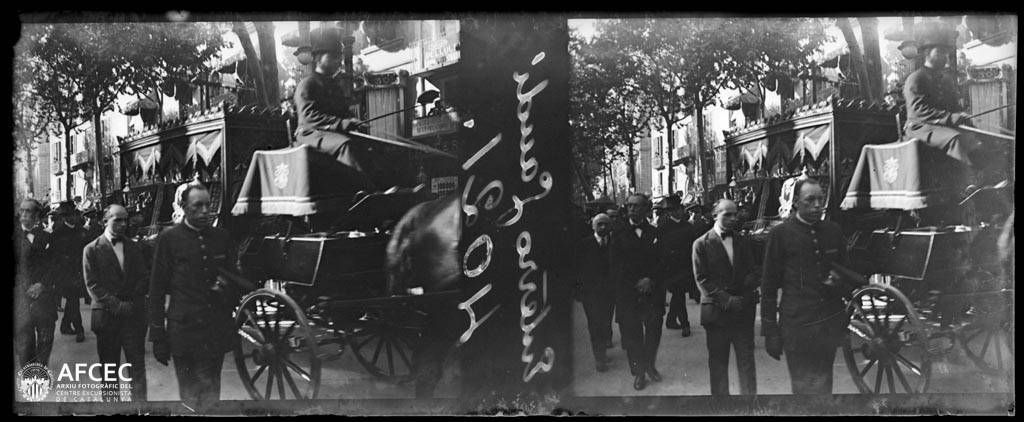
Carles Fargas’s stereograph shows the funeral carriage at Gaudí’s burial procession on 12 June 1926. Carles Fargas i Bonell, Arxiu Fotogràfic del Centre Excursionista de Catalunya. Image source. Public domain. Resized for the web.
The centenary in Barcelona
In 2026 Barcelona marked the accident and the death on their separate anniversaries. On 7 June a plaque was unveiled opposite number 665 on the Gran Via near Bailèn, at the site of the accident. On 10 June the Sagrada Família held a morning floral tribute at his tomb. Later that day Pope Leo XIV prayed in the crypt, presided at the centenary Mass and blessed the tower of Jesus Christ. The celebrations returned to the two places that frame the events of 1926: the crossing in the Eixample and the chapel beneath the building site. The tower ceremony belonged to the centenary of Gaudí’s death, two days before the anniversary of his funeral. [14] [15] [16] [17]
Browse the buildings and designs
Explore Gaudí’s buildings, landscapes and designed objects, alongside lost works and projects known through documents. The entries identify collaborative and attributed work where relevant.
| Name | Date | Place, use and survival |
|---|---|---|
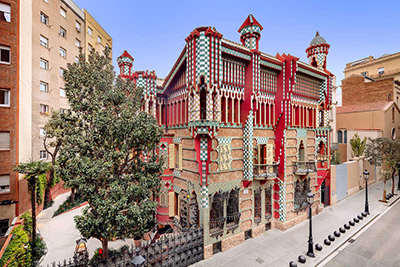
| Casa Vicens | 1883–85, original house | Summer house with a later enlargement. |
| Güell Pavilions and Estate | 1880s | Estate entrance and service buildings. The site and gardens changed in later campaigns. |
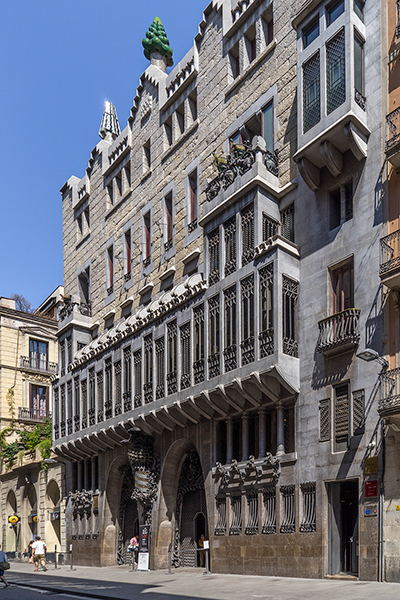
| Palau Güell | 1886–90, main campaign | Restored urban mansion in the Raval. |
| Teresian College | Late 1880s | College and convent adapted from an earlier project. The existing annex chapel is by Gabriel Borrell i Cardona. |
| Casa Calvet | Late 1890s | Textile premises and dwellings. |
| Torre Bellesguard | Early 1900s | House and site works beside traces of an earlier royal residence. |
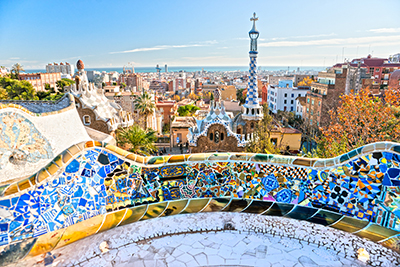
| Park Güell | c. 1900–14, estate works | Partly realised residential estate, later a public park. |
| Gaudí House Museum | Early 1900s; Gaudí lived here 1906–25 | Estate show house designed by Francesc Berenguer, later Gaudí’s residence. |
| Portal Miralles | Early 1900s | Surviving estate gateway and a length of enclosing wall. |
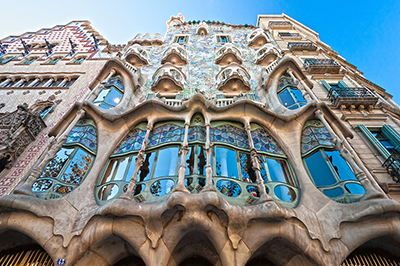
| Casa Batlló | 1904–06, remodelling | Remodel of an existing residential building. |
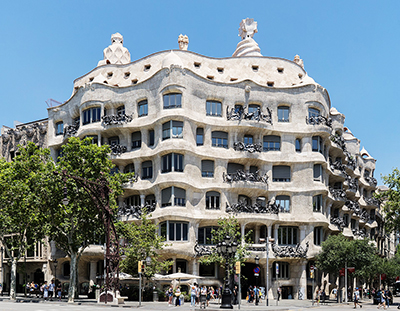
| Casa Milà | 1906–12 | Apartment block, later restored. |
| Sagrada Família | Begun 1882; Gaudí from 1883 | Basilica built in successive campaigns under Gaudí and other architects. |
| Sagrada Família Schools | Early 1900s, original school | School subsequently rebuilt and relocated on the site. |
| Plaça Reial Lampposts | 1878 commission; installed 1879 | Municipal street furniture. |
| Sant Pacià Mosaic Pavement | Late 1870s | Tessellated church pavement. |
| Nau Gaudí and the Mataró Workers’ Cooperative | 1883, bleach hall | Mataró. Restored bleach hall and a separate surviving latrine building within a larger scheme. |
| Bodegas Güell | 1890s | Garraf. Winery and service buildings, with drawings credited by the architects’ archive to Gaudí and Francesc Berenguer. |
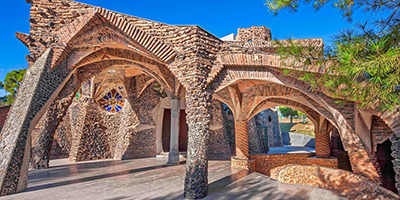
| Church of Colònia Güell | Begun 1908; lower church opened 1915 | Santa Coloma de Cervelló. Lower church of a partly realised design. |
| Jardins Artigas | Early 1900s | La Pobla de Lillet. Restored riverside garden. |
| Xalet del Catllaràs | Early 1900s | La Pobla de Lillet. Lodge associated with the mines. Research published by the Consell distinguishes Gaudí’s design from decisions made in execution. |
| First Mystery of Glory at Montserrat | Early 1900s, first campaign | Montserrat. Monument to the Resurrection in a larger devotional ensemble, executed in phases. |
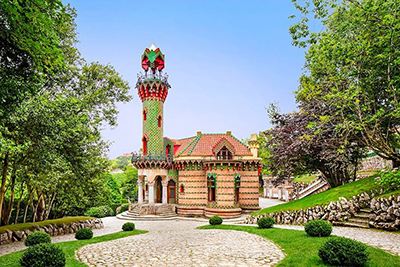
| El Capricho de Gaudí | 1880s | Comillas. Summer villa, subsequently restored. |
| Puerta de los Pájaros | Early 1900s, attributed | Comillas. Casa del Moro boundary gate, locally attributed to Gaudí. |
| Casa Botines | 1891 drawings; building work in 1892 | León. Commercial and residential building, later converted to new uses. |
| Episcopal Palace of Astorga | 1889–93 under Gaudí; finished 1913 | Astorga. Palace begun under Gaudí and finished by Ricardo García-Guereta. |
| Gaudí’s Restoration of Mallorca Cathedral | Early 1900s | Palma. Liturgical intervention in an existing cathedral. |
| Bar Torino | 1902, Passeig de Gràcia interior | Barcelona, Passeig de Gràcia. Lost collaborative bar interior. |
| Compañía Trasatlántica Pavilion | 1888, Barcelona exposition | Barcelona, 1888 Universal Exposition. Lost exhibition building. |
| Banner of Misericòrdia | 1900 | Reus. Lost pilgrimage banner designed by Gaudí with a painting by Aleix Clapés. |
| Franciscan Missions in Tangier | Early 1890s | Tangier. Documented unbuilt mission complex. |
| Hotel Attraction and Its Attribution | Posthumous drawings of the 1950s | New York. Unbuilt hotel associated with Gaudí through posthumous drawings. The commission is uncertain. |
| Capilla de Nuestra Señora de los Ángeles | 1922 correspondence; later proposal | Rancagua. The historic proposal was unbuilt. A later Chilean project drew on Gaudí’s Barcelona chapel design. |
Frequently Asked Questions
La Publicitat reported that people at the Sagrada Família searched for him and that he had been identified by the time of his Tuesday morning transfer to another room. La Veu de Catalunya credited doctors with recognising him. The reports leave the first person and precise time uncertain. [2] [4] [6]
Discussion
Look again at the images and ideas explored in Gaudí’s Death and Funeral. These editorial prompts invite your observations.
Reader Insights
What does the black bow at Casa Calvet reveal about the role Gaudí’s buildings played in the funeral?
How do the hospital records and Sagarra’s photographs help answer different questions about the events of June 1926?
What does Carles Cardó ask readers to carry forward from Gaudí’s life, and what qualities does Manuel Vega y March ask them to recognise in his work?
Join the Conversation
Share a detail, comparison or question about Gaudí’s Death and Funeral below.
References
- Sagrada Família, Antoni Gaudí. Humanism and spirituality, “Death” and the gallery of archival photographs and documents. View source.
- La Publicitat, L’arquitecte Antoni Gaudí, ferit greument, 9 June 1926, p. 1. ARCA digitised issue, Biblioteca de Catalunya. View source.
- Biblioteca de Catalunya, Llibre d’entrades de malalts de l’Hospital, record 27589, catalogue description of the 7 June 1926 admission. View source.
- La Vanguardia, Gaudí ha muerto, 11 June 1926, p. 7. View source.
- La Vanguardia, La muerte de Gaudí, 12 June 1926, p. 9. View source.
- La Veu de Catalunya, En Gaudí a Santa Creu and Josep F. Ràfols, La humilitat d’En Gaudí, 12 June 1926, evening edition, p. 5. ARCA digitised issue, Biblioteca de Catalunya. View source.
- Biblioteca de Catalunya, Llibre de defuncions de malalts de l’Hospital, record 27590, catalogue description of the 10 June 1926 death entry. View source.
- Arxiu Històric de l’Hospital de la Santa Creu i Sant Pau, handwritten death entry for Antoni Gaudí, 10 June 1926, folio marked 30, entry 454, facsimile reproduced by the Sagrada Família. View source.
- Consell Gaudí, Antoni Gaudí, biographical chronology. View source.
- La Veu de Catalunya, La mort d’Antoni Gaudí, including Carles Cardó’s La mort apassionada and the temple board’s announcement, no. 9370, 11 June 1926, evening edition, p. 5. ARCA digitised issue, Biblioteca de Catalunya. View source.
- La Vanguardia, El entierro de Gaudí, including Manuel Vega y March’s Antonio Gaudí, 13 June 1926, p. 13. View source.
- La Veu de Catalunya, La mort d’Antoni Gaudí, 12 June 1926, morning edition, pp. 5–6. ARCA digitised issue, Biblioteca de Catalunya. View source.
- La Veu de Catalunya, La mort d’Antoni Gaudí and L’enterrament grandiós, 13 June 1926, morning edition, pp. 5–6. ARCA digitised issue, Biblioteca de Catalunya. View source.
- Generalitat de Catalunya, Descoberta de la placa commemorativa en honor a Antoni Gaudí, event listing for 7 June 2026. View source.
- Zen Kannon Barcelona, Centenario Gaudí, a participant’s account of the plaque unveiling on 7 June 2026. View source.
- Junta Constructora del Temple Expiatori de la Sagrada Família, The Sagrada Familia commemorates the centenary of Antoni Gaudí’s death with a floral tribute at his tomb, 10 June 2026. View source.
- Junta Constructora del Temple Expiatori de la Sagrada Família, Pope Leo XIV presides over solemn mass commemorating hundredth anniversary of Antoni Gaudí’s death and blesses tower of Jesus Christ, 10 June 2026. View source.