 by Tom Gurney
Tom Gurney BSc (Hons) is an art history expert with over 20 years experience
Published on June 19, 2020 / Updated on November 22, 2026
Email: tomgurney1@gmail.com / Phone: +44 7429 011000
Antoni Gaudí Quotes: Introduction
“Ornament has been, is and will be coloured,” Antoni Gaudí wrote in a notebook now in the Museu de Reus. He went on to explain why he expected buildings to change colour as they aged. Gaudí is often quoted in a single sentence, but in this case we can follow the argument in his own writing. The architect’s remarks about the Sagrada Família come down to us by a different route. Some were passed on by people who worked with him and others survive in the versions told by the institution that carries on the work. English translations of the Spanish and Catalan excerpts below are ours. [1] [2]
At a Glance
- Autograph evidenceNotes on ornament in the Museu de Reus notebook, inventory MR 2121 [1][2]
- Published writingAn article on a decorative-arts exhibition in La Renaixensa [3][4]
- Witness evidenceRecollections published by people who knew Gaudí, including Joan Bergós [5]
- LanguagesCatalan and Spanish source texts; English translations accompany the quotations
Contents
- What Gaudí wrote about colour
- What Gaudí wrote about good workmanship
- “My teacher” and the palms at Casa Vicens
- “My client is in no hurry”
- A reply recorded in Chile
- Originality, the book of nature and straight lines
What Gaudí wrote about colour
The notebook at Reus contains a young architect’s notes, sketches and reflections on ornament. In the section transcribed by researchers from the Diputació de Barcelona, Gaudí moves from vegetation to geology and animal life. He argues that nature presents contrasts of colour and that an architect should therefore consider colouring a building element, wholly or in part. He then imagines the colouring wearing away so that time can give the material a character of its own. In a few lines he is thinking about both the first day of a building’s life and the surface someone might encounter many years later. He cites Greek temples as buildings where even fine marble could have been painted. [1] [2]
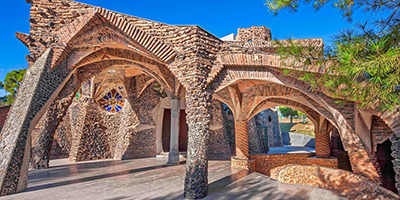
Gaudí describes how ornament can make a heavy form seem lighter or draw attention to its mass. You can see the distinction at the church of Colònia Güell. Compare the dark, rough supports of the porch with the small areas of glazed decoration near the openings. A glint of glaze draws the eye to an edge or an opening, while the uneven surface of a support makes its bulk and texture conspicuous. The notebook gives us a way to describe these effects in a building made long after Gaudí wrote the passage. [2]
The restoration team also compared fragments in the wall with records of materials sent to the site. A 1913 invoice documents the transport of pieces of tile from Park Güell and Esplugues to the colony. The researchers found related ceramic material in the two projects, arranged to different effect. Gaudí also selected and commissioned materials for the church. The variation he admired in nature could come from deliberate choices about which materials to buy, which to reuse and where to put them. [2]
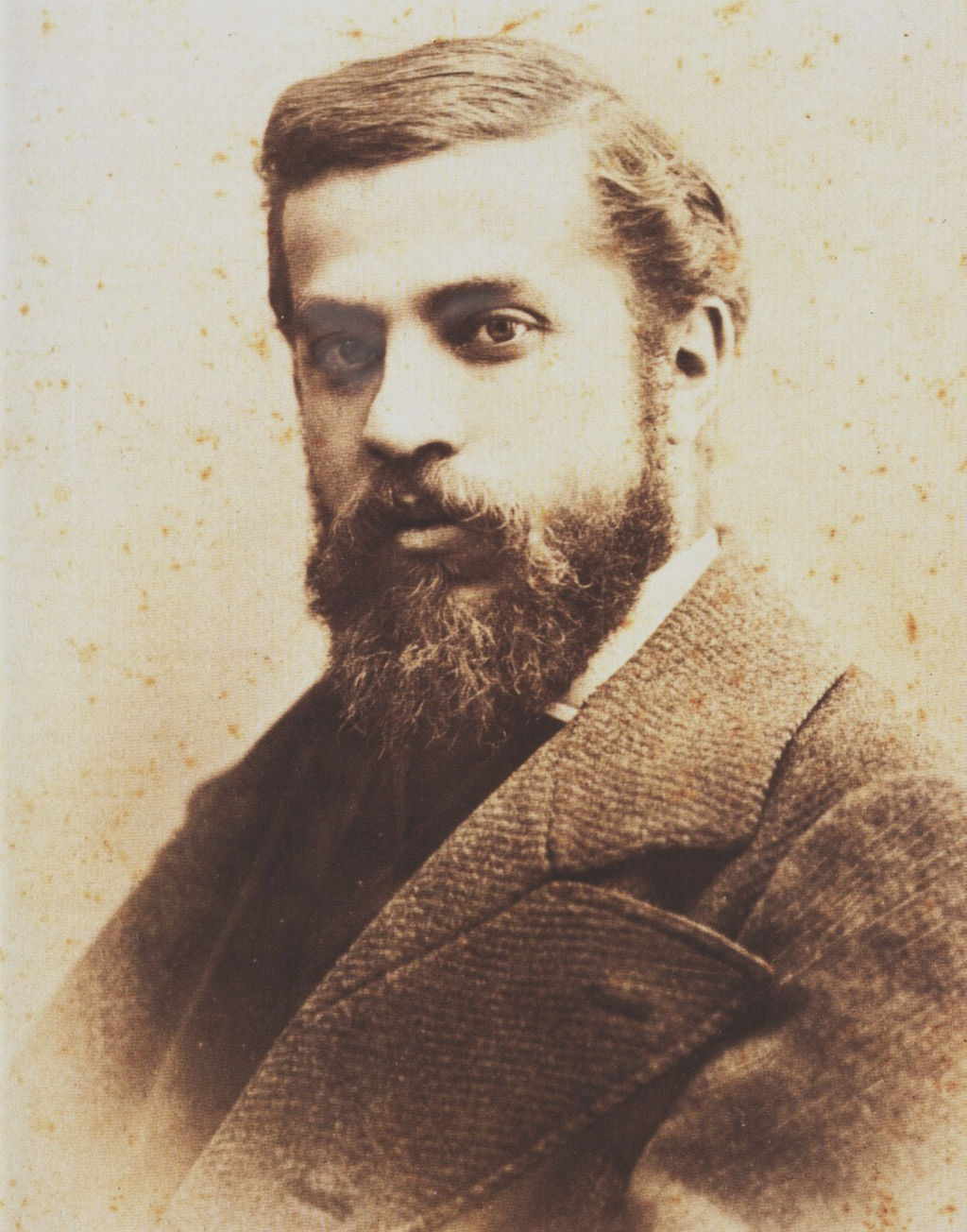
Pau Audouard photographed Gaudí in 1878, the year he qualified as an architect. Pau Audouard Deglaire. Image source. Public domain. Resized for the web.
What Gaudí wrote about good workmanship
In February 1881 Gaudí published a two-part review of a decorative arts exhibition at Barcelona’s Institut del Foment del Treball Nacional. He judged objects by how well their shape suited their intended use and the materials available to the maker. He found some of the exhibits skilfully made but weak in design, with little to reward the eye in their subject, ornament or colour. The historians Teresa-M. Sala and Xavier Jové point out that he applied the same reasoning to objects made by hand and those made by industrial processes. Both called for an idea that the maker could bring out in the execution. [6] [3]
This is a useful piece of Gaudí’s writing to read alongside the well-known saying about originality and returning to the origin. In the exhibition review, the argument can be tested against a thing made for someone to use. The question is how its form follows from what it has to do and how it can be made. The passage also helps explain how an architect who took inspiration from older work and familiar natural forms could produce objects that looked strikingly new. Gaudí’s report appears in Laura Mercader’s critical edition of his written legacy, alongside other kinds of material that allow us to follow his reasoning at greater length. [6] [3] [4]
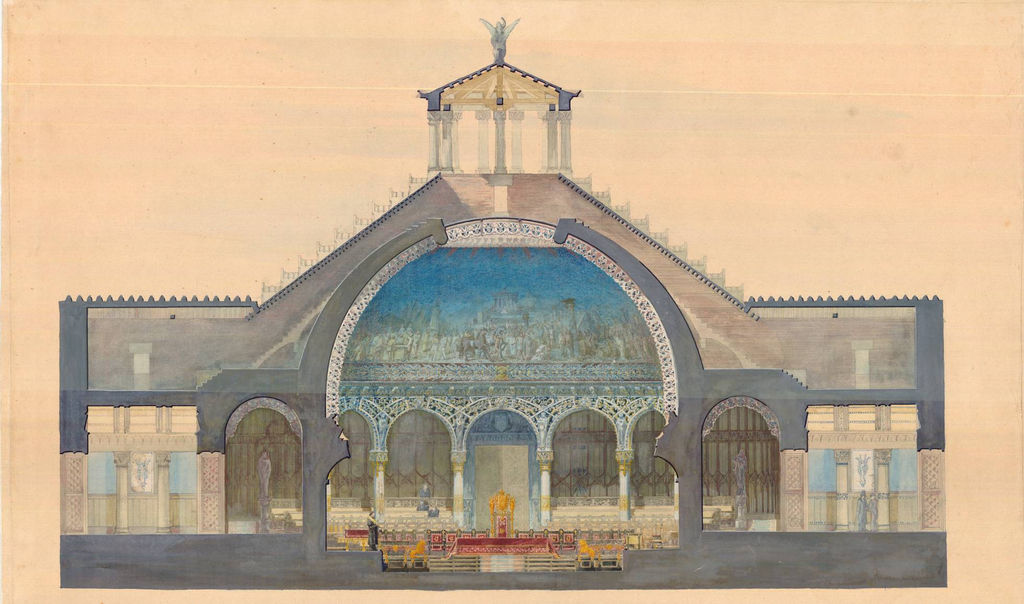
A richly coloured section from Gaudí’s 1877 university assembly hall project. Antoni Gaudí. Image source. Public domain. Resized for the web.
“My teacher” and the palms at Casa Vicens
Joan Bergós, an architect who assisted Gaudí on the Sagrada Família, remembered him speaking of nature as “my teacher”. Bergós set that phrase in a description of the family’s country property at Riudoms, with olive trees and vineyards around it and the Prades mountains in the distance. The passage on page 14 of his Gaudí. L’home i l’obra is Bergós’s account of Gaudí looking back. Its landscape and sounds belong to the biographer’s description. Bergós gives just those two words to Gaudí. [5]
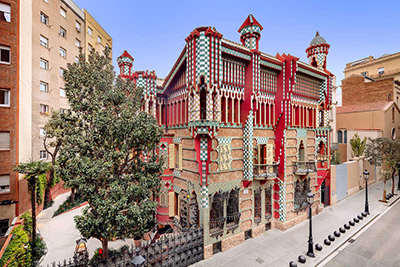
There is a more specific recollection in the same book about Casa Vicens. In the version published by the house museum, Gaudí says he found “small yellow flowers” on the site when he went to take measurements and used them for the ceramics. He also recalls a palm whose leaves suggested the shapes on the entrance grille. The two motifs make a good comparison. The flower on the wall repeats within the square of a glazed tile. On the grille, separate fronds spread like fans across the iron compartments. Each pattern depends on the material and the surface that carries it. [7]
Watch films on Gaudí’s architecture
Explore the Sagrada Família, Casa Milà and Casa Batlló, then consider Gaudí’s place in European Art Nouveau.
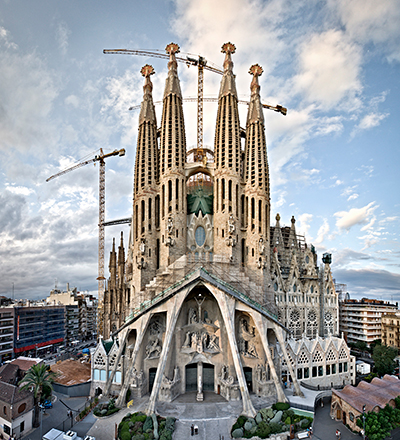
Gaudí, Sagrada Família
Beth Harris and Steven Zucker look at the façades, branching columns and the Gothic precedents behind the basilica. The film records the building around its 2010 consecration.
Watch on YouTubeThe museum reproduces the elevation from the 1883 building application, in which Gaudí drew the leaves within the grille. The drawing also belongs to a history of shared work. The museum credits sculptor Lorenzo Matamala with executing the commission and Juan Oñós with the foundry work. Bergós’s recollection traces the idea back to the site as Gaudí remembered it. The drawing fixes the design on a dated sheet, and the names of the makers explain how the leaf travelled from that sheet into iron. [7]
“My client is in no hurry”
The Sagrada Família’s Curiositats booklet tells how, when asked how long the building would take, Gaudí replied, “My client is in no hurry.” The Catalan wording, El meu client no té pressa, already appeared in Catalunya Cristiana in 1998. The newspaper reported the story through the temple’s rector, Lluís Bonet, in an article about the opening of Gaudí’s beatification cause. In 2017 the architect Jordi Faulí referred to an account by a collaborator in an interview with Ara, without identifying the book or page there. He read the line as a reminder to think through the designs and to build them well. These are three records of the story being told, each at a considerable distance from Gaudí’s lifetime. [8] [9] [10]
In the story, the word client gives a question about a finish date an answer about faith. The temple’s exhibition on Gaudí’s humanism and spirituality makes the dependence on people explicit in another passage it attributes to Gaudí. It describes the Sagrada Família as a work “in the hands of God and the will of the people”. The building’s early history gives the second half of that sentence weight. Donations enabled the Association of the Devotees of Saint Joseph to buy the site, and after the founder and his son-in-law died a construction board was established to manage the funds and carry on the work. [11] [12]
The exhibition separately attributes to Gaudí the view that the personal tastes of the architects who succeeded him might benefit the temple. He lived to see the completion of the Saint Barnabas bell tower in 1925. After his death and the destruction of workshop material in 1936, later architects worked from what they could recover and compare with photographs and published plans. Some choices they faced concerned how to recover a detail from damaged evidence. Others concerned what to do where that evidence ended. The exhibition’s recollection belongs alongside that construction history as an expression of Gaudí’s reported attitude towards succession. [11] [13]
A reply recorded in Chile
Written exchanges can still pose problems of attribution. In 1922 the Franciscan Angélico Aranda approached Gaudí about designing a chapel for Rancagua. The Diocese of Rancagua reports that Gaudí referred Aranda to a chapel he had designed for the Sagrada Família. The Chilean Chamber of Construction’s magazine likewise links the reply to the chapel of the Assumption in Barcelona, but dates the response differently and says it came through Gaudí’s secretary. The two accounts give the exchange a common outline, while leaving the date and the exact words of the response uncertain. [14] [15]
Originality, the book of nature and straight lines
The architect Isidre Puig Boada gathered writings and reported remarks in El pensament de Gaudí. The maxim about originality is associated with this tradition. Carlos Salas gives the short Spanish wording about returning to the origin in a study that cites Cèsar Martinell’s 1967 book. The exhibition catalogue Gaudí: Barcelona, 1900 prints a version that adds the idea of approaching the origin, and points to a 1982 collection of manuscripts, articles and conversations. These are two routes by which the saying reached print in its present forms. [16] [17] [18]
The book of nature has a similar history. Torre Bellesguard’s account quotes the image of a book that is always open and takes effort to read. In the longer Catalan passage that Raimon Ramis cites from Puig Boada’s collection, human books come from this first book and can introduce their own errors. The following sentence goes on to distinguish the lessons of nature from those given by religious teaching. The metaphor does more here than commend close observation. Bergós’s recollection about nature as Gaudí’s teacher comes from a different passage, in which the setting is the family’s country property. [5] [18] [19]
The saying that divides straight lines and curves between human and divine authorship also circulates under Gaudí’s name. Its familiar wording has an uncertain source. The exhibition catalogue cites a passage in Puig Boada where Gaudí explains the curved vaults through the straight lines that generate their shape. Architectural historian Santiago Huerta shows the same principle at work in the saddle-shaped vaults under the porch of Colònia Güell. Follow one of their surfaces across the bricks and you can see why a saying about curves tells only part of the story. [18] [20]
When two versions differ, the interesting question is often what the speaker is meant to be doing. One version of the originality saying defines a word. Another asks the architect to go back to the conditions from which a design begins. At Casa Vicens, that might mean looking again at the leaves of a palm, then asking what an iron grille can do with them. Gaudí’s 1881 review gives us a contemporary account of that second step. The surviving leaf design shows us what the answer looked like. [6] [7]
Browse the buildings and designs
Explore Gaudí’s buildings, landscapes and designed objects, alongside lost works and projects known through documents. The entries identify collaborative and attributed work where relevant.
| Name | Date | Place, use and survival |
|---|---|---|
| Casa Vicens | 1883–85, original house | Summer house with a later enlargement. |
| Güell Pavilions and Estate | 1880s | Estate entrance and service buildings. The site and gardens changed in later campaigns. |
| Palau Güell | 1886–90, main campaign | Restored urban mansion in the Raval. |
| Teresian College | Late 1880s | College and convent adapted from an earlier project. The existing annex chapel is by Gabriel Borrell i Cardona. |
| Casa Calvet | Late 1890s | Textile premises and dwellings. |
| Torre Bellesguard | Early 1900s | House and site works beside traces of an earlier royal residence. |
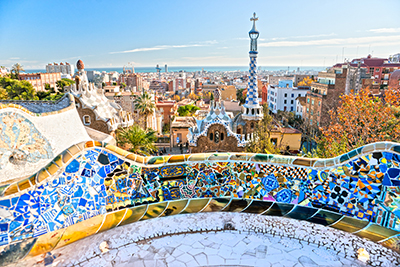
| Park Güell | c. 1900–14, estate works | Partly realised residential estate, later a public park. |
| Gaudí House Museum | Early 1900s; Gaudí lived here 1906–25 | Estate show house designed by Francesc Berenguer, later Gaudí’s residence. |
| Portal Miralles | Early 1900s | Surviving estate gateway and a length of enclosing wall. |
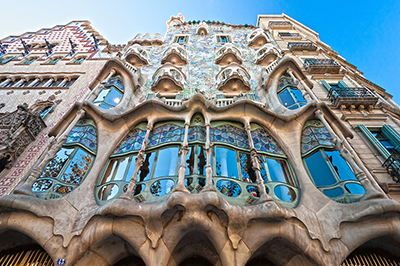
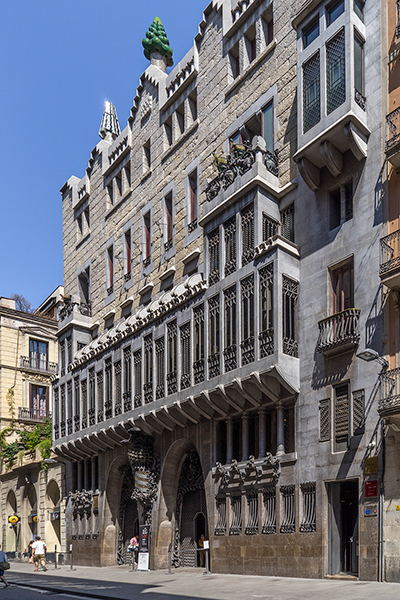
| Casa Batlló | 1904–06, remodelling | Remodel of an existing residential building. |
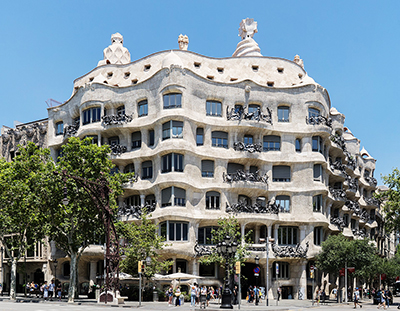
| Casa Milà | 1906–12 | Apartment block, later restored. |
| Sagrada Família | Begun 1882; Gaudí from 1883 | Basilica built in successive campaigns under Gaudí and other architects. |
| Sagrada Família Schools | Early 1900s, original school | School subsequently rebuilt and relocated on the site. |
| Plaça Reial Lampposts | 1878 commission; installed 1879 | Municipal street furniture. |
| Sant Pacià Mosaic Pavement | Late 1870s | Tessellated church pavement. |
| Nau Gaudí and the Mataró Workers’ Cooperative | 1883, bleach hall | Mataró. Restored bleach hall and a separate surviving latrine building within a larger scheme. |
| Bodegas Güell | 1890s | Garraf. Winery and service buildings, with drawings credited by the architects’ archive to Gaudí and Francesc Berenguer. |
| Church of Colònia Güell | Begun 1908; lower church opened 1915 | Santa Coloma de Cervelló. Lower church of a partly realised design. |
| Jardins Artigas | Early 1900s | La Pobla de Lillet. Restored riverside garden. |
| Xalet del Catllaràs | Early 1900s | La Pobla de Lillet. Lodge associated with the mines. Research published by the Consell distinguishes Gaudí’s design from decisions made in execution. |
| First Mystery of Glory at Montserrat | Early 1900s, first campaign | Montserrat. Monument to the Resurrection in a larger devotional ensemble, executed in phases. |
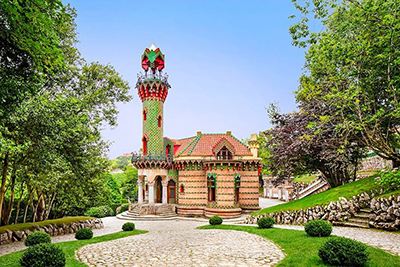
| El Capricho de Gaudí | 1880s | Comillas. Summer villa, subsequently restored. |
| Puerta de los Pájaros | Early 1900s, attributed | Comillas. Casa del Moro boundary gate, locally attributed to Gaudí. |
| Casa Botines | 1891 drawings; building work in 1892 | León. Commercial and residential building, later converted to new uses. |
| Episcopal Palace of Astorga | 1889–93 under Gaudí; finished 1913 | Astorga. Palace begun under Gaudí and finished by Ricardo García-Guereta. |
| Gaudí’s Restoration of Mallorca Cathedral | Early 1900s | Palma. Liturgical intervention in an existing cathedral. |
| Bar Torino | 1902, Passeig de Gràcia interior | Barcelona, Passeig de Gràcia. Lost collaborative bar interior. |
| Compañía Trasatlántica Pavilion | 1888, Barcelona exposition | Barcelona, 1888 Universal Exposition. Lost exhibition building. |
| Banner of Misericòrdia | 1900 | Reus. Lost pilgrimage banner designed by Gaudí with a painting by Aleix Clapés. |
| Franciscan Missions in Tangier | Early 1890s | Tangier. Documented unbuilt mission complex. |
| Hotel Attraction and Its Attribution | Posthumous drawings of the 1950s | New York. Unbuilt hotel associated with Gaudí through posthumous drawings. The commission is uncertain. |
| Capilla de Nuestra Señora de los Ángeles | 1922 correspondence; later proposal | Rancagua. The historic proposal was unbuilt. A later Chilean project drew on Gaudí’s Barcelona chapel design. |
Frequently Asked Questions
Discussion
Look again at the images and ideas explored in Antoni Gaudí Quotes. These editorial prompts invite your observations.
Reader Insights
What can you learn from the full notebook passage that disappears when its first sentence is quoted on its own?
How would you present a vivid story told by someone who knew Gaudí when an autograph version does not survive?
Which words would you keep beside an English translation to show where the original phrasing permits more than one reading?
Join the Conversation
Share a detail, comparison or question about Antoni Gaudí Quotes below.
References
- Museu de Reus and Ajuntament de Reus, Dossier d’activitats de l’Any Gaudí, 2026, catalogue entry for Gaudí’s notebook, MR 2121, on PDF page 6. View source.
- David Galí Farré, Raquel Lacuesta Contreras and Marina Micaló Aumedes, “Atles del material decoratiu de ceràmica i de vidre de l’església de la Colònia Güell”, in Gaudí i l’SPAL, Diputació de Barcelona, 2004, pp. 187–190. The Reus notebook transcription is on printed p. 189 (PDF page 184). View source.
- Antoni Gaudí, “L’Exposició d’Arts Decoratives en l’Institut del Foment del Treball Nacional”, La Renaixensa, no. 52, 1 February 1881, pp. 709–711, and no. 53, 2 February 1881, pp. 739–740. Original issue and page details recorded in the Universitat de Barcelona study Estructura relacional, p. 170, note 10. View source.
- Antoni Gaudí, Escritos y documentos, critical edition by Laura Mercader, Acantilado, 2002. The exhibition review is on pp. 287–294, as located by Sala and Jové. View source.
- Joan Bergós, Gaudí. L’home i l’obra, Ariel, Barcelona, 1954, p. 14, quoted under “Mas de la Calderera i voltants” in the Sagrada Família’s “Camp de Tarragona: tornant als orígens d’Antoni Gaudí”. View source.
- Teresa-M. Sala and Xavier Jové, Història d’un Gaudí ocult. L’estendard de l’Orfeó Feliuà, Edicions de la Universitat de Barcelona, 2024, p. 53 and note 39. View source.
- Casa Vicens, “El projecte original de Gaudí (1883–1885)”, reproducing the building application drawings from the Arxiu Municipal del Districte de Gràcia and citing Joan Bergós, Gaudí. L’home i l’obra, Ariel, Barcelona, 1954, for the recollection. View source.
- Junta Constructora del Temple Expiatori de la Sagrada Família, Curiositats, 2026, Catalan section, PDF page 2. View source.
- Marta Puyol, “S’engeguen els motors per a la causa de beatificació de Gaudí”, Catalunya Cristiana, no. 989, 3 September 1998, p. 7. View source.
- Antoni Bassas, interview with Jordi Faulí, “Un cop acabada respondrà d’una manera clara al que Gaudí havia pensat”, Ara, 19 March 2017. View source.
- Junta Constructora del Temple Expiatori de la Sagrada Família, Antoni Gaudí. Humanismo y espiritualidad, “Crecer” exhibition section, display labels “CITA GAUDÍ CRÉIXER” and “CITA INFERIOR 10”. View source.
- Junta Constructora del Temple Expiatori de la Sagrada Família, “Heritage assets”, on the Association’s founding campaign, the creation of the construction board and the archive. View source.
- Junta Constructora del Temple Expiatori de la Sagrada Família, “History of the Temple”, entries for 1925, 1936 and 1939. View source.
- Diócesis de Rancagua, “Embajador de España entregó su apoyo a proyecto Gaudí de Rancagua”, section “Historia del proyecto”. View source.
- Beatriz Espinoza, report on the chapel and cultural centre in Rancagua, En Concreto, Cámara Chilena de la Construcción, no. 170, p. 55. View source.
- Isidre Puig Boada, El pensament de Gaudí. Compilació de textos i comentaris, La Gaya Ciència, Barcelona, 1981, bibliographic record of the first edition. View source.
- Carlos Salas, “Valores éticos, estéticos y científicos de la ecología integral: El ejemplo de Gaudí”, Quién, no. 19, 2024, pp. 117–134, especially p. 129, section 4.1 and note 26, which cites Cèsar Martinell’s Gaudí: su vida, su teoría, su obra, 1967, p. 141. View source.
- Instituto Tomie Ohtake, Gaudí: Barcelona, 1900, exhibition catalogue, 2016. See “Glosario gaudiano”, “Originalidad”, citing Manuscritos, artículos, conversaciones y dibujos (1982), p. 93, and “Paraboloide hiperbólico”, citing the Dux edition of Puig Boada’s El pensament de Gaudí (2004), pp. 242–243. See also Raimon Ramis i Juan’s “Gaudí más allá de Gaudí”, note 16, citing Puig Boada (2004), p. 91. View source.
- Ferran Garcés, “Did you know? The books from Gaudí’s library…”, Torre Bellesguard, 2 May 2026. View source.
- Santiago Huerta, “Structural Design in the Work of Gaudí”, Architectural Science Review 49, no. 4, 2006, pp. 324–339, especially p. 333 and figs. 23–24. View source.