


 by Tom Gurney
Tom Gurney BSc (Hons) is an art history expert with over 20 years experience
Page Created on September 22, 2026 / Page Updated on September 22, 2026
Email: tomgurney1@gmail.com / Phone: +44 7429 011000
At a Glance
- ArtistGeorgia O’Keeffe
- ArtworkBlack Cross, New Mexico
- Artistic contextAmerican modernism
Contents
- A cross that interrupts the country
- The Chicago canvas
- One object, many titles
- Geometry in front of sunset
- Pegs, moon and handmade weight
- A first summer in the Southwest
- Crosses, moradas and Los Hermanos
- The danger of picturesque secrecy
- Catholic presence and contested land
- New Mexico, Arizona or a composite
- A series built through rearrangement
- Painting the country through an obstruction
- From An American Place to Chicago
- Labels as an exhibition archive
- A long public life
- Cross, skull and national modernism
- What the legacy page gets wrong
- Looking through and at the cross
A cross that interrupts the country
Georgia O’Keeffe’s Black Cross, New Mexico places a massive timber form so close that its upright leaves both top and bottom of the vertical canvas, while its crossbeam extends beyond either side. The cross does not stand conveniently within a landscape; it blocks and divides the view. Only strips of sky, sunset and rolling hills remain visible around it, making the act of looking past the object inseparable from confronting its weight.[1][2]
Its blackness is not completely uniform: four dim circular peg heads emerge from the crossing, slight tonal differences separate upright from crossbeam, and a dark bluish oval lies near the lower joint. Behind this near-silhouette, a brilliant yellow-red horizon runs through two narrow openings, while grey, blue, russet and pale hills multiply into the distance. A tiny white celestial point at upper right answers the almost lightless wood.[1]
The image appears emphatic, yet its historical identity is less settled than the familiar title suggests. O’Keeffe affirmed New Mexico in an archive note, but her later description of a large pegged cross near Cameron points towards Arizona.[1] The painting’s place, religious association and meaning therefore require degrees of certainty: the cross is visible; its precise observed location and institutional affiliation are not securely documented.
The Chicago canvas
The Art Institute of Chicago owns the painting as accession 1943.95, purchased through its Art Institute Purchase Fund. It is an oil on canvas dated 1929 and assigned catalogue raisonné number 667.[1][2] Access O’Keeffe publishes 39 1/8 by 30 inches, while the Art Institute commonly rounds the dimensions to 39 by 30 inches, or 99.1 by 76.2 centimetres.[1][2]
The large format matters because the cross approaches bodily scale. Its upright is nearly as tall as many viewers, and the crop makes it impossible to see the structure as a whole object standing at a measured distance. O’Keeffe converts a handmade roadside or devotional form into the condition through which the landscape is seen, giving it greater visual area than earth and sky together.
The painting remains in the artist-commissioned original metal frame. A 2022 technical report supplied by the Art Institute identifies a commercially preprimed canvas tacked to a four-member F. Weber and Company stretcher.[1] Infrared examination reveals pencil drawing for the cross and peg heads, while some flowing foreground hills were introduced in paint without preliminary drawing. O’Keeffe therefore planned the dominating structure more explicitly than every contour of the country behind it.
Cracks expose a lightly coloured wash beneath thicker upper paint in at least some areas. Where visible, the wash and final layers use closely related colours, suggesting development and reinforcement rather than wholesale chromatic revision.[1] This evidence clarifies sequence without disclosing a complete pigment map: the published report identifies drawing, wash and thicker paint, but does not provide pigment analysis or prove that every passage followed the same procedure.
One object, many titles
The 1999 catalogue raisonné gives the title Black Cross, derived from the first backing inscription.[1] The Whitney Archive, Downtown Gallery Archive and Abiquiú Notebooks also preserve Black Cross, Arizona and Black Cross, New Mexico, the latter adopted by the Art Institute. Title variation here records a real geographic problem rather than mere editorial inconsistency.
Publication names shifted further. The work appeared as The Black Cross in Creative Art in January 1931, Cross with Arizona Sandhills in Atelier that June, Desert Cross, Arizona in America & Alfred Stieglitz in 1934, and Black Cross, New Mexico in the Art Institute’s 1943 bulletin.[1] Each title directs attention differently towards emblem, terrain, state or museum identity.
The physical object accumulated labels repeating the New Mexico form through major loans, including Houston, the Whitney, San Francisco, the Amon Carter and the Art Institute itself.[1] Repetition has stabilised the current title without erasing the contrary evidence. A responsible account can use the owner’s name while allowing “Arizona” to remain part of the picture’s documentary life.
Geometry in front of sunset
The upright is not centred exactly: more landscape is exposed on the right, while the left opening is narrower and darker. Its sides taper and bend slightly rather than forming a mechanically perfect rectangle. The crossbeam also rises and falls across its length, preserving the irregularity of timber even as the overall silhouette becomes an imposing geometric sign.
Landscape occupies two principal windows below the beam. Blue-grey hills gather in closely stacked waves, with warmer russet ridges emerging to the right and pale foreground earth sweeping across the base. O’Keeffe suppresses vegetation, road, chapel and human scale, so distance is constructed through overlapping contours and temperature rather than through descriptive topographical inventory, buildings or named landmarks.
The horizon is compressed into a narrow, incandescent band. Yellow lies above orange and red, then gives way to muted violet and grey hills, making the sunset seem to burn along the crossbeam’s underside. Above, the sky grades from pale yellow near the timber to turquoise and cool blue at the top, a slow atmospheric transition held against the cross’s abrupt, nearly unmodulated darkness.[2]
Pegs, moon and handmade weight
Four round marks cross the central timber, unevenly arranged and barely lighter than the wood. O’Keeffe later remembered a cross “put together with wooden pegs”, and the catalogue identifies these circles with that description.[1] Their irregular spacing prevents the cross from becoming a purely abstract diagram; they retain evidence of construction, labour and material joining within the canvas’s largest and most visually dominant field of darkness.
The lower joint is unusual. A broad dark blue-black oval overlaps the upright just below the crossbeam, possibly describing a thickened joint, shadow or another structural element. The published object records do not identify it, so naming it as a knot, support or symbolic form would overstate the image; visually, it interrupts the vertical and echoes the rounded hills immediately behind it.
The tiny white disc in the upper-right sky may be a moon or bright star, as the museum description cautiously proposes.[1] It supplies scale through contrast rather than measurement, and its isolation intensifies the cross’s opacity. The point should not be turned into a theological sign without evidence; it is enough to observe how the smallest light counters the largest dark shape across an otherwise empty upper sky.
A first summer in the Southwest
O’Keeffe travelled to New Mexico for the first time in 1929, staying in Taos as a guest of Mabel Dodge Luhan.[3][4] She encountered a landscape, architecture and religious material culture unlike Lake George or Manhattan, while also joining an established network of Anglo modernists, patrons and writers whose access to the region was socially unequal.
The summer produced crosses, churches, hills and other motifs that would become central to her public identity. It did not mark an immediate permanent migration: O’Keeffe returned east, revisited New Mexico seasonally and settled there only in 1949.[2][7] Reading the 1929 canvas through her later residence can make the first encounter seem inevitable when it remained exploratory, mobile and open to later revision.
Daniel Catton Rich, then an assistant curator at the Art Institute, met O’Keeffe at Luhan’s house that summer.[3][8] Their meeting became consequential fourteen years later when he organised her Chicago retrospective and selected this painting for purchase. The work’s making and museum history are thus linked by relationships formed in Taos, though no evidence says Rich saw it being painted or even completed there.
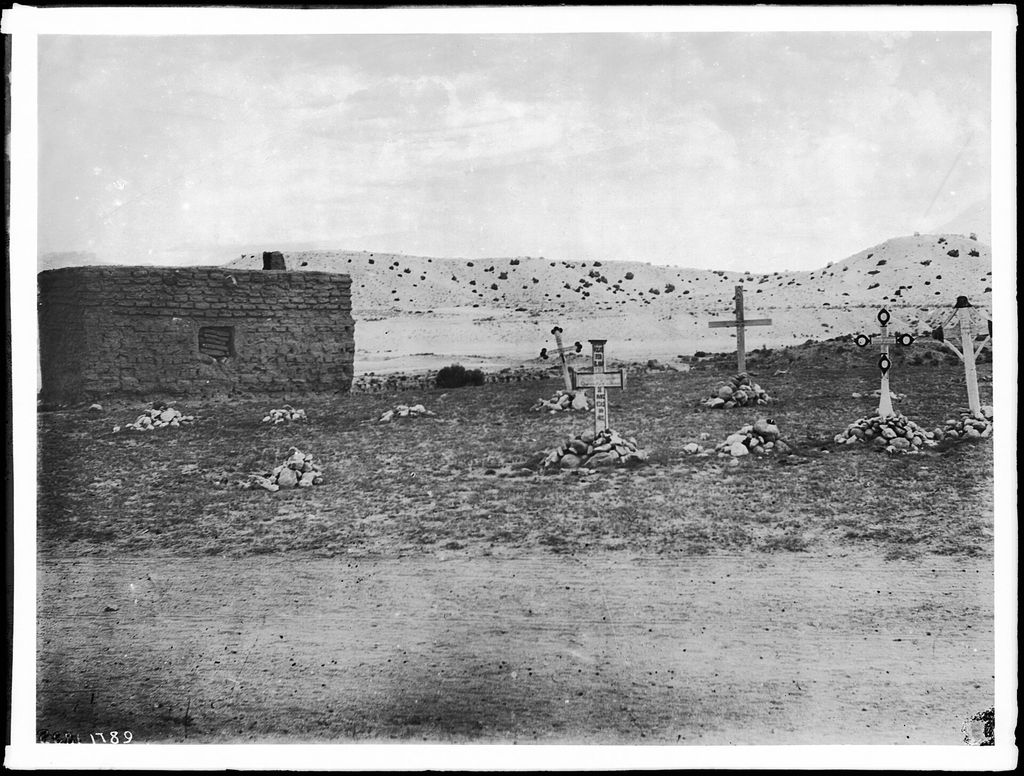
Jeffrey Richmond-Moll’s peer-reviewed reconstruction places O’Keeffe in La Casa Rosita on the Luhan compound, with Taos Mountain and a Penitente morada visible beyond.[21] A period photograph records one of three crosses by that morada on Taos Pueblo land. Tony Luhan’s Taos Pueblo identity gave the household’s guests unusual access to sacred places usually closed to Anglo visitors, making O’Keeffe’s visual opportunity inseparable from a specific Indigenous mediator and unequal structure of access.
Crosses, moradas and Los Hermanos
O’Keeffe recalled seeing crosses repeatedly and in unexpected places, describing them as a dark veil of the Catholic Church across the New Mexico landscape.[1] Some were associated with moradas, meeting houses used by Los Hermanos de Nuestro Padre Jesús Nazareno, commonly called Penitentes. Yet the Art Institute carefully says the monuments were “probably” erected near such chapels rather than identifying this particular cross with a documented brotherhood site.[2]
National Park Service scholarship describes the Hermanos as locally organised Hispano-Catholic confraternities in northern New Mexico and southern Colorado. Their leaders were Hermanos Mayores, their moradas held meetings and devotions, and their work extended beyond commemorating Christ’s Passion to community leadership and social integration.[9][10] “Secret brotherhood” captures outsiders’ limited access but can distort a living structure of prayer, mutual aid and local authority.
Their emergence is also debated. Historic-register research connects their growth with shortages of clergy after Franciscan decline, while noting that historians disagree on precise origins and dates.[10][11] The brotherhoods assisted with wakes, funerals, feast days and Holy Week without assuming sacramental duties reserved to priests, evidence that counters the legacy page’s reduction of them to clandestine makers of mysterious roadside crosses and monuments.
Richmond-Moll further identifies the crosses beside the Taos morada as processional objects lifted from their bases and carried on holy days.[21] His interpretation reads O’Keeffe’s abrupt superimposition of cross and receding hills as registering both her movement through the landscape and the crosses’ ceremonial mobility. That argument adds a competing account to the familiar image of a fixed roadside monument, although CR 667’s uncertain Arizona–New Mexico source prevents the Taos example from becoming its proven physical model.
The danger of picturesque secrecy
Anglo writers often sensationalised Penitente practices, especially flagellation and Holy Week rites. The National Register nomination for La Morada de Nuestra Señora de Guadalupe explicitly warns that popular writing after Anglo occupation perpetuated misconceptions because the confraternity guarded its ceremonies.[11] Repeating “secret cult” language around O’Keeffe’s cross would reproduce that history of spectacle rather than explain the religious community on its own local terms.
O’Keeffe’s painting itself offers no morada, procession, worshipper or ritual implement. A cross can belong to Catholic landscape culture without being securely assigned to the Hermanos, and the four pegs do not identify a confraternity. The image’s power has encouraged viewers to fill its absences with ethnographic certainty, which is precisely where institutional qualifiers must be retained.
Spanish-language National Park Service interpretation calls the organisations hermandades, notes their autonomous local structure and emphasises leadership, prayer and social life despite external criticism.[10] That vocabulary shifts attention from secrecy towards community. It also reminds English-language art history that “Penitentes” is an outsider-facing shorthand for named brotherhoods with their own religious and linguistic terms.
Catholic presence and contested land
O’Keeffe’s metaphor of a Catholic veil recognises the visual reach of crosses, yet it can sound as though the Church simply settled on empty country. Catholic institutions in New Mexico developed through Spanish colonisation, mission systems, Pueblo resistance, Mexican government and United States conquest. The landscape was already Indigenous homeland, and its religious signs participated in histories of conversion, survival, mixture and dispossession.[9][12]
National Park research at El Cerro Tomé describes communities containing detribalised Indigenous people, mestizo families and Hispano settlers whose Roman Catholicism became a shared institution.[12] The brotherhood’s social importance grew where parish clergy were absent. This history is more complex than the legacy page’s claim that the cross symbolises the religion of an enormous population, because neither population nor Catholic identity was culturally uniform.
The painting removes those social distinctions. Its cross becomes a single dark form and its hills an unpeopled distance, a modernist compression that produces intensity while withholding community history. Close analysis should acknowledge both achievements: O’Keeffe found a powerful relation of sign and country, and the visual economy leaves the people who built, used and understood such crosses outside the painted frame.
New Mexico, Arizona or a composite
The strongest New Mexico evidence is O’Keeffe’s own Whitney Archive note: “Miss O’Keeffe says this New Mexico.”[1] The accepted museum title and the general 1929 Taos context both agree with it. If considered alone, that evidence would make the state identification straightforward, even though no town, morada or precise observed geographic site is named.
The Arizona evidence comes from another first-person account. O’Keeffe described a large, pegged cross seen at sunset near Cameron, with immense hills revealed by telephone poles that looked like toothpicks.[1] Because this painting visibly includes the remembered pegs and sunset, the catalogue raisonné proposes that its landscape configuration may derive from Arizona observation despite the contrary New Mexico archive statement preserved in other records.
The contradiction may reflect memory, multiple observed crosses or a studio composition combining experiences. There is no need to select one solution without further documentation. “Black Cross, New Mexico” remains the collection title, while the image’s source location stays unresolved; this is stronger history than assigning the scene confidently to a single late-night New Mexico walk, as the legacy page repeatedly does.
A series built through rearrangement
O’Keeffe did not treat the cross as one fixed view. Black Cross with Stars and Blue, CR 668, sets a large cross against Taos Mountain and a star-filled sky; she later said that she painted cross and mountain together although she had never seen them in that relationship.[13] The statement makes recomposition explicit rather than exceptional.
Cross with Red Sky, CR 669, places a black cross before dark blue mountains and a saturated red sky.[14] A 1958 letter identifies Taos Mountain and records damage from bad packing, followed by treatment by conservator Caroline Keck.[14] That object-specific history belongs to CR 669; it cannot establish that Chicago’s CR 667 was sprayed, damaged or built through the same paint procedure and materials.
Serial comparison reveals the decisions unique to Black Cross. Its sky is pale rather than nocturnal or red, the sunset survives only beneath the beam, the four pegs are conspicuous, and layered hills occupy the lower openings. The series does not document consecutive views of one structure; it tests how scale, colour, orientation and imagined conjunction change a cross’s visual and historical relation to country.
Painting the country through an obstruction
O’Keeffe later said that painting crosses was a way of painting the country.[2] The claim is borne out structurally: the cross does not replace landscape but divides it into zones, forcing each fragment of sky and hill to gain intensity around a black boundary. Country becomes perceptible through obstruction rather than through a panoramic view.
The approach also connects religious form and built form. Like her New York skyscrapers, the cross rises beyond the frame, dwarfs the viewer and creates narrow glimpses of atmosphere around an upright mass. The 2024–25 My New Yorks exhibition placed urban pictures within her wider late-1920s experiments, including the Southwest, to show that magnification, cropping and geometric pressure travelled across otherwise dissimilar subjects.[15][16]
This formal continuity does not make cross and skyscraper culturally equivalent. One belongs to a devotional landscape, the other to capitalist urban construction, and their communities experienced modernity through markedly different histories. The comparison identifies O’Keeffe’s compositional method while preserving the historical work required by each object, avoiding a universal “spiritual geometry” that would flatten their distinctions.
From An American Place to Chicago
The painting appeared in O’Keeffe’s 1930 exhibition of twenty-seven recent pictures at An American Place and is clearly visible in several surviving Stieglitz installation photographs from that show and her 1935 exhibition.[1] Reproductions circulated under changing titles during the early 1930s, ensuring that competing Arizona and New Mexico associations developed well before museum acquisition.
Contemporary critics quickly cast the cross paintings in spiritual terms. Edward Alden Jewell treated them as direct religious experience, while the New York Sun claimed a church would suit them better than a gallery.[21] Such responses establish the paintings’ immediate force but also show how readily New York reception converted a regionally specific Hispano-Catholic object into universal transcendence, anticipating the later canonisation that can obscure community, ritual and contested land.
In 1943 Rich organised O’Keeffe’s first extensive retrospective at a major museum and the Art Institute’s first solo exhibition devoted to a woman.[2][3][7] O’Keeffe and Stieglitz required the museum to purchase a work as a condition of the exhibition; Rich agreed and selected Black Cross, New Mexico.[7][8] Acquisition was thus negotiated into the retrospective rather than arising as an unplanned response after opening.
The painting became the first O’Keeffe work in the Art Institute’s permanent collection.[2][3][5][6] Contemporary Chicago reception praised the Southwestern pictures in universal terms, a response that increased their institutional reach while potentially separating them from specific Hispano and Indigenous histories.[3] Rich’s relationship with O’Keeffe later influenced her major placement of the Stieglitz Collection in Chicago after her husband’s death.[7][17]
Labels as an exhibition archive
The backing retains an unusual material record of movement. A February 1943 label names O’Keeffe as owner at Room 1710, 509 Madison Avenue; later labels document Houston in 1966, the Whitney in 1970, San Francisco in 1971, McNay in 1975 and other loans.[1] Museum handling instructions—including “FRAMED UNDER PLEXIGLAS / DO NOT TAPE”—make exhibition history visible as changing object care across institutions and decades.
The original metal frame is itself part of O’Keeffe’s presentation, because she commissioned it rather than leaving framing entirely to a later owner.[1] The vibration-reducing backing represents a subsequent preventive intervention. These components complicate the idea of an untouched autonomous canvas: what viewers encounter includes an artist-selected boundary and museum measures developed through decades of circulation.
The technical record also preserves the cost of that movement. The canvas was grime-cleaned and coated with polyvinyl acetate varnish in 1971; cracking associated with early travel led to a travel restriction after 1986.[1] Conservators locally edge-lined and restretched the buckled upper-left corner in 1991, consolidated cleavage in the yellow horizon during a 2019 treatment that also removed dust and added minimal inpainting, and consolidated lifting paint around the foldover and perimeter in 2024.
The canvas remains unlined, somewhat slack and unevenly tensioned, with buckling at both upper corners and along the lower edge. Drying or traction crackle occurs through the black, brown and orange-brown passages, while the varnish has slight gloss differences because the porous paint absorbed it unevenly.[1] These observations distinguish condition from intention: cracking and gloss variation belong partly to the material history of paint, coating, travel and age rather than to O’Keeffe’s original design.
The current stretcher is stable despite a small split near its upper centre, numerous holes, missing keys and remnants of newsprint attached around three bars.[1] A polybatting insert now reduces vibration, and the original metal frame remains part of the artist’s presentation. Preventive care therefore responds directly to the painting’s structural vulnerabilities while preserving the frame and unlined support, rather than erasing the physical record accumulated through nearly a century of display and transport.
A long public life
After Chicago, the painting entered Romantic Painting in America in 1943–44 and O’Keeffe’s 1946 Museum of Modern Art retrospective.[1][18] It travelled in landmark American-art and O’Keeffe surveys during the 1950s, 1960s and 1970s, including the Amon Carter–Houston retrospective and the Whitney–Chicago–San Francisco tour documented by surviving labels attached to its backing.[1]
The 1987–89 retrospective carried it to the National Gallery, Chicago, Dallas, the Metropolitan Museum and Los Angeles County Museum.[1] Each venue reinforced its canonical status while placing a locally rooted religious form inside a national museum narrative. Exhibition prestige does not resolve the source location or the Penitente attribution; it explains how a contested image became familiar.
Its inclusion in Georgia O’Keeffe: “My New Yorks” in 2024–25 connected the cross to approximately one hundred urban, abstract, still-life and Southwestern works.[1][15][16] The curators’ point was developmental rather than geographical: the New York pictures were part of the same modernist investigation that O’Keeffe carried into new subjects when she reached the Southwest in 1929.
Cross, skull and national modernism
National Gallery scholarship places Black Cross beside the similarly ambitious Black White and Blue and Cow’s Skull: Red, White, and Blue.[19] All three use a large central sign against a compressed field, and the skull’s horns with its vertical black band can suggest a cruciform. The comparison traces an evolving compositional device without claiming that cross, animal remains and national colours share one fixed symbolism.
Later scholarship has continued to treat the object as a research problem rather than a settled icon. The Phillips Collection archive finding aid records a dedicated “Crosses, Black Cross, New Mexico, 1929” object-research folder assembled for The Poetry of Things.[20] Its contents are not online, so the folder proves sustained curatorial inquiry but cannot be cited as support for conclusions unavailable to public inspection.
Canonisation has both preserved and simplified the painting. Large retrospectives made it exemplary of American modernism, while owner interpretation often translated a specific Hispano-Catholic material culture into universal spirituality.[2][3] The strongest account can recognise the canvas’s national importance and formal economy while retaining the location dispute, the limits of Penitente attribution and the communities absent from its apparently empty, carefully ordered painted country.
What the legacy page gets wrong
The legacy page identifies the scene as a late-night New Mexico encounter and the crosses as Penitente structures with little qualification. Current catalogue evidence makes the first claim uncertain and institutional interpretation makes the second probable rather than specific.[1][2] Its statement that the cross symbolises the religion of an enormous population also substitutes generalisation for the documented social functions of autonomous local brotherhoods.
Its formal account is more useful: the cross dominates and nearly removes the background. Yet calling the silhouette “trifurcated” is inaccurate; the object is a conventional cruciform with an upright and one crossbeam. The four circular pegs, tapered timber, joint form, horizon bands and asymmetrical landscape openings provide more precise ways to describe its construction and visual force.
The legacy comparison with O’Keeffe’s Chestnut Tree and Stieglitz imagery is unsupported on the page and unnecessary to establish the cross’s strength. Better comparisons exist within O’Keeffe’s documented 1929 cross series and her substantially enlarged New York architectural paintings. These comparisons show recurrence of pictorial method while respecting differences among tree, building and devotional object.
Looking through and at the cross
Begin with the narrow horizon rather than the black centre. Follow the yellow, orange and red band until it disappears behind the upright, then resume it on the other side. The interrupted continuity reveals that the landscape extends behind the cross even as the painted object prevents a single panoramic view, making absence and continuation work together.
Next, look into the dark timber. The crossbeam, upright, four pegs and lower oval are differentiated just enough to preserve handmade assembly inside what first seems a flat silhouette. Those small distinctions matter because they hold abstraction, construction and objecthood in balance: the black shape can organise the canvas without ceasing to be constructed wood.
Finally, keep the location and religious history open. The title says New Mexico, the pegged-cross recollection points towards Cameron, and Penitente association remains probable rather than proved.[1][2] Uncertainty does not weaken the painting’s encounter; it prevents visual authority from becoming historical certainty and allows the cross to be seen as a powerful modernist form embedded in a country whose communities cannot be reduced to scenery.
Discussion
Which piece of evidence most changes the way you read Black Cross, New Mexico?
Reader Insights
Which visible detail most changes your reading of Black Cross, New Mexico?
How do medium, setting and documented history shape the encounter?
What remains uncertain when documented fact is separated from interpretation?
Join the Conversation
Share your reading of Black Cross, New Mexico below.
References
- Georgia O’Keeffe Museum, Access O’Keeffe, “Black Cross, 1929”, CR 667: View Source
- Art Institute of Chicago, “Black Cross, New Mexico”, American Art collection resource: View Source
- Art Institute of Chicago, “Window on the West: Chicago and the Art of the New Frontier, 1890–1940”: View Source
- Georgia O’Keeffe Museum, Access O’Keeffe, “Artist’s Chronology”: View Source
- Georgia O’Keeffe Museum, “A Brilliant Pictorial Record: The O’Keeffe and Stieglitz Collection at the Art Institute of Chicago”: View Source
- Georgia O’Keeffe Museum, Exhibiting O’Keeffe: The Making of an American Modernist: View Source
- Art Institute of Chicago, One Hundred Years at the Art Institute: A Centennial Celebration: View Source
- Art Institute of Chicago, Ryerson and Burnham Libraries, 1943 O’Keeffe retrospective catalogue record: View Source
- National Park Service, “American Latino Theme Study: Religion”: View Source
- National Park Service, “Religión y espiritualidad”: View Source
- National Park Service, National Register nomination, La Morada de Nuestra Señora de Guadalupe: View Source
- National Park Service, National Register nomination, El Cerro Tomé: View Source
- Georgia O’Keeffe Museum Custom Prints, “Black Cross with Stars and Blue, 1929”: View Source
- Georgia O’Keeffe Museum, Access O’Keeffe, “Cross with Red Sky, 1929”, CR 669: View Source
- High Museum of Art, “Georgia O’Keeffe: ‘My New Yorks’”: View Source
- High Museum of Art, Georgia O’Keeffe: “My New Yorks” press release: View Source
- Art Institute of Chicago, “The Alfred Stieglitz Collection”: View Source
- Museum of Modern Art, Romantic Painting in America catalogue: View Source
- National Gallery of Art, “Black White and Blue”: View Source
- Phillips Collection archive, Georgia O’Keeffe: The Poetry of Things finding aid: View Source
- Jeffrey Richmond-Moll, “Georgia O’Keeffe, Black Cross with Stars and Blue”, MAVCOR Journal 2, no. 1 (2018): View Source