


 by Tom Gurney
Tom Gurney BSc (Hons) is an art history expert with over 20 years experience
Page Created on September 22, 2026 / Page Updated on September 22, 2026
Email: tomgurney1@gmail.com / Phone: +44 7429 011000
Introduction
Georgia O’Keeffe’s Radiator Building—Night, New York turns a new Manhattan skyscraper into a structure of darkness, electrical light and personal inscription. A black tower rises through a narrow canvas. White windows and beams interrupt it; smoke or steam curves across a deep blue sky; at lower right, the name “Alfred Stieglitz” glows red above the city. Painted in 1927, the work is oil on canvas, 48 by 30 inches (121.9 by 76.2 centimetres), catalogue raisonné number 577.[1]
The painting belongs to the Alfred Stieglitz Collection and is jointly owned by Fisk University in Nashville and Crystal Bridges Museum of American Art in Bentonville. That unusual arrangement is not a footnote. It grows from O’Keeffe’s decision to place modern art at a historically Black university, the conditions attached to her gift, Fisk’s later financial crisis, protracted litigation and a court-approved sharing plan.[2][14][15]
The image is equally layered. It represents Raymond Hood and J. André Fouilhoux’s American Radiator Building, completed only a few years earlier, but it does not reproduce the structure neutrally. O’Keeffe compressed the city, shifted the building’s black-and-gold corporate identity towards black, blue and white, and inserted Stieglitz’s name as an imaginary neon sign. Architecture becomes portrait, advertisement and argument about who occupies the modern skyline.
At a Glance
- ArtistGeorgia O’Keeffe
- ArtworkRadiator Building—Night, New York
- Artistic contextAmerican modernism
Contents
- Object identity and catalogue record
- Tower, colour and the city at night
- The American Radiator Building and its commission
- The invented Stieglitz sign
- The Shelton view and modernity
- Date, title and the 1928 debut
- Later exhibitions and architectural reception
- Fisk, ownership and legal dispute
- Why provenance changes interpretation
- Material evidence and technical limits
- Reproduction and postcard afterlife
- Interpretive possibilities
- Close looking
- Why the painting matters
Object identity and catalogue record
- Maker: Georgia O’Keeffe (1887–1986)
- Catalogue title: Radiator Bldg – Night, New York
- Common current title: Radiator Building—Night, New York
- Date: 1927
- Medium: oil on canvas
- Unframed dimensions: 48 × 30 inches (121.9 × 76.2 cm)
- Catalogue raisonné: CR 577
- Collection: Alfred Stieglitz Collection, co-owned by Fisk University and Crystal Bridges Museum of American Art
- Crystal Bridges accession: ASC.2012.73
- First documented exhibition: O’Keeffe exhibition, Intimate Gallery, New York, 1928[1][2]
Crystal Bridges lists the framed dimensions as 49½ by 31½ by 2⅝ inches.[2] The distinction matters because the narrow vertical proportions are part of the painting’s bodily effect. The canvas is four feet high, while the frame adds only a modest architectural border.
Tower, colour and the city at night
The Radiator Building does not sit comfortably inside the view. It enters from below, fills most of the width and rises almost to the top edge. Its setbacks make the upper mass narrower, but the silhouette remains forceful. The spectator looks upward without being shown a street, pavement or conventional foreground.
O’Keeffe suppresses many architectural details. Rows of small illuminated windows provide scale, but black absorbs much of the façade. White light traces the crown and appears in a few openings; searchlight-like bands cross the atmosphere. Smoke or steam curls from right to left, loosening the rigid vertical structure.[1][3] The surrounding city is fragmented.
Low dark masses, windows and the red sign occupy the bottom rather than forming a continuous panorama. That uneven base makes the skyscraper seem at once anchored and detached. It is a building, but also a black form lifted into blue. The canvas is not merely celebratory. The tower can look commanding, theatrical or ominous.
Its windows imply occupied offices, yet its dark surface withholds access. Light reveals selected points and conceals the rest. O’Keeffe’s night city is charged with modern energy while remaining psychologically difficult to enter. The building’s black is not an empty absence. It sets a dense plane against the blue sky and makes each white window register as an event.
Slight changes in the surrounding dark keep the tower from becoming a flat cut-out, but its mass remains more graphic than the ordinary view of a masonry façade. Blue provides atmosphere without becoming naturalistic daylight. It appears behind smoke, beams and the broken skyline, a saturated interval against which black can remain visible. White performs several jobs: window illumination, crown, searchlight and mist.
These bright elements do not share one physical source, yet O’Keeffe binds them into a system of electrical and atmospheric movement. Red is reserved for “Alfred Stieglitz”. Because it occurs low and to one side, it competes with the monumental centre without displacing it. The name acts almost like a signature, although it is not O’Keeffe’s.
The small glowing letters convert private relationship and gallery identity into urban spectacle. Colour therefore distributes power. Black belongs to corporate architecture; white activates the tower; blue gives depth and weather; red names a cultural impresario. O’Keeffe’s authorship contains all four. The apparent tribute to Stieglitz remains a construction made and positioned by her.
The American Radiator Building and its commission
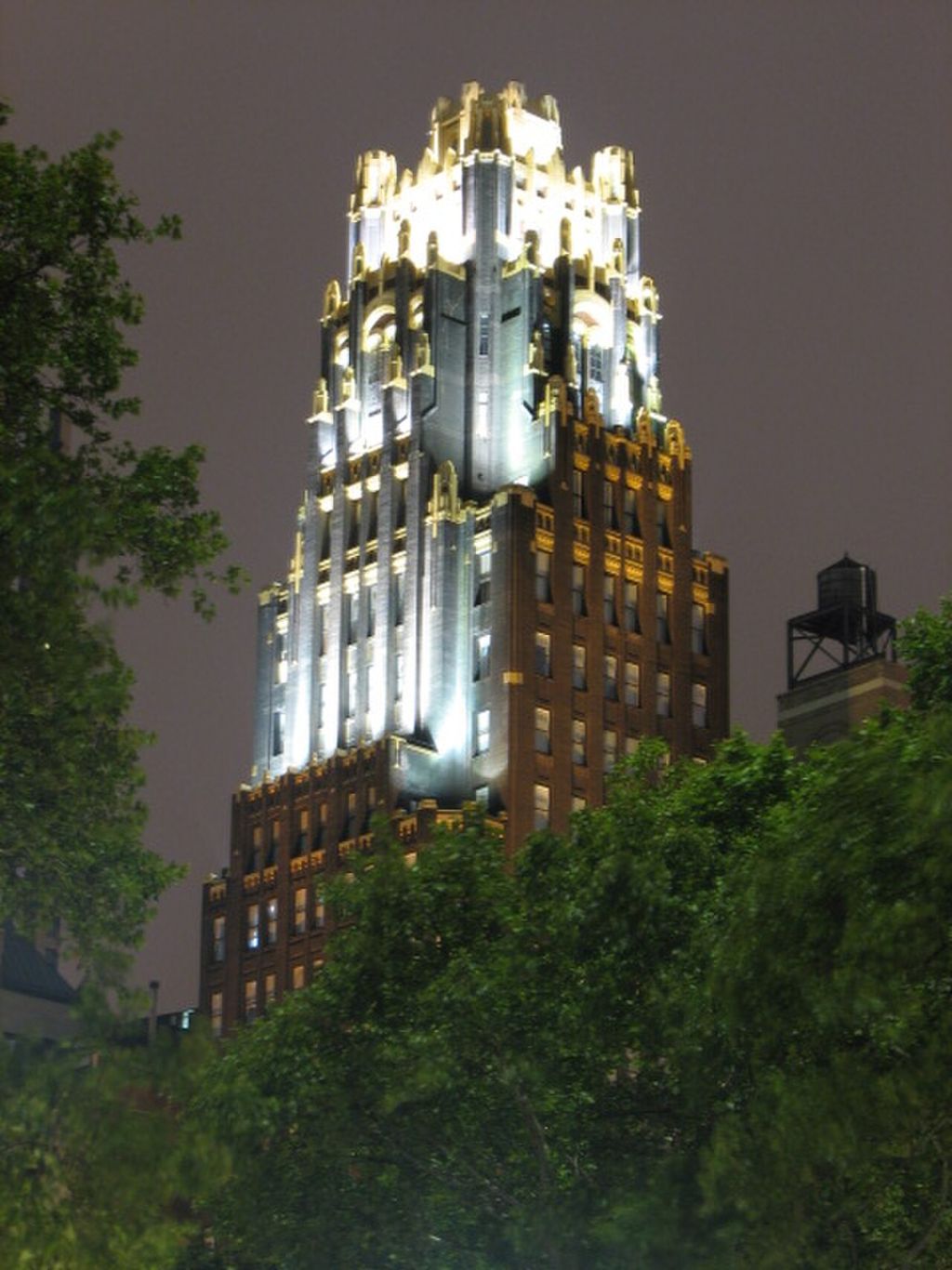
The represented building stands at 40 West 40th Street, opposite Bryant Park. Designed by Raymond Hood with J. André Fouilhoux and built in 1923–24, it has twenty-three storeys. New York’s Landmarks Preservation Commission designated it in 1974 and described its black-and-gold tower, cubic setbacks and departure from heavily classical skyscraper design as architecturally significant.[4]
Hood covered the steel frame in black brick so that walls and dark window openings would form a coherent mass. Gold-coloured ornament concentrated around setbacks and crown. The result combined Gothic vertical aspiration with a freer, more abstract massing often associated with Art Deco.[4][5] Lighting was integral. Seen after dark, the gold summit appeared to glow above the black shaft.
Bryant Park’s history compares the effect to a heated radiator coil.[6] The building thus served as an advertisement for the American Radiator Company through colour, material and illumination even without displaying a conventional corporate name. O’Keeffe understood this designed night identity. She remembered walking across 42nd Street when the black building was new and feeling that it had to be painted.
Her canvas does not invent the building’s drama; it selects and intensifies a drama already built into the architecture.[19] The tower’s façade translated a heating company’s product into urban symbolism: dark fuel, glowing fire, warmth and technological progress. Its form was therefore never culturally neutral. It entered the skyline as architecture and branding at once.[4][6] O’Keeffe removed most literal gold, however.
The crown becomes pale and spectral rather than richly metallic. Black is pushed towards near-total mass, and artificial beams spill into the sky. The painted building is recognisable but no longer simply the company’s polished self-image. That transformation matters when placed beside the red Stieglitz sign. One modern enterprise advertises itself through architecture; another, the Stieglitz art world, appears as letters in light.
Corporate and cultural promotion share the same nocturnal field. The comparison may be affectionate, comic or critical, and the painting does not force one tone. Crystal Bridges proposes that the name could monumentalise Stieglitz’s stature or tease his habit of claiming that his galleries were under-advertised.[2] Both readings remain plausible because the sign is at once conspicuous and slightly absurd. It is large enough to command notice, yet placed beneath a building that overwhelms it.
The invented Stieglitz sign
No evidence indicates that such a sign stood beside the Radiator Building. Its invention is therefore one of the canvas’s most consequential departures from observed fact. O’Keeffe does not simply record a view; she edits the city to make a relationship visible. Stieglitz was her husband, photographer, dealer and influential advocate. His galleries framed her public career, while his writing, exhibitions and photographs also shaped the gendered terms through which critics approached her.
Writing his name into the city may register intimacy and gratitude, but it also places his promotional identity inside a painting whose authorship is hers. The sign can be read as a portrait without a body. It presents a public name rather than a face, appropriate for a figure whose institutions and rhetoric mediated modern art.
Its red glow resembles commercial neon, collapsing the boundary between avant-garde prestige and advertising. Yet the name does not crown the building. It remains low, hazy and lateral. O’Keeffe gives Stieglitz visibility while reserving the dominant vertical axis for the architectural form she has chosen. The compositional hierarchy prevents a simple reading of homage.
The Shelton view and modernity
O’Keeffe lived with Stieglitz in the Shelton Hotel from 1925 to 1936. Their high apartment offered broad views across Manhattan and the East River. The Metropolitan Museum records that she used the thirtieth-floor viewpoint for East River from the Shelton Hotel in 1928.[10] Between 1925 and 1930 she made more than twenty New York paintings.[3] They do not deliver one verdict on the city.
The Shelton with Sunspots, N.Y. turns vertical architecture into bands pierced by circular light; Ritz Tower sets another recently completed skyscraper against darkness; East River pictures look outward across industrial smoke and water.[10][11][12] The Radiator Building was southwest of the Shelton rather than simply the subject outside one window. O’Keeffe’s recollection of walking across 42nd Street suggests repeated street-level looking as well as elevated urban experience.
The final composition need not correspond to a single fixed vantage.[19] These city works emerged within a life divided seasonally between Manhattan and Lake George. The contrast did not place culture in one location and nature in another. Smoke behaves like cloud; a skyscraper becomes an abstract mass; leaves and buildings can both be organised through close cropping.
O’Keeffe carried formal questions across environments.[13] The skyscraper was celebrated in the 1920s as an especially American architectural invention. Its height, steel frame and illuminated summit could signify confidence, commerce and technical power.[3][4] Radiator Building—Night participates in that discourse through scale and upward thrust. At the same time, O’Keeffe fills the supposedly rational city with unstable atmosphere.
Smoke crosses the tower; searchlights fan without visible machinery; the blue sky feels deep and theatrical; the sign introduces personality into corporate space. Modernity appears as sensation rather than engineering diagram. The narrow vertical format intensifies the body’s response. A viewer looks up along the building and encounters a summit close to the frame. This upward movement is checked by lateral smoke and diagonal light.
The painting’s structure is active because its directions compete. The result differs from a machine-age celebration based on clarity and precision alone. Windows form a grid, but fog interrupts it. The skyscraper is solid, yet illumination seems to dissolve its crown. O’Keeffe treats modern architecture as something seen through weather, movement and memory.
Date, title and the 1928 debut
Access O’Keeffe adopts 1927 because the Whitney Archive, Downtown Gallery Archive and Abiquiú Notebooks agree, and because the painting appeared in the 1928 Intimate Gallery exhibition. One backing label, associated with William Einstein, says 1925.[1] That discrepant label cannot simply be deleted. It forms part of the object’s physical archive, but the catalogue’s date rests on a broader convergence of contemporary exhibition and studio records. Publication should use 1927 while acknowledging the surviving 1925 inscription.
The reverse and backing preserve the painting’s administrative career. Stieglitz wrote versions of the title and successive gallery addresses on labels; another label gives a $3,500 value, later crossed out; Doris Bry’s Fisk label fixes the 1927 title and date used in the collection.[1] None is neutral metadata. The crossed-out figure is a historical valuation, not evidence of a completed sale, while the addresses trace the gallery infrastructure through which the canvas circulated. Physical labels record changing custody and knowledge alongside paint.
Titles multiplied too. Records include Radiator Bldg – Night New York, Radiator Building, Night – N.Y. City, Radiator Building, Radiator Building – Night and A Building, N.Y. – Night.[1] The catalogue preserves its abbreviated “Bldg”; Crystal Bridges uses the more readable expanded form.[2] Magazine and newspaper reproduction generated further names. The picture was called The American Radiator Building at Night in the New York Herald-Tribune, New York’s Black Tower in Fortune, and simply Radiator Building in a Philadelphia museum bulletin.[1]
Each title changes the emphasis from identified structure to atmospheric icon. The work’s first documented showing was O’Keeffe’s 1928 exhibition at the Intimate Gallery. A contemporary New Yorker review records the annual exhibition under Stieglitz’s banner and the polarised habits of response that already surrounded her.[9] The review discusses the exhibition broadly rather than providing a secure object-specific analysis, so it should not be made to speak more narrowly than it does.
By the later 1920s O’Keeffe was substantially involved in Intimate Gallery installations and daily gallery business, according to the Museum chronology.[28] Her 1928 debut should therefore not be narrated as a display wholly constructed for her by Stieglitz. The gallery remained his institution and his promotion mattered, but selection, hanging and operational work also formed part of her agency. The invented sign inside the painting and her labour outside it meet here: she represented promotion while participating in the machinery that made the image public.
Early exhibition supplied decisive dating evidence. It also placed the black tower among works through which viewers knew O’Keeffe: organic abstractions, flowers, landscapes and other city subjects. The contrast would have made it harder to restrict her to a single motif than later popular memory often does. In 1929 the painting entered the Museum of Modern Art’s Paintings by Nineteen Living Americans. The catalogue lists Radiator Building, gives the 48-by-30-inch dimensions and identifies the collection as the artist’s.[7]
MoMA’s institutional framing positioned O’Keeffe within a selective account of living American modernism soon after the museum’s founding.[8] Reproduction extended that audience. Between 1929 and 1945, the canvas appeared in art magazines, newspapers, general-interest publications and museum bulletins.[1] A work rooted in night colour circulated largely through print systems that could alter or suppress that colour. Its black mass and white lights nevertheless made it graphically durable.
Later exhibitions and architectural reception
The painting appeared in 20th Century New York in Paintings and Prints in 1933, O’Keeffe exhibitions in 1935 and 1937, a 1941 city exhibition and a 1944 history of Stieglitz’s “291” and later activity. These settings alternately treated it as city image, individual work and part of a cultural network.[1] It entered the major 1970–71 O’Keeffe retrospective at the Whitney Museum, Art Institute of Chicago and San Francisco Museum of Modern Art.
It travelled again in the 1987–89 retrospective and the 1993–94 exhibition Georgia O’Keeffe: American & Modern, whose itinerary reached London, Mexico City and Yokohama.[1] In 2018–19 The Beyond placed O’Keeffe with later and contemporary artists. The 2024–25 exhibition Georgia O’Keeffe: “My New Yorks” restored her city pictures to the centre of interpretation. A scholarly review notes that an opening near Radiator Building—Night revealed A Celebration, drawing attention to shared cloud-like curves and breaking down a rigid division between urban and organic works.[19]
The exhibition record demonstrates changing questions. Earlier shows asked how O’Keeffe represented a modern city or belonged to American modernism. More recent ones ask why her urban work was marginalised by the fame of her flowers and desert landscapes. Spanish-language scholarship at the Museo Nacional Thyssen-Bornemisza places the painting within O’Keeffe’s sequence from New York Street with Moon through the Shelton and later night pictures.
Its collection essay relates that group to contemporary photography and to the skyscraper as a sign of modernity and progress, while also registering crowding and unease.[26] This framing is useful because it resists treating American urban confidence as the only available tone. The Detroit Institute of Arts opened Georgia O’Keeffe: Architecture on 11 September 2026, presenting about thirty-five to forty works from the 1920s through the 1960s.
It is the first exhibition devoted to the breadth of her built-environment subjects, moving among New York skyscrapers, rural barns and New Mexico adobe architecture.[20][21] That framework places CR 577 within a lifelong practice rather than a brief urban exception. Line, geometry, colour and the personal meanings of inhabited places link the dark tower to farm structures, churches, houses and doors. Architecture becomes a recurring way of thinking about boundary and belonging. The organising museum gives the run as 11 September 2026 to 3 January 2027.
Access O’Keeffe currently records 17 August 2026 to 15 January 2027.[20][22] Because the two institutional records disagree, the organising museum’s public dates control while the catalogue discrepancy remains noted for future correction. Current exhibition history matters because scholarship has not stopped. A manuscript fixed to an older retrospective would miss a material change in reception occurring now: the first sustained institutional effort to put O’Keeffe’s architectural paintings across four decades into one field.
Fisk, ownership and legal dispute
The catalogue provenance begins with O’Keeffe, passes to Stieglitz, returns to O’Keeffe after his death and then records Fisk University in 1949.[1][2] Court records make the last transition more precise. CR 577 was one of four works O’Keeffe personally owned and initially placed at Fisk on permanent loan in 1949 alongside ninety-seven works distributed from the Stieglitz estate. The gift of Radiator Building—Night was completed in 1954.[14]
O’Keeffe chose Fisk, a historically Black university, as the southern home for this collection. Evidence examined by the Tennessee courts showed her wish to expose Nashville and the segregated South to modern art and to place it where Black and white audiences could encounter it. Fisk was the only university among the institutions receiving major Stieglitz groups.[15] Her accompanying language emphasised “many ways of seeing and thinking” and encouraged students to return to the works repeatedly.[15]
Those ideas suit the painting: one may see building, advertisement, portrait, atmosphere and abstraction without collapsing them into one meaning. The gift was conditional. The works were to remain together, not be sold, and be displayed at Fisk. These conditions protected O’Keeffe’s educational design but later confronted the university’s limited resources for conservation, security and institutional finance.[14][15] In 2005 Fisk sought permission to sell Radiator Building—Night and Marsden Hartley’s Painting No. 3 to support its finances and academic plans.
A proposed sale of O’Keeffe’s canvas to the Georgia O’Keeffe Museum for $7.5 million gave way to a Crystal Bridges proposal: $30 million for a half-interest in the entire 101-work collection.[14] The litigation turned on charitable restrictions, standing and the doctrine of cy pres, which allows a court to modify terms when carrying out a charitable gift exactly has become impracticable, while seeking a result close to the donor’s intent.
In 2009 the Tennessee Court of Appeals held that the O’Keeffe Museum lacked a reversionary interest and sent the case back for consideration of such relief.[14] The later decision upheld a plan based on co-ownership. The court treated continued access in Nashville, the integrity of the collection and its link to Fisk as important parts of O’Keeffe’s design.[15]
The resulting agreement allowed Fisk and Crystal Bridges to share administration, care and educational use rather than dispersing individual objects.[16] The collection now rotates between Nashville and Bentonville. Crystal Bridges marked fifteen years of the co-ownership arrangement and seventy-five years since the Fisk presentation in its 2026 exhibition Many Ways of Seeing.[17] The painting’s current credit line therefore records a legal and ethical compromise, not a routine joint purchase.
That exhibition generated the first book-length publication devoted to the collection. Developed collaboratively by Fisk and Crystal Bridges, Many Ways of Seeing frames the 101 works through race and education as well as modernist canon formation, and follows their institutional afterlife through Fisk figures including Aaron Douglas and David C. Driskell.[27] This widened account matters for CR 577: the painting’s meaning at Fisk was not exhausted by O’Keeffe’s donor intention or later litigation. Students, teachers, artists and administrators made the collection part of an institutional history over decades.
Why provenance changes interpretation
Provenance is often written as a sequence of owners. Here it also records cultural purpose. O’Keeffe placed an image of Manhattan capital and architectural power within a university founded for Black students in the South. That relocation changed who could study the work and made access part of the gift’s meaning.[15][18] The later dispute cannot be reduced to villain and rescuer.
Fisk faced real costs; sale restrictions protected donor intention; the O’Keeffe Museum asserted a position the court ultimately found lacked standing; Crystal Bridges supplied capital and facilities while gaining half ownership. The judicial record reveals competing public interests rather than a simple custody tale. Co-ownership creates alternating visibility. Crystal Bridges currently marks the object as not on view, and collection rotations can make availability change.[2]
A visitor should check the current venue instead of assuming permanent display in either city. The arrangement also makes care shared. Institutional partnership can support conservation, research and teaching while retaining Fisk’s title. Whether it perfectly reproduces O’Keeffe’s original wish is impossible; the court’s task was to approximate that wish under changed circumstances.
Material evidence and technical limits
The public catalogue identifies oil on canvas but does not attach an object-specific technical report, pigment analysis, radiograph or treatment record.[1][24] The dark façade may look smoothly unified in reproduction, yet no chemical or microscopic claim should be drawn from that appearance. Backing labels are themselves material evidence. They preserve addresses, values, exhibition movements, title variants and the conflicting 1925 date.
They also record handling by Stieglitz, Doris Bry, galleries, museums and Fisk.[1] The unseen reverse functions as a paper archive of the visible city. The Georgia O’Keeffe Museum’s conservation programme documents how technical tools can address her materials, including paint protrusions and earlier images on reused supports.[24] Unless CR 577 is named in a study, those findings cannot be transferred.
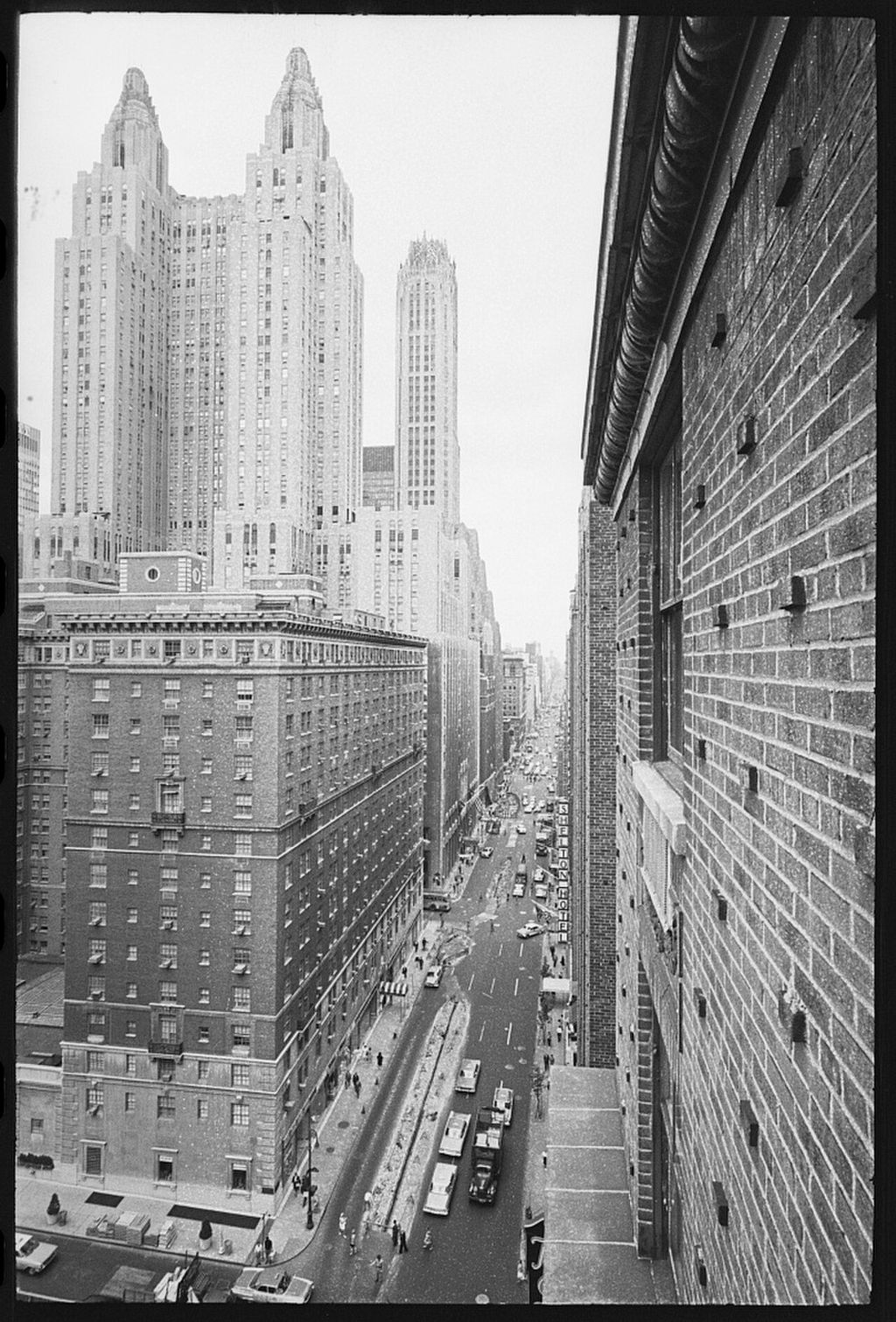
A general issue in O’Keeffe’s oils is a reason to seek examination, not a diagnosis of this canvas. The Library of Congress photograph identifies the real building and supports comparison of its architecture.[25] It cannot identify O’Keeffe’s exact viewpoint or prove which visual changes were made at what stage. Comparison should reveal transformation without pretending to reconstruct process.
Reproduction and postcard afterlife
The painting became a reproduced image early, and circulation continued after it entered Fisk. Around 1959 O’Keeffe sent Charles Wickham Moore a postcard carrying the painting on its front.[23] The object moved from canvas to a small mailed picture accompanied by private correspondence. That format reverses the original scale.
A four-foot tower becomes something held in one hand, while the red name and bright windows must survive reduction. The postcard also binds public icon and personal communication, echoing the way the painted sign binds city spectacle and intimate relationship. Digital reproduction changes it again. Backlit screens can exaggerate blue saturation and white luminosity; crops can remove frame and proportions; high contrast can make black appear uniform.
A text-led publication should state dimensions, owner, catalogue number and direct record rather than allowing a floating image to stand as the object. The copyright boundary is equally clear. The Access O’Keeffe record allows limited educational use under stated conditions and requires permission for commercial reproduction.[1] Public visibility does not make the image public domain.
Interpretive possibilities
As a modern-city picture, the canvas celebrates architectural novelty and electric night. The building had been designed as a visual landmark, and O’Keeffe gives it a commanding presence.[3][4] This interpretation explains upward scale and illumination. As a portrait of Stieglitz, it replaces a body with a red name. It may honour the person who promoted modern art while recognising that promotion itself operates like advertising.
The sign’s subordinate position allows affection and irony to coexist.[2] As a study in abstraction, the canvas arranges one black vertical, a blue field, white diagonals and a red horizontal accent. Architectural identification enriches rather than cancels those relations. The work shows how representation can produce abstraction through selection. As an institutional object, it carries O’Keeffe’s attempt to broaden access to modern art in the South and the later struggle to sustain that purpose.
This history does not reside inside the depicted tower, but it now governs how the physical painting moves and is seen.[14][15] No single interpretation absorbs the others. Their evidence differs: visible form, architectural history, curator inference, correspondence, court record and exhibition practice. A rigorous account marks those differences rather than blending them into an all-purpose symbol.
Close looking
Begin at the bottom. Find the broken skyline and the red name, then ask how quickly the eye leaves it for the black shaft. Notice that the building does not need a detailed base to feel immense. Follow the windows upward.
Their irregular illumination prevents the façade from becoming a simple grid. At the crown, compare physical structure with the white light that makes it seem partly suspended. Then follow the opposing movement: smoke and beams crossing sideways through the blue. The canvas holds vertical ascent against atmospheric drift.
Its drama depends on both. Finally remember the object’s second geography. The painted site is Manhattan, but the canvas’s educational home became Fisk in Nashville and is now shared with Crystal Bridges in Arkansas. Place in this work includes subject, making, gift and present custody.
Why the painting matters
Radiator Building—Night, New York restores O’Keeffe to the technological city without treating the city pictures as a detour from her “real” nature subjects. Architecture, smoke, light and night provide the same opportunity to test scale, contour and perception that she found in flowers, shells and hills. It also refuses a simple story of modern triumph. Corporate branding and avant-garde promotion meet; black solidity is disrupted by fog; a husband’s name glows inside his wife’s composition; an image of metropolitan power enters a historically Black university under conditions meant to broaden ways of seeing.
The painting’s history keeps changing. The 1927 date rests beside a 1925 label. An individual gift became disputed shared property. Recent exhibitions have repositioned the New York work within O’Keeffe’s career, and the first comprehensive architectural survey opened in 2026. The tower remains fixed on canvas, but the institutions and arguments around it continue to move.
Discussion
Which piece of evidence most changes the way you read Radiator Building—Night, New York?
Reader Insights
Which visible detail most changes your reading of Radiator Building—Night, New York?
How do medium, setting and documented history shape the encounter?
What remains uncertain when documented fact is separated from interpretation?
Join the Conversation
Share your reading of Radiator Building—Night, New York below.
References
- Access O’Keeffe, Radiator Bldg – Night, New York, 1927, CR 577. View Source
- Crystal Bridges Museum of American Art, Radiator Building—Night, New York, ASC.2012.73. View Source
- Jennifer Padgett and Steven Zucker, “Georgia O’Keeffe, Radiator Building—Night, New York,” Smarthistory. View Source
- New York City Landmarks Preservation Commission, American Radiator Building (now American Standard Building), designation report, 1974. View Source
- Brown University, Raymond Hood exhibition, “American Radiator Building.” View Source
- Bryant Park, “The Grounds,” American Radiator Building. View Source
- Museum of Modern Art, Paintings by Nineteen Living Americans, 1929–30 exhibition catalogue. View Source
- Museum of Modern Art, press release for Nineteen Living Americans, 1929. View Source
- Murdock Pemberton, “But We Know What We Like,” The New Yorker, 21 January 1928. View Source
- Metropolitan Museum of Art, East River from the Shelton Hotel, 1928. View Source
- Access O’Keeffe, The Shelton with Sunspots, N.Y., 1926, CR 540. View Source
- Georgia O’Keeffe Museum, “Ritz Tower.” View Source
- Georgia O’Keeffe Museum, “From the Curator: Georgia O’Keeffe, East River, 1932.” View Source
- Tennessee Court of Appeals, Georgia O’Keeffe Foundation (Museum) v. Fisk University, 2009. View Source
- Tennessee Court of Appeals, In re Fisk University, 2011. View Source
- Crystal Bridges, “The Artists’ Eye: Georgia O’Keeffe and the Alfred Stieglitz Collection.” View Source
- Crystal Bridges, Many Ways of Seeing: The Alfred Stieglitz Collection, 2026. View Source
- Georgia O’Keeffe Museum, “The Stieglitz Collection at Fisk University.” View Source
- Lee Ann Custer, review of Georgia O’Keeffe: “My New Yorks”, Panorama, 2024. View Source
- Detroit Institute of Arts, Georgia O’Keeffe: Architecture. View Source
- Detroit Institute of Arts, press release for Georgia O’Keeffe: Architecture, 2026. View Source
- Access O’Keeffe, Georgia O’Keeffe: Architecture exhibition record. View Source
- Georgia O’Keeffe Museum Archives, postcard to Charles Wickham Moore, c.1959. View Source
- Georgia O’Keeffe Museum, “Conservation and Technical Documentation.” View Source
- Library of Congress, Am. Radiator Co. Bldg. View Source
- Museo Nacional Thyssen-Bornemisza, Calle de Nueva York con luna (New York Street with Moon), Spanish collection essay. View Source
- Crystal Bridges Museum of American Art and Fisk University, Many Ways of Seeing: The Alfred Stieglitz Collection, publication page, 2026. View Source
- Access O’Keeffe, “Artist’s Chronology.” View Source