


 by Tom Gurney
Tom Gurney BSc (Hons) is an art history expert with over 20 years experience
Page Created on September 22, 2026 / Page Updated on September 22, 2026
Email: tomgurney1@gmail.com / Phone: +44 7429 011000
Introduction
A blue mountain fills nearly half the canvas, yet Georgia O’Keeffe does not make it an impassable wall. Bands of plain, trees and foothills lead towards it. Pink light travels through the blue mass. Above, a pale sky presses close to the summit. Below, autumnal yellow, green and red vegetation gathers into a brilliant horizontal seam.
Pedernal is a picture of distance made unusually intimate. The painting dates from 1941–42 and belongs to the Georgia O’Keeffe Museum. It is oil on canvas, measures 20 1/8 × 30 1/4 inches (51.1 × 76.8 cm) and has catalogue raisonné number 1029.[1] Those details matter because O’Keeffe made several works of this mountain in 1941, and another canvas in the same museum is also called Pedernal.
Confusing the two changes the dimensions, colour, exhibition history and technical evidence. Cerro Pedernal was visible from O’Keeffe’s Ghost Ranch house. Its Tewa name is Tsí Pín, and the land around it has never been the unoccupied wilderness implied by older accounts of the artist’s solitude. The painting can be read as an intensely personal encounter with a recognised profile while also belonging to a landscape with Tewa names, histories and present-day communities.[4][7]
At a Glance
- ArtistGeorgia O’Keeffe
- ArtworkPedernal
- Artistic contextAmerican modernism
Contents
- Object identity
- Which Pedernal ?
- Mountain, colour and visible making
- Date evidence
- Ghost Ranch and the Pedernal sequence
- My mountain and the limits of possession
- Tsí Pín, geology and human history
- Scientific imaging and pigments
- Metal soaps and technical correction
- Materials and exhibition pressure
- The 1943 debut
- Later exhibitions and international reception
- Provenance
- Landscape, abstraction and likeness
- Competing interpretations
- Unknowns and close looking
- The landscape’s present life
- Why Pedernal matters
Object identity
- Artist: Georgia O’Keeffe (1887–1986)
- Title: Pedernal
- Date: 1941–1942
- Medium: oil on canvas
- Dimensions: 20 1/8 × 30 1/4 inches (51.1 × 76.8 cm)
- Catalogue raisonné: CR 1029
- Collection: Georgia O’Keeffe Museum, Santa Fe
- Accession: 1997.5.12
- Credit: Gift of The Burnett Foundation and The Georgia O’Keeffe Foundation[1]
The catalogue raisonné title comes from O’Keeffe’s Abiquiú Notebooks and the Downtown Gallery Archive. Printed labels prepared by the artist preserve two alternatives: The Pedernal and Pedernal, Blue and Yellow. The last is especially useful because it records colour as part of the work’s historical identity rather than as a later critic’s impression.[1]
Which Pedernal?
The title is deceptively simple. CR 1029 is the pale, predominantly blue landscape dated 1941–42, measuring just over twenty by thirty inches. The Georgia O’Keeffe Museum also owns CR 1022, Pedernal of 1941, a slightly smaller oil measuring 19 × 30 1/4 inches. That work has a darker green mountain, dense orange-green growth and the alternate titles My Front Yard – Autumn and Pedernal Dark Green.[16]
The distinction is not pedantry. CR 1022 appeared in O’Keeffe’s 1942 exhibition of recent 1941 paintings and has since travelled in exhibitions including O’Keeffe and Moore. CR 1029 first entered the recorded exhibition history in 1943 and remained with the artist.[1][16] Conservation publications have also used the short title Pedernal for both canvases. Readers must check catalogue numbers, accessions and measurements before applying a technical finding.
There is a third closely related 1941 canvas, My Front Yard, Summer, CR 1023. Its mountain is green rather than blue, and its title turns the landscape into the view immediately associated with home.[17] O’Keeffe’s series is therefore not a set of interchangeable mountain pictures. Each work tests season, distance, palette, scale and the relation between foreground and summit.
Mountain, colour and visible making
The canvas is built in receding horizontal zones. A pale sandy strip occupies the bottom. Small green shrubs punctuate it, then a low wall of foliage stretches across the width. Yellow crowns, deep green masses and isolated red accents make this the most saturated band in the picture. Beyond it lies a broad, muted plain.
O’Keeffe marks distance with changes of tone more than with conventional perspective. Thin grey-brown and pale green strips pass laterally across the land. Dark clusters of trees become smaller as they recede, but they remain simplified marks rather than individually described plants. A low chain of pink-and-blue foothills divides the plain from the mountain. Their angular forms are more emphatic on the right, where a pale pink ridge enters from the edge.
Higher up, the mountain expands into a great blue body. Rose-coloured facets interrupt it, particularly along the upper right slope and through the interior ridges. The summit is almost centred but not symmetrical. Its flat top rises into a rounded projection on the right, then drops into long descending shoulders. Cream cloud presses behind and partly around the profile.
Patches of clear turquoise-blue sky open near the upper corners and above the summit, so mountain, cloud and atmosphere remain distinct without becoming hard-edged cut-outs.[1] Pedernal looks monumental partly because O’Keeffe denies the viewer an uninterrupted middle distance. The foreground vegetation, plain, foothills and mountain are stacked tightly. Each band is shallow in itself, but together they create a long approach.
The mountain’s base is hidden behind the foothills. Its visible body begins high in the composition and spreads nearly from edge to edge. This cropping enlarges it without requiring a close viewpoint. The viewer understands distance from the receding bands while feeling the mountain’s scale through its occupation of the canvas. The central summit supplies stability, but the lower bands refuse stillness.
Shrubs bunch and separate; horizontal lines broaden and narrow; pink ridges point diagonally. The painting moves laterally and inward at once. O’Keeffe does not reproduce the irregular surface as a topographical inventory. She selects the features needed to make a recognisable structure: the flattened summit, sloping shoulders and layered approach. Reduction makes the mountain legible, while the changing colour prevents it from becoming a logo.
The alternate title Pedernal, Blue and Yellow identifies the principal chromatic relation.[1] Blue dominates the mountain and appears again in distant ridges and sky. Yellow concentrates in the near foliage. These colours establish far and near, cool mass and illuminated growth. They are not isolated opposites.
Green mediates between them in trees and scrub, while pink crosses the blue mountain and reappears in the nearer hills. Warm colour therefore penetrates distance rather than staying in the foreground. Cool colour reaches forward through shadowed vegetation. The mountain is not filled with one uniform blue. Broad areas shift between pale powder blue, blue-grey and stronger cyan.
Pink underforms or overlying passages expose its internal ridges. The effect resembles atmospheric light travelling across a solid form, but it also makes the mountain feel less materially fixed. The pale sky intensifies that ambiguity. Cream cloud and bare canvas-toned passages approach the lightest values in the foreground. Instead of a dark object silhouetted against brightness, the mountain shares softened tones with the air around it.
The museum catalogue identifies oil on canvas, and close viewing of the museum’s image shows a surface that does not conceal every stroke.[1] Broad horizontal applications establish the sky and plain. Shorter, rounded touches accumulate into trees. The mountain is constructed from overlapping blue and pink passages rather than polished into an optically seamless surface. Its outer contour varies.
Some sections are relatively crisp, especially around the summit; others soften where cloud and blue meet. This modulation prevents the outline from becoming equally emphatic everywhere. The viewer alternates between reading a named mountain and attending to adjacent fields of paint. The foreground foliage is more broken. Dark green forms anchor the band, and yellow-green strokes flare above them.
Red marks are sparse but strategically placed. They slow the eye at points across the width and keep the lower zone from merging into decorative pattern. These are visual observations, not a complete reconstruction of technique. The painting has been scientifically examined, but no public report supplies a full layer map or chronological sequence for every passage. Visible brushwork can support an account of handling; it cannot by itself prove which colour was laid down first.
Date evidence
The catalogue currently gives 1941–42. It also records that the Downtown Gallery Archive and O’Keeffe’s Abiquiú Notebooks date the work 1941. The Whitney Archive did not record it.[1] This apparent tension should remain visible. The range may reflect later catalogue judgement about completion or documentation, while the surviving artist and gallery records support 1941.
Public evidence does not identify a particular day, month or second campaign in 1942. Access O’Keeffe explains why such distinctions require care. O’Keeffe sometimes began a work in one place and completed it elsewhere, and the catalogue raisonné reconciles inscriptions, notebooks, Downtown Gallery material and Whitney records when they disagree.[30]
In CR 1029, the inaccessible stretcher and verso remove two potential sources of further evidence.[1] It is safest to use the museum’s preferred 1941–42 date while stating the archival alternatives. Calling it simply “the 1941 painting” may be convenient, but it obscures the catalogue’s unresolved range and increases the risk of collision with CR 1022.
Ghost Ranch and the Pedernal sequence
O’Keeffe bought her Ghost Ranch house in 1940 after renting nearby accommodation during earlier New Mexico seasons. The U-shaped Pueblo Revival house opened around a south-facing patio, and the view towards Pedernal became one of its defining relationships.[4] National Park Service research describes the flat-topped peak as a recurring feature across twenty-nine paintings and drawings made between 1936 and 1958. In early works it may be a distant sign behind red hills or a partially obscured profile; by 1941 it could dominate the entire landscape.[4] The house made repetition possible.
O’Keeffe did not encounter Pedernal only as a spectacular destination. It was part of weather, season, daily movement and the framed view from a working home. The photographic archive includes the Ghost Ranch patio with Pedernal and later images of the mountain and surrounding landscape.[29] That familiarity does not establish an exact easel position for CR 1029. The public catalogue does not identify a window, patio point or road location.
The painting should be located within the Ghost Ranch field of vision without converting a plausible view into a surveyed coordinate. The works catalogued around CR 1029 show how actively O’Keeffe tested the motif. A graphite drawing, Untitled (Road to Pedernal), CR 1019, establishes a direct route towards the mountain. The related six-by-ten-inch oil CR 1020 keeps the road cresting a slight hill with Pedernal centred beyond it.[19][20] Untitled (Pedernal), CR 1021, is a seven-by-sixteen-inch oil on board.
A small blue silhouette sits below a dark sky while broad red forms occupy much of the foreground. Its catalogue title is based on its relation to CR 1022, showing how later cataloguing can encode a visual sequence even when O’Keeffe’s notebooks do not name an object.[18] CR 1022 converts the mountain into a dark green autumn presence. My Front Yard, Summer, CR 1023, makes the domestic viewpoint explicit and distributes cooler greens across the foreground.[16][17]
CR 1029 then enlarges the blue mountain while introducing pale cloud and a band of yellow growth. These variations matter more than a search for one definitive likeness. O’Keeffe could approach by road, look across her front yard, compress the mountain into a distant strip or allow it to fill the canvas. Repetition was an instrument for discovering difference. In Pedernal with Red Hills of 1936, CR 900, the mountain rises beyond red-brown foreground hills.
Its title history and inscriptions show how carefully colour and landform were combined in the work’s identity. The New Mexico Museum of Art now identifies its support as linen, correcting the catalogue raisonné’s earlier “oil on canvas” description.[21] That later institutional correction is a useful reminder that object records remain open to material verification. Datura and Pedernal of 1940, now at the Orlando Museum of Art, places a flower against the distant mesa.
Near botanical form and far geological profile occupy one compact field.[24] CR 1029 removes such a single foreground emblem. Its band of vegetation belongs to the landscape rather than hovering before it. The 1945 pastel Pedernal, CR 1117, stretches to more than forty-three inches wide and places the mountain beneath a large red-and-blue abstract sky form. Conservation research identifies ultramarine, cobalt–Prussian blue, zinc oxide and red lead in that pastel and records visible white underdrawing.[22]
Those findings belong to the pastel, not to CR 1029, but the work demonstrates how the mountain could persist while medium and spatial language changed radically. In Pedernal – From the Ranch II of 1958, the profile appears through an oval opening in a pale orange foreground form.[23] Across two decades, the mountain moves between observed landscape, framed distance and near abstraction without losing its distinctive top.
My mountain and the limits of possession
O’Keeffe repeatedly used possessive language for Pedernal. A 1944 letter to the filmmaker Henwar Rodakiewicz describes haze and “my mountain” floating light blue in the distance like a dream.[5] The phrase is later than CR 1029, so it should not be presented as a studio note for the canvas. It does, however, confirm the importance of blue atmospheric change within her continuing observation. The letter also records a world more variable than the iconic silhouette suggests.
On one day individual trees could be visible; on another the whole mass could seem to float. CR 1029 holds both conditions together: its summit is recognisable, while pale colour and cloud reduce its physical certainty. O’Keeffe’s much repeated claim that God would give her the mountain if she painted it enough belongs to her later public mythology. It is often quoted as evidence of devotion, humour or spiritual possession.
The actual series supports the devotion; the language of ownership now requires a more critical hearing. When O’Keeffe died in 1986, her ashes were scattered on Pedernal, further binding the mountain to accounts of her life.[6] That biographical ending should not be used to turn a 1941–42 landscape into a prediction of death. It documents the endurance of the relationship, not the original meaning of every earlier canvas.
Tsí Pín, geology and human history
The Georgia O’Keeffe Museum now foregrounds the mountain’s Tewa name, Tsí Pín. Its exhibition Tewa Nangeh/Tewa Country, developed with Tewa artists and scholars, describes the peak as a significant sacred landmark within the natural boundaries of traditional Tewa land.[7] This changes the ethical frame around “my mountain”. O’Keeffe owned a modest Ghost Ranch property and painted a view; she did not own the mountain or the histories attached to it.
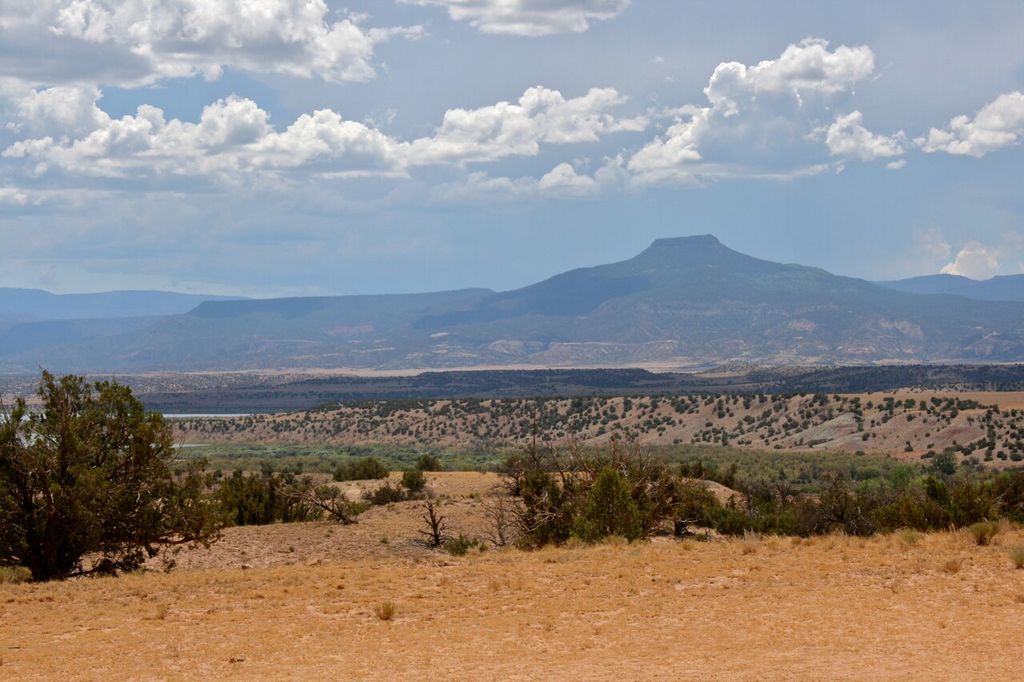
The canvas omits people, buildings and roads, but pictorial absence does not establish territorial emptiness. Co-curator Jason Garcia, from Kha’p’o Owingeh/Santa Clara Pueblo, has answered O’Keeffe’s repeated motif with an expanding series of his own works on paper. The project was designed to exceed the twenty-nine Pedernal works associated with O’Keeffe and to enact conversation and cultural reclamation rather than possession.[8] This response need not be added as a moral caption over the painting.
It supplies historical knowledge that older formal accounts excluded. A responsible reading can recognise the precision and feeling of O’Keeffe’s looking while refusing a frontier story in which an apparently empty view becomes available to the settler artist who names it most forcefully. The Spanish word pedernal means flint or chert. The United States Geological Survey records the Pedernal Chert Member of the Abiquiu Formation, named from Cerro Pedernal, and places the unit broadly in the Oligocene–Miocene.[10]
Detailed geological research describes the mountain as an isolated, basalt-capped peak near the boundary between the Colorado Plateau and the Rio Grande rift. Its strata preserve evidence for rift-margin subsidence and long periods of weathering. Silica replacement within ancient calcareous soils helped form the distinctive chert.[9] That stone connects geological time to human time. Archaeological evidence shows Pedernal chert used for tool manufacture over more than thirteen millennia.
Primary quarries and widely transported or redeposited cobbles complicate attempts to assign every artefact to a single extraction point.[9] The mountain is therefore neither a timeless blue symbol nor merely scenery behind O’Keeffe’s house. Its rocks circulated through long histories of knowledge, work and movement. Those histories are not visible as narrative incidents in CR 1029, but they prevent its unpeopled bands from being mistaken for an untouched land.
Scientific imaging and pigments
CR 1029 became a case study in conservation science because its paint surface contains numerous microscopic protrusions. A collaborative team from Northwestern University and the Georgia O’Keeffe Museum developed ultraviolet-induced fluorescence photometric stereo to map these features in three dimensions.[2] The method fixed a camera perpendicular to the surface and photographed a selected region under ultraviolet illumination from different directions. Fluorescence offered a more diffuse response than ordinary reflected light, allowing researchers to calculate surface normals, depth and albedo. The tested field measured roughly 7.6 × 5 centimetres, with sampling fine enough to resolve features around ten micrometres wide.[2]
The protrusions ranged from tiny raised points to larger forms several hundred micrometres across. Some had erupted “caldera-like” centres. Manual and automated detection methods were compared, although the automated method missed more small features when adjusted to avoid mistaking brush texture for deterioration.[2] This is important evidence about the actual object, not simply a general statement about O’Keeffe’s oils. The familiar smoothness of reproduction conceals a surface with its own chemical and topographical life.
A 2021 critical review of metal-soap analysis treated CR 1029 as an important case beyond O’Keeffe scholarship.[35] It emphasised the method’s capacity to map early-stage and aggregated alteration products and summarised the dominant protrusion size as roughly 100–200 micrometres. Its account confirms the painting’s place within a broader conservation problem, while adding no published time-series measurement of later growth. Scientific uptake strengthens the evidence for the phenomenon without converting a 2017 survey into a current condition report.
Metal soaps and technical correction
The same CR 1029 study used X-ray fluorescence mapping and portable Fourier-transform infrared spectroscopy. It identified iron-associated reds, chromium-based greens and cadmium-associated yellows and oranges within the examined area.[2] Lead was most concentrated in lighter passages, suggesting that lead white had been mixed with coloured paints to create pale tones. Those lead-rich regions also contained more protrusions. In beige, light green, light red, yellow and yellow-green areas, researchers counted far more raised features than in dark green, dark red and orange passages.[2]
Metal carboxylates were present across both protrusion-rich and protrusion-poor colours. Their presence alone did not determine whether a raised aggregate formed. The 2017 study therefore linked the uneven distribution most closely to the formulation and proportion of lead-white tube paint in particular colour mixtures, while treating the commercial primer as a less direct cause for this object.[2] The result complicates visual analysis.
The pale blues, pinks and yellow-greens that make the landscape luminous are also the areas where lead-rich mixtures have proved most vulnerable. Colour is simultaneously pictorial structure and changing material. A 2020 peer-reviewed investigation compared artist-primed and commercially pre-primed canvases and concluded that the layered, porous commercial preparation played a crucial role in lead-soap formation. Its Pedernal sample, however, came from CR 1022, the 19 × 30 1/4-inch 1941 painting, not from CR 1029.[3][16]
The two studies are related but not interchangeable. The later paper helps explain O’Keeffe’s use of commercial canvas during years of intense exhibition demand and demonstrates how ground composition can interact with upper paint. It does not overwrite the catalogue identity or object-specific results of the 2017 CR 1029 study. This distinction also explains why a bare title in secondary writing is inadequate.
“The conservation study of Pedernal” may refer to two canvases, different samples and evolving conclusions. Catalogue numbers and accessions turn apparent contradiction into a more precise research history. No public record located for CR 1029 gives a full treatment chronology or states how quickly its protrusions are currently changing. The imaging method was designed for repeat monitoring, but a method’s capacity should not be confused with published longitudinal results.
Materials and exhibition pressure
The conservation studies place material choice within career structure. During the decades of frequent annual exhibitions, O’Keeffe increasingly used commercially prepared supports rather than sizing and priming every canvas herself.[3] Efficiency mattered when new work was expected for regular New York display. CR 1029’s making therefore belongs to an art world as well as a remote landscape. The painting’s apparent quiet depends on manufactured canvas, tube colours, gallery records, transport and exhibition.
Its surface history joins Ghost Ranch observation to commercial materials and urban presentation. The museum’s 2010–11 exhibition O’Keeffiana: Art and Art Materials placed the work within precisely this material culture.[1] The earlier Frames of Preference display of 2003–04 examined O’Keeffe’s unusually deliberate framing practices, and CR 1029 was included.[12] The public object page does not identify CR 1029’s original frame or confirm that its present frame dates from 1943. Inclusion in a frame exhibition shows relevance to that history; it does not by itself supply a frame chronology.
The 1943 debut
The first recorded display was Georgia O’Keeffe: Paintings—1942–1943 at An American Place in New York, from 27 March to 22 May 1943. Alfred Stieglitz organised the exhibition.[11] The timing helps explain the date problem. A work documented in notebooks as 1941 could enter public view in a show named for 1942–43. Exhibition title, making date and completion range are separate forms of evidence.
The show followed O’Keeffe’s first large retrospective at the Art Institute of Chicago in January–February 1943.[6][33] The exact canvas is not listed by the current object record as part of that retrospective, so its participation should not be assumed merely because the dates are close. At An American Place, a New Mexico landscape entered a setting central to O’Keeffe’s New York career. Its blue mountain could be marketed as a far western subject, yet the painting’s layered colour and near abstraction also belonged to the modernist formal debates through which Stieglitz had promoted her work.
Later exhibitions and international reception
After its debut, the published exhibition history becomes quiet until the twenty-first century. The work appeared in Georgia O’Keeffe: Frames of Preference in 2003–04, then in O’Keeffiana: Art and Art Materials in 2010–11.[1][12] From 2012 to 2014 it travelled in Georgia O’Keeffe in New Mexico: Architecture, Katsinam, and the Land to the Montclair Art Museum, Denver Art Museum, Georgia O’Keeffe Museum and Heard Museum.
That exhibition combined landscapes with O’Keeffe’s images of regional architecture and cultural objects, an interpretive framework broader than isolated formal beauty.[13] It returned for a 2016 thematic display and then joined Georgia O’Keeffe: Living Modern, a seven-venue exhibition from Brooklyn to Florida between 2017 and 2020. Living Modern examined the artist’s clothing, photographed persona and control over public identity alongside paintings.[14] The object record lists CR 1029 in the Georgia O’Keeffe Museum’s main-gallery refresh beginning on 10 February 2024, with no closing date currently supplied.[15]
That makes the work part of the Museum’s continuing presentation rather than only a stored catalogue object. European and Canadian exhibitions have made Pedernal central to the international understanding of O’Keeffe’s New Mexico landscapes, but they have not always shown CR 1029. The Montreal Museum of Fine Arts described the 1941 CR 1022 Pedernal in French as part of a section on landscapes built from simplified form, shifts of light and monumental scale.[25]
A Spanish-language O’Keeffe Museum feature uses Camino a la Pedernal—Road to Pedernal—to discuss the artist’s colour cards and compositional thinking.[26] A bilingual Santa Fe civic education resource reproduces CR 1029 itself and asks learners to identify geological features before creating an abstract landscape, joining art vocabulary to terms such as volcanic neck, mesa, plain and plateau.[36] A German retrospective at the Kunsthalle München placed New Mexico’s bones, geological formations and adobe architecture within O’Keeffe’s break from European tradition.[27]
These sources reveal how the motif travels through languages, public education and institutions. They do not enlarge CR 1029’s own loan history.
The distinction matters because reproductions of one mountain painting can easily become commentary on another. MoMA’s 1946 retrospective later framed O’Keeffe’s New Mexico landscapes as an essential part of her achievement and was the museum’s first retrospective devoted to a woman artist.[32] CR 1029 is not identified on the current object record as a loan to that exhibition. Institutional importance and object-level participation must remain separate.
Provenance
The recorded provenance begins with O’Keeffe’s estate in 1986. In 1993 the work passed to the Georgia O’Keeffe Foundation. The Burnett Foundation acquired a partial share in 1996, and the painting was given to the Georgia O’Keeffe Museum in 1997.[1] Unlike many works sold through Stieglitz or the Downtown Gallery, CR 1029 remained in the artist’s possession until her death. That may indicate personal value, but the provenance record alone does not explain why she retained it or whether she refused particular offers.
The gift places ownership and interpretation within the institution devoted to her work. It also means that object data can be updated through direct examination. The current museum record, verified against the holding collection, supersedes loose online captions that omit the catalogue number or give CR 1022’s measurements.[1][30] Its provenance is explicitly sourced to the Museum in 2026, and its core fields were updated on 26 August 2026.[1] The Burnett Foundation’s partial share reminds us that transfer can be legally more complex than a simple chain of solitary owners. The museum credit preserves both foundation contributions rather than collapsing them into an undifferentiated bequest.
Landscape, abstraction and likeness
CR 1029 is representational enough for the mountain to be named, yet abstract enough for the painting to organise experience through bands, intervals and colour weights. Those qualities do not cancel each other. Recognition gives the simplified shapes their tension. A literal topographic reading would ask how accurately every ridge corresponds to the site.
A formal reading would treat blue, pink, yellow and green as an autonomous arrangement. The painting supports both approaches but is exhausted by neither. O’Keeffe’s repeated return suggests that likeness was not a one-time problem. The mountain could be blue in haze, green in autumn, distant behind a road, framed by a flower or compressed beneath an abstract sky.
Constancy of profile made variation visible. The O’Keeffe Museum’s Ghost Ranch Views project describes the house and patio as framing a magnificent view of Cerro Pedernal while bringing landscapes, bones and architectural images together.[31] That curatorial grouping is useful because it treats the mountain as one element in a larger practice of selecting, framing and recombining what was near at hand.
Competing interpretations
One interpretation sees Pedernal as an image of attachment: daily observation enlarges a distant formation until it fills the artist’s visual world. The retained painting, possessive language and repeated series support this account, although none proves a single private symbolism. A second treats the mountain as a modernist equivalent for stability. Its broad central mass holds together the restless colours below and the moving cloud above. Yet its softened blue also makes stability atmospheric and conditional.
A third reads the landscape through national myth. O’Keeffe’s New Mexico pictures helped create a widely circulated image of the American Southwest as spacious, spare and personally discoverable. The absence of figures can reinforce that myth even when the artist’s immediate concern was formal.[7] A fourth, supplied by current Tewa scholarship, asks who disappears when the view is described as empty and who can claim the mountain as “mine”.
This reading does not make the painting worthless or fraudulent. It changes the historical field within which its beauty operates.[7][8] A fifth begins with material science. The mountain and foliage are not stable colour fields but reactive oil mixtures whose microscopic protrusions distribute themselves according to pigment composition. The work’s future appearance depends on conservation decisions as much as its art-historical reputation.[2]
Unknowns and close looking
No located public source identifies CR 1029’s exact viewpoint, the day or season of painting, the number of sessions, a preparatory drawing, the order of paint applications or O’Keeffe’s intended final interpretation. The catalogue does not expose the stretcher or verso and gives no signature information. The public record also lacks a complete condition narrative, treatment history, original-frame record and current longitudinal measurements of the metal-soap protrusions.[1][2]
O’Keeffe’s 1944 letter proves how she described Pedernal three years later; it does not prove what she thought while making CR 1029. Later ownership sayings and the scattering of her ashes document an enduring relationship, but they cannot serve as retrospective instructions for every earlier picture.[5][6] The limits are productive. They keep visual analysis close to the canvas, archive and site while leaving room for interpretation that identifies itself as interpretation.
Begin at the bottom, where isolated shrubs sit in pale earth. Move to the dense yellow-green band and notice how the red accents interrupt it. Then cross the quiet plain by following the shrinking dark marks. At the foothills, compare pink shapes on the right with those embedded in the mountain. Warm colour creates a path through the cool mass.
Look at how little of the mountain’s base is visible and how that concealment increases its apparent size. Trace the summit against the cloud. Its most recognisable line is neither perfectly hard nor geometrically flat. Then step back and see how the mountain nearly becomes one blue interval among several horizontal bands. If viewing the original, remember that reproduction suppresses its microscopic relief.
The lighter mixtures contain many protrusions invisible at ordinary scale. Scientific images and naked-eye experience describe the same surface at different resolutions.[2] Finally, hold two names together: Pedernal and Tsí Pín. The first connects the Spanish word for flint to a long art-historical title. The second restores Tewa language and continuing cultural presence to the landscape the painting renders without inhabitants.[7][10]
The landscape’s present life
The view associated with O’Keeffe now participates in decisions about land protection. The Ghost Ranch Conservation Plan proposes voluntary easements across approximately 6,000 acres, including land near Abiquiú Lake, the Rio Chama and views towards Tsí Pín. The stated aims include preventing subdivision, protecting habitat, sustaining traditional ranching and preserving the vistas made famous by her paintings.[28]
This is an afterlife of representation with practical consequences. A painted landscape can help make a view culturally legible and therefore worth protecting. At the same time, preservation framed only through O’Keeffe risks repeating the erasure that Tewa Nangeh seeks to correct.
National Park Service cultural-landscape work treats views, circulation, buildings, gardens and environmental change as evidence rather than as a scenic backdrop alone.[34] That method suits CR 1029. The painting belongs to a network of home, sightline, geology, plant life, archives, communities and conservation. The canvas does not contain all those histories. Research places it among them.
Why Pedernal matters
Pedernal shows how repetition can deepen rather than exhaust a subject. O’Keeffe did not fix the mountain once. She tested how road, season, cloud, colour, distance and foreground altered its presence. CR 1029 is especially important because the history exists at several scales.
At viewing distance it is a lucid modern landscape. In the catalogue it is one member of a difficult same-title cluster. Under scientific imaging it becomes a terrain of reactive pigments and microscopic protrusions. Within Tewa history it depicts a sacred landmark that no artist’s affection can make private.
Its blue mountain appears calm, but the work is not static. Warm colour passes through cool form; cloud changes the summit; records shift the date; science revises the surface; contemporary voices revise the story of the land. The painting endures because its clarity can hold those complications without losing the force of looking.
Discussion
Which piece of evidence most changes the way you read Pedernal?
Reader Insights
Which visible detail most changes your reading of Pedernal?
How do medium, setting and documented history shape the encounter?
What remains uncertain when documented fact is separated from interpretation?
Join the Conversation
Share your reading of Pedernal below.
References
- Georgia O’Keeffe Museum, Access O’Keeffe, “Pedernal, 1941–1942,” CR 1029. View Source
- Johanna Salvant et al., “Photometric Stereo by UV-Induced Fluorescence to Detect Protrusions on Georgia O’Keeffe’s Paintings,” 2017. View Source
- Annette S. Ortiz Miranda, Dale Kronkright and Marc Walton, “The influence of commercial primed canvases in the manifestation of metal soaps protrusions in Georgia O’Keeffe’s oil paintings,” Heritage Science 8 (2020). View Source
- National Park Service/National Register of Historic Places, Georgia O’Keeffe Ghost Ranch House nomination. View Source
- Library of Congress, Georgia O’Keeffe to Henwar Rodakiewicz, 1944. View Source
- Library of Congress, “Georgia O’Keeffe: The Making of the Artist, 1887–1950, and After.” View Source
- Georgia O’Keeffe Museum, “Tewa Nangeh/Tewa Country,” press release, 2025. View Source
- Georgia O’Keeffe Museum, “‘Tewa Nangeh/Tewa Country’ Set to Open,” 2025. View Source
- Gary A. Smith and Bruce B. Huckell, “The geological and geoarchaeological significance of Cerro Pedernal, Rio Arriba County, New Mexico,” 2005. View Source
- United States Geological Survey, National Geologic Map Database, “Geolex — Pedernal.” View Source
- Georgia O’Keeffe Museum, Access O’Keeffe, “Georgia O’Keeffe: Paintings—1942–1943.” View Source
- Georgia O’Keeffe Museum, Access O’Keeffe, “Georgia O’Keeffe: Frames of Preference.” View Source
- Georgia O’Keeffe Museum, Access O’Keeffe, “Georgia O’Keeffe in New Mexico: Architecture, Katsinam, and the Land.” View Source
- Georgia O’Keeffe Museum, Access O’Keeffe, “Georgia O’Keeffe: Living Modern.” View Source
- Georgia O’Keeffe Museum, Access O’Keeffe, “2024 Main Galleries Refresh.” View Source
- Georgia O’Keeffe Museum, Access O’Keeffe, “Pedernal, 1941,” CR 1022. View Source
- Georgia O’Keeffe Museum, Access O’Keeffe, “My Front Yard, Summer, 1941,” CR 1023. View Source
- Georgia O’Keeffe Museum, Access O’Keeffe, “Untitled (Pedernal), 1941,” CR 1021. View Source
- Georgia O’Keeffe Museum, Access O’Keeffe, “Road to Pedernal, 1941,” CR 1020. View Source
- Georgia O’Keeffe Museum, Access O’Keeffe, “Untitled (Road to Pedernal), 1941,” CR 1019. View Source
- Georgia O’Keeffe Museum, Access O’Keeffe, “Pedernal with Red Hills, 1936,” CR 900. View Source
- Georgia O’Keeffe Museum, Access O’Keeffe, “Pedernal, 1945,” CR 1117. View Source
- Georgia O’Keeffe Museum, Access O’Keeffe, “Pedernal – From the Ranch II, 1958,” CR 1334. View Source
- Orlando Museum of Art, “Datura and Pedernal.” View Source
- Musée des beaux-arts de Montréal, “Georgia O’Keeffe et Henry Moore : géants de l’art moderne.” View Source
- Georgia O’Keeffe Museum, “Música Para Los Ojos: Una nueva experiencia de Georgia O’Keeffe.” View Source
- Kunsthalle München, “Georgia O’Keeffe.” View Source
- Ghost Ranch Conservation Plan, “Frequently Asked Questions.” View Source
- Georgia O’Keeffe Museum, Access O’Keeffe, “Georgia O’Keeffe Photographs.” View Source
- Georgia O’Keeffe Museum, Access O’Keeffe, “Information for Researchers.” View Source
- Georgia O’Keeffe Museum, “Georgia O’Keeffe: Ghost Ranch Views.” View Source
- Museum of Modern Art, “Georgia O’Keeffe,” 1946. View Source
- Metropolitan Museum of Art, Georgia O’Keeffe, Bulletin 42, no. 2, 1984. View Source
- National Park Service, “The Cultural Landscapes of Georgia O’Keeffe.” View Source
- Angelica Izzo et al., “A Critical Review on the Analysis of Metal Soaps in Oil Paintings,” ChemistryOpen 10 (2021), View Source.
- City of Santa Fe Arts Commission and Georgia O’Keeffe Museum, bilingual landscape-learning resource featuring Pedernal, 1941–1942, View Source.