


 by Tom Gurney
Tom Gurney BSc (Hons) is an art history expert with over 20 years experience
Page Created on September 22, 2026 / Page Updated on September 22, 2026
Email: tomgurney1@gmail.com / Phone: +44 7429 011000
Introduction
Landscape was not a single phase in Georgia O’Keeffe’s career. It was a method that changed with location, travel, scale, medium and memory. The Texas plains, Lake George, Manhattan’s elevated horizons, Hawai‘i, northern New Mexico and the sky seen from aircraft all generated distinct pictorial problems. Even objects usually separated from landscape—bones, flowers, doors and clouds—often organise a view of land or atmosphere. The familiar story of a painter escaping New York for an empty desert is too simple.
O’Keeffe made more than two hundred works during her Lake George years, worked from memory as well as direct observation, travelled through inhabited and politically layered places, and maintained relationships between city and country throughout her life.[2][3] Northern New Mexico was and remains Indigenous homeland, not vacant scenery. Recent museum work with Tewa artists, scholars and culture bearers directly addresses the erasure produced when O’Keeffe’s landscapes are narrated as untouched solitude.[22][23]
At a Glance
- ArtistGeorgia O’Keeffe
- SubjectGeorgia O’Keeffe Landscapes
- Artistic contextAmerican modernism
Contents
- Landscape as selection
- Scale, horizon and bodily orientation
- Texas and Lake George
- Lake George paintings and conservation
- Cultivated land
- New Mexico: encounter and continuity
- Black Mesa, Black Place and White Place
- Pedernal, view and possession
- Ghost Ranch and Abiquiú
- Tewa Nangeh and inhabited history
- Bones, flowers and montage
- Hawai‘i and travel
- Aerial landscape and clouds
- Technique, colour and abstraction
- Spiritual claims and conservation
- Titles, archives and “The Faraway”
- Crosses, markets and the Southwest
- How landscape worked across the career
Landscape as selection
O’Keeffe did not copy every visible detail. She selected contours, compressed distance, altered colour relations and repeated motifs until place became a constructed image. This was not a retreat from observation. A horizon, hill profile or river bend often anchors even the most reduced composition.
The distinction between observation and transcription matters. She could finish an oil months after encountering its subject, make a canvas “out of my head”, or return to the same mountain across decades.[16] Landscape therefore includes remembered duration. The painting records what survived attention, not a neutral inventory of terrain.
Scale, horizon and bodily orientation
Her landscapes range from small canvases that feel held in the hand to the twenty-four-foot width of Sky Above Clouds IV. A low horizon can make sky immense; a cropped hill can fill the support like a body; repeating clouds can remove any stable ground. Dimensions should precede interpretation because reproduction equalises radically different experiences. Landscape on Lake George is under sixteen inches wide, while the cloud mural engulfs peripheral vision.[4][20] Both simplify space, but one invites intimacy and the other requires bodily movement.
Texas and Lake George
The geographical sequence should begin before Texas. Untitled (Houses and Landscape) was painted in Virginia in 1916, before O’Keeffe moved to Canyon that August.[37] Its small watercolour sheet sets purple-walled, red-roofed houses against green-yellow ground, blue mountains and a narrow sky. The work matters because buildings and cultivated colour already interrupt any model of landscape as unpeopled expanse. Creases, abrasions and surface dirt also preserve the handling history of a working sheet rather than the immaculate surface suggested by reproduction.
The Texas works of 1916–18 formed O’Keeffe’s first sustained landscape sequences. Watercolour let sky, sunrise, evening star and canyon become bands, pools and radiating arcs. The plains appear vast, but they were inhabited, crossed by railways and connected to the college where she taught. These early works establish a recurrent tension. A specific weather event can become nearly abstract, while title and sequence preserve place.
Later European retrospectives begin the geographical arc with these “cosmic” responses to Texas before moving through rural New York and New Mexico.[27][29] From 1918 into the mid-1930s O’Keeffe spent part of most years at the Stieglitz family estate near Lake George. Scholarship once treated the property mainly as an obligation from which she wished to escape.
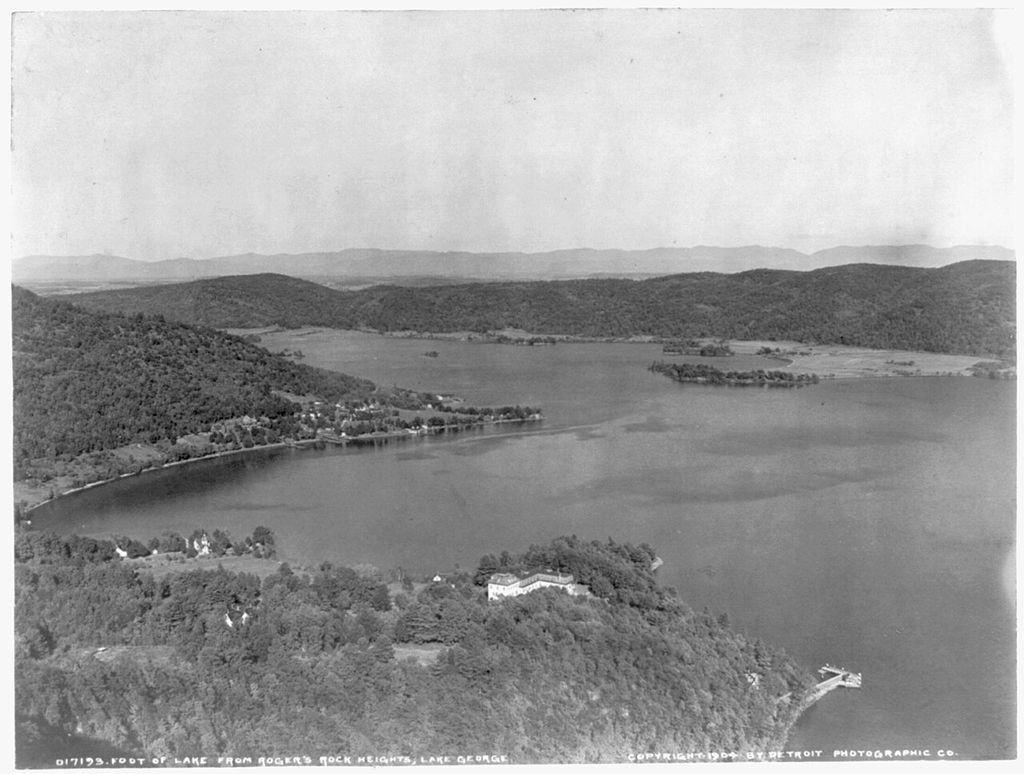
Modern Nature reconstructed it as one of her most productive environments: more than two hundred paintings and works on paper, including trees, leaves, fruit, barns, lake views and abstractions.[2][3] Work was seasonal. O’Keeffe painted during summer and autumn, then carried canvases to New York for completion and spring exhibition. Landscape was therefore entangled with household rhythms, transport, studio revision and the annual gallery calendar.
Lake George paintings and conservation
Landscape on Lake George of 1922 is oil on canvas, only 8¾ by 15⅞ inches, now at the New Mexico Museum of Art.[4] Black foreground forms meet a dark blue lake and hills; one long cloud crosses a pale sky. The compressed support makes each zone emphatic. Its provenance passes through Stieglitz to Rebecca Salsbury James in 1923 and eventually to the museum through her estate.
The early transfer indicates that a small landscape could participate in the same network of friendship, collection and exhibition as O’Keeffe’s larger abstractions. For years Storm Cloud, Lake George was read as a nocturnal tempest because accumulated glossy varnish darkened its surface. Conservation removed layers of later film and revealed an afternoon storm, along with what researchers believe is O’Keeffe’s earliest known use of matte-textured paint.[5][6]
This is a powerful warning about landscape interpretation. Mood may appear intrinsic while depending partly on altered material. Cleaning did not merely make the picture prettier; it changed the time of day and reopened the relation between colour, weather and texture. The museum’s decision to exhibit the canvas partly conserved allowed viewers to compare those histories directly.
Cultivated land
Lake George was not wilderness. Gardens, orchards, pasture, barns, woodland paths and domestic labour structured the estate. O’Keeffe painted at least twenty-five tree compositions and around twenty-nine leaf canvases, along with fruit and architecture.[2]
These subjects enlarge the meaning of landscape. A telescoped leaf can stand for seasonal change; a barn records working land; an apple links cultivation to still life. The site’s productivity came from movement among scales rather than from panoramic lake views alone.
New Mexico: encounter and continuity
O’Keeffe first travelled to New Mexico in 1929. The change in geology, light and distance was decisive, but it did not erase earlier methods. Met scholarship notes that the first landscapes used established approaches; after her second visit, panoramic scenes increasingly emphasised sculptural contours and receding layers.[7]
This continuity corrects the myth of instant rebirth. New terrain supplied new forms, while serial work, cropping and colour organisation had already been developed in Texas, Lake George and New York. Innovation emerged through encounter between place and practice.
Black Mesa, Black Place and White Place
The 1930 Black Mesa Landscape, New Mexico/Out Back of Marie’s II is oil on canvas, about 24 by 36 inches, at the Georgia O’Keeffe Museum.[9] Blue peaks, dark and purple ground and a lower strip of vegetation build distance in horizontal layers. Its compound title preserves two ways of locating the view: geological feature and personal proximity to Marie Tudor Garland’s property.
Backing labels also shifted from Taos to Black Mesa. Such revisions reveal landscape naming as historical work. A place is not secured simply by what later viewers think a profile resembles. Small Pelican sketchbook drawings reduce the mesa to a few graphite relations on seven-inch sheets.[10] They show how field observation could precede the larger studio canvas without predetermining it.
O’Keeffe called the Bisti/De-Na-Zin badlands she visited the Black Place. Across paintings and drawings, rolling grey-black formations fill the frame and narrow the sky. The Black Place of 1943 is a thinly painted, matte oil whose canvas weave remains visible; it survives unlined and apparently unvarnished in the artist’s original metal frame.[11] Other versions change scale, orientation and central cleft.
SFMOMA’s Black Place, I of 1944 fills the composition with paired dark hills, while small graphite studies record canyon profiles on textured paper.[12][13] The series moves between bodily proximity and geological distance. “Black Place” is O’Keeffe’s title, not a claim that the land lacked identity before her. The area holds Navajo histories and names. Describing it as a private discovery repeats the colonial habit of making inhabited land available through artistic possession.
The pale formations near Plaza Blanca generated another series. White Place in Shadow is dated 1941 through correspondence even though a backing inscription says 1940.[14] The White Place in Sun of 1943 opens a V-shaped blue interval between chalky cliffs.[15] Light does not simply reveal one stable landform; it produces a new arrangement. The White Place – A Memory makes mediation explicit.
O’Keeffe wrote that she painted a new White Place “out of my head”, and archive records called the canvas unfinished.[16] Memory does not weaken its status as landscape. It shows place being reconstructed after physical encounter. Todd Webb’s later photographs of O’Keeffe walking among the formations restore human scale that the canvases suppress. Comparing media resists the illusion that the painted cliffs are unmeasured emblems outside time.
Pedernal, view and possession
Cerro Pedernal’s flat top recurs from the 1930s through the 1950s. A small 1936 canvas renders it in purple with yellow and green light; a 1941–42 oil places it beyond coloured vegetation; a 1945 pastel transforms mountain and sky into broad chromatic shapes.[17][18] O’Keeffe’s famous claim that God promised her the mountain if she painted it enough is witty and revealing, but it must not become a property statement.
Repetition created artistic possession within an oeuvre; it did not supersede Indigenous relationships, land tenure or the mountain’s Tewa and other histories.[22] Later Pedernal – From the Ranch I places the distant peak inside the aperture of a pelvis bone.[19] Landscape is literally framed by an object gathered from the land. The device joins near and far while making ownership and collection part of vision.
Ghost Ranch and Abiquiú
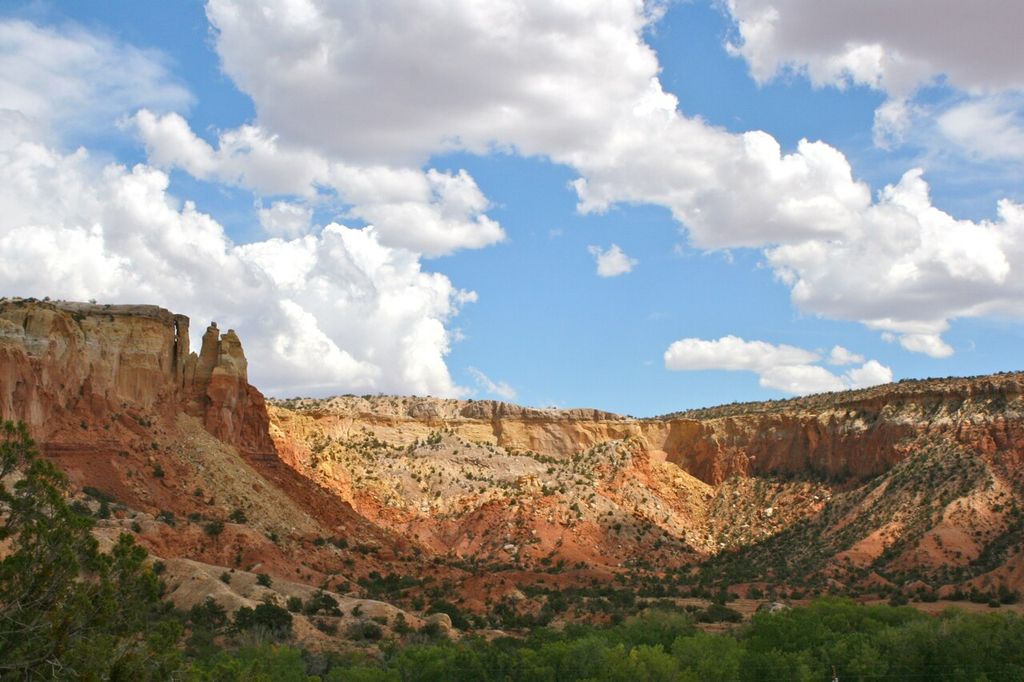
O’Keeffe first visited Ghost Ranch in 1934 and bought a house there in 1940. Its views included red and yellow cliffs and Pedernal, and the ranch became a summer centre for work.[8] A house does more than provide shelter: window, patio, road and habitual walk determine repeated viewpoints. “Remote” is a relative description.
Her landscape practice also depended on mobility, equipment and physical endurance. An O’Keeffe Museum exhibition reconstructs camping and day trips through photographs, boots, tent, lantern, cooking vessels and other personal effects; it records that she first rafted the Colorado River at seventy-four.[31][32] These materials replace the frictionless myth of solitary inspiration with preparation, transport, weather and bodily effort. They also connect her excursions to the expanding culture of American outdoor recreation, whose access to land was structured by roads, guides, tourism and uneven histories of possession.
The ranch was connected to employees, guests, neighbouring communities and histories of Indigenous and Spanish colonial land use. Solitude was cultivated within a social landscape, not proof of emptiness. O’Keeffe acquired the Abiquiú property in 1945 and completed its renovation before making it her permanent home in 1949. Courtyard walls, door, road and surrounding valley became both subjects and frames for looking.
Domestic architecture organised access to land. This complicates the division between landscape and architecture. A patio wall may occupy most of a canvas while a small opening releases sky; a road may lead outward from the house; collected stones bring exterior geology inside. The home was an evolving working environment rather than a picturesque backdrop.
Tewa Nangeh and inhabited history
The Georgia O’Keeffe Museum’s Tewa Nangeh/Tewa Country brings artists, scholars and culture bearers from Nambé, Pojoaque, San Ildefonso, Ohkay Owingeh, Santa Clara and Tesuque into dialogue with O’Keeffe’s northern New Mexico work.[22][23] Its premise is corrective: landscapes described as isolated or untouched are homelands marked by sacred relationships, belonging and cultural ownership.
This does not require removing O’Keeffe from the story. It requires changing the story’s scale. Her paintings document one settler artist’s sustained vision; Tewa knowledge establishes that the land exceeds that vision. Contemporary Indigenous voices are primary interpreters of their own country, not contextual decoration.
The museum had already tested a different model of American landscape in its 2012 Jaune Quick-to-See Smith exhibition.[36] Smith’s Petroglyph Park works addressed contested lands beside the Río Grande through figures, signs and modernist abstraction, while the institution described them as “inhabited landscapes”. That comparison is historiographic rather than evidence of influence on O’Keeffe. It demonstrates that abstraction need not require emptied terrain and that Indigenous modernism can speak about land from within political belonging, rather than entering only as a correction to a settler painter.
Bones, flowers and montage
O’Keeffe sometimes suspended skulls, flowers or pelvis bones against distant hills and sky. These arrangements are neither straightforward still lifes nor transparent records of outdoor scenes. They join objects collected near the ground to remote landscape through studio montage. The method disrupts normal scale.
A bone can exceed a mountain; a flower can float above hills. Such canvases show that her landscapes were constructed arguments about seeing. They should also prompt questions about collecting: who is entitled to gather, name and relocate material from a place?
From the River—Pale of 1959 reverses that relation between object and view.[35] The painting resembles a pale, branching river system seen from above, yet the catalogue identifies its source as a stick O’Keeffe found beside the river. A 1963 Todd Webb photograph shows the stick on a table beside her easel and the finished canvas. Documentary evidence therefore prevents an easy aerial reading: a portable fragment generated a landscape-like structure. The transformation joins collection, memory and formal analogy without pretending that the canvas maps an actual watercourse.
Hawai‘i and travel
In 1939 O’Keeffe spent two months travelling through O‘ahu, Maui, Kaua‘i and Hawai‘i Island on a commission connected to the Hawaiian Pineapple Company. She painted coasts, waterfalls, lava, valleys, tools and flowers.[21] The work extends her landscape practice beyond the continental United States and beyond the arid Southwest. The commission also places these views inside plantation agriculture, tourism and US territorial power.
Hawaiian land cannot be reduced to tropical difference. The most responsible account preserves the visual intensity of ‘Īao Valley and lava coast paintings while acknowledging Indigenous Hawaiian history and the corporate conditions of the trip. O’Keeffe also worked from the Gaspé Peninsula, Bermuda, Peru and Colorado River travel. These bodies vary in size and medium, and some are better understood as drawings or aerial studies than as conventional landscape painting.
The 1932 Gaspé works show that travel landscape could include buildings and religious markers rather than scenery alone. White Canadian Barn, No. 2 stretches a bright barn and two black doors across a 12-by-30-inch canvas, while Cross by the Sea, Canada acquired titles specifying both Gaspé and the coast.[38][39] Their archival title changes reveal how “Canada” became a portable exhibition category in New York. The paintings register selected structures, not an account of local community, language or economy; that limitation belongs within their travel history.
Peru produced another materially varied group. Peruvian Landscape of 1956–57 is watercolour on paper, while a graphite Untitled (Peru) occupies the reverse of a sheet whose other side later received an undated landscape drawing.[33][34] The double-sided support resists counting every catalogue image as a separate object and records continued reuse after travel. Watercolour and graphite also preserve a speed and portability different from the large studio oils. “Peru” locates one encounter, but it cannot turn a brief journey into comprehensive knowledge of Andean land or culture.
Together they show that “place” was not limited to homes. Travel does not automatically produce understanding. A brief encounter yields different knowledge from years of repeated walks. The catalogue must therefore keep date, medium and circumstances close to each claim rather than treating every distant site as evidence of a universal communion with nature.[1]
Aerial landscape and clouds
Air travel supplied a viewpoint detached from road, house and ground. Sky Above Clouds IV of 1965 measures eight by twenty-four feet. Rows of white cloud forms diminish towards a pink-blue horizon, creating a landscape without visible land.[20] The repetition is optical and abstract.
Near clouds behave like separate ovals; distant ones merge into pattern. Its scale approaches mural painting and requires the viewer to scan rather than grasp it at once. The work extends the elevated view of the Shelton into atmospheric infinity, but commercial aviation replaces the skyscraper window.
Technique, colour and abstraction
O’Keeffe used commercial paints and maintained a stable core palette across decades, including alizarin red, lead and zinc whites, chromium green, cerulean and cobalt blues, cadmium yellow, lead red, iron-oxide reds and earth colours.[26] She also tested additives and kept samples beneath a glass palette. This material continuity helps explain how new places could enter a recognisable practice without becoming formulaic.
New Mexico did not simply hand her “bright colour”; she mixed, layered and selected pigments within a disciplined studio system. Support proportions, unpainted grounds and texture were likewise planned. The Fondation Beyeler retrospective stresses O’Keeffe’s movement between images close to abstraction and images close to natural description.[28][29] Landscapes make that mobility explicit.
A recognisable mesa can become stacked colour; a cloud field can become a grid; a canyon wall can fill the support until scale becomes uncertain. Abstraction and place are therefore not opposites. Titles and series retain geography even when the image sheds topographic detail. Conversely, a precise hill profile can operate as an abstract edge. O’Keeffe’s modernism resides in keeping both readings active.
Spiritual claims and conservation
European retrospective scholarship connects O’Keeffe’s feeling for nature to Romanticism and to the pantheistic thought associated with D. H. Lawrence.[27] This can illuminate the scale of her skies and the emotional charge of geological forms. It can also universalise too quickly. “Nature” is not outside history, and spiritual language may erase land use, sovereignty and environmental change. Romantic inheritance should be treated as one interpretive tradition alongside object history, Indigenous scholarship and material evidence.
The cleaning of Storm Cloud shows that conservation can alter art-historical conclusions. Technical evidence for The Black Place—thin paint, visible weave, matte unvarnished surface and original metal frame—likewise defines how its hills meet the eye.[5][6][11] A glossy reproduction can falsify a matte desert; yellowed varnish can turn afternoon into night; cropping can remove the amount of sky that establishes scale. Landscape interpretation must begin with the current object and its treatment history, not colour memory from books.
Titles, archives and “The Faraway”
Landscape titles often accumulated through artist inscriptions, Stieglitz labels, gallery inventories and later catalogue decisions. Black Mesa Landscape preserves corrected place wording; White Place in Shadow has a date conflict; Pedernal works share generic titles across years.[9][14][17] These are not clerical irritations. A wrong title can move a scene; a wrong date can reverse the order of a series; a shortened caption can merge distinct objects. The digital catalogue raisonné provides the controlling framework, while current owner records can add conservation and provenance updates.[1]
The phrase “the faraway” became closely associated with O’Keeffe’s New Mexico through her own language and later exhibitions. The Thyssen’s digital project places Black Mesa Landscape, New Mexico/Out Back of Marie’s II beside paintings that combine hills with skulls and flowers, making clear that distance was repeatedly framed, interrupted and brought into the studio.[25] “Faraway” describes an experience from O’Keeffe’s position, not an objective quality of the land. Communities already lived within and named these regions. The term is useful when treated as a record of metropolitan travel and desire; it becomes misleading when it converts proximity for Indigenous residents into universal remoteness.
Crosses, markets and the Southwest
The National Gallery’s Black White and Blue study relates O’Keeffe’s post-1929 work to crosses, parched land and an increasingly monumental, iconic scale. It notes that New York and New Mexico were the subjects that most consistently prompted large canvases.[30] The comparison helps explain why landscape can feel architectural and why a cross can organise the surrounding country as strongly as a mountain. Religious symbolism, however, is historically situated.
Crosses in northern New Mexico arise within Spanish colonial and Hispano Catholic traditions on Indigenous land. Formal monumentality should not collapse those histories into a timeless “Southwest”. Nor should O’Keeffe’s statement that one must feel the crosses be treated as the only valid response. The painting records her encounter with a layered cultural landscape. O’Keeffe sent works back east for exhibition, where New Mexico was presented to metropolitan audiences through An American Place and later museums.
The landscape’s meaning was therefore produced between site, studio, title and gallery. Collectors could purchase a view of the “faraway” without sharing its journey. The 2021 Madrid, Paris and Basel retrospective traced the career geographically from Texas and New York to New Mexico, demonstrating the continuing power of place in international reception.[24][27][28] Such exhibitions broaden access while also packaging complex regions into legible chapters. Their framing deserves analysis alongside the paintings.
How landscape worked across the career
Start by locating the horizon and the viewer’s implied position. Identify whether the work was made from a habitual view, a journey, a memory or a series of studies. Check physical size, support and present surface. Compare related versions before treating one canvas as definitive. Then ask what the image excludes.
Are roads, buildings or people removed? Does the absence serve formal concentration, and what histories might it conceal? Use Indigenous names and scholarship where available. Finally, distinguish the artist’s title and recollection from later museum interpretation. Landscape offered O’Keeffe a way to test distance.
Texas light could be reduced to arcs; Lake George condensed into dark bands; New Mexico hills became bodily folds; a mountain passed through a pelvis aperture; airborne clouds extended beyond conventional ground. The continuity is not a single style but a repeated act of choosing relations. Her achievement becomes richer when solitude is separated from emptiness and personal attachment from ownership. The paintings can be intense records of experience while remaining partial views of inhabited worlds. That double recognition—formal power and historical limit—is the basis for seeing them fully.
Discussion
Which piece of evidence most changes the way you read Georgia O’Keeffe Landscapes?
Reader Insights
Which visible detail most changes your reading of Georgia O’Keeffe Landscapes?
How do medium, setting and documented history shape the encounter?
What remains uncertain when documented fact is separated from interpretation?
Join the Conversation
Share your reading of Georgia O’Keeffe Landscapes below.
References
- Access O’Keeffe digital catalogue raisonné. View Source
- Georgia O’Keeffe Museum, Modern Nature: Georgia O’Keeffe and Lake George. View Source
- Access O’Keeffe, Modern Nature exhibition record. View Source
- Access O’Keeffe, Landscape on Lake George. View Source
- Georgia O’Keeffe Museum, Storm Cloud, Lake George conservation. View Source
- Georgia O’Keeffe Museum, conservation release for Storm Cloud. View Source
- Metropolitan Museum of Art Bulletin, Georgia O’Keeffe. View Source
- Georgia O’Keeffe Museum, Ghost Ranch Views. View Source
- Access O’Keeffe, Black Mesa Landscape, New Mexico/Out Back of Marie’s II. View Source
- Access O’Keeffe, Untitled (Black Mesa Landscape), CR1877. View Source
- Access O’Keeffe, The Black Place. View Source
- Access O’Keeffe, Black Place, I. View Source
- Access O’Keeffe, Untitled (Black Place). View Source
- Access O’Keeffe, White Place in Shadow. View Source
- Access O’Keeffe, The White Place in Sun. View Source
- Access O’Keeffe, The White Place – A Memory. View Source
- Access O’Keeffe, Pedernal, 1941–42. View Source
- Access O’Keeffe, Pedernal, New Mexico. View Source
- Access O’Keeffe, Pedernal – From the Ranch I. View Source
- Access O’Keeffe, Sky Above Clouds IV. View Source
- Georgia O’Keeffe Museum, Hawai‘i Pictures. View Source
- Georgia O’Keeffe Museum, Tewa Nangeh/Tewa Country announcement. View Source
- Georgia O’Keeffe Museum, Tewa Nangeh exhibition listing. View Source
- Museo Nacional Thyssen-Bornemisza, Georgia O’Keeffe retrospective. View Source
- Museo Thyssen-Bornemisza, The Faraway. View Source
- Museo Thyssen-Bornemisza, O’Keeffe’s studio and technique. View Source
- Centre Pompidou, Georgia O’Keeffe retrospective. View Source
- Fondation Beyeler, Georgia O’Keeffe retrospective. View Source
- Fondation Beyeler, exhibition press dossier. View Source
- National Gallery of Art, Black White and Blue. View Source
- Georgia O’Keeffe Museum, O’Keeffe in the Landscape exhibition. View Source
- Georgia O’Keeffe Museum, O’Keeffe in the Landscape curator talk. View Source
- Access O’Keeffe, Peruvian Landscape. View Source
- Access O’Keeffe, Untitled (Landscape), 1960s. View Source
- Access O’Keeffe, From the River—Pale. View Source
- Georgia O’Keeffe Museum, Jaune Quick-to-See Smith: Landscapes of an American Modernist. View Source
- Access O’Keeffe, Untitled (Houses and Landscape), 1916. View Source
- Access O’Keeffe, White Canadian Barn, No. 2. View Source
- Access O’Keeffe, Cross by the Sea, Canada. View Source