


 by Tom Gurney
Tom Gurney BSc (Hons) is an art history expert with over 20 years experience
Page Created on September 22, 2026 / Page Updated on September 22, 2026
Email: tomgurney1@gmail.com / Phone: +44 7429 011000
At a Glance
- ArtistGeorgia O’Keeffe
- ArtworkBlack Place
- Artistic contextAmerican modernism
Contents
- A landscape with no way around it
- Identifying the canvas behind the inherited page
- Hills built from pressure and overlap
- A palette darker and stranger than grey
- Where the Black Place was, and what it was made of
- Naming a place already inhabited
- First sight in 1936 and repeated returns
- Maria Chabot and the labour behind solitude
- The road towards the 1944 sequence
- Four canvases, four different Black Places
- Drawing, pastel and memory
- Abstraction without abandoning the site
- Bodies, elephants and the risk of easy metaphor
- What the material record can and cannot tell us
- From An American Place to SFMOMA
- Later artists, extraction and a changed landscape
- Correcting the inherited account
- Looking through the ravine
A landscape with no way around it
Georgia O’Keeffe’s Black Place I brings the viewer so close to a range of grey hills that landscape becomes an enclosing structure. There is no sky, horizon, tree line or human figure to set the scale. Rounded masses advance from both sides, their folded ridges funnelling the eye into a narrow central cleft, while a pale pink and white shelf interrupts the darkness along the lower edge.[1][2]
The painting is recognisably topographical but not conventionally scenic: it does not offer a prospect across land towards a distant destination; instead, the land fills the entire visual field. O’Keeffe turns looking into an encounter with surfaces, descents and obstructions. The central valley promises entry while repeatedly narrowing, and every apparent route folds behind another hill before the viewer can imagine following it.
That tension helps explain why the Black Place became one of her most sustained subjects. Between 1936 and 1949 she returned to the site and translated it into oils, pastel and drawings.[3][4] The 1944 canvas now in San Francisco belongs to the series’ most concentrated phase, but it is not a generic summary. Its particular scale, colours and crowded arrangement distinguish it from the neighbouring numbered paintings.
Identifying the canvas behind the inherited page
The fixed web page calls its subject simply Black Place, yet its image matches SFMOMA’s Black Place I of 1944. The museum records oil on canvas, 26 by 30⅛ inches, or 66 by 76.5 centimetres, acquired in 1954 as a gift of Charlotte Mack and currently not on view.[1] Access O’Keeffe identifies it as catalogue raisonné number 1080 and supplies the preferred comma title, Black Place, I.[2]
Archival titles vary without changing the object: the Whitney Archive supports Black Place, I; Downtown Gallery records use Black Place – I and Black Place I; O’Keeffe’s Abiquiú notebooks use Black Place No. I. SFMOMA omits the comma and the broad URL omits the number; these forms belong to different documentary systems, so punctuation should not be mistaken for a separate painting.[1][2]
This clarification matters because several 1944 canvases share nearly identical names. Black Place II is at the Metropolitan Museum of Art, Black Place III belongs to the Georgia O’Keeffe Museum, and Black Place No. IV remains in a private collection.[8][9][10] The inherited image is not the Met canvas commonly reproduced under the shortened title, nor the larger third version sometimes attached to online discussions of the series.
Hills built from pressure and overlap
In Black Place I, paired hills rise from the lower corners and crowd towards a central vertical seam. Their contours resemble nested arches: each swelling crest partly conceals the one behind it, then descends towards the ravine. O’Keeffe does not outline every unit continuously but models the slopes through narrow tonal boundaries, so a hill can appear to press forward in one passage and dissolve into the adjoining mass in another.[1][2]
The left side begins with a broad, nearly black curve above the pale foreground shelf, while higher bands become cooler and lighter as they recede. On the right, the largest foreground slope cuts diagonally across the corner and conceals much of the valley’s lower course. The asymmetry keeps the central cleft from operating like a static axis, even though the overall design appears balanced at first glance.
Near the top, thin pale channels branch across smaller grey forms. SFMOMA’s audio description likens them to tributaries and notes tiny touches of pale green.[1] Those marks may suggest sparse vegetation, drainage lines or colour exposed between ridges, but the reproduction cannot decide their physical identity. Their importance is spatial: minute accents make the upper zone feel farther away without supplying a measurable horizon.
Two V-shaped structures govern the composition: the first is the tight ravine descending from the upper centre, pinched by alternating ridges until it reaches the middle. The second is much broader, formed by the lower grey banks and the light shelf spanning the bottom. One V pulls vision inward; the other opens laterally, making descent and expansion occur together.[1][14]
The arrangement does not describe a bird’s-eye map with consistent altitude. At moments the viewer seems to stand above the badlands, looking down through the channel; elsewhere the upright hills confront the body like walls. Fondation Beyeler’s multilingual gallery guide calls the series an aerial perspective with the horizon removed.[19] That account is useful if “aerial” describes elevation, but the canvas deliberately destabilises any single viewing station.
Metropolitan Museum scholarship connects the V configuration in Black Place II with O’Keeffe’s longer repertory, from music-inspired abstractions to Hawaiian waterfalls and later river and canyon images.[14] The comparison illuminates a repeated compositional engine rather than proving that all those works mean the same thing. In the San Francisco canvas, the V is simultaneously geological cut, channel, interval and abstract directional force.
A palette darker and stranger than grey
Grey dominates, but it is never singular: warm taupe, cool slate, charcoal and near-black move across the hills, while narrow highlights lean towards cream or muted green. These shifts separate overlapping planes without turning them into hard-edged geometry. The eye learns depth through temperature and value, even as the close crop withholds the usual atmospheric cues of distance.[1][2]
The pale foreground is especially disruptive. Pink-violet striations descend through a white and beige ledge at lower left, and smaller white-pink passages flicker across the lower-right slope. SFMOMA’s description compares the bottom paint to marbled flesh; that metaphor catches its visual tenderness without making the land anatomical in any literal sense, so mineral surface and bodily association remain available at the same time.[1]
Darkness therefore has several functions: it names the place, marks shadowed folds, increases depth and supplies the painting’s emotional gravity. Yet the canvas is not uniformly black or nocturnal: light seems broad and diffuse, with no single cast shadow fixing a sun position. The restricted colour range intensifies small variations, making apparently austere terrain chromatically active under sustained attention.
SFMOMA interprets the absence of sky and atmosphere as a shift towards geological time—monumental and apparently unchanging.[1] The point describes the canvas’s effect, but the site itself was neither timeless nor still. Wind, heat, rain and changing light shaped O’Keeffe’s work there, while erosion continuously produced the cracked surfaces she admired.[4][5] The painting suspends weather rather than denying that weather exists.
Without a horizon, familiar rules for judging size fail. The rounded forms might be distant hills, nearby mounds or something viewed at an indeterminate scale. O’Keeffe recalled that the site resembled “a mile of elephants” when approached from a distance, a comparison that combines enormous extent with the repeating backs of animals.[4] Her image preserves that rhythm while cutting away the external view from which the resemblance was first noticed.
Nor is there a road, tent, car or painting equipment to measure the scene against. Such things existed outside the frame and survive in photographs, but their removal matters because the canvas does not document an expedition by showing its personnel. It concentrates the bodily sensation of negotiating rising and falling ground, then leaves viewers to reconstruct scale through the pressure of forms alone.
Where the Black Place was, and what it was made of
O’Keeffe placed the Black Place about 150 miles from Ghost Ranch, encountered while driving into Navajo country.[4] Museum accounts locate it in the Bisti Badlands of north-western New Mexico and within Navajo territory.[18][19] The name was O’Keeffe’s own descriptive designation, not an official replacement for Diné geography, and the exact painting position is more specific than the much larger modern Bisti/De-Na-Zin Wilderness boundary.
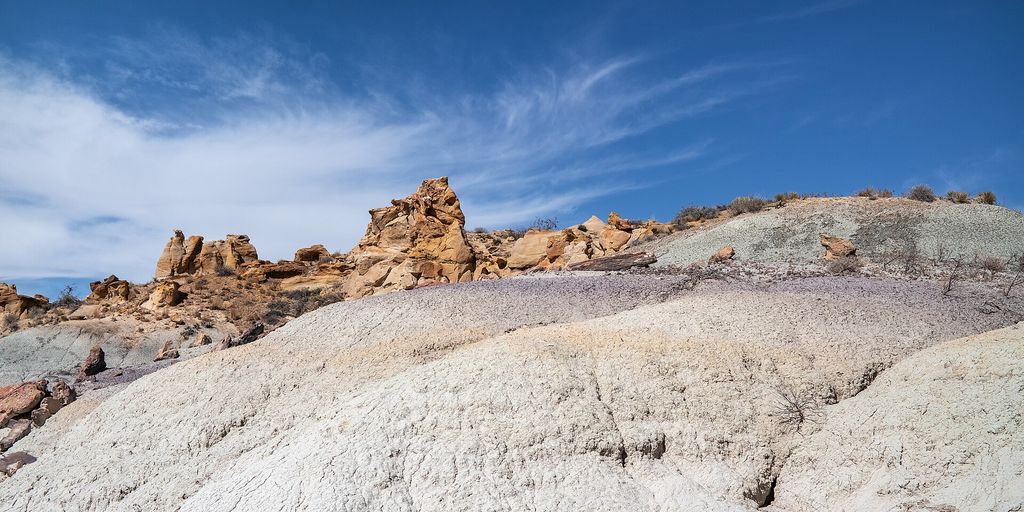
The Bureau of Land Management describes Bisti/De-Na-Zin as interbedded sandstone, shale, mudstone, coal and silt, weathered into rolling badlands, hoodoos and other formations.[5] Its name derives from Navajo: Bisti refers to a large area of shale hills, while De-Na-Zin refers to cranes.[5] Federal planning records identify Kirtland and Fruitland formations, situating the landscape within a sedimentary San Juan Basin history rather than a simple volcanic one.[6]
SFMOMA’s audio calls the site’s dark material “black volcanic soil”.[1] Because the official geological account emphasises sedimentary beds, that phrase is best treated as museum interpretation, perhaps describing appearance rather than verified origin. The difference is not pedantic. O’Keeffe’s smooth grey masses are transformations of eroded, layered material, and knowing that history makes the painted folding more specific without requiring it to become a geological diagram.
Naming a place already inhabited
O’Keeffe’s phrase “the Black Place” is now inseparable from her work, but it can encourage the idea that the artist discovered and named an empty landscape. Her own 1976 description called it untouched and lonely-feeling, while later accounts repeatedly use remote, desolate or uninhabited.[4] Those words record her experience of distance and solitude; they do not establish that the surrounding territory lacked people, histories, governance or claims.
The Navajo Nation describes Diné Bikéyah as a homeland extending across Arizona, New Mexico and Utah and exceeding 27,000 square miles.[20] Museum guides likewise place O’Keeffe’s campsite in Navajo territory.[18][19] In 1936–45, when she developed the series, Navajo communities were living through federal land, livestock and resource policies whose effects are absent from the painted view but relevant to the language used around it.
This context need not turn Black Place I into an illustration of Diné history or assign it an Indigenous meaning no source supports, but it changes the frame of interpretation. Solitude describes one visitor’s temporary working conditions; “empty” would make a broader historical claim. O’Keeffe’s intense attachment to the site can be respected while recognising that her private name exists inside a much older and continuing cultural geography.
First sight in 1936 and repeated returns
Access O’Keeffe’s chronology records two painting visits to the Black Place in August 1936 and lists the catalogue numbers generated across the following years.[3] O’Keeffe later remembered first seeing it while driving past on a journey into Navajo country and feeling compelled to return, even in midsummer heat.[4] Her uncertainty about what she painted on the earliest trip is a useful warning against manufacturing a perfectly ordered origin story.
Sascha T. Scott’s archival reconstruction anchors those first working visits in O’Keeffe’s letters to Alfred Stieglitz of 16–18 August 1936.[24] Scott also identifies November 1940 as the earliest known use of the phrase “Black Place” in their correspondence. The distinction matters: encountering and painting the land preceded the durable name under which works were later gathered, so the title should not be projected backwards as if it arrived fully formed at first sight.
The visits became systematic. She travelled there with Maria Chabot in 1940, returned in September and November 1941, worked there in August and October 1943, and camped again in May and June 1944.[3] The sequence makes the subject cumulative: memory of earlier contours, renewed observation, seasonal difference and the practical experience of access all entered a body of work rather than a single moment of revelation.
The catalogue records support a span from early 1936 works through oils and drawings of the 1940s, ending with highly reduced green versions dated 1949.[3][14] “Fourteen years” is therefore a convenient inclusive description of 1936–49, not proof of continuous annual production. Gaps, revisitations and changes of medium are central to the series’ development.
Letters cited by Scott document painting at the site again in September and November 1941; the resulting works were exhibited under Black Place titles at An American Place in February–March 1942.[24] A letter to Chabot, postmarked 31 January 1942, records work beginning on the canvas later known as Black Hills with Cedar or The Black Place—No. 3. Private language, studio work, exhibition naming and later catalogue order therefore overlap without producing a perfectly linear sequence.
Maria Chabot and the labour behind solitude
Maria Chabot met O’Keeffe in 1940 and, from 1941 through 1945, managed the Ghost Ranch house, pursued her own writing and accompanied the artist on painting expeditions.[3] At the Black Place she did more than appear at the edge of a heroic solitary narrative. Travel, water, food, shelter, driving and camp maintenance made sustained work in an exposed landscape possible, and her photographs preserve that practical world.[15]
The Maria Chabot Archive contains 1944 images titled Georgia O’Keeffe, Morning, The Black Place, Campsite, The Black Place and The Tent, The Black Place, alongside views of O’Keeffe painting numbered Black Place canvases.[15] The photographs distinguish the site from the finished pictures. Tent fabric, bedding, utensils, automobile and human activity occupy the documentary frame even when O’Keeffe removes them from the canvas.
That removal should not erase collaboration. O’Keeffe made the painting and controlled its visual decisions, while Chabot’s logistical and photographic work supported the conditions in which it emerged. The archive replaces the myth of effortless isolation with a more interesting account: chosen solitude was actively produced, materially demanding and shared with another woman whose labour and eye shaped what survives of the expedition.
O’Keeffe recalled using a Model A Ford as a studio because its high windows provided light. By late afternoon, bees settled on the vehicle and forced her to close the windows, making the interior intensely hot.[4] The anecdote anchors the pictures in bodily discomfort and technical improvisation. A cropped, controlled oil painting emerged from conditions far less controlled than its smooth organisation suggests.
Her longer account describes a clear morning overtaken by hard wind, gathering clouds and a night storm violent enough to pull down one corner of the tent. O’Keeffe and her companion tied it to the car; dawn arrived under grey sage, wet sand, sombre hills, cloud and a pale moon.[4] Grey in the series can therefore recall changing weather and wet ground as well as the nominal colour of rock.
These memories were published in 1976, decades after the 1944 expedition, and combine several visits in a retrospective voice.[4] They remain valuable first-person testimony but should not be assigned automatically to the exact day CR 1080 was painted. Chabot’s dated 1944 photographs provide firmer evidence for that season; O’Keeffe’s narrative supplies the wider sensory and working history of repeated returns.
The road towards the 1944 sequence
The numbered group did not begin the subject. Black Place of 1942, catalogue raisonné 1039, is a 20-by-30-inch oil whose documented alternate title The Black Place – No. 1 shows that numbering was already unstable across exhibitions and records.[7] A 1943 canvas at the Art Institute of Chicago, CR 1058, stretches the grey hills into an unusually wide format and retains a strip of blue sky.[11]
The Chicago record preserves O’Keeffe’s explanation that summer sun seemed to burn colour out of everything.[11] It also now supplies rare technical evidence for a Black Place canvas: the paint is thin enough for the weave to remain visible, the work is unlined and apparently unvarnished, and it remains in the artist’s original silver-tone metal frame. Those facts belong to CR 1058 and cannot be transferred wholesale to CR 1080.
Together the earlier works show experimentation before the 1944 concentration: format expands and contracts; sky can appear and disappear; hills may spread laterally or close around a ravine. CR 1080’s force lies partly in selecting from those alternatives. It brings the slopes near, excludes the blue opening and lets the doubled V organise the field without reducing every contour to a single emblem.
Four canvases, four different Black Places
Black Place II, CR 1081, measures 23⅞ by 30 inches and is now at the Met. A narrow pale channel descends through black and grey forms, with a small warm accent towards the lower edge.[8][21] The central drop is more emphatic than in CR 1080, while broad dark planes replace some of the San Francisco picture’s numerous rounded overlaps.
Black Place III, CR 1082, expands to roughly 36 by 40 inches. Its ravine descends between large, steep hill masses and the painting has an extensive exhibition history, including the Georgia O’Keeffe Museum’s 2018 dialogue with Michael Namingha.[9][16] Black Place No. IV, CR 1083, differs sharply again: yellow and orange ground surrounds dark forms beneath a visible blue sky.[10]
Serial titles can make the canvases sound like successive stages towards one final solution, although their visual differences suggest a less linear process. O’Keeffe varied viewpoint, crop, scale, colour and the amount of environmental information retained. The group is best understood as parallel tests of what the place could become in paint, with CR 1080 distinguished by its dense grey layering and unusually tender foreground colours.
Drawing, pastel and memory
O’Keeffe also worked through the subject on paper. Untitled (Black Place), dated 1944–45 and catalogued as CR 1098, is a graphite drawing measuring 7⅝ by 11⅜ inches.[12] Its modest scale and restricted means make contour and directional movement easier to isolate. Drawings of this kind were not merely lesser reproductions of oils; they offered a rapid way to test spatial relationships and retain motifs for later development.
In December 1945, O’Keeffe wrote that she was working on a pastel of the Black Place. The Black Place III, CR 1112, measures 27¾ by 43¾ inches and uses the medium’s direct colour and broad lateral format.[13] The shift from graphite to pastel to oil demonstrates how a recurring site could generate materially distinct problems rather than one design recopied across supports.
O’Keeffe later said she had painted the place from memory in red and then green.[4] Memory loosened topography without making observation irrelevant: repeated climbing, drawing and camping had furnished a deep store of forms. By 1949, Black Place Green could compress the valley into a forceful descending shape.[14] CR 1080 occupies an earlier balance, where individual ridges remain legible even as they approach abstraction.
Abstraction without abandoning the site
The painting resists a choice between landscape and abstraction. Every contour can be understood as a hill or channel, yet the absence of sky, scale markers and continuous perspective makes value, edge and rhythm unusually autonomous. Spanish-language Thyssen-Bornemisza interpretation calls the Black Place works especially abstract representations, while stressing travel and walking as foundations of O’Keeffe’s process.[18]
Fondation Beyeler’s French and German guides similarly describe an increasingly abstracted grey-black hillscape, a vanished horizon and a valley dividing the field.[19] The agreement across languages reflects a strong formal reading, but “increasingly” should not become an inevitable march away from place. O’Keeffe moved back and forth between descriptive and reduced versions, and the colour of No. IV complicates any tidy progression towards darkness.
Met scholarship reads the V as a stable expressive structure recurring across decades, capable of dynamic movement, symmetry and metaphysical force.[14] That interpretation helps connect Black Place I with O’Keeffe’s non-objective beginnings without dissolving the badlands into a private symbol. The painting’s achievement is precisely that formal economy and remembered terrain remain mutually active.
Scott places the series inside another visual history: the Second World War’s circulation of aerial photographs, films and maps that made distant destruction newly visible.[24] On that account, horizonless views, uncertain scale and plunging channels do more than abstract a familiar landscape. They participate in a period when aircraft and cartography were changing how Americans imagined distance, terrain and the capacity to damage both human life and the natural world.
That argument is contextual rather than iconographic proof. No published statement establishes that O’Keeffe modelled CR 1080 on one military photograph or intended its central ravine as a bombed landscape, while its forms arose through years of direct looking before and during the war.[24] The interpretation gains force from chronology, menace and the destabilised viewpoint; it remains one historically grounded reading among others, not a concealed subject that cancels the Bisti terrain.
Scott also finds a kinship with the emerging Abstract Expressionists in the series’ tense response to a transformed technological and visual world.[24] “Kinship” is the useful limit of the claim: the concentrated scale, cropped terrain and disciplined surface differ from the large gestural canvases soon associated with the New York School. The comparison moves O’Keeffe into a shared 1940s problem of abstraction and historical pressure without turning her into a precursor whose value depends upon later painters.
Bodies, elephants and the risk of easy metaphor
O’Keeffe’s “mile of elephants” comparison begins with distant rhythm: repeated grey hills of roughly similar size above almost white sand.[4] In the painting, rounded backs and clustered masses sustain the association. SFMOMA’s flesh metaphor for the pink foreground adds another bodily register.[1] Such comparisons describe how land can prompt recognition without turning the scene into a concealed herd or body.
The central cleft has also invited sexual, anatomical and psychological interpretations familiar from criticism of O’Keeffe’s flowers and abstractions. No object-specific statement by the artist identifies a sexual subject here. A viewer may experience enclosure, opening, pressure or vulnerability, but assigning a fixed bodily code would repeat the reductive criticism O’Keeffe often resisted; formal resemblance is evidence of visual possibility, not a signed declaration of intent.
French reception shows that this dispute remains active. Reviewing the Centre Pompidou retrospective of 2021, Philippe Dagen argued that sexualised anthropomorphism migrated from O’Keeffe’s flowers into her landscapes and suggested Black Place might be called Birth Place.[25] Lara Cox records the remark while criticising an exhibition language of the biomorphic and anatomical that renewed precisely the biologising frame O’Keeffe resisted, rather than treating the painting’s bodily suggestions as one contingent response.
Cox widens the issue from a single metaphor to museum history. Her study argues that the Paris presentation repeatedly organised O’Keeffe through white male precursors and the exceptional-woman mythology, while giving too little space to communities of women artists or to historically specific Indigenous relations in the American West.[25] For Black Place I, that criticism supports a double caution: anatomy should not become destiny, and solitary authorship should not erase Chabot’s labour or Diné geography.
The title offers a firmer interpretive anchor than speculative anatomy. Blackness belonged to the site as O’Keeffe experienced and named it: she recalled that parts could look truly black and that it was an especially good place to climb.[1] Movement through the terrain, rather than a hidden icon, may best explain why the creases feel bodily—the composition translates the sensation of navigating them.
What the material record can and cannot tell us
For CR 1080, public records establish oil on canvas, size, archival titles, catalogue number and an unverified backing inscription reading “Black Place I” and “1944”. A March 1946 examination at An American Place found no signature, according to the Whitney Archive.[2] SFMOMA publishes no object-specific conservation report identifying pigments, ground, preparatory drawing, varnish, canvas weave or treatment history.[1][2]
Direct inspection of the authorised image supports only visual statements: paint shifts softly across large forms, narrow light bands define ridges, and the canvas presents both opaque-looking masses and delicately modulated passages.[1][2] A digital reproduction cannot establish layer sequence or chemical composition. Descriptions such as scumbled, glazed or unvarnished should wait for technical examination rather than being inferred from photographic appearance.
The 2025 conservation entry for CR 1058 proves why object boundaries matter. It documents a thin, unlined and apparently unvarnished 1943 canvas with visible weave, local deformation and its original frame.[11] That evidence supplies useful comparative questions for CR 1080, but adjacent series membership does not guarantee identical materials, handling or condition. The absence of a report should be made explicit rather than filled with borrowed facts.
From An American Place to SFMOMA
Access O’Keeffe first records CR 1080 in the 1946 exhibition Georgia O’Keeffe at An American Place.[2] It entered SFMOMA in 1954 as Charlotte Mack’s gift, although the public catalogue does not currently publish a full chain of ownership between artist and donor.[1] That gap limits claims about acquisition while leaving museum entry and credit secure.
The canvas soon appeared in institutional surveys: the 1949–50 Annual Exhibition of Contemporary American Painting, a 1950 selection of twentieth-century painters and SFMOMA’s 1955 anniversary exhibition.[2] Later presentations placed it within O’Keeffe retrospectives, landscape comparison and American modernism. Exhibition history did not merely repeat a stable meaning; it alternately foregrounded artist, nation, abstraction and landscape.
In 1993–94 Georgia O’Keeffe: American & Modern carried the work to London, Mexico City and Yokohama. The 2009–10 Georgia O’Keeffe: Abstraction travelled among the Whitney, Phillips Collection and O’Keeffe Museum, while The Painter’s Lens reached Madrid, Paris and Basel in 2021–22.[2] Those multilingual contexts helped detach the Black Place series from a narrowly regional reputation while returning attention to travel, cropping and viewpoint.
Later artists, extraction and a changed landscape
The Georgia O’Keeffe Museum’s 2018 exhibition placed Black Place III and related works in conversation with Michael Namingha, an artist of Ohkay Owingeh and Hopi heritage.[9][16][22] Museum staff introduced him to the site in 2017. Where O’Keeffe had carried camping and painting equipment, Namingha used a drone camera, then divided, stretched and reorganised digital images on a computer.[16][17]
Namingha’s coloured bands refer to hydraulic fracturing infrastructure, yellow pipeline markers and satellite maps of methane concentration over the Four Corners.[17] His work does not simply update O’Keeffe’s view with new technology. It exposes activities that the older paintings omit and asks how extraction, surveillance and environmental change alter the meaning of a supposedly timeless or untouched landscape.
The comparison also sharpens a historical question: O’Keeffe’s canvas removes weather, roads, workers and utilities to concentrate landform, while Namingha reintroduces systems operating above and below the visible surface. Both artists abstract, but abstraction serves different knowledge. A 2019 O’Keeffe Museum viewshed project likewise mapped roads, mineral ownership and development risk around painted locations, treating views as environments requiring protection rather than timeless images.[23]
That project also demonstrates the need for object-level checking: its list illustrates the 36-by-40-inch CR 1082 but calls it Black Place I, a mismatch between image, dimensions and title.[9][23] The error does not invalidate its conservation model, but it confirms why the inherited page’s picture had to be matched independently. The later environmental dialogue prevents “geological time” from excusing current pressures on Diné and neighbouring lands.
Correcting the inherited account
The legacy page correctly recognises repeated visits, the importance of grey hills, the elephant comparison and the series’ movement among paintings, pastels, photographs and sketches. It also notices rolling continuity and O’Keeffe’s attraction to isolation. Those subjects become more precise when tied to CR 1080, the documented chronology, Chabot’s archive and the distinct sequence of 1942–45 works.[2][3][7][15]
Several claims need revision. O’Keeffe’s first New Mexican summer in 1929 did not immediately lead her to buy Ghost Ranch; she first stayed there in 1934 and purchased the house in 1940.[3] The Black Place is not simply the setting around her home, and “150 miles” is her approximate recollection rather than a surveyed route. Nor should all numbered paintings, pastels and drawings be collapsed into one visual description.
Most importantly, tranquillity is only part of the evidence. O’Keeffe remembered heat, bees, violent wind, wet sand and a dismal dawn as well as beauty and loneliness.[4] SFMOMA finds a menacing quality she relished, while the formal image combines tenderness with obstruction.[1] The Black Place offered peace at times, but the work’s depth comes from danger, effort, changing weather and the pressure of enclosing terrain.
Looking through the ravine
Begin at the upper edge, where small folds and branching pale lines establish a distant zone without revealing a horizon. Follow the central channel downward as it narrows, widens briefly and is pinched again by alternating ridges. The path never becomes continuous enough to walk mentally from back to front; interruption is the mechanism by which O’Keeffe gives a shallow canvas the sensation of deep terrain.
Then compare left and right: the left hills form stacked, rounded bands, while the right foreground slope cuts more decisively across the field. Their tonal correspondence creates balance, but differences in contour prevent mirroring. Small greenish touches above and pink-white marks below puncture the grey, rewarding the slow attention that the initially restricted palette demands.
Finally, return to the title and ask what “black” now describes. It is local colour, artist’s name, mood, spatial depth and the historical identity of a series, yet no one definition controls the painting. Black Place I turns a repeatedly visited landscape into a structure that remains physically particular and perceptually unstable. Its ravine invites entry, its hills block mastery, and its dark surfaces keep changing as the eye adjusts.
Discussion
Which piece of evidence most changes the way you read Black Place?
Reader Insights
Which visible detail most changes your reading of Black Place?
How do medium, setting and documented history shape the encounter?
What remains uncertain when documented fact is separated from interpretation?
Join the Conversation
Share your reading of Black Place below.
References
- San Francisco Museum of Modern Art, “Georgia O’Keeffe, Black Place I, 1944”, object 54.3536, including audio and visual-description transcripts: View Source
- Georgia O’Keeffe Museum, Access O’Keeffe, “Black Place, I, 1944”, CR 1080: View Source
- Georgia O’Keeffe Museum, Access O’Keeffe, “Chronology”: View Source
- Whitney Museum of American Art, Georgia O’Keeffe: Abstraction teacher materials, excerpts from O’Keeffe’s 1976 account: View Source
- Bureau of Land Management, “Bisti/De-Na-Zin Wilderness Area”: View Source
- Bureau of Land Management, Farmington Mancos-Gallup Affected Environment Supplemental Report, geological and palaeontological context: View Source
- Georgia O’Keeffe Museum, Access O’Keeffe, “Black Place, 1942”, CR 1039: View Source
- Georgia O’Keeffe Museum, Access O’Keeffe, “Black Place II, 1944”, CR 1081: View Source
- Georgia O’Keeffe Museum, Access O’Keeffe, “Black Place III, 1944”, CR 1082: View Source
- Georgia O’Keeffe Museum, Access O’Keeffe, “Black Place No. IV, 1944”, CR 1083: View Source
- Georgia O’Keeffe Museum, Access O’Keeffe, “The Black Place, 1943”, CR 1058, including Art Institute of Chicago conservation report: View Source
- Georgia O’Keeffe Museum, Access O’Keeffe, “Untitled (Black Place), 1944–1945”, CR 1098: View Source
- Georgia O’Keeffe Museum, Access O’Keeffe, “The Black Place III, 1945”, CR 1112: View Source
- Lisa Mintz Messinger, Metropolitan Museum of Art, Georgia O’Keeffe, Metropolitan Museum of Art Bulletin, vol. 42, no. 2, 1984: View Source
- Georgia O’Keeffe Museum, Access O’Keeffe, “Maria Chabot Archive”, 1944 Black Place photographs: View Source
- Georgia O’Keeffe Museum, “The Black Place: Georgia O’Keeffe and Michael Namingha”, 2018: View Source
- Georgia O’Keeffe Museum, Access O’Keeffe, touring-exhibition record for The Black Place: Georgia O’Keeffe and Michael Namingha: View Source
- Museo Nacional Thyssen-Bornemisza, Georgia O’Keeffe, Spanish press dossier, 2021: View Source
- Fondation Beyeler, Georgia O’Keeffe gallery guide, English, French and German editions, 2022: View Source
- Navajo Nation, “History”: View Source
- Metropolitan Museum of Art, “Black Place II”, object 59.204.1: View Source
- Georgia O’Keeffe Museum, “Tewa Nangeh/Tewa Country”, identifying Michael Namingha as Ohkay Owingeh and Hopi: View Source
- National Center for Preservation Technology and Training and Georgia O’Keeffe Museum, Georgia O’Keeffe Museum Viewshed Project, 2019: View Source
- Sascha T. Scott, “Georgia O’Keeffe’s ‘Black Place’”, The Art Bulletin, vol. 101, no. 3, 2019, pp. 88–114: View Source
- Lara Cox, “Georgia O’Keeffe: A New Entrant in the French Love Affair with the American West”, Revue d’histoire culturelle, no. 6, 2023: View Source