


 by Tom Gurney
Tom Gurney BSc (Hons) is an art history expert with over 20 years experience
Page Created on September 22, 2026 / Page Updated on September 22, 2026
Email: tomgurney1@gmail.com / Phone: +44 7429 011000
Introduction
Georgia O’Keeffe first went to New Mexico in 1929 and made the state her permanent residence twenty years later. Between those dates, and for decades afterwards, she built a large body of work from northern New Mexico’s eroded hills, river valleys, churches, trees, roads, animal bones and domestic architecture. The range matters. “O’Keeffe’s New Mexico” is not one red-desert style but an extended practice shaped by repeated journeys, two houses, changing seasons, studio decisions and the circulation of paintings through New York galleries and museums.[1][2]
The usual story presents a solitary artist discovering an empty landscape. That story confuses selective composition with uninhabited land. Abiquiú and Ghost Ranch lie within places long known, lived in and cared for by Pueblo, Diné and Hispano communities. The Georgia O’Keeffe Museum’s Tewa Nangeh/Tewa Country project, made with artists, scholars and culture bearers from the six Tewa Pueblos, explicitly confronts the erasure caused by treating the land as pristine scenery awaiting a modern painter.[6] O’Keeffe’s attachment can be studied without turning personal vision into first possession.
At a Glance
- ArtistGeorgia O’Keeffe
- SubjectGeorgia O’Keeffe and New Mexico
- Artistic contextAmerican modernism
Contents
- New Mexico and two structures of vision
- Tewa Nangeh and weather
- Red Hills, White Place and date conflicts
- Assembled objects and doubled titles
- Patio doors and snow
- Churches and corrected locations
- Red hills and concentrated colour
- Chama River and Alcalde
- Rivers, roads and ambiguous records
- Studies, churches and trees
- Cottonwoods and dead piñons
- Hills and hollyhocks
- Rocks and road sequences
- Abiquiú as a working system
- Churches, crosses and colonial history
- Material evidence and uncertainty
- Exhibition and New Mexico reputation
- Sustained practice rather than legend
New Mexico and two structures of vision
O’Keeffe travelled to New Mexico with Rebecca Strand in 1929 and stayed in Taos as a guest of Mabel Dodge Luhan. She returned in later summers, worked at Ghost Ranch from the mid-1930s, bought its Rancho de los Burros property in 1940, acquired the ruined Abiquiú compound in 1945 and moved from New York permanently in 1949.[2][3] This sequence replaces the misleading idea of an immediate desert conversion. New Mexico became central through recurrence, property negotiations, building work and accumulated local knowledge.
Her methods also had precedents. Serial observation, radical cropping and the reduction of landscape to strong tonal masses had developed in Texas, Lake George and New York. New geology prompted new solutions without erasing those earlier habits. The Metropolitan Museum’s career survey accordingly places the first New Mexico works within a longer formal development, while later European retrospectives trace continuities across locations rather than isolating a picturesque “Southwest” episode.[45][46][47][48] The Ghost Ranch house and the Abiquiú home created different ways of looking.
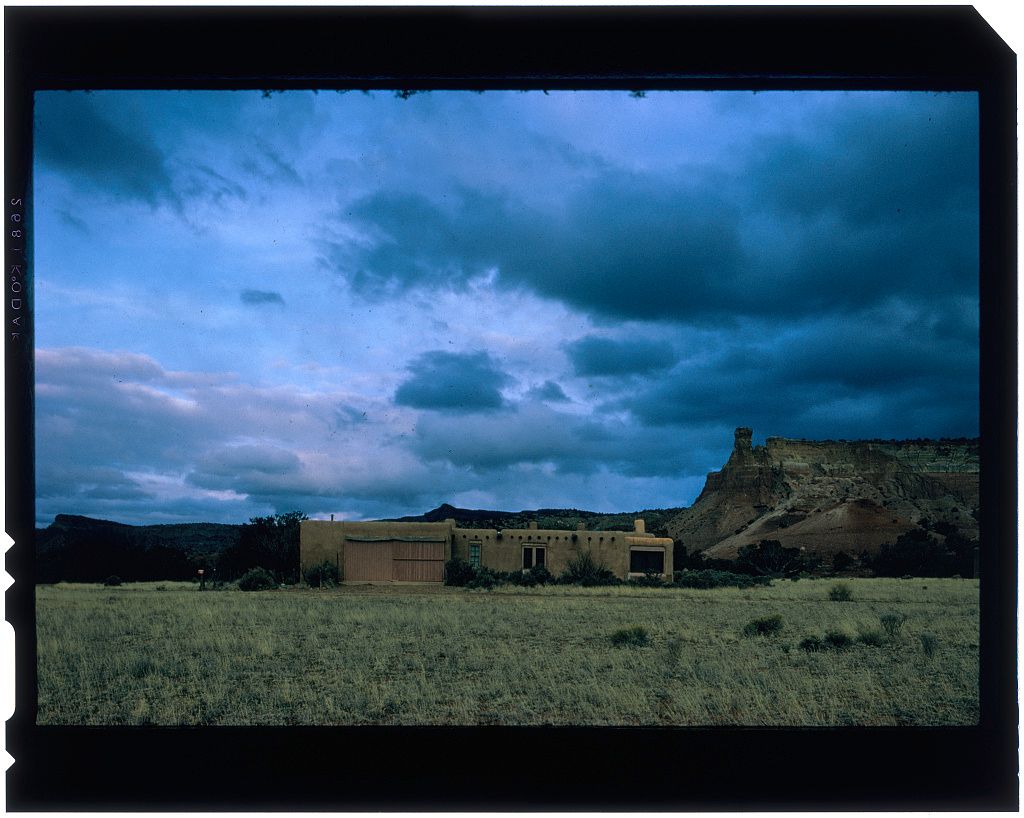
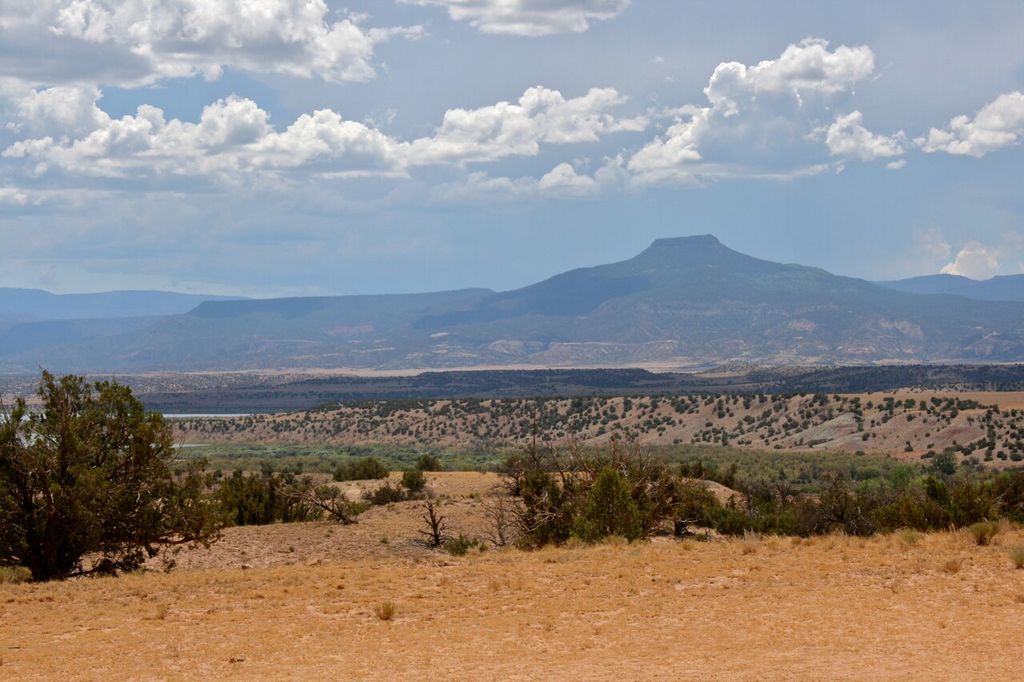
Ghost Ranch opened towards cliffs, arroyos and the flat top of Cerro Pedernal. O’Keeffe’s studio and small sleeping room gave immediate access to the red hills she repeatedly walked and painted.[5] The property functioned mainly as a summer base because it was unsuitable for year-round occupation. The Abiquiú compound looked inward around a patio. Its oldest rooms may date to the eighteenth century; the building combined Pueblo and Spanish Colonial practices and stood on land connected to the Santo Tomás Apóstol de Abiquiú land grant.
O’Keeffe bought the ruin from the Catholic Church and, with Maria Chabot directing much of the reconstruction, adapted it between 1945 and 1949.[3][4] Large windows cut into the former stable and buggy house made the Chama valley, cottonwoods and winding road available from the studio. The house was therefore not merely shelter or self-portrait. It was a viewing instrument constructed through other people’s labour and through regional building knowledge.[44]
Tewa Nangeh and weather
Current museum scholarship uses Tewa Nangeh, or Tewa Country, to name the homelands of Nambé, Pojoaque, San Ildefonso, Ohkay Owingeh, Santa Clara and Tesuque Pueblos. Its method changes how O’Keeffe’s landscapes should be described. Empty foregrounds and absent figures are pictorial choices; they are not evidence that the country lacked inhabitants, names, ceremony, farming, governance or sovereignty.[6] That distinction also limits the language of spiritual ownership.
The exhibition that opened in 2025 makes that method concrete rather than merely corrective. Co-curated by Jason Garcia of Santa Clara Pueblo and Bess Murphy, it places O’Keeffe’s art and personal objects beside new work by twelve Tewa artists addressing sacred spaces, belonging, identity and ownership.[49] The institution also follows each participant’s chosen spelling for community affiliation, recognising variation within a primarily spoken language. Authority therefore enters through named living makers and culture bearers, not through a museum speaking generically on behalf of “Native context”.
O’Keeffe’s often repeated joke that painting Pedernal would make God give it to her describes attachment and serial practice, not title to a mountain. “The faraway” records distance as she experienced it, travelling from New York and later from her houses. It cannot define the place for those whose communities were already there. A responsible account holds formal intensity and historical partiality together. A Black Bird with Snow-Covered Red Hills (1946; CR 1148) is a 36-by-48-inch oil on canvas now in the National Gallery of Art, Washington.
A simplified black bird crosses a graded blue sky over two snow-covered hills that meet in a deep V.[7][8] The picture reverses the expected palette of O’Keeffe’s red-hill paintings: snow suppresses local colour, and the bird supplies the strongest dark accent. The catalogue preserves O’Keeffe’s recollection that a morning snowfall startled her when familiar red hills appeared white. That account supports an interpretation based on disrupted recognition rather than timeless symbol.
The bird’s scale is indeterminate—it may be near the viewer or monumentalised—and the white slopes refuse ordinary measurements of distance. The painting was exhibited at An American Place in the 1946–50 presentation and entered the National Gallery as an anonymous gift in 2021.[7][8] Its recent public ownership makes the object record, rather than old reproduction colour, the best point of reference.
Red Hills, White Place and date conflicts
Red Hills with the Pedernal (1936; CR 898) is pastel on paper mounted to cardboard or pastel board, 21½ by 27¼ inches, bequeathed by O’Keeffe to the Brooklyn Museum.[9] Reddish foreground hills rise in sweeping layers while Pedernal sits as a cooler blue profile beyond them. Cloud bands extend the horizontal rhythm without making the scene topographically neutral. The medium changes the relation between near and far. Pastel can produce dense, velvety colour while retaining the drag of pigment across paper.
The warm hills advance and the blue mountain recedes, but the shallow stacking of shapes also brings the whole view close to the picture plane. Catalogue variants—Red Hills with Pedernal and a backing label adding “New Mexico”—show how location and grammar shifted across archival systems.[9] Pedernal is one motif within a carefully staged spatial sequence, not a detachable emblem. From The White Place (1940; CR 996) is a 30-by-24-inch oil on canvas in the Phillips Collection, acquired in 1941.[10][11]
Pale cliffs rise on either side of a narrow green and shadowed interval. The vertical canvas and cropped formations make a geological view feel close and bodily; the difficulty of deciding between panorama and close-up is part of the work’s pressure. The catalogue record demands caution. A backing inscription and Downtown Gallery documentation support 1940, while Whitney and Abiquiú records give 1942; the 1941 purchase makes the later date impossible.[10]
The current Access O’Keeffe automated visual description also mistakenly describes figs, an obvious mismatch with the image and owner record. This is a useful example of source hierarchy: catalogue fields, inscriptions, acquisition evidence and the Phillips object page outweigh an erroneous generated description. A 1 May 1941 telegram records Duncan Phillips’s purchase for $3,800.[11] Early acquisition placed the White Place within a major modern-art collection while O’Keeffe was still travelling seasonally between New York and New Mexico. The painting’s later reputation should not obscure that precise institutional history.
Assembled objects and doubled titles
Head with Broken Pot (1943; CR 1046), an oil on canvas measuring 16 by 19 inches, belongs to the Georgia O’Keeffe Museum.[12] A human skull rests within an overturned, broken black ceramic pot on reddish ground, with blue sky behind. The conjunction is staged rather than discovered: gathered and made objects have been brought together, positioned and enlarged. The work complicates accounts that separate landscape from still life.
The horizontal division of ground and sky locates the assembly outdoors, yet the shallow arrangement behaves like a studio construction. Bone and pottery also have different cultural histories. Treating both as generic “desert finds” would suppress the distinction between biological remains and a human-made vessel. The catalogue can document title, date, scale, exhibition and ownership; it cannot by itself establish the pot’s maker, community or original function. Interpretation should stop at that evidential limit.
The legacy title does not identify a single object. O’Keeffe used Red Hills with Flowers for at least two oils now at the Art Institute of Chicago. The 1937 canvas (CR 926) measures 20 by 25 inches and places two large red-and-yellow blanket-like flowers before smooth red hills.[13] The 1940 painting (CR 995) is a low, panoramic 12 by 30⅛ inches: small white-flowering plants punctuate sloping hills beneath distant mountains and long clouds.[14] Their difference is interpretively productive.
In 1937 the blooms dominate, compressing still life and landscape into a near-far collision. In 1940 vegetation remains embedded within the terrain, so scale reads more conventionally. The earlier canvas was painted over an image of trees, physical evidence that composition could be revised on an already used support.[13] The later work carries a backing inscription naming “Summer 1940”, which anchors a title otherwise liable to conflation.[14] Any unqualified reference to Red Hills with Flowers should provide year or CR number.
Patio doors and snow
Patio Door with Green Leaf (1956; CR 1292) is a 36-by-30-inch oil on canvas in the Georgia O’Keeffe Museum.[15] An adobe wall fills most of the support; a black door opens at the right, a sliver of blue sky appears above, and a small green-yellow leaf seems suspended against the earthen field. The picture joins architecture, still life and abstraction.
The wall’s warm expanse is not empty background but a large chromatic shape whose scale makes the leaf exceptionally vulnerable. The door is spatial—it marks an opening—yet its blackness also reads as a flat rectangle. The title was documented on the backing and in gallery and archival records, while Patio with Green Leaf survives as an alternate title.[15] That small change matters: “door” names the dark form and fixes an architectural reading that “patio” leaves more open.
Black Door with Snow (1953–55; CR 1279) is a 36-by-30-inch oil in a private collection. A brown adobe wall is seen at a sharp angle, its black doorway surrounded by tiled ground and falling snow.[16] The three-year date span records uncertainty rather than a prolonged continuous execution. The image turns the familiar Abiquiú door into a measure of weather: white flakes interrupt the large brown and black planes.
A distinct Black Door with Snow II (1955; CR 1284), 30 by 18 inches, belongs to the Milwaukee Art Museum.[17] Its narrower support demonstrates that the subject was reconsidered rather than simply copied. O’Keeffe’s Abiquiú notebook photograph used the shorter title for the second version, while catalogue numbering now separates them. Series evidence prevents a common error: treating “with Snow” as one definitive view of the patio.
Churches and corrected locations
The legacy label “Another Church, Hernandez, New Mexico” does not match the current catalogue title. Another Church, New Mexico (1931; CR 770) is a 10-by-23⅞-inch oil on canvas in the American Museum of Western Art—The Anschutz Collection.[18] A tan adobe wall extends across the wide support; a doorway aligns the viewer with a church and small cross beyond, while hills and blue sky complete the layered view.
The structure is seen through architecture rather than offered as an isolated monument. Door, courtyard and church form successive thresholds, and the unusual width slows movement across them. No evidence in the controlling catalogue record securely adds Hernández to the title. Retaining that place name as fact would turn a legacy URL into provenance. The defensible form is the catalogue title, with the superseded web wording recorded as a migration variant.
Red hills and concentrated colour
Red Hills Grey Sky (1937; CR 929) is a 14-by-20-inch oil, also in the American Museum of Western Art.[19] Bright red hills nearly fill the small canvas, divided by a darker, river-like band; a narrow cream-grey sky compresses the scene. The work’s force comes from restricted means rather than from geographical breadth. Archival titles include Red Hills Gray Sky, Red Hills, Grey Sky and simply Red Hills.[19] “Grey” and “gray” are harmless spelling variants, but the shortened title loses the atmospheric counterweight that distinguishes the work.
The sky is not descriptive surplus. Its restrained value prevents the red forms from becoming wholly detached from weather and horizon. Cebolla Church (1945; CR 1103), oil on canvas, measures 20 1/16 by 36¼ inches and belongs to the North Carolina Museum of Art.[20] O’Keeffe viewed the modest building laterally: a long earthen wall and pitched grey roof extend across green ground, two windows open into darkness, and a low steeple bears a white cross.
The format resists the frontal symmetry often used to monumentalise mission churches. Its low, stretched structure remains part of the terrain. Formal analysis should nevertheless retain the building’s social category. A church is a site of worship and community history, not only an arrangement of tan, grey and blue. The catalogue supplies the title from Whitney, Downtown Gallery and Abiquiú records; fuller local identification would require parish and community evidence beyond what the object entry establishes.[20]
Chama River and Alcalde
The title Chama River, Ghost Ranch refers to more than one painting. A 1934 oil (CR 851) measures 8 by 16 inches and is privately held.[21] A 1937 oil (CR 933), 30¼ by 16 inches, belongs to the New Mexico Museum of Art.[22] The move from a small horizontal support to a tall vertical one changes the subject fundamentally: river, bank and distant forms no longer occupy the same spatial hierarchy.
The pair also spans O’Keeffe’s early encounter with Ghost Ranch and her more established seasonal practice. A title can name a viewpoint family without implying identical observation. Current collection, year, dimensions and CR number are therefore necessary whenever the work is discussed. “Chama River” should likewise not be reduced to a decorative blue path. The river organises settlement, irrigation and ecological life through a valley whose human history greatly exceeds the artist’s residence.
Small Hills Near Alcalde exists as a graphite drawing of 1929–30 (CR 692), about 7 by 10 inches, in a private collection.[23] A 1930 oil with the same title (CR 727), 10 by 24¼ inches, belongs to the Jule Collins Smith Museum of Fine Art at Auburn University.[24] Their shared subject does not make the drawing a disposable preliminary.
Graphite tests the land through contour, pressure and reserved paper; oil uses a long horizontal band and colour relations. The difference clarifies O’Keeffe’s process. Reduction could occur at the drawing stage, but the later painting still required new decisions about scale, colour and spacing. Alcalde is also a living community in the Española Valley. “Near” records the artist’s positional title, not a claim that the hills were nameless.
Rivers, roads and ambiguous records
The legacy heading “Blue River” resolves most securely to Sandhills with Blue River (1930; CR 728), a 16-by-36-inch oil on canvas in a private collection.[25] The full title is essential because it describes a relation: the river is one band within a larger sequence of sand-coloured hills and distant forms. Omitting “Sandhills” makes water appear to be the isolated subject and increases the risk of confusion with other blue-river images. The wide canvas, painted during O’Keeffe’s second New Mexico summer, suggests the continued importance of panoramic formats after the smaller 1929 studies.
Yet the land is not surveyed evenly. Curves and colour zones organise a selective, modernist construction rather than a cartographic record. Several works carry the catalogue title Untitled (Patio Door). Two graphite sheets from about 1946 are CR 1154, 16 15/16 by 14 inches in the Georgia O’Keeffe Museum, and CR 1155, 17 by 14 inches in a private collection.[26][27] Two works from the 1970s, CR 1687 in watercolour and charcoal and CR 1688 in watercolour, return to related architecture at a later stage of the career.[28][29]
Because their titles derive from the image rather than a documented artist inscription, a bare legacy URL cannot select one with confidence. The correct response is not to invent certainty from similarity. The group shows the patio door moving across media and decades: graphite defines edge, proportion and opening; later washes make wall and void depend on diluted colour. A precise publication must match the legacy image to a catalogue object before assigning a single date or support.
Studies, churches and trees
Church Steeple (1930; CR 706), a 30⅛-by-16 1/16-inch oil on canvas, is in the Georgia O’Keeffe Museum.[30] The upright format concentrates a bell opening, cross and planes of adobe against the sky. Cropping removes most of the building, so a functional architectural element becomes a vertical structure of nested shapes. An Untitled (Church Steeple) drawing in the Pelican sketchbook (CR 1887) records graphite instructions including adjustments to the cross, sky, bell interior and warm colour.[31]
Those notes are unusually direct evidence of translation from observation to painting. They show colour and proportion being planned rather than spontaneously copied. The finished canvas’s simplicity is therefore the result of measured decisions. The legacy “Pinion and Cedar Trees” corresponds to Piñons with Cedar (1956; CR 1304), a 30-by-26-inch oil on canvas in a private collection.[32] A tall brown cedar with bare limbs rises beside a shorter green piñon against a pale orange hill and cloudy sky.
The unequal pair makes species, age and condition visible through silhouette. The archival alternate Pinion With Cedar explains the anglicised legacy spelling, but “piñon” is the catalogue form and the regional tree’s usual name. Singular and plural also alter the description: the current title identifies piñons collectively with one cedar. Botanical caution matters because O’Keeffe’s trees are often turned into loose symbols of endurance. The painting first records different growth forms sharing one site.
Cottonwoods and dead piñons
Untitled (Cottonwood Tree) (1945; CR 1119) is oil on board, 24¼ by 20 inches, in the Georgia O’Keeffe Museum.[33] A thick trunk divides into three major limbs while green and yellow leaves scatter across the upper field; smaller trees appear at lower right. The support is board rather than canvas, a material fact easily lost in reproduction. The catalogue title derives from the image, and the record points to a related numbered work. “Untitled” should therefore be preserved: supplying a poetic title would imply artist authority that the archive does not provide.
The close crop turns trunk and branching into the composition’s scaffold, while distant trees retain the cottonwood’s place within a river-valley ecology. Winter Cottonwoods (1951; CR 1227), a 26-by-21-inch oil on canvas in a private collection, shows bare grey trees across brown ground.[34] The Downtown Gallery alternate title Winter Trees, Abiquiú V places it within a numbered sequence and identifies location more explicitly. Double catalogue entries in the gallery archive warn that even apparently simple series histories can be administratively unstable. The absence of leaves redirects attention from colour masses to branching rhythm.
This is seasonal observation, not a universal image of death. Other works called Cottonwoods East and related variants should not be merged with it merely because they show the same species. Date, directional title and catalogue number preserve distinct viewpoints from the Abiquiú studio environment. Dead Piñon Tree (1943; CR 1068) is a 40-by-30-inch oil on canvas in the Georgia O’Keeffe Museum.[35] A large bare tree occupies most of the upright canvas; drooping branches stand against distant green growth, hills and a lightly clouded sky.
The contrast between dead foreground tree and living distance is observable, but it does not prove a single allegorical intention. Dating illustrates the value of exhibition records. The Downtown Gallery and Abiquiú notebooks gave 1953, whereas inclusion in the 1944 An American Place exhibition establishes 1943.[35] A ten-year error would relocate the picture from the wartime period to O’Keeffe’s settled Abiquiú life. The corrected chronology also distinguishes it from later architectural and cottonwood series.
Hills and hollyhocks
Hill – Alcalde II (1929–30; CR 690) is graphite on paper, only 8⅛ by 12 inches, in a private collection.[36] A low hill rises through a few economical contours and scattered dark shrubs. The catalogue’s paper survey identifies a very thin, beige, smooth wove sheet, evidence that affects how lightly drawn marks should be understood. The title came from a label printed by O’Keeffe, giving it stronger documentary standing than an image-derived untitled work.
Catalogue cross-references connect the sheet to later paintings, but its spareness remains specific to drawing. The page is not an incomplete landscape waiting for colour; it is a compact test of which contours make a hill recognisable. The legacy phrase “Hollyhock with Pedernal” conflates two 1937 oils. Hollyhock White with Pedernal (CR 923), 16 by 30 inches, belongs to the National Museum of Modern Art, Tokyo.[37] A white flower frames a green centre above a blue Pedernal and pale sky.
Hollyhock Pink with the Pedernal, New Mexico (CR 924), 20 by 30 inches, belongs to the Milwaukee Art Museum and sets an enlarged pink bloom against a more chromatic mountain and broad blue sky.[38] The pair demonstrates repetition with difference. Flower colour, scale, placement and canvas height alter how near blossom and distant mountain interact. The Tokyo record preserves several alternate titles that join Pedernal to a “green & white flower”; the Milwaukee work also circulated under shorter variants.[37][38] Year alone cannot distinguish them.
Full title, colour, dimensions, collection and CR number are necessary. These compositions also resist a simple choice between flower painting and landscape. Each uses abrupt scale to make two categories coexist. The flower does not naturally tower over a mountain; pictorial montage makes it do so. That constructed relation is more defensible than assigning fixed sexual or spiritual symbolism without evidence.
Rocks and road sequences
Access O’Keeffe records a cluster of Untitled (Rock) drawings from the 1960s, including CR 1517 in the Georgia O’Keeffe Museum and CR 1519 in a private collection.[39][40] CR 1517 is graphite on an 11⅞-by-8⅞-inch blued-white wove sheet; CR 1519 uses a 9½-by-11⅞-inch beige Manila paper. One sketches a rock on a base, while the other gives the object a circular support and cast shadow. The repeated image-derived title cannot securely resolve a singular legacy page without its illustration.
Paper type, orientation, dimensions and ownership are identification tools, not incidental conservation data. The sheets also disclose sustained interest in collected small objects. A rock removed from the landscape becomes an object for rotation, shadow and contour within the studio, joining the exterior geology of New Mexico to domestic looking. A 1959 group numbered CR 1361–68 carries the title Untitled (Road). Most are graphite studies; CR 1364, for example, is graphite on an uneven 19-by-24-inch sheet in a private collection and reduces the road to a stretched, widening S-curve.[41]
CR 1368 is an oil on canvas, 19¼ by 23¼ inches, in which a pale pink band twists diagonally through softly modulated pink and green fields.[42] O’Keeffe connected the motif to the road seen from her eastern Abiquiú window and to an experiment in tilting a camera so that its winding course would fit the frame.[42] This statement supports a relation among view, photography, drawing and painting. It does not make the oil a literal aerial map.
The turning support and stripped setting transform practical road geometry into an unstable figure. A separate 1941 sheet, Untitled (Road to Pedernal) (CR 1019), is graphite on paper and has another landscape drawing on its reverse.[43] It must not be silently folded into the 1959 Abiquiú-road sequence. The legacy slug “untitled-road” remains unresolved at object level until its original image is matched; the responsible treatment presents the candidates and preserves their distinctions.
Abiquiú as a working system
The Abiquiú works make most sense together. The black door supplies a repeated geometric opening; the patio wall becomes a broad colour field; the studio window frames cottonwoods and road; leaves and rocks move between garden, land and interior. Maria Chabot’s building plan made the large studio and picture window possible, so the visual system was designed collaboratively even though the paintings are O’Keeffe’s.[3][44]
This context also checks biographical mythology. O’Keeffe sought control over her environment, but control depended on restoration work, irrigation, local employees and a functioning village. The archive identifies multilingual sources concerning the land grant and the property’s ownership history.[4] Domestic modernism here is embedded in older architectural and communal systems.
National Park Service and University of New Mexico cultural-landscape research maps that dependence physically. The property sits on a steep slope between two arroyos connected to the larger acequia system and overlooks farmland irrigated from the Chama River.[50] Archaeological and documentary evidence extends occupation of the area thousands of years before the house, while the surviving compound reused the footprint and some fabric of a Spanish colonial courtyard ruin. The studio view was thus produced inside a water-managed agricultural landscape rather than placed above an untouched valley.
The land-grant history also requires more precision than “Spanish Colonial”. The National Historic Landmark research traces the eighteenth-century refounding of Abiquiú around a fortified plaza with Genízaro settlers: Indigenous people displaced, detribalised and drawn into Spanish colonial labour, conversion and frontier defence before receiving land.[53] Later Hispano family inheritance, sale and boundary disputes shaped the parcel O’Keeffe eventually bought from the Catholic archdiocese.[4] Naming this history avoids treating either “Pueblo” or “Hispano” as a timeless, internally uniform category.
Restoration was itself a meeting of historical fabric and modern construction. Maria Chabot managed the work from 1946 to 1948, balancing O’Keeffe’s desire for a modern house with the existing nineteenth-century adobe ruins.[51] Correspondence and construction photographs show her drawing on a network of Santa Fe women and post-war building technology. This evidence strengthens the case for shared architectural authorship: O’Keeffe set decisive aesthetic priorities, while Chabot coordinated knowledge, labour and materials that made the environment—and the later paintings framed by it—possible.
The irrigated garden was part of the visual and subsistence system, not an ornamental afterthought. O’Keeffe and Chabot planned native shrubs and trees, fruit trees, vegetables, herbs and flowers supplied through the local acequia; surviving plantings include roses, lilies, crocus, lilac, jasmine, forsythia, iris and poppies.[52] Food production reduced dependence on trips to Santa Fe, while seasonal foliage entered the house through windows, harvested objects and repeated observation. The black door, road and cottonwoods belonged to a cultivated domestic ecology sustained by communal water infrastructure.
Churches, crosses and colonial history
Church steeples and adobe walls offered O’Keeffe sharp formal contrasts, but their history cannot be reduced to shape. Northern New Mexico’s Catholic buildings emerged through Spanish colonial and later Hispano religious life on Indigenous homelands. A cross may act compositionally as a dark vertical against sky while remaining a specific devotional sign.
Comparing Another Church, Church Steeple and Cebolla Church shows how O’Keeffe varied distance: view through a courtyard, radical architectural crop, and lateral building profile.[18][20][30] None provides a complete ethnographic record. Their omissions are part of the modernist image, and viewers should not infer an absent congregation from an unpeopled canvas.
Material evidence and uncertainty
The works discussed here use oil on canvas, oil on board, pastel, graphite, watercolour and charcoal. Supports vary from small, thin wove sheets to a four-foot canvas. O’Keeffe reused at least one canvas, annotated a church study with colour decisions and worked through serial drawings before an oil.[13][31][41][42] These facts replace the idea of instantaneous revelation with repeated material testing. Digital images obscure many differences.
Pastel’s powdery deposit, exposed paper, matte paint, board rigidity and the actual width of a panoramic canvas all govern viewing. Catalogue paper surveys and conservation notes are interpretive evidence because they show how a line or surface was physically made. Measurements also prevent a small study and a large exhibition canvas from appearing falsely equivalent on screen.[1] New Mexico titles are unusually prone to romantic simplification. The current record corrects “Blue River” to Sandhills with Blue River, “Pinion and Cedar Trees” to Piñons with Cedar, and “Another Church, Hernandez” to Another Church, New Mexico.[18][25][32]
Other titles remain legitimately plural: two Red Hills with Flowers, two hollyhock-and-Pedernal canvases, several patio doors, rocks and roads. Dates can also be evidential arguments. Acquisition excludes 1942 for From The White Place; a 1944 exhibition supports 1943 for Dead Piñon Tree.[10][35] Good art history exposes these decisions rather than smoothing them away. Where the legacy image has not yet been matched, candour about candidates is more accurate than a confident but invented object biography.
Exhibition and New Mexico reputation
O’Keeffe’s New Mexico pictures were often completed, titled, exhibited and sold through eastern institutions. An American Place and later the Downtown Gallery turned particular views into a public body of “New Mexico” work; collectors and museums then separated related series across the United States and abroad. The current locations in Washington, Brooklyn, Chicago, Milwaukee, Tokyo, Raleigh, Santa Fe and private collections demonstrate that dispersed history.[7][9][13][14][20][37][38]
Spanish, French and German-language retrospectives have since recast that body of work for European audiences. The Museo Thyssen’s “Faraway” framing foregrounds distance and travel; the Centre Pompidou and Fondation Beyeler place New Mexico within a whole-career modernism.[45][46][47] These accounts expand reception but should be read alongside object catalogues and Indigenous-led regional work. No single exhibition vocabulary exhausts the paintings.
Sustained practice rather than legend
Begin with identification: title, year, CR number, medium, support, dimensions and current collection. Ask whether the title came from an inscription, archive, exhibition checklist or later visual description. Compare works with the same subject before treating one as definitive. Look for the physical devices that create meaning—crop, horizon, paper tooth, colour interval, wall, window and serial variation. Then restore what the frame excludes.
Locate the house, river, church or mountain within inhabited country. Separate O’Keeffe’s remembered experience from a universal account of the place. Treat a road as infrastructure as well as line, adobe as building knowledge as well as colour, and a church as community architecture as well as geometry. This does not diminish formal analysis; it makes the terms of that analysis visible.
New Mexico gave O’Keeffe no single answer. Snow could make red hills unfamiliar; a mountain could recur behind different flowers; a ruined house could become a studio, subject and frame; a road could pass through photograph, drawing and oil; a rock could travel from land to tabletop. Her achievement lies partly in sustaining these transformations over more than half a century.
The strongest account therefore avoids both worship and dismissal. O’Keeffe made formally exacting, materially varied images from profound attention to northern New Mexico. She also selected, cropped and depopulated places whose histories did not begin with her. Seeing the work fully requires the object record, the archive, current community knowledge and the humility to mark what remains unresolved.
Discussion
Which piece of evidence most changes the way you read Georgia O’Keeffe and New Mexico?
Reader Insights
Which visible detail most changes your reading of Georgia O’Keeffe and New Mexico?
How do medium, setting and documented history shape the encounter?
What remains uncertain when documented fact is separated from interpretation?
Join the Conversation
Share your reading of Georgia O’Keeffe and New Mexico below.
References
- Access O’Keeffe digital catalogue raisonné. View Source
- Georgia O’Keeffe Museum, artist timeline. View Source
- Georgia O’Keeffe Museum, Georgia O’Keeffe’s Homes. View Source
- Georgia O’Keeffe Museum Archives, Larsen Abiquiú Research. View Source
- Georgia O’Keeffe Museum, Ghost Ranch Views. View Source
- Georgia O’Keeffe Museum, Tewa Nangeh/Tewa Country announcement. View Source
- National Gallery of Art, A Black Bird with Snow-Covered Red Hills. View Source
- Access O’Keeffe, A Black Bird with Snow-Covered Red Hills. View Source
- Access O’Keeffe, Red Hills with the Pedernal. View Source
- Access O’Keeffe, From The White Place. View Source
- The Phillips Collection, From the White Place. View Source
- Access O’Keeffe, Head with Broken Pot. View Source
- Access O’Keeffe, Red Hills with Flowers, 1937. View Source
- Access O’Keeffe, Red Hills with Flowers, 1940. View Source
- Access O’Keeffe, Patio Door with Green Leaf. View Source
- Access O’Keeffe, Black Door with Snow. View Source
- Access O’Keeffe, Black Door with Snow II. View Source
- Access O’Keeffe, Another Church, New Mexico. View Source
- Access O’Keeffe, Red Hills Grey Sky. View Source
- Access O’Keeffe, Cebolla Church. View Source
- Access O’Keeffe, Chama River, Ghost Ranch, 1934. View Source
- Access O’Keeffe, Chama River, Ghost Ranch, 1937. View Source
- Access O’Keeffe, Small Hills Near Alcalde, drawing. View Source
- Access O’Keeffe, Small Hills Near Alcalde, painting. View Source
- Access O’Keeffe, Sandhills with Blue River. View Source
- Access O’Keeffe, Untitled (Patio Door), CR 1154. View Source
- Access O’Keeffe, Untitled (Patio Door), CR 1155. View Source
- Access O’Keeffe, Untitled (Patio Door), CR 1687. View Source
- Access O’Keeffe, Untitled (Patio Door), CR 1688. View Source
- Access O’Keeffe, Church Steeple. View Source
- Access O’Keeffe, Untitled (Church Steeple), Pelican sketchbook. View Source
- Access O’Keeffe, Piñons with Cedar. View Source
- Access O’Keeffe, Untitled (Cottonwood Tree). View Source
- Access O’Keeffe, Winter Cottonwoods. View Source
- Access O’Keeffe, Dead Piñon Tree. View Source
- Access O’Keeffe, Hill – Alcalde II. View Source
- Access O’Keeffe, Hollyhock White with Pedernal. View Source
- Access O’Keeffe, Hollyhock Pink with the Pedernal, New Mexico. View Source
- Access O’Keeffe, Untitled (Rock), CR 1517. View Source
- Access O’Keeffe, Untitled (Rock), CR 1519. View Source
- Access O’Keeffe, Untitled (Road), CR 1364. View Source
- Access O’Keeffe, Untitled (Road), CR 1368. View Source
- Access O’Keeffe, Untitled (Road to Pedernal). View Source
- Georgia O’Keeffe Museum, Abiquiú Views. View Source
- Museo Nacional Thyssen-Bornemisza, The Faraway. View Source
- Centre Pompidou, Georgia O’Keeffe retrospective. View Source
- Fondation Beyeler, Georgia O’Keeffe retrospective. View Source
- Metropolitan Museum of Art Bulletin, Georgia O’Keeffe. View Source
- Georgia O’Keeffe Museum, Tewa Nangeh/Tewa Country exhibition. View Source
- National Park Service, The Cultural Landscapes of Georgia O’Keeffe. View Source
- Georgia O’Keeffe Museum, Modernist and Preservation: O’Keeffe, Chabot and the Restoration and Conservation of the Home & Studio. View Source
- Georgia O’Keeffe Museum, Exploring Georgia O’Keeffe’s Garden. View Source
- National Park Service, Georgia O’Keeffe Home and Studio National Historic Landmark nomination. View Source